You grow around a tree with a name bright,
You cling together steeped in autumn light.
If your flowers could be stored up like gold,
The rich would pluck you down since days of old.
Original Poem
「金钱花」
罗隐
占得佳名绕树芳,依依相伴向秋光。
若教此物堪收贮,应被豪门尽劚将。
Interpretation
This poem is a satirical work by the late Tang poet Luo Yin, who uses an object to convey his critique. Renowned for his literary talent, Luo Yin "failed the imperial examinations ten times" due to his humble origins and inability to flatter, remaining trapped in the examination system for decades. This endowed him with an extraordinary sensitivity to and indignation at the fickleness of the world and the greed of the powerful. He excelled at chanting about objects to depict worldly affairs; using the triviality of flowers and plants to expose the ills of society.
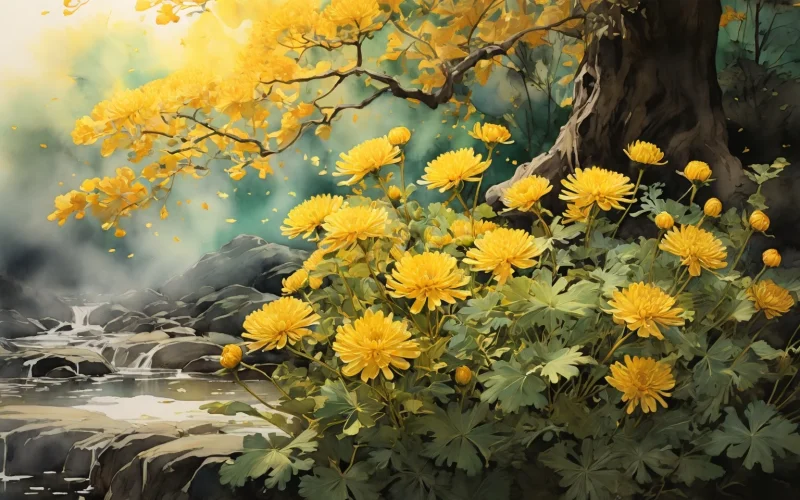
The "coin-flower" sung of in this poem, also known as the inula flower, has golden yellow blossoms resembling copper coins, hence its name. However, the coin-flower in Luo Yin's verse is no ordinary plant—it "appropriates a beauteous name" yet is doomed to the fate of plunder. During the late Tang period, powerful nobles and officials indulged in extreme luxury and insatiable greed, scraping the fat and marrow from the common people, funneling the wealth of the land into their private coffers. Under the pretext of singing the coin-flower's praises, the poet uses the flower as a metaphor for "money" itself. He describes its beauty as "sweet fragrance around the tree" and its tenderness as "intimately entwined," then abruptly shifts his brushstroke: if this flower could truly be hoarded, it would inevitably be dug up root and stem by the mighty families. In just twenty-eight characters, the poem is both a ruthless expose of aristocratic greed and a profound lament for the inevitable destruction of beautiful things, embodying Luo Yin's consistent cynical spirit and critical edge.
First Couplet: "占得佳名绕树芳,依依相伴向秋光。"
Zhàn dé jiā míng rào shù fāng, yīyī xiāngbàn xiàng qiū guāng.
It appropriates a beauteous name, its sweet fragrance around the tree;
Intimately entwined, they greet the autumn light, carefree.
The poem opens with a gentle brush, depicting the graceful beauty of the coin-flower. "占得佳名" (appropriates a beauteous name) highlights the allure of its name—the very word "coin" inevitably sparks covetous thoughts. "绕树芳" (sweet fragrance around the tree) describes its pervasive fragrance and its climbing growth habit, a picture of vibrant vitality. The next line, "依依相伴向秋光" (Intimately entwined, they greet the autumn light, carefree), further personifies the flowers with warmth: they nestle close to one another, basking in the autumn sun, like a group of carefree lives blooming fully in their season. The phrase "依依相伴" (intimately entwined) describes both the flower's profusion and subtly hints at its fragility—they need to rely on each other to survive in this world. The poet elaborates with a tone of appreciation and affection, creating a warm, harmonious autumnal scene, yet simultaneously foreshadowing the turn to come: can something so beautiful endure long in this greedy world?
Final Couplet: "若教此物堪收贮,应被豪门尽劚将。"
Ruò jiào cǐ wù kān shōu zhù, yīng bèi háomén jìn zhǔ jiāng.
If it could be hoarded like coins, I fear
The rich would dig it up, leaving not one here.
This couplet marks an abrupt shift in tone, using a hypothesis to lead to a cold, grim conclusion, forming the soul of the entire poem. "若教此物堪收贮" (If it could be hoarded like coins) presents a supposition that pushes the coin-flower from "flower" towards the metaphor of "money"—flowers cannot be hoarded, but what if, as its name suggests, it were actually wealth that could be collected? The next line, "应被豪门尽劚将" (The rich would dig it up, leaving not one here), confirms the outcome of this hypothesis with definitive certainty. "豪门" (the rich) refers to those insatiably greedy nobles. "尽劚将" (dig it up, leaving not one) uses the word "尽" (all) to depict their boundless greed—not picking a few blossoms, but digging up every last one, leaving not a trace. The word "劚" (dig, hack out) is used with particular harshness—not plucking, not picking, but digging out with a pickaxe, uprooting completely, eradicating it. Within this word "劚" lies both deep-seated hatred for aristocratic greed and a sense of powerlessness and indignation at the inevitable destruction of beautiful things. The warmth and beauty of the first two lines are shattered in this moment—it turns out that in this world, the more beautiful something is, the more likely it is to attract greedy eyes; the more fragile a life, the harder it is to escape the fate of plunder.
Holistic Appreciation
This is a powerful satirical piece among Luo Yin's object-chanting poetry. The entire poem consists of four lines and twenty-eight characters. Using the coin-flower as a starting point, it merges the flower's beauty and fate, its name and substance, revealing the poet's cold critique and profound grief over the greedy ethos of late Tang society.
Structurally, the poem presents a progressive layering from surface to core, first elevating then deconstructing. The first couplelet极力 (forcefully) describes the coin-flower's beauty—"appropriates a beauteous name," "sweet fragrance around the tree," "intimately entwined," "greet the autumn light"—every stroke is appreciation, every line is affection. The final couplet turns abruptly on a hypothesis, using "if" and "would" to introduce a cold conclusion, instantly shattering the beauty of the previous lines into desolation. Between the two couplets, the tone shifts from beauty to ugliness, from gentleness to coldness, from affection to indignation, creating a powerful, startling contrast.
Thematically, the core of this poem lies in the juxtaposition of the words "占" (appropriate) and "尽" (all). The first line's "appropriates a beauteous name" is the flower's fortune—it possesses a beautiful name. The final line's "dig it up, leaving not one" is the flower's calamity—it will ultimately be completely plundered by the greedy. Between this "appropriation" and "complete destruction" lies the world's cruelest logic: Beautiful things often incur destruction precisely because of their beauty; fragile lives are often powerless to resist precisely because of their fragility. Using the flower as a metaphor for people and the object to satirize the world, the poet lays bare the essence of aristocratic greed.
Artistically, the poem's most striking feature is the skillful use of "hypothetical deduction and cold irony." The poet does not directly accuse or comment; he merely gently introduces a hypothesis—what if this thing could be hoarded? What would happen? Then, with the seven characters "The rich would dig it up, leaving not one here," he provides the answer, not uttering a single word of explicit judgment, yet judgment is inherent within. This technique of cold, detached observation is more powerful than vehement accusation, more shocking than tearful wailing. As the ancients remarked: "Without using a single explicit word, it captures the essence entirely; without speaking of its evil, the evil manifests itself."
Artistic Merits
- Using Objects to Express Intent, Employing Flowers to Satirize People: Using the coin-flower's name to write of the reality of money, using the flower's fate to critique societal ills. A single object carries dual meaning, the intent lying beyond the words.
- First Elevation Then Deconstruction, Stark Contrast: The first couplet goes out of its way to describe beauty, the final couplet turns abruptly to coldness. Placed side by side, warmth turns to desolation, affection transforms into indignation.
- Hypothetical Deduction, Cold Irony: "If" and "would" form a progression from hypothesis to certainty. It does not directly criticize, yet criticism emerges from within.
- Language Precise, Each Word Weighty: The word "占" (appropriate) describes the flower's fortune; "尽" (all) describes the nobles' greed; "劚" (dig/hack) describes the brutality of the plunder. Each word cuts to the bone, with force penetrating the page.
Insights
Using the tiny coin-flower as a metaphor, this poem speaks to an eternal theme: The greedy never pass up anything that can be seized, and beautiful things often incur destruction precisely because of their beauty.
It first allows us to see the "trap of a name." The coin-flower is an innocent plant, but merely because it is named "coin," the poet envisions for it a fate of plunder. This name is both its fortune and its misfortune—fortunate because it is thus remembered by the poet; unfortunate because it is thus destroyed in imagination. This reminds us: many things in the world are often misunderstood because of their label, coveted because of their title.
On a deeper level, this poem prompts us to contemplate the relationship between "beauty and fragility." That beauty of "sweet fragrance around the tree," that tenderness of "intimately entwined," should be the things most cherished in this world. Yet in the eyes of the greedy, they are merely wealth waiting to be seized; to the mighty families, they are merely objects to be "dug up, leaving not one." The poet tells us: beautiful things are often fragile because they do not know how to protect themselves; and the greedy are often powerful because they spare nothing.
And most thought-provoking is the clarity of vision found within the poem's sense of "powerlessness." The poet clearly knows beauty will ultimately be plundered, yet he does not choose to whitewash reality or sing praises. Instead, with a cold brush, he reveals this cruel truth. This clarity is painful, yet it is also precious—because only by seeing the truth clearly is it possible to change it; only by confronting the darkness is it possible to dispel it.
This poem writes of the coin-flower in the late Tang, yet it allows people of every era to see their own reflection within it. That beauty of "sweet fragrance around the tree" is the original intention of everyone who values beauty; that outcome of "dig it up, leaving not one" is the fate of all who are plundered; that hypothesis of "if" and "would" is the cold gaze of all clear-sighted people upon reality. This is the vitality of poetry: it writes of a flower, but it reads as the human world.
Poem translator
Xu Yuanchong (许渊冲)
About the Poet
Luo Yin (罗隐 833 - 910), a native of Fuyang, Hangzhou, Zhejiang Province, was a renowned writer and thinker of the late Tang Dynasty. As a key literary figure of the late Tang period, Luo Yin was unparalleled in his time for his satirical poetry and prose. His poems often directly targeted social darkness, employing sharp and accessible language that cut straight to the heart of late Tang political corruption. With nearly 500 surviving poems, he was known alongside Du Xunhe and Luo Ye as one of the "Three Luos" in the late Tang poetic circle, standing out as a unique and powerful voice amidst the ornate and decadent trends of the era.