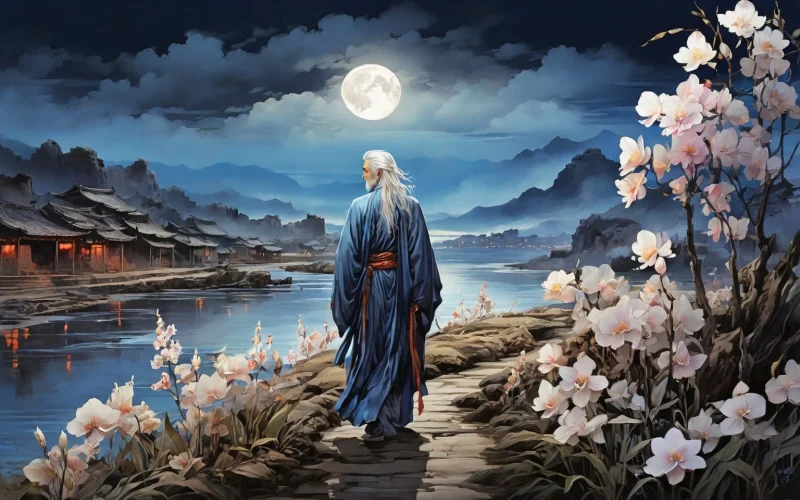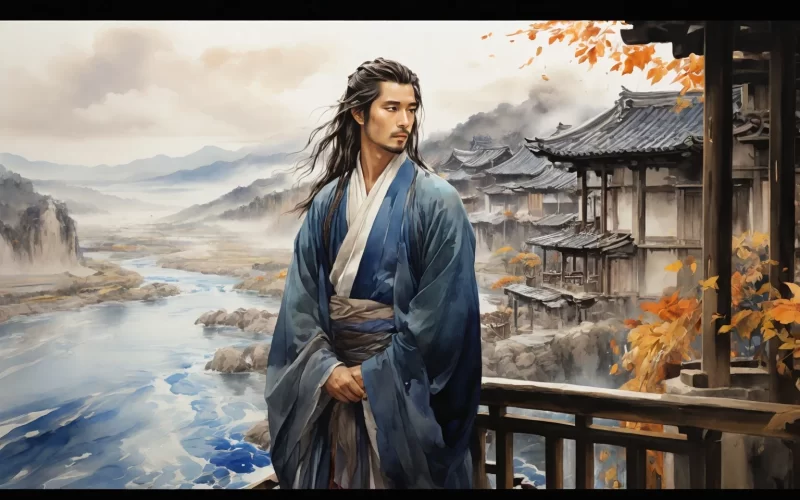



The kingdom collapsed after the Song of Jade Tree;
The garrison deserted when came the enemy.
Planted with pines, a thousand tombs spread far and nigh;
Buried amid the weed, palaces stand low and high.

The swallow of stone scrapes the white cloud, rain or shine;
The night breeze blows with waves raised by the river swine.
The splendor fades when heroes are gone one and all;
Only green hills look like the ancient capital.
Original Poem
「金陵怀古」
许浑
玉树歌残王气终,景阳兵合戍楼空。
松楸远近千官冢,禾黍高低六代宫。
石燕拂云晴亦雨,江豚吹浪夜还风。
英雄一去豪华尽,惟有青山似洛中。
Interpretation
This poem is a monumental work among the late Tang poet Xu Hun's historical laments, composed around 834 AD during the Taihe era, near the end of his life. While traveling in the Jiangnan region and facing the desolate ruins of Jinling, the ancient capital of the Six Dynasties, he was filled with sighs over the rise and fall of empires. Xu Hun, renowned for his skill in writing historical laments and often ranked alongside Du Mu, frequently reflected on traces of the past in mountains and rivers, lamenting historical transitions. His language is elegant and pure, his conception profound and far-reaching, earning him praise like "A thousand poems by Xu Hun, a lifetime of sorrow by Du Fu."
Jinling (present-day Nanjing) was once the ancient capital of the Six Dynasties. From the Eastern Wu and Eastern Jin through the Song, Qi, Liang, and Chen dynasties, for over three hundred years, its prosperity was unmatched in the Jiangnan region. However, after the Sui dynasty destroyed the Chen, Jinling's walls and palaces were largely destroyed, its gardens reduced to ruins, the former royal aura utterly vanished. Passing through this place, the poet looked all around: among the pines and catalpas lay the tombs of a thousand officials; amidst the swaying millet stood the palace walls of six dynasties. The Jingyang Palace, where the tune "Jade Tree, Backyard Flowers" once echoed, was now empty, its watchtowers silent. Where were the heroes who once shook the world? Only the stone swallows over the river and the river snouts amidst the waves still soared and churned in the clear, rainy, or windy nights, as if the storms of history had never subsided. Confronting this unchanging landscape and the vanished glory, what welled up in the poet's heart was a deep lament over the impermanence of fortune, as well as a melancholic self-pity for his own frustrated official career. The entire poem takes the word "空" (empty/deserted) as its eye, and the word "尽" (ended/exhausted) as its bone, fusing reflections on historical change and personal feeling, making it a model of ancient Chinese historical laments.
First Couplet: "玉树歌残王气终,景阳兵合戍楼空。"
Yù shù gē cán wáng qì zhōng, Jǐngyáng bīng hé shù lóu kōng.
The song of jade-like trees is done, the kingly aura passed away; By the Jingyang Palace besieged, the watchtower is deserted today.
The poem opens by invoking the historical fact of the Sui's conquest of the Chen, establishing the mournful, indignant tone. "玉树歌残" (The song of jade-like trees is done) alludes to the last ruler of Chen's tune "Jade Tree, Backyard Flowers." The decadent music still seems to linger, yet the dynasty has already fallen. The word "残" (done/fragmented) signifies both the interrupted song and the extinguished royal aura. The next line, "景阳兵合戍楼空" (By the Jingyang Palace besieged, the watchtower is deserted today), describes the crisis of troops at the gates and the desolation of empty towers. This word "空" (empty/deserted) is the first "eye" of the entire poem—the watchtower is empty because people fled when troops arrived; the royal aura ended because the song faded and the state perished. One "残" and one "空" freeze the moment the Chen dynasty turned from prosperity to ruin, also raising the curtain on the poem's historical reflections.
Second Couplet: "松楸远近千官冢,禾黍高低六代宫。"
Sōng qiū yuǎn jìn qiān guān zhǒng, hé shǔ gāo dī liù dài gōng.
Where pine and cypress stand, officials' tombs lie far and nigh; Where wild grain thrives, six dynasties' palaces stand low and high.
This couplet shifts from historical fact to the actual scene, using present desolation to confirm historical change. "松楸" (pine and cypress) are trees commonly planted at graves. "远近" (far and nigh) describes the number and spread of the tombs. "千官冢" (officials' tombs) — three words that capture the former prominence of the court and today's desolation. The grand spectacle of a thousand officials gathered is now reduced to mounds of yellow earth. The next line, "禾黍高低六代宫" (Where wild grain thrives, six dynasties' palaces stand low and high), uses "高低" (low and high) to describe the broken palace walls and the overgrown wild grain. Six dynasties of glory, three hundred years of elegance, are now all surrendered to these undulating wild grasses. The poet does not directly express grief; he only presents this picture of pines, catalpas, and wild grain, yet the grief is already within it.
Third Couplet: "石燕拂云晴亦雨,江豚吹浪夜还风。"
Shí yàn fú yún qíng yì yǔ, jiāng tún chuī làng yè hái fēng.
The rock-swallow sweeps by clouds, rain falls though fine it seems; The river-snouts blow on waves, wind blows though night is deep.
This couplet shifts from the actual scene to symbolism, using the unpredictable transformations of nature as a metaphor for the stormy turbulence of history. "石燕" (rock-swallow), legendary stones that fly when wind and rain come, can brush the clouds even on a sunny day, as if they could stir storms at any time. "江豚" (river-snout/dolphin), a mammal in the river, often appears amidst the waves; legend says its emergence brings wind. The six words "晴亦雨" (rain falls though fine) and "夜还风" (wind blows though night) use nature's unpredictability to metaphorically suggest history's unforeseeable storms, the impermanence of fortune. Those once earth-shaking heroes, are they not like these stone swallows and river snouts, stirring up storms for a time, only to vanish into smoke and mist? The poet uses the scene to embody a principle, infusing his lament over change into the cosmos itself.
Fourth Couplet: "英雄一去豪华尽,惟有青山似洛中。"
Yīng xióng yī qù háo huá jìn, wéi yǒu qīng shān sì Luò zhōng.
Gone are the heroes with their grandeur and their fame, Green mountains look the same as those in Northern capital's domain.
The final couplet concludes the whole piece with a contrast, elevating the historical lament to eternity. "英雄一去豪华尽" (Gone are the heroes with their grandeur and their fame)—seven words that say it all. Those heroic figures, those glorious times, are gone forever, turned to emptiness. The next line, "惟有青山似洛中" (Green mountains look the same as those in Northern capital's domain), uses the words "惟有" (only/green mountains look) to mark a turn, pointing to the unchanging landscape. The green mountains of Jinling remain lush, looking like the mountains near the Northern capital, Luoyang. The three words "似洛中" (look the same as those in Northern capital's domain) are both descriptive and emotional—Jinling and Luoyang, the Six Dynasties and the Han-Tang, the landscape is similar, but human affairs are already different. Gazing at these unchanging green mountains, thinking of that vanished glory, what welled up in the poet's heart was a deep sigh for history's indifference, and also a clear awareness of life's brevity.
Holistic Appreciation
This is a divine work among Xu Hun's historical laments. The entire poem consists of eight lines and fifty-six characters. Taking a lament for Jinling as its starting point, it blends historical fact, actual scenery, symbolism, and contrast, showcasing the poet's deep feelings about the impermanence of fortune and his clear awareness of life's transience.
Structurally, the poem shows a progression from history to scene, from scene to principle, from principle to emotion. The first couplet opens with the historical fact of the Sui's conquest of Chen, pinpointing the moment of change. The second couplet shifts to the actual scene of Jinling, using pines, catalpas, and wild grain to depict desolation. The third couplet uses the stone swallow and river snout as comparisons, infusing the lament over change into nature's transformations. The fourth couplet contrasts heroes with green mountains, elevating the historical lament to eternity. Across the four couplets, the poem moves from ancient to present, from concrete to abstract, from human to cosmic, each layer deepening, forming a seamless whole.
Thematically, the core of this poem lies in the interplay between the word "空" (empty) and the word "尽" (ended/exhausted). The "戍楼空" (watchtower deserted) in the first couplet is the emptiness before the eyes. The "千官冢" (officials' tombs) in the second couplet is the emptiness of human affairs. The "晴亦雨" (rain falls though fine) and "夜还风" (wind blows though night) in the third couplet speak to history's unpredictability. The "英雄一去豪华尽" (Gone are the heroes with their grandeur) in the fourth couplet is the ultimate void. Between this "空" and "尽" lies the poet's complete perception of historical change: all will eventually turn to emptiness, all will eventually be exhausted. Yet the "似" (look the same) in "青山似洛中" introduces a note of constancy within this void—the landscape remains, eternal and silent.
Artistically, the poem's most moving aspect lies in its grand structure of "juxtaposing past and present, contrasting human and cosmos." The poet places historical events alongside the contemporary scene, contrasts heroic figures with natural landscapes, allowing the reader to feel, through powerful contrasts, the brevity of human affairs and the permanence of the landscape. The contrast between "英雄一去" (Gone are the heroes) and "青山依旧" (Green mountains look the same) is the poem's most profound tragic core—humans can create history, but cannot conquer time; they can leave legends, but cannot preserve themselves.
Artistic Merits
- Precise Structure, Clear Layers: Moving from history to scene, scene to principle, principle to emotion, the four couplets are interlocked, each layer progressing logically.
- Blending Concrete and Abstract, Embedding Emotion in Scene: Using pines, catalpas, and wild grain to depict desolation; using stone swallows and river snouts to depict transformation. Words of scene are words of feeling; images of objects are images of the heart.
- Precise Diction, Profound Conception: Words like "残" (done), "空" (empty), "尽" (ended), and "惟" (only) reveal the essence of prosperity and decline with extreme economy.
- Vivid Contrast, Powerful Juxtaposition: The disappearance of heroes contrasted with the unchanging green mountains creates a strong opposition, making one keenly feel history's indifference and life's brevity.
Insights
This poem, through the rise and fall of an ancient capital, speaks to an eternal theme—Power and glory will ultimately vanish like the wind; only heaven, earth, mountains, and rivers remain unchanged.
First, it lets us see "the weight of history." The bones in those "千官冢" (officials' tombs), the wild grain on those "六代宫" (six dynasties' palaces), were once living lives, glorious pasts. Now, they can only remind later generations, in the form of tombs and ruins: this is the nature of change. It reminds us: every age believes itself eternal, but every age ultimately becomes history.
On a deeper level, this poem makes us contemplate "change within constancy." The green mountains remain, the landscape does not age, yet human affairs are different, heroes are no more. This unchanging landscape precisely bears witness to countless changes; this eternal mountain has precisely witnessed countless endings. It makes us understand: true constancy is not avoiding change, but witnessing it.
And what is most evocative is that "clear-eyed, poignant lament" in the poem. The poet does not wail, does not complain about heaven and fate; he merely writes these lines calmly, presenting the truth of history before the reader's eyes. This clarity is the sediment after pain, the composure after seeing through.
This poem writes of the Jinling of the Six Dynasties, yet allows everyone standing by the river of time to find resonance within it. The lingering sound of that "玉树歌残" (song of jade-like trees is done) is the echo of every golden age nearing its end. The wild grass of those "千官冢" (officials' tombs) is the witness after every hero's final bow. The sigh of that "青山似洛中" (Green mountains look the same) is the shared feeling of everyone confronting eternity. This is the vitality of poetry: it writes of the rise and fall of the ancients, but one reads the hearts, in all ages, that are clear-eyed and deep.
About the poet
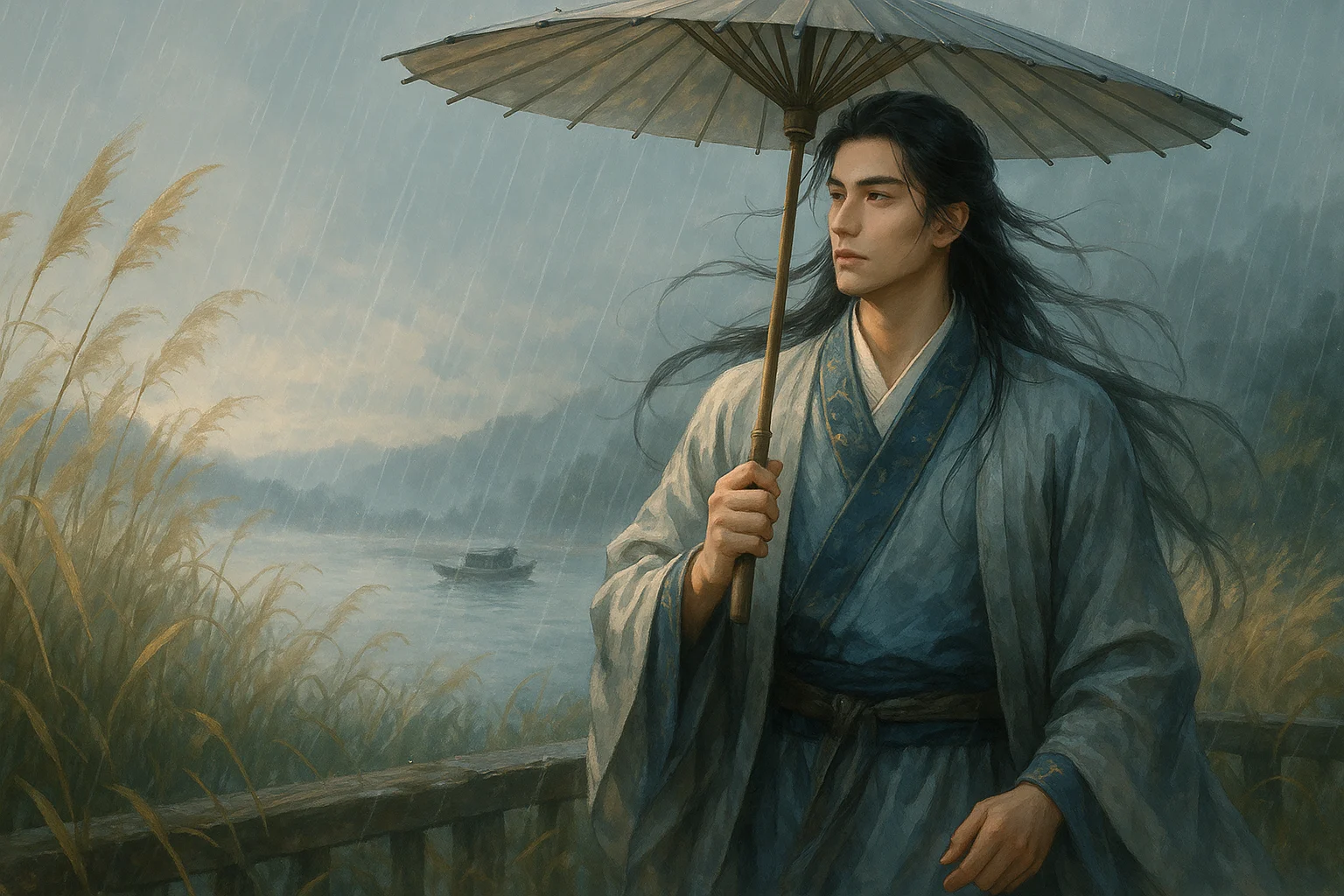
Xu Hun (许浑 c. 788 – c. 858), a native of Danyang, Jiangsu Province, was a renowned poet of the late Tang Dynasty. His ancestor was Xu Yushi, a chancellor during the reign of Empress Wu Zetian, and his family once held prominent status but had declined by Xu Hun's time. He obtained the jinshi degree in the sixth year of the Taihe era (832 AD) and successively served as magistrate of Dangtu and Taiping counties, eventually rising to the position of Vice Director of the Forestry and Crafts Bureau. As an important representative of the late Tang poetic circle, Xu Hun was celebrated for his mastery in depicting water and rain. His poetry often features nostalgic reflections on history, characterized by a desolate and solemn style. He excelled particularly in seven-character regulated verse, with language that is concise, refined, and harmonious in rhythm. Standing apart from Du Mu and Li Shangyin, he established his own distinctive school, exerting a profound influence on later poets such as Wei Zhuang and Luo Yin.