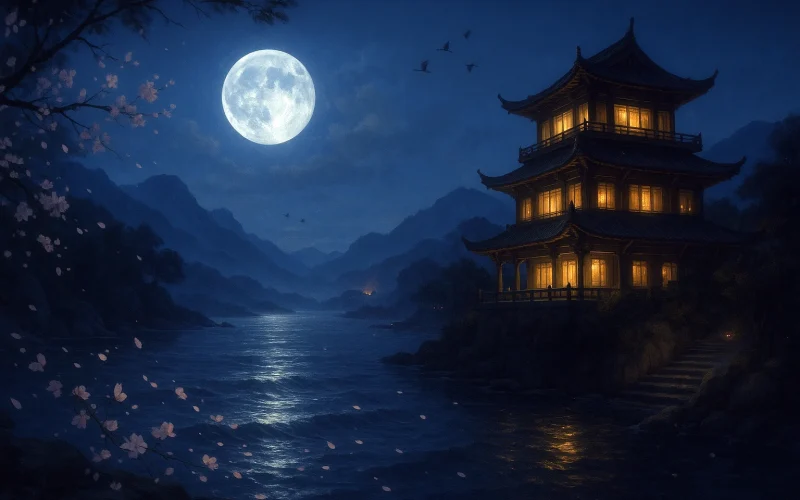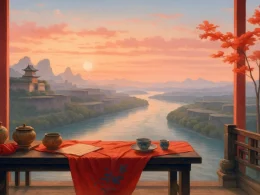



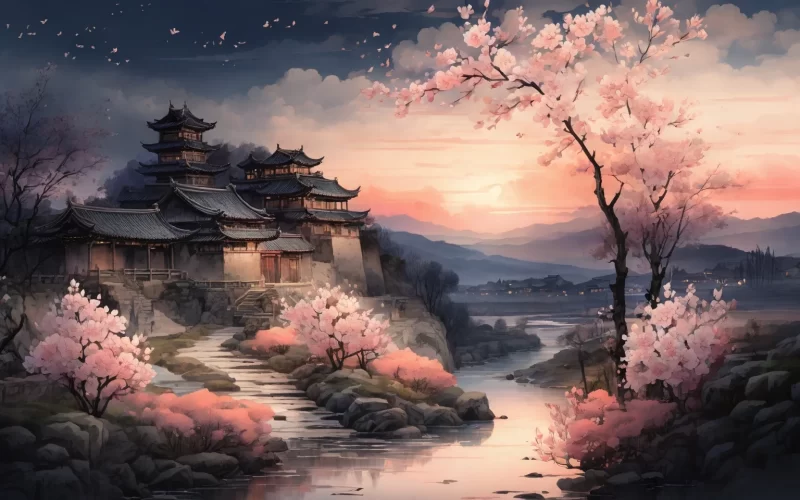
Eastward by riverside tower the waters flow;
Spring, lazy and weary, leans on breeze soft and slow.
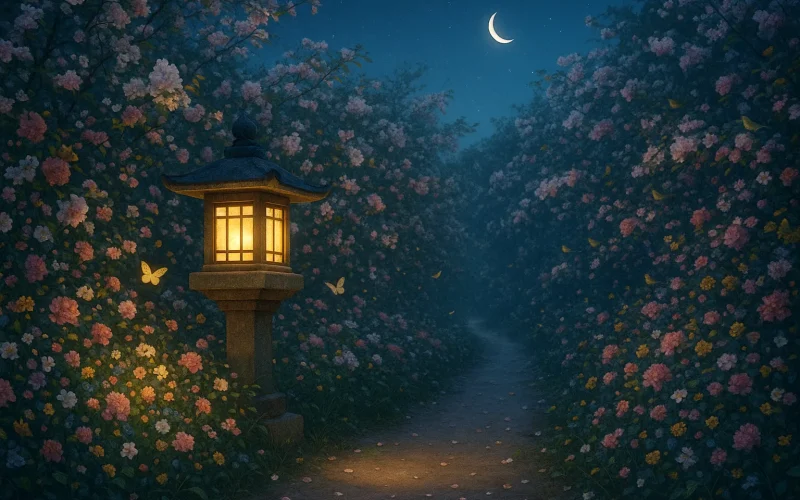
A cluster of peach blossoms run riot, no master nigh.
Which do you prefer, tell me, the deep or the shy?
Original Poem
「江畔独步寻花 · 其五」
杜甫
黄师塔前江水东,春光懒困倚微风。
桃花一簇开无主,可爱深红爱浅红?
Interpretation
This poem is the fifth in the series Along the River for Flowers Alone, composed in the spring of 767 CE, the second year of the Dali era under Emperor Daizong, while Du Fu was living in his thatched cottage by the Huanhua Stream in Chengdu. Although the An Lushan Rebellion had been suppressed, the affairs of state were unsettled, and the poet, adrift in the southwest, faced a life of material hardship. Yet, within this brief period of stability and the relative calm of his later years, Du Fu, with a near-childlike innocence, immersed himself in the nature surrounding his cottage. Under the pretense of "seeking flowers," he was truly engaged in a spiritual wandering. The walk commemorated in this poem—his visit to the "Stupa of Master Huang" (the funerary pagoda of a monk surnamed Huang)—was one such journey of the spirit, revealing the poet's pure celebration of life and beauty in the aftermath of catastrophe.
First Couplet: “黄师塔前江水东,春光懒困倚微风。”
Huáng shī tǎ qián jiāng shuǐ dōng, chūn guāng lǎn kùn yǐ wēi fēng.
Before the Stupa of Master Huang, eastward the river flows; / Spring light, grown drowsy, languid, on the gentle breeze repose.
The opening couplet establishes the location and season in a tone as leisurely as a stroll. The religious connotation of "the Stupa of Master Huang" (a monk's funerary monument) and the eternal passage of "eastward the river flows" engage in a silent dialogue about life and time. The brilliance lies in the second line: "Spring light, grown drowsy, languid, on the gentle breeze repose." The poet personifies the abstract "Spring light"; it feels "drowsy, languid" like a person and lazily "repose[s]" upon the breeze. This is not merely a projection of the poet's own comfort in the warm sun, but an infusion of the entire natural world with a mood of ease, relaxation, and a nearly intoxicating vitality. Observer and observed merge; self and world are forgotten.
Second Couplet: “桃花一簇开无主,可爱深红爱浅红?”
Táo huā yī cù kāi wú zhǔ, kě ài shēn hóng ài qiǎn hóng?
A cluster of peach blossoms blooms, ownerless, free; / Their loveliness! Do I love the deep red more, or the red paler to see?
The poet's gaze focuses on a cluster of wild peach blossoms by the river. The three words "blooms, ownerless, free" are richly suggestive: they describe the blossoms' natural, untamed, and freely exuberant state, while also quietly conveying a sense of lonely beauty, perhaps an inadvertent echo of the poet's own rootless, drifting state of mind. Yet, the poet's mood does not linger here. It is swiftly captivated by the radiant beauty of the blossoms themselves, bursting forth in an artless, irrepressibly delighted question: "Do I love the deep red more, or the red paler to see?" This is not genuine indecision, but the sweet, rapturous bewilderment one feels before an overwhelming abundance of beauty. The repetition of the word "love" vividly sketches the poet's delighted confusion, his eyes darting from one hue to another, utterly enchanted, driving the poem's joyful sentiment to its climax.
Holistic Appreciation
This quatrain is one of the brightest, most buoyant movements in Du Fu's collected works. It captures and crystallizes the pure poetry that sparks when a great soul encounters a simple cluster of peach blossoms on an ordinary spring day. The poem's structure is simple yet meaningfully fluid: it moves from the large to the small (river, stupa, spring light to a single cluster of flowers), from stillness to motion (from drowsy repose to the leap of an inquiring heart), finally concentrating on a question brimming with the warmth of life.
Its artistic essence lies in the remarkable balance it strikes between "the weight of existence" and "the lightness of joy." The poet stands before "the Stupa of Master Huang" (a symbol of death and stillness), facing the "eastward" flowing river (a metaphor for time's eternal passage)—a setting easily prompting laments on transience. Yet, he writes of spring light's "drowsy" languor and the eager dilemma of choosing between reds. This is not forgetfulness, but rather, after weathering life's storms, an extreme sensitivity to and redoubled cherishing of the vivid vitality before him. The "ownerless" blossoms symbolize freedom, yet also hint at beauty's fragility and preciousness. The poet's question is a wholehearted immersion in and praise for this transient, absolute beauty.
Artistic Merits
- Masterful Use of Synesthesia and Personification: In "Spring light, grown drowsy, languid, on the gentle breeze repose," sight (spring light), bodily sensation (drowsy), kinesthetic sense (repose), and touch (breeze) are blended. The intangible spring light is given perceptible volume, weight, and posture—a novel, wonderfully imaginative conception full of life's charm.
- The Resonant, Open-Ended Quality of the Concluding Question: Ending with a question that seeks no answer allows the delight to linger, rippling between the "deep red" and the "red paler." This vastly expands the line's imaginative and emotional space. The question itself is the highest form of praise.
- Fusion of Colloquial Language and Classical Atmosphere: Words like "drowsy, languid," "ownerless," and "loveliness" are almost conversational, simple and fresh. Yet, "the Stupa of Master Huang" and "eastward the river flows" carry a classical sense of time and space. Their combination makes the poem both intimately lively and distantly suggestive.
- The Emotional Suggestion of Color Contrast: "Deep red" and "red paler" are not merely color descriptions; they may also suggest different layers and aspects of life. The poet's refusal to choose signifies a total acceptance and love for life in its entirety, for all forms of beauty.
Insights
This work demonstrates a vital human capacity: "to discover blossoms blooming beside the ruins." After experiencing the destruction of his country, the loss of his home, and a life of displacement, Du Fu did not grow numb or desiccated. On the contrary, in the Chengdu spring, he displayed this keen perceptiveness and this pure joy. He reminds us that true resilience and broad-mindedness lie not in denying suffering, but in retaining, even after enduring it, that innocence and passion which leads one to ask, before a cluster of "ownerless" blossoms, "Do I love the deep red more, or the red paler to see?"
It offers a lesson for our modern, high-pressure, goal-oriented age: perhaps we need moments of "drowsy languor" in a gentle breeze, we need spiritual rambles like "strolling alone by the river, seeking flowers," to rediscover those "ownerless" yet vibrantly alive beauties. More importantly, we must learn, like Du Fu, to dare to voice the simplest, most direct admiration for what we love, to recover life's most fundamental joy and fullness in the delightful dilemma and rapture between "deep red" and "red paler." This poem is a dewdrop, reflecting the clarity and brightness a soul can attain after weathering the storms of life.
About the poet
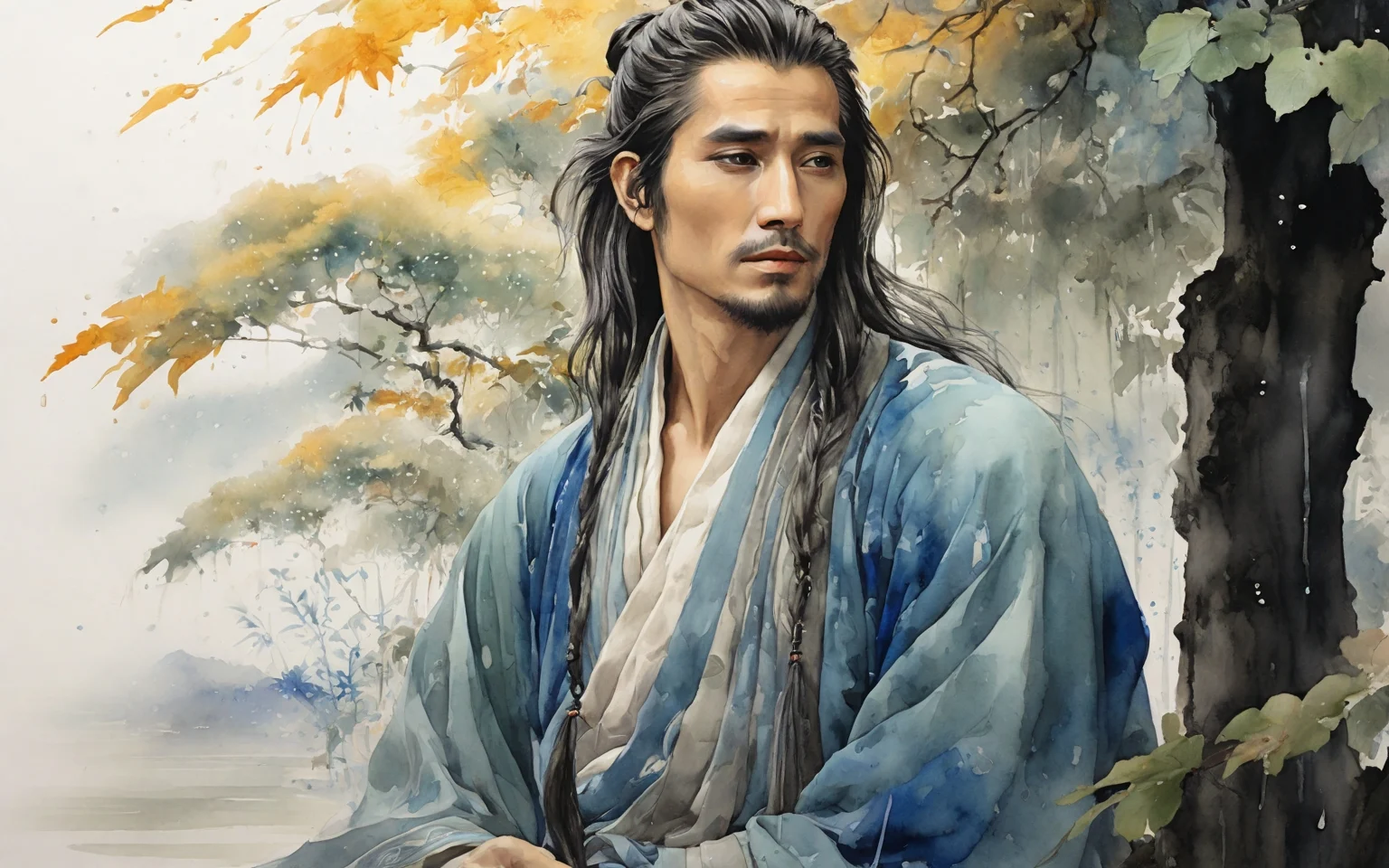
Du Fu (杜甫), 712 - 770 AD, was a great poet of the Tang Dynasty, known as the "Sage of Poetry". Born into a declining bureaucratic family, Du Fu had a rough life, and his turbulent and dislocated life made him keenly aware of the plight of the masses. Therefore, his poems were always closely related to the current affairs, reflecting the social life of that era in a more comprehensive way, with profound thoughts and a broad realm. In his poetic art, he was able to combine many styles, forming a unique style of "profound and thick", and becoming a great realist poet in the history of China.