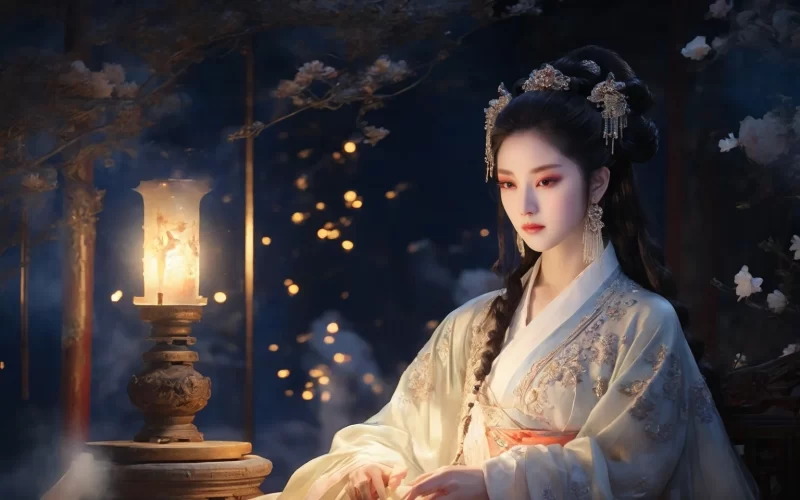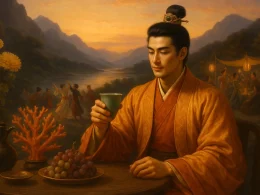



When the Emperor sought guidance from wise men, from exiles,
He found no calmer w i sdom than that of young Chia
And assigned him the foremost council-seat at midnight,
Yet asked him about gods, instead of about people.
Original Poem
「贾生」
李商隐
宣室求贤访逐臣,贾生才调更无伦。
可怜夜半虚前席,不问苍生问鬼神。
Interpretation
This poem was written in 848 AD during Li Shangyin's service as an aide to Zheng Ya, the Military Governor of the Gui Region. Emperor Xuanzong had recently ascended the throne, presenting a façade of diligent governance while actually indulging in Buddhism and empowering eunuchs; the so-called "Great Mid-Reign Restoration" was already revealing its hollow nature. Through the historical episode of Emperor Wen of Han consulting the exiled scholar Jia Yi on matters of ghosts and spirits at night, Li Shangyin constructs a pointed allegory for the political realities of the late Tang dynasty.
By this time, the poet had been deeply embroiled in the Niu-Li factional strife for years, personally witnessing the political turbulence of Emperor Wuzong's reign—the dismissal of Chief Minister Li Deyu—and the subsequent resurgence of the Niu faction under Emperor Xuanzong. He possessed a profound understanding of the chasm between a ruler's ostentatious "quest for worthy men" and the actual substance of his appointments. The genius of "Jia Yi" lies in its choice of a quintessential scene from the historical record—the encounter between a ruler lauded as enlightened (Emperor Wen of Han) and an acknowledged genius (Jia Yi)—only to expose, beneath the surface narrative, a fundamental disconnect inherent even in this ideal pairing. This disconnect arose not from a lack of talent or a foolish sovereign, but from the power structure's systemic aversion to genuine wisdom.
First Couplet: 宣室求贤访逐臣,贾生才调更无伦。
Xuān shì qiú xián fǎng zhú chén, Jiǎ shēng cái diào gèng wú lún.
In the Xuan Chamber, seeking wisdom, he summoned a banished man;
Master Jia's talent and spirit then were matchless, none outran.
The opening lines adopt a historiographical tone to paint the ideal picture of an enlightened ruler meeting a worthy minister. The conjunction of "seeking wisdom" and "summoned a banished man" underscores Emperor Wen's exceptional sincerity, surpassing normal protocol. The phrase "matchless, none outran," a superlative judgment, establishes Jia Yi's rare caliber. The subtlety here is deliberate: the more the legitimacy and high expectations of this audience are amplified, the more powerful the critical reversal that follows becomes. The poet first meticulously constructs a historical scene that meets all conventional criteria for wise rulership and talent recognition, precisely to later unveil its essential emptiness.
Final Couplet: 可怜夜半虚前席,不问苍生问鬼神。
Kělián yèbàn xū qiánxí, bù wèn cāngshēng wèn guǐshén.
How pitiable! Past midnight, he leaned forward on his mat—a voided scene;
Asked not of the people's suffering, but of ghosts and spirits unseen.
"How pitiable!" acts as the poem's emotional pivot, shifting from objective narration to value judgment. "Leaned forward on his mat—a voided scene" adapts the historical典故 from the Records of the Grand Historian describing one leaning forward on the mat in engrossed attention. By inserting "a voided," the physical gesture is transformed into a metaphor for the state of mind—the body inclined, but no meeting of minds occurred. The stark opposition between "asked not" and "asked" completes the thorough deconstruction of the "quest for wisdom's" true nature. Most profound is the dichotomy between "the people's suffering" and "ghosts and spirits": the former signifies real-world woes demanding rational engagement, the latter a mystical domain manipulable by authority. Emperor Wen's choice lays bare a ruler's subconscious inclination: when faced with the complex burdens of human governance, he preferred the supernatural realm, where power could be ritually asserted without challenge.
Holistic Appreciation
This is an analytical poem dissecting power structures with the precision of a historian's scalpel. Li Shangyin's acumen lies in selecting Emperor Wen of Han—a ruler historians celebrate as enlightened—as his subject. This grants the critique universal force: if even a sovereign like Wen could succumb to the misalignment of "asking of spirits, not of people's woes," then the rift between "seeking talent" and "utilizing talent" within systems of power might be intrinsic.
The poem executes a flawless narrative inversion. The first couplet presents the extraordinary act of "summoning a banished man" (breaking protocol, implying high regard) paired with "talent matchless" (deserving such regard), jointly elevating expectation. The final couplet presents the performative posture of "leaning forward" (formally correct) alongside the substantive misdirection of "asking of unseen spirits" (essentially misplaced). This immense gap between raised anticipation and revealed reality generates the core force of the satire.
Particularly significant is the poem's implied philosophy of discourse. Emperor Wen did not "refuse to listen"; he "asked the wrong questions." Jia Yi was not "unable to reply"; he was "asked to reply to the wrong questions." This communicative dislocation reveals a profound truth: power listens selectively, hearing only what reinforces its authority and fulfills ritual needs. "Ghosts and spirits" were "asked about" precisely because they posed no threat to the existing power structure and could even enhance its legitimacy through mystical sanction. Conversely, "the people's suffering" was "not asked about" because it pointed directly to power's fundamental responsibilities, demanding tangible reform, not symbolic consolation.
Artistic Merits
- Microscopic Focus on Historical Detail: The poem concentrates laser-like on the specific moment of "leaning forward on his mat past midnight." By magnifying a physical gesture and a conversational topic, it achieves a radical reinterpretation of a canonical historical event. A minor detail becomes the keyhole to historical essence.
- Layered Deconstruction of Values: The poem executes a reevaluation on three interconnected levels: of action (from "seeking wisdom" to "asking of spirits"), of person (from "talent matchless" to "how pitiable!"), and of event (from the "summons in the Xuan Chamber" to the "voided scene"). This cascading reversal of judgment lends the critique intellectual depth.
- Precise Deployment of Temporal Setting: "Past midnight" is not merely a chronological marker but the hour when power sheds its public persona and reveals private preoccupations. In the daylight court, Emperor Wen might have discussed statecraft; in the privacy of night, power's genuine interests were exposed. The choice of setting is itself an act of political psychology.
Insights
This work lays bare a perennial dynamic of power: formal deference can mask substantive disregard; performative engagement can sidestep genuine dialogue. Emperor Wen's bodily posture demonstrated respect for Jia Yi the individual, while his chosen topic avoided Jia Yi's political intellect. This schism repeats throughout history: we may confer honor, titles, and ceremonial praise upon talent, yet deflect their most challenging insights.
The choice of "asking of spirits, not of people's woes" points to power's chronic retreat from complexity. "The people's suffering" represents messy, intractable problems requiring structural change. "Ghosts and spirits" represent abstract or technical matters that can be discussed without disturbing the status quo. The lesson for any era is this: to discern a system's true priorities, observe not which talents it honors, but which conversations it permits them to have.
Ultimately, the poem cultivates a discerning political eye: Significance lies not in what power proclaims, but in what it omits; not in what it inquires about, but in what it chooses to ignore. In this sense, "Jia Yi" transcends historical verse to become a timeless guide for seeing through political theater to the substance of power. It reminds us in every age: when authority becomes preoccupied with "asking of spirits," it is often the precise moment when "the people's suffering" most urgently requires—and is most dangerously denied—a hearing.
Poem translator
Kiang Kanghu
About the poet
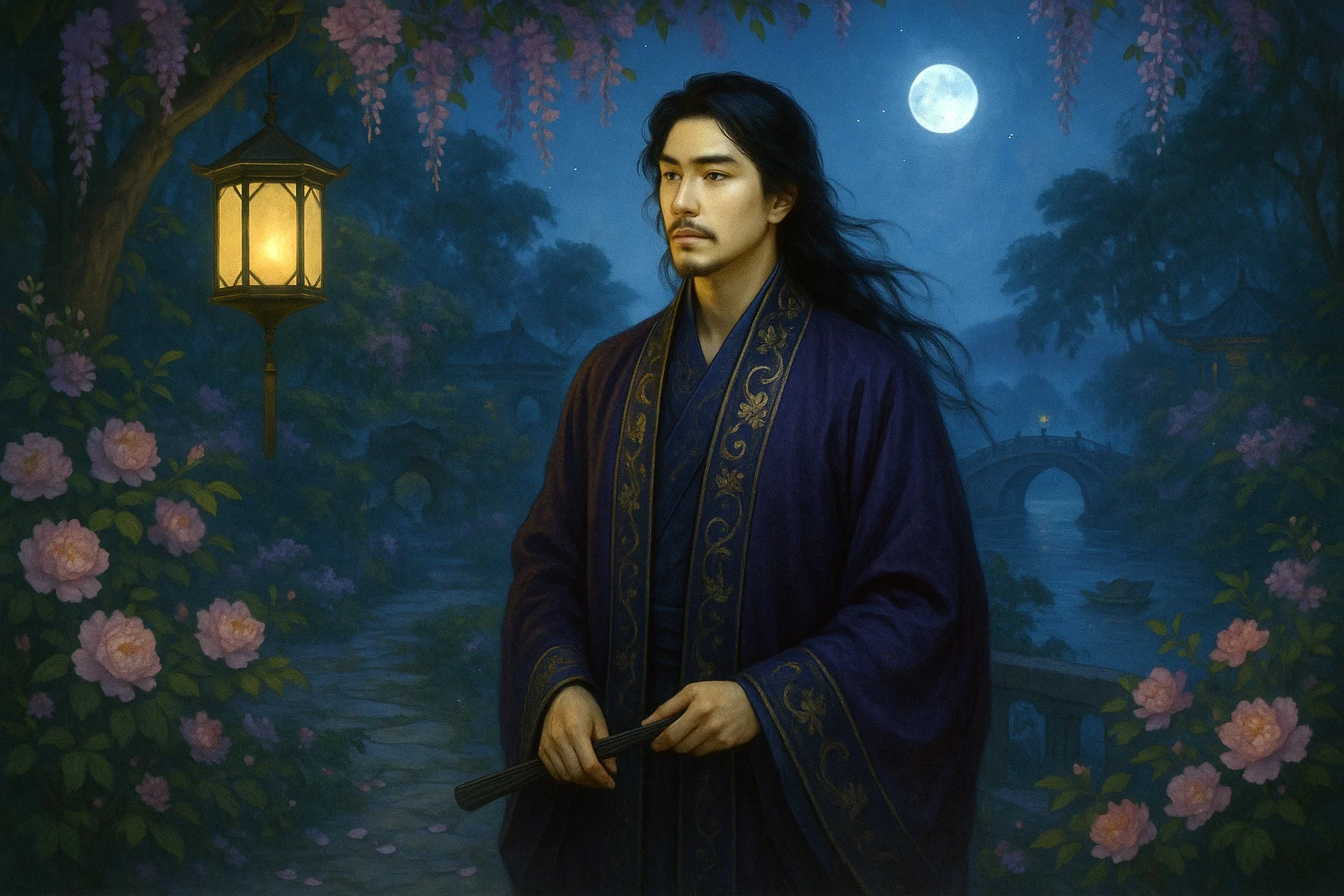
Li Shangyin (李商隐), 813 - 858 AD, was a great poet of the late Tang Dynasty. His poems were on a par with those of Du Mu, and he was known as "Little Li Du". Li Shangyin was a native of Qinyang, Jiaozuo City, Henan Province. When he was a teenager, he lost his father at the age of nine, and was called "Zheshui East and West, half a century of wandering".