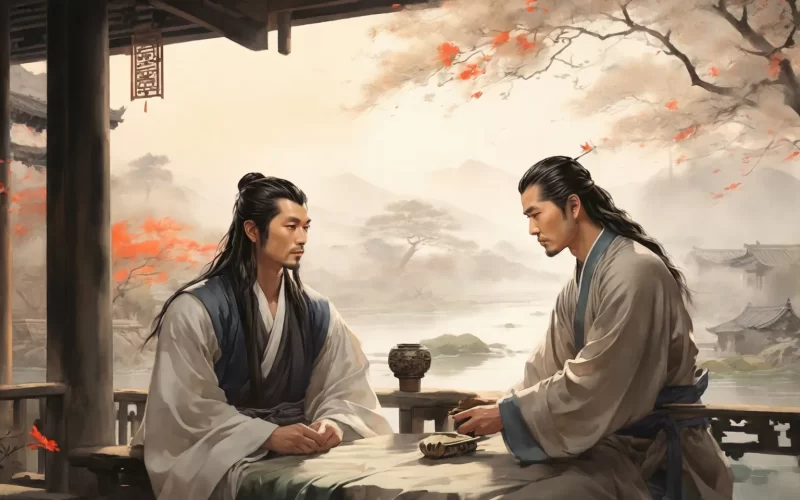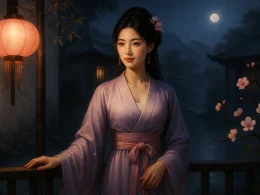



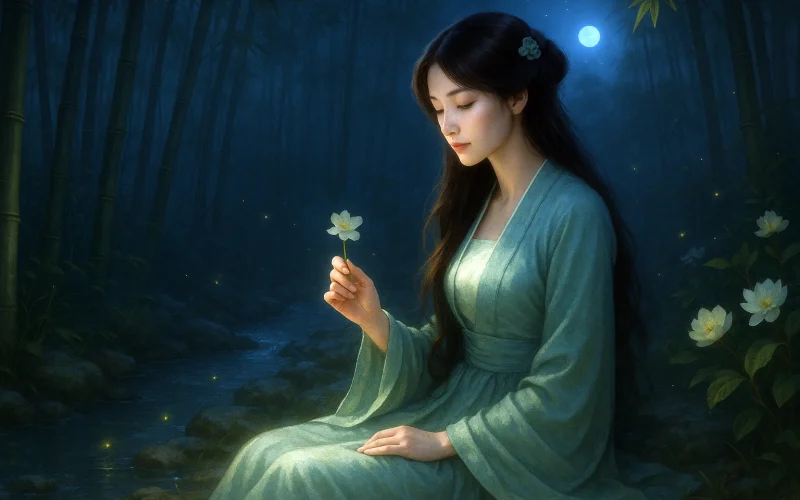
Who is lovelier than she?
Yet she lives alone in an empty valley.
She tells me she came from a good family
Which is humbled now into the dust.

…When trouble arose in the Kuan district,
Her brothers and close kin were killed.
What use were their high offices,
Not even shielding their own lives? --
The world has but scorn for adversity;
Hope goes out, like the light of a candle.

Her husband, with a vagrant heart,
Seeks a new face like a new piece of jade;
And when morning-glories furl at night
And mandarin-ducks lie side by side,
All he can see is the smile of the new love,
While the old love weeps unheard.
The brook was pure in its mountain source,
But away from the mountain its waters darken.

…Waiting for her maid to come from selling pearls
For straw to cover the roof again,
She picks a few flowers, no longer for her hair,
And lets pine-needles fall through her fingers,
And, forgetting her thin silk sleeve and the cold,
She leans in the sunset by a tall bamboo.
Original Poem
「佳人」
杜甫
绝代有佳人,幽居在空谷。
自云良家子,零落依草木。
关中昔丧乱,兄弟遭杀戮。
官高何足论,不得收骨肉。
世情恶衰歇,万事随转烛。
夫婿轻薄儿,新人美如玉。
合昏尚知时,鸳鸯不独宿。
但见新人笑,那闻旧人哭。
在山泉水清,出山泉水浊。
侍婢卖珠回,牵萝补茅屋。
摘花不插发,采柏动盈掬。
天寒翠袖薄,日暮倚修竹。
Interpretation
This poem was composed in the autumn of 759 CE, the second year of the Qianyuan era under Emperor Suzong of Tang. It was written during Du Fu's stay in Qinzhou (present-day Tianshui, Gansu), after he had abandoned his official post as Army Advisor in Huazhou and was drifting with his family. The An Lushan Rebellion still raged, and famine plagued the Guanzhong region. The poet personally endured the hardships of war, displacement, and dire poverty. Through the image of a "beautiful lady" adrift in the world yet steadfast in virtue, the poem reflects the common tragedy of women (especially noblewomen) during the turmoil while also conveying Du Fu's own profound feelings of political disappointment and his commitment to personal integrity. It stands as an outstanding work where Du Fu uses a woman's fate to write of both the era's suffering and his own resolve.
First Couplet: 绝代有佳人,幽居在空谷。
Jué dài yǒu jiā rén, yōu jū zài kōng gǔ.
There is a lady, peerless in her time, / Who dwells in solitude in an empty valley.
The opening is like a cinematic close-up, focusing immediately on the stark contrast between “peerless” and “dwells in solitude.” “Peerless” describes her extraordinary grace, while “dwells in solitude in an empty valley” places her in an isolated, lonely setting. The juxtaposition of “peerless” and “solitude” not only sets the poem’s tone of sorrowful beauty but also hints at the great conflict between her fate and her external environment.
Second Couplet: 自云良家子,零落依草木。
Zì yún liáng jiā zǐ, líng luò yī cǎo mù.
She tells me she comes of an honorable house, / Now fallen low, dependent on grass and trees.
The perspective shifts from the poet to the lady's own account, revealing her origin and current state. “Honorable house” indicates her original social standing and upbringing, while “fallen low, dependent on grass and trees” fully captures the tragic fate of a woman from a good family who, amidst war, loses her support and sinks to the bottom of society. The drastic change in her personal destiny begins to emerge.
Third Couplet: 关中昔丧乱,兄弟遭杀戮。
Guān zhōng xī sāng luàn, xiōng dì zāo shā lù.
“In former days,” she said, “the Guanzhong region fell to chaos; / My brothers were slain by the rebels.
Fourth Couplet: 官高何足论,不得收骨肉。
Guān gāo hé zú lùn, bù dé shōu gǔ ròu.
High office could not save them; / I could not even gather their bones for burial.”
These two couplets detail her family tragedy with grievous strokes. “Fell to chaos” is the backdrop of the era; “slain” is the specific disaster. The line “High office could not save them” is particularly profound. It exposes how, in the face of great historical catastrophe, former social status and power prove utterly fragile, unable to fulfill even the most basic human wish (to bury one's kin). This is not only a personal family tragedy but also a profound portrayal of how all order and values were destroyed in a time of turmoil.
Fifth Couplet: 世情恶衰歇,万事随转烛。
Shì qíng wù shuāi xiē, wàn shì suí zhuǎn zhú.
“The ways of the world turn against the fallen; / All things shift like a flame in the wind.
Her account moves from specific events to a general lament on human fickleness and worldly affairs. “Turn against the fallen” directly points to the cruelty of a cold, mercenary reality; “shift like a flame in the wind” uses the image of a flickering candle flame to symbolize the impermanence of fate and the transience of worldly matters. This is the lady's summary of her own plight, carrying also a philosophical sense, articulating the common experience of survival in a chaotic age.
Sixth Couplet: 夫婿轻薄儿,新人美如玉。
Fū xù qīng bó ér, xīn rén měi rú yù.
My husband is a fickle, heartless man; / He has taken a new wife, beautiful as jade.
Seventh Couplet: 合昏尚知时,鸳鸯不独宿。
Hé hūn shàng zhī shí, yuān yāng bù dú sù.
The mandarin-duck plant knows to open and close with the dawn and dusk; / Even the lovebirds do not roost alone.
Eighth Couplet: 但见新人笑,那闻旧人哭。
Dàn jiàn xīn rén xiào, nǎ wén jiù rén kū.
Men only see the smiles of the new wife; / Who will listen to the sobs of the forsaken?”
These three couplets focus intensely on marital betrayal, with emotion building layer by layer. They first directly state her husband's “fickle, heartless” nature and the new wife's “beautiful as jade,” creating a cruel realistic contrast. Then, using the “mandarin-duck plant” (which opens and closes with daylight) and the “lovebirds” (which always stay paired)—natural beings faithful to their rhythms and partners—as a foil, they sharply criticize the husband's fickleness, inferior even to plants and birds. Finally, the vivid contrast between “the smiles of the new wife” and “the sobs of the forsaken” brings the emotion to its peak. The outpouring of grief and indignation makes this one of the most direct and powerful lines condemning faithlessness.
Ninth Couplet: 在山泉水清,出山泉水浊。
Zài shān quán shuǐ qīng, chū shān quán shuǐ zhuó.
When the spring stays in the mountain, its waters run clear; / Leaving the mountain, they turn muddy.
This couplet serves as the spiritual turning point and the “pivotal line” of the poem. By employing the image of the “mountain spring” as a metaphor for herself, the lady asserts that even in hardship and seclusion, her integrity remains unsullied, like the clear waters at their source. The contrasting phrase, “Once it leaves the mountain, it turns turbid,” subtly criticizes the moral corruption of the outside world—society at large and her faithless husband in particular. Here, she makes a vow regarding her own character, marking her moral and spiritual ascent from passively enduring her fate to actively choosing and upholding virtue.
Tenth Couplet: 侍婢卖珠回,牵萝补茅屋。
Shì bì mài zhū huí, qiān luó bǔ máo wū.
My maid returns from selling my pearls; / She gathers vines to mend our thatched hut.
Eleventh Couplet: 摘花不插发,采柏动盈掬。
Zhāi huā bù chā fà, cǎi bǎi dòng yíng jū.
I pluck flowers, but do not pin them in my hair; / I cull cypress needles, often filling my hands.
These two couplets depict, with straightforward description, the lady's daily life of embracing poverty and upholding her principles. “Selling my pearls” shows her dire straits, needing to sell her former possessions; “gathers vines to mend our thatched hut” shows her acceptance of poverty and hardship, laboring with her own hands. “Pluck flowers, but do not pin them in my hair” shows her rejection of the worldly female adornment of beauty, her heart now still as water; “cull cypress needles, often filling my hands” suggests she uses them for sustenance (or perhaps for their symbolism of constancy), content with austerity. The privation of material life contrasts sharply with the self-sufficiency of her spiritual world.
Final Couplet: 天寒翠袖薄,日暮倚修竹。
Tiān hán cuì xiù báo, rì mù yǐ xiū zhú.
In the cold, her azure sleeves are thin; / At sunset, she leans against the tall bamboos.
The poem concludes with a highly symbolic silhouette. “In the cold” and “at sunset” evoke a desolate, lonely atmosphere. “Azure sleeves are thin” portrays her material deprivation and frail, solitary figure. However, the posture “leans against the tall bamboos” completely crystallizes her spiritual character. In Chinese culture, the bamboo symbolizes integrity, moral strength, nobility, and resilience. The lady standing with the bamboo implies her character has become one with it: though in adversity, her moral fortitude stands firm. This image is hauntingly beautiful and sublime.
Holistic Appreciation
This poem exemplifies Du Fu’s seamless fusion of narrative and lyricism. Framed by the lady’s first-person account and enriched by the poet's own observations, its structure is clear and its emotion deeply resonant. Its power lies not only in portraying a woman’s twin misfortunes of war and marital betrayal, but even more in depicting her awakening and steadfast commitment to her inner world in the face of utter desperation. From the passive drifting of "fallen low, dependent on grass and trees" to the active resolve of "When the spring stays in the mountain, its waters run clear," and finally to the definitive, symbolic stance of "leans against the tall bamboos," the image of the "beautiful lady" completes her transformation from tragic victim to a figure of independent moral character.
Furthermore, Du Fu imbues the poem with his own profound sense of personal experience. Is not the lady's “dwells in solitude in an empty valley” a reflection of the poet himself, having abandoned office and drifted? Do not her experiences of “My brothers were slain” and “The ways of the world turn against the fallen” mirror the common tragedy of countless families in the war? And is not her steadfast “When the spring stays in the mountain, its waters run clear” the poet's own declaration of integrity—one who “all year long grieves for the common people, / Sighing, with inward burning heat” yet never compromises? This elevates The Beautiful Lady beyond a simple poem on a female subject, making it a profound meditation on how to protect one's spiritual homeland in an age of chaos.
Artistic Merits
- Integration of Narrative and Lyricism, Clear Structure
The poem is structured around the lady's account of her life, with a clear progression: from her origin, family disaster, and abandonment to her secluded life upholding her principles. The narrative is infused with deep feeling, and the emotion arises directly from the events, each enhancing the other to deeply moving effect. - Pervasive Use of Contrast, Reinforcing the Theme
The poem employs several strong contrasts: “peerless” vs. “dwells in solitude,” “smiles of the new wife” vs. “sobs of the forsaken,” “waters run clear” in the mountain vs. “turn muddy” outside it, “azure sleeves are thin” in the cold vs. a “will firm as bamboo.” These contrasts powerfully intensify the tragedy of fate, the fickleness of the world, and the nobility of character. - Skillful Use of Metaphor and Symbolism, Profound Meaning
“Flame in the wind” symbolizes worldly impermanence; “spring waters” symbolize the purity or corruption of integrity; “mandarin-duck plant” and “lovebirds” serve as foils to human fickleness; “cypress” and “bamboo” symbolize constancy and noble resilience. These natural images allow the poem's significance to transcend the specific story, attaining universal symbolic meaning. - Plain, Concise Language with Strong Visual Imagery
Lines such as “gathers vines to mend our thatched hut,” “pluck flowers, but do not pin them in my hair,” and “leans against the tall bamboos” use simple language to sketch vivid pictures. The telling details make the character come alive, demonstrating that beyond his famous pursuit of startling diction, Du Fu also achieved mastery in straightforward, descriptive narrative.
Insights
Reading this work, we see not only the fate of one woman but a microcosm of a shattered era. With profound empathy, Du Fu forever engraved the voice and figure of a woman of the troubled times into the hall of poetry. Her weeping is the weeping of countless war victims; her seclusion is the displacement of all who lost their homes in the upheaval; and her final act of “leaning against the tall bamboos” lights a lamp for us on how to rebuild a spiritual order amidst the ruins.
Crossing a thousand years, this poem still asks us: When the outer world has descended into "chaos" and "decline," and even the closest bonds have betrayed us, what can a person rely upon to settle the soul? Through the voice of the “beautiful lady,” Du Fu’s answer is: return to the clarity within (“When the spring stays in the mountain, its waters run clear”), and uphold the integrity of one’s character—even if it means enduring the solitude and poverty of "azure sleeves are thin" in the cold. This conscious pursuit and steadfast commitment to spiritual height in the face of extremity is Du Fu’s precious legacy to posterity. It reminds us that the dignity of life ultimately depends not on the vagaries of fate, but on the substance of the soul.
Poem translator
Kiang Kanghu
About the poet
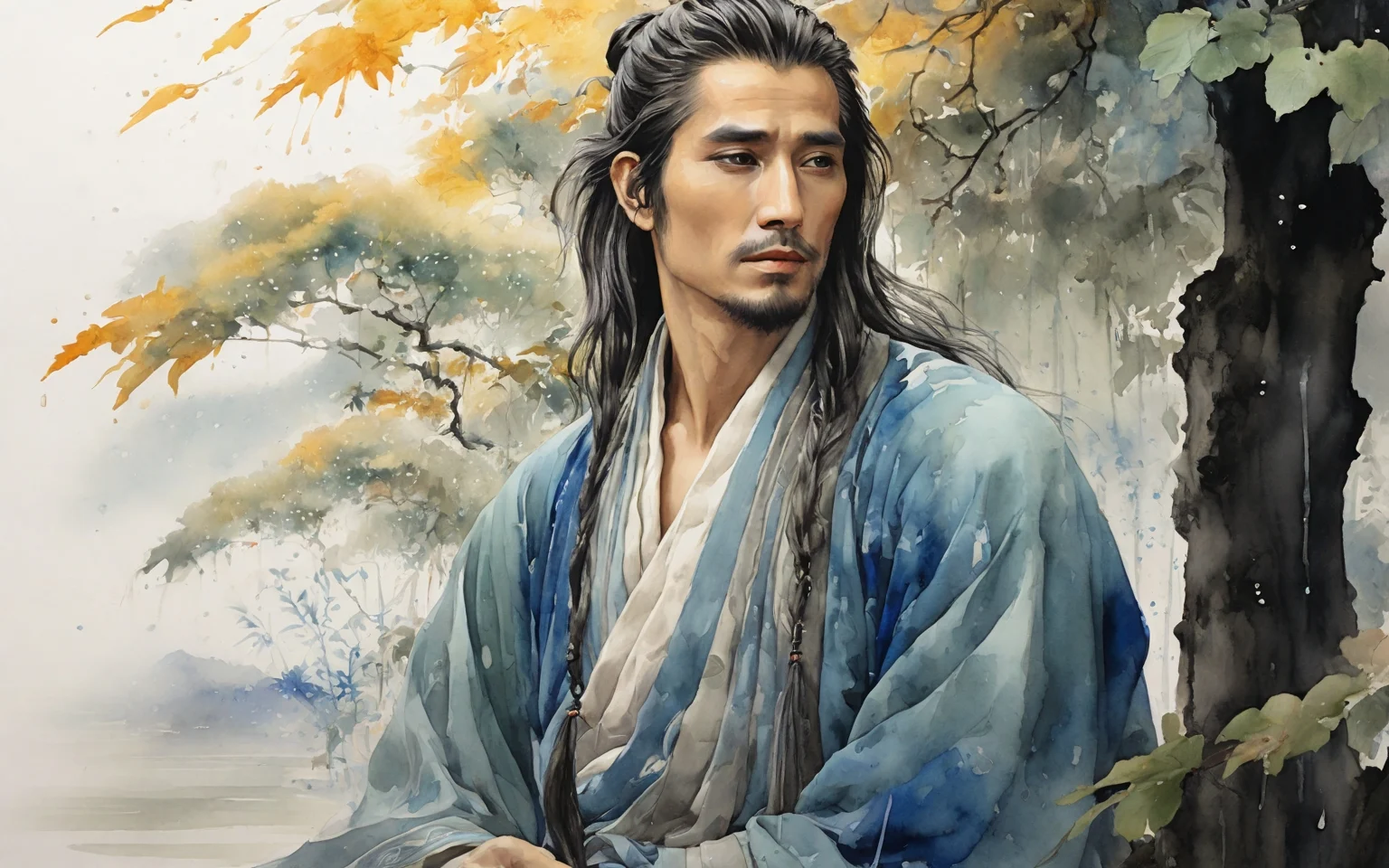
Du Fu (杜甫), 712 - 770 AD, was a great poet of the Tang Dynasty, known as the "Sage of Poetry". Born into a declining bureaucratic family, Du Fu had a rough life, and his turbulent and dislocated life made him keenly aware of the plight of the masses. Therefore, his poems were always closely related to the current affairs, reflecting the social life of that era in a more comprehensive way, with profound thoughts and a broad realm. In his poetic art, he was able to combine many styles, forming a unique style of "profound and thick", and becoming a great realist poet in the history of China.