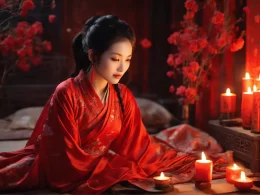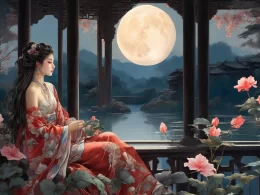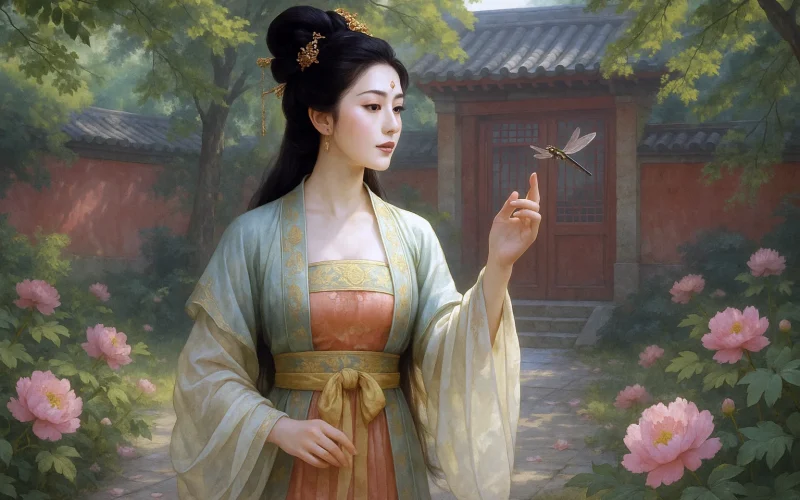
In gala robes she comes down from her chamber
Into her courtyard, enclosure of spring...
When she tries from the centre to count the flowers,
On her hairpin of jade a dragon-fly poises.
Original Poem
「和乐天春词」
刘禹锡
新妆宜面下朱楼,深锁春光一院愁。
行到中庭数花朵,蜻蜓飞上玉搔头。
Interpretation
This poem is part of a poetic exchange between Liu Yuxi and Bai Juyi. Bai Juyi first wrote "Spring Song," which, with concise strokes, sketched the image of a young woman leaning against a tower, lost in thought, a sorrow lingering between her brows. Upon reading it, Liu Yuxi responded with a poem of the same title, approaching the theme from a different angle: he depicts the woman descending the tower and entering the courtyard, attempting to dispel her melancholy amidst the spring scene, only to have her heart's secret inadvertently revealed by a dragonfly.
This exchange occurred during a period of close association between the two poets. Liu Yuxi and Bai Juyi were born in the same year; they shared a deep friendship and frequently exchanged poems. They often wrote on the same theme, showcasing both their talent and their camaraderie. The brilliance of this reply poem lies in its refusal to repeat the original's perspective, shifting the lens from the tower to the courtyard, extending the posture of contemplation into the details of action, forming a clever complement to the original. One is static, the other dynamic; one gazes, the other wanders—together they complete a three-dimensional portrayal of the same character's inner world.
First Couplet: "新妆宜面下朱楼,深锁春光一院愁。"
Xīn zhuāng yí miàn xià zhū lóu, shēn suǒ chūn guāng yī yuàn chóu.
Freshly adorned, her makeup flawless, she descends the scarlet tower;
Spring's splendor locked deep within, the courtyard brims with sorrow.
The first line describes the woman descending the stairs. The phrase "Freshly adorned, her makeup flawless" is a stroke of genius—"freshly adorned" speaks of her careful dressing; "flawless" takes it a step further: her makeup is not only exquisite but perfectly suited to her face. This detail hints at the woman's subtle psychology: perhaps she hopes for someone's appreciation, or perhaps she simply wishes not to appear haggard amid the spring scene. However, the more composed the act of "descend[ing] the scarlet tower," the heavier the following turn feels.
The second line, "Spring's splendor locked deep within, the courtyard brims with sorrow," holds three layers of contrast within seven characters: "spring's splendor" should be bright; "the courtyard" should be lively, yet they are entirely subverted by the words "locked" and "sorrow." The phrase "locked deep within" is especially exquisite—who has locked the spring splendor away? Not a door or a wall, but the intangible sorrow in the woman's heart. As she steps into the courtyard, the garden's vibrant colors are all tinged with melancholy by her gaze. This is a classic example of describing sorrow through joyful scenery: the richer the spring scene, the deeper the sorrow.
Second Couplet: "行到中庭数花朵,蜻蜓飞上玉搔头。"
Xíng dào zhōng tíng shǔ huā duǒ, qīngtíng fēi shàng yù sāo tóu.
She walks to the courtyard's heart, counting blooms, listless and low;
A dragonfly alights upon her jade-adorned hairpin's glow.
This couplet is formed by action and surprise. The woman "walks to the courtyard's heart," hoping to dispel her sorrow by admiring the flowers. But the words "counting blooms" betray her distracted state—true flower appreciation involves contemplation, lingering; "counting" is a mechanical, unconscious act. She counts bloom by bloom, her thoughts wandering who knows where. This detail powerfully conveys the depth of her sorrow: her body is amidst spring's glory, but her heart remains trapped in a city of sorrow.
Just then, the dragonfly arrives. "Alights upon her jade-adorned hairpin's glow" is the poem's most dazzling touch. This detail carries at least three layers of meaning: First, using the creature's innocence to contrast the human's feeling—the dragonfly knows nothing of human sorrow, mistaking her for a flower, and thus alights gently. Second, using movement to depict stillness—the woman's motionless stance makes the dragonfly mistake her for part of the courtyard scenery. Third, using an unexpected scene to express an inevitable emotion—the dragonfly's alighting is accidental, but the woman's flower-like quiet beauty and flower-like solitude are inevitable. This single brushstroke blends the character's beauty, the depth of her solitude, and the charm of nature into a seamless whole.
Holistic Appreciation
This reply poem, in just twenty-eight characters, presents a miniature psychological drama. The first line describes her adornment, hinting at expectation; the second describes the spring scene, yet points to sorrow; the third describes action, revealing distraction; the final line describes the surprise, freezing the entire tableau. The poem moves from inner to outer, from action to stillness, building layer upon layer, finally crystallizing into a moment rich with meaning—the instant the dragonfly alights on the hairpin, the woman's loneliness is quietly framed, and quietly illuminated.
Not a single word in the poem directly writes of sorrowful thought, yet every line builds power for "sorrow." The care of "Freshly adorned, her makeup flawless" contrasts the loneliness of having no one to appreciate it. The image of "Spring's splendor locked deep within" projects subjective emotion onto the objective scene. The unconscious act of "counting blooms" reveals the emptiness within. The surprise of "A dragonfly alights" uses the lightest touch to point to the heaviest solitude. With the most minimal brushstrokes, Liu Yuxi writes the deepest feeling, achieving the realm in classical Chinese poetry described as "without using a single word, capturing the entire essence".
Artistic Merits
- Vivid Detail, Revealing the Great through the Small: "Freshly adorned, her makeup flawless" shows her expectation; "counting blooms" shows her distraction; "A dragonfly alights" shows her quiet beauty. Every detail points to the character's inner world.
- Depicting Stillness through Movement, Interplay of Concrete and Abstract: The dragonfly's arrival is movement, yet it contrasts the woman's motionless stance. The touch is light and spirited, yet it describes a deep solitude.
- Vivid Contrast, Striking Juxtaposition: "Freshly adorned" vs. "sorrow"; "spring's splendor" vs. "locked deep within"—everywhere, sorrow is described through joyful scenery, redoubling the poignancy.
- Concise Language, Rich Meaning, Lingering Resonance: Within twenty-eight characters are contained action, psychology, imagery, and symbolism. The words end, but the meaning is boundless.
Insights
The most important insight this poem offers is about the universality of loneliness and the unexpected arrival of beauty. The woman who carefully adorns herself yet can only count flowers alone is an image from classical poetry, but also a reflection of countless people in modern life—have we not all prepared ourselves with care, only to wait in vain for the hoped-for response? Have we not all found ourselves amidst bustle, yet felt a profound solitude?
Liu Yuxi uses a dragonfly to tell us: There is unexpected beauty even in loneliness. While the woman, immersed in sorrow, distractedly counts the flowers, a dragonfly flies over and alights on her jade hairpin. In that moment, she may not notice, but we, as observers, see it—a lonely person can herself be a scene of beauty. This beauty that still blooms within solitude is the gentlest comfort for the lonely.
Looking deeper, this poem also encourages us to contemplate the significance of the gaze of the other. The dragonfly's alighting is an unintended "seeing"—it mistakes the woman for a flower, giving her the purest form of attention. This reminds us: when we long to be seen by a specific person and are not, perhaps there is another kind of seeing, coming from nature, from chance, from places we do not expect. This seeing, while it cannot dissolve loneliness, can make loneliness bearable.
Finally, the poem's artistic power to crystallize a fleeting moment into eternity is especially moving. A dragonfly alighting on a hairpin is but an instant; yet, transformed by the poet's art, this instant becomes a picture that remains vivid a thousand years later. This inspires us: many subtle moments in life contain profound emotion and beauty, but we often rush past them, never pausing to look closely. Liu Yuxi's poem teaches us: Slow down, look deeply. Those seemingly insignificant moments may be the most precious gifts life gives us.
About the poet
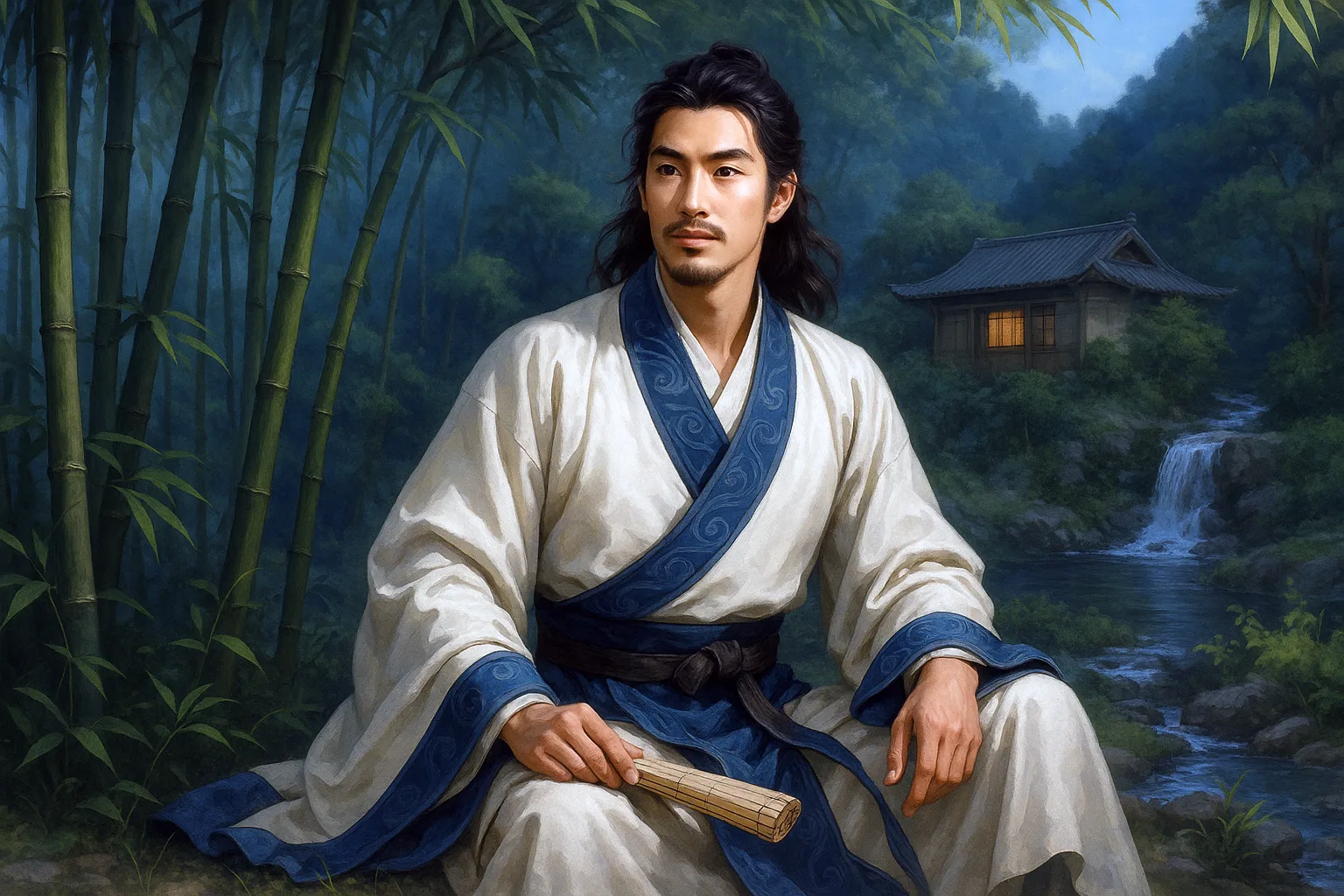
Liu Yuxi(刘禹锡), 772 - 842 AD, was a native of Hebei. He was a progressive statesman and thinker in the middle of the Tang Dynasty, and a poet with unique achievements in this period. In his compositions, there is no lack of poems reflecting current affairs and the plight of the people.