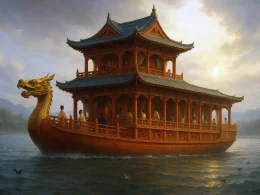



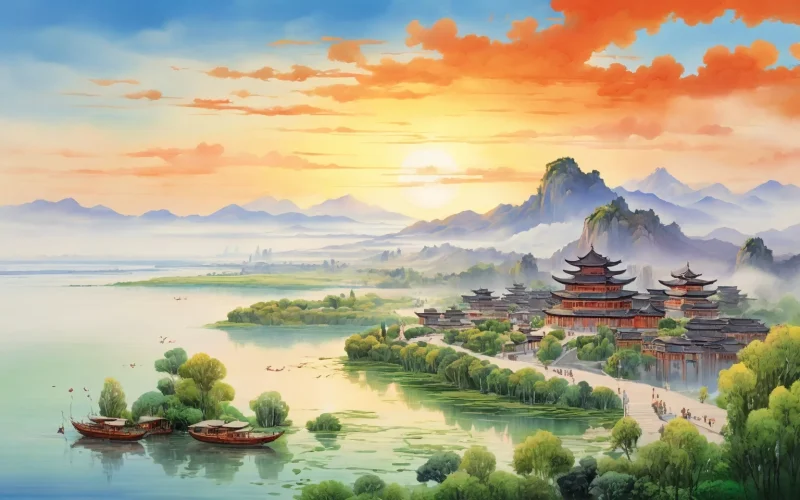
Viewed from the Seaside Tower morning clouds look bright;
Along the riverbank I tread on fine sand white.
The General's Temple hears roaring nocturnal tide;
Spring dwells in the Beauty's Bower green willow hide.
The red sleeves weave brocade broidered with flowers fine;
Blue streamers show amid pear blossoms a shop of wine.
Who opens a southwest lane to the temple scene?
It slants like a silk girdle around a skirt green.
Original Poem
「杭州春望」
白居易
望海楼明照曙霞,护江堤白踏晴沙。
涛声夜入伍员庙,柳色春藏苏小家。
红袖织绫夸柿蒂,青旗沽酒趁梨花。
谁开湖寺西南路,草绿裙腰一道斜。
Interpretation
This poem was composed in the spring of 823 or 824 CE, when Bai Juyi served as Governor of Hangzhou. After enduring the ups and downs of official life, this posting to a celebrated southeastern city brought him a more serene state of mind. The scenic beauty and prosperous tranquility of Hangzhou deeply captivated him. Unified by the act of "viewing," the poem is not a static depiction. Through a shifting gaze and imaginative leaps, it melds Hangzhou's natural wonders, historical layers, facets of daily life, and poetic beauty into a vivid, three-dimensional scroll painting of a city in spring. It showcases Bai Juyi's unique perception in his dual role as administrator and poet, standing as a prime example where his landscape poetry meets his sketches of urban life.
First Couplet: 望海楼明照曙霞,护江堤白踏晴沙。
Wàng hǎi lóu míng zhào shǔ xiá, hù jiāng dī bái tà qíng shā.
Sea-View Tower glows, bathed in dawn's roseate light; / The river-guarding dyke gleams white on sand sun-bright.
The poem opens with a vast morning scene, establishing its bright tone. "Sea-View Tower" stood east of Hangzhou, a vantage point overlooking the Qiantang River. "The river-guarding dyke" refers to the embankment Bai Juyi built to control the lake (a precursor to Bai Causeway). One is tall, the other long, forming a grand framework for the city's eastern prospect. "Glows, bathed" and "gleams white" give the image strong luminosity and texture: the tower is resplendent in the morning clouds; the sand is bright under the clear sky. The verb "on" subtly implies the presence and movement of the poet, animating the scene. The couplet exhibits precise parallelism, with colors (the hues of dawn, the whiteness of sand) and lines (the tower's verticality, the dyke's stretch) interweaving to paint Hangzhou's magnificent spring morning.
Second Couplet: 涛声夜入伍员庙,柳色春藏苏小家。
Tāo shēng yè rù Wǔyuán miào, liǔ sè chūn cáng Sūxiǎo jiā.
Night tides' roar seems to wash through Wu's hallowed shrine; / Willows' spring green half-conceals the lane once Su's, now divine.
This couplet shifts from the concrete to the imagined, from day to night, connecting sound, sight, past, and present. "Night tides' roar seems to wash through" is a brilliant conceit: the poet imagines the mighty sound of the Qiantang tidal bore penetrating time to resonate within the temple of the loyal minister Wu Zixu (legend said his spirit became the tide god), lending the natural sound a solemn historical echo. "Willows' spring green half-conceals" turns to a delicate mood: the emerald fronds by West Lake gently veil the burial site of the famed courtesan Su Xiaoxiao, adding a layer of poignant cultural resonance to the spring scene. "Wash through" versus "half-conceals"—one vigorous, the other subtle—juxtaposes Hangzhou's historical gravitas (Wu's loyalty) and its legendary romance (Su's story), revealing the city's dual cultural character of strength and grace.
Third Couplet: 红袖织绫夸柿蒂,青旗沽酒趁梨花。
Hóng xiù zhī líng kuā shì dì, qīng qí gū jiǔ chèn lí huā.
Sleeves of red weave damask, praise its persimmon-patterned art; / Flags of blue mark the tavern, for pear-blossom wine plays its part.
The gaze turns from historical sites to the vibrant present, capturing Hangzhou's distinctive craft and seasonal custom. "Sleeves of red weave damask" focuses on the thriving local silk industry. "Persimmon-patterned" refers to a prized brocade design of the time; the word "praise" reveals the weavers' pride in their local craft. "Flags of blue mark the tavern" depicts the lively wine trade; "for pear-blossom wine plays its part" signals mid-spring when pears bloom, also alluding to the seasonal "Pear Blossom Brew." It conveys the local custom of enjoying life in harmony with nature's rhythms. Red sleeves and blue flags provide bright hues; the focused weaving and the convivial wine-selling offer a lively contrast. Together, they sketch a picture of Hangzhou's affluent, peaceful, and dynamic everyday life.
Fourth Couplet: 谁开湖寺西南路,草绿裙腰一道斜。
Shéi kāi hú sì xīnán lù, cǎo lǜ qún yāo yī dào xié.
Who laid the isle-temple path that slants southwest, I pray? / A sash of grass-green silk cinching a beauty's waist, I'd say.
The final couplet pulls the panorama together, elevating the scene with a stroke of genius. The rhetorical question "Who laid…?" expresses wonder, perhaps also hinting at the poet's own role in the lake's management. "The isle-temple path" likely refers to a causeway linking Gushan (Solitary Hill) Temple to the shore. The masterstroke is the metaphor: "A sash of grass-green silk cinching a beauty's waist." It compares the spring-grass-covered causeway to a sash on a gown, and the entire West Lake to a graceful lady. This metaphor is apt in form and spirit, instantly personifying the landscape. Ending with such a graceful, imaginative image leaves a lasting charm, crowning the "spring view" with supreme aesthetic delight.
Holistic Appreciation
This regulated verse is Bai Juyi's "panoramic spring portrait" of Hangzhou. Guided by the act of "viewing," the perspective moves from high to low, day to imagined night, past to present, nature to culture. The four couplets respectively highlight geographical spectacle, historical culture, social vitality, and poetic imagination, constructing a complete image of Hangzhou: majestic yet delicate, ancient yet vibrant. The poet is both observer and participant. He blends his administrative perspective (the dyke, the path), his historical sense (the temple, the grave), his engagement with daily life (weaving, wine), and his keen aesthetic eye (the sash metaphor). This synthesis elevates the poem beyond mere landscape description into a profound ode to the soul of a city.
Artistic Merits
- Interwoven Dimensions of Space and Time: The poem's space flows from the city's east (tower, dyke) to its center (historical sites) to the lake. Time flows from morning to imagined night to the present season, creating a multi-layered tableau.
- Culturally Resonant, Iconic Imagery: The chosen images—Wu's shrine, Su's lane, persimmon-patterned damask, pear-blossom wine, the isle-temple path—are quintessential symbols of Hangzhou's nature, history, products, and scenery, forming a浓缩 cultural catalogue.
- Precise Parallelism with Fluid Meaning: The middle couplets show masterful parallelism in diction and structure (e.g., "Night tides' roar" / "Willows' spring green"; "Sleeves of red" / "Flags of blue"). Yet within this formal precision, meaning flows freely, connecting history and the present, production and leisure.
- A Creative, Elevating Metaphor: The "sash… on a beauty's waist" metaphor is an immortal line in West Lake description. It is novel, apt, and beautiful, animating the static scene and showcasing the poet's extraordinary imaginative power to transform the ordinary into poetic elegance.
Insights
This work is more than scenic poetry; it is a city ode and a celebration of life. It shows that a great city's charm lies in its layered beauty: natural spectacle, historical depth, the pulse of daily commerce, and poetic sensibility. As governor, Bai Juyi's "view" of Hangzhou unified administration and aesthetics, duty and affection.
For us today, the poem teaches how to truly appreciate a city: not just by visiting sites, but by listening for its historical echoes (like the "tidal roar in the shrine"), feeling the rhythm of its life (like the "weavers praising their craft"), and discovering its unique poetry with a creative eye (seeing the causeway as a "sash on a beauty's waist"). True appreciation involves engaging with a city's past, present, and essence with all one's senses and cultural awareness, finding harmony between people, nature, and history. This profound, holistic connection to place remains a valuable lesson for city dwellers and stewards alike.
Poem translator
Xu Yuanchong (许渊冲)
About the Poet
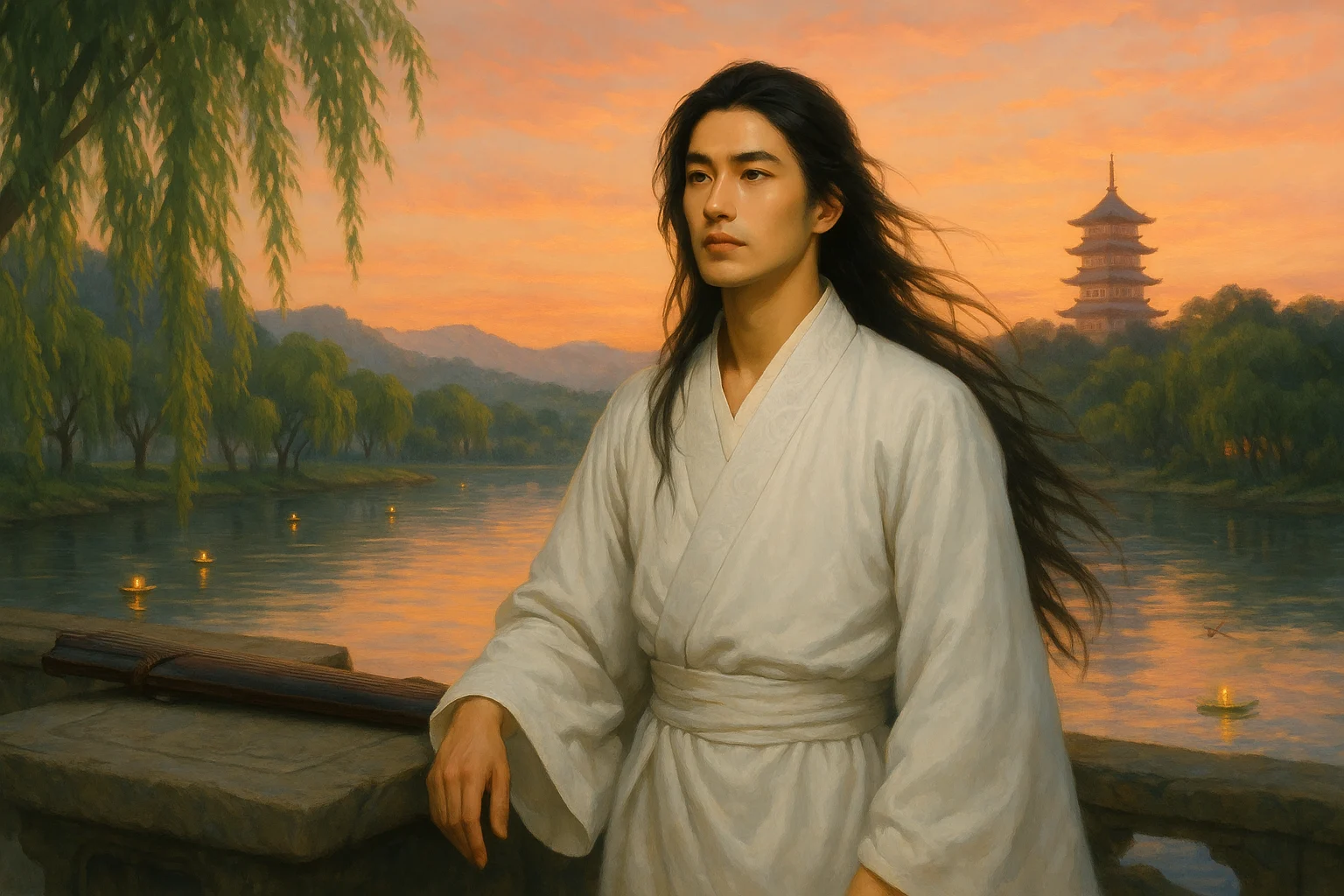
Bai Juyi (白居易), 772 - 846 AD, was originally from Taiyuan, then moved to Weinan in Shaanxi. Bai Juyi was the most prolific poet of the Tang Dynasty, with poems in the categories of satirical oracles, idleness, sentimentality, and miscellaneous rhythms, and the most influential poet after Li Bai Du Fu.