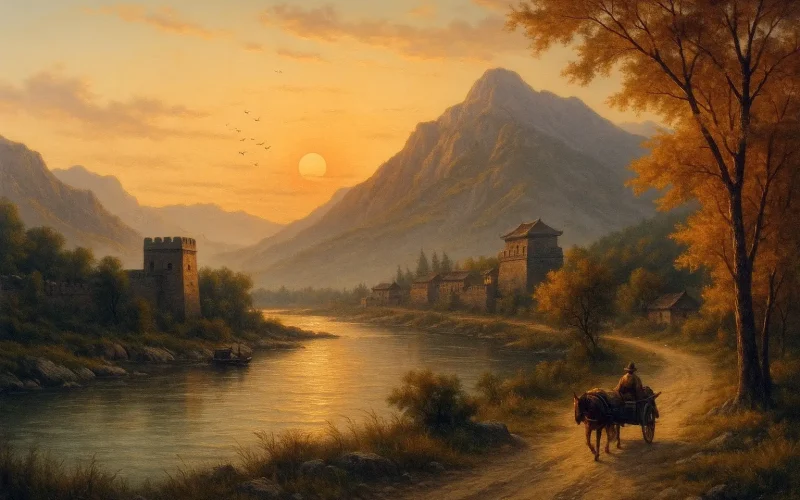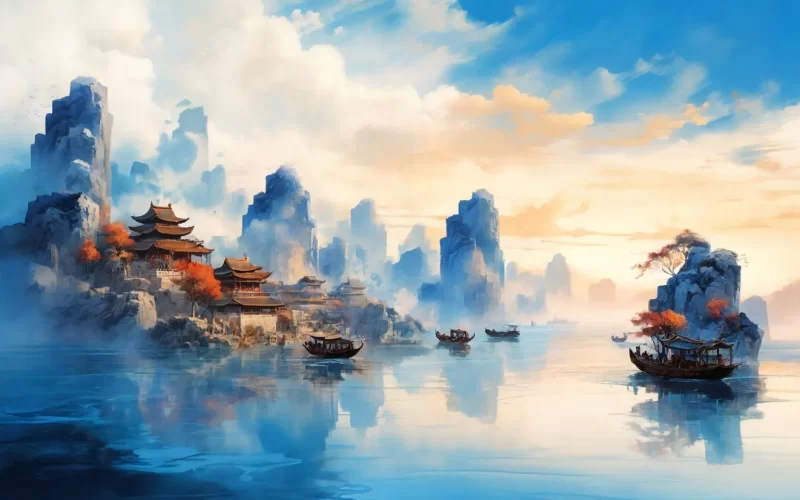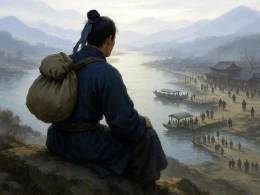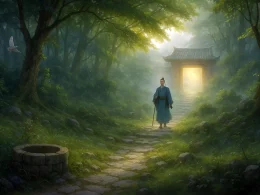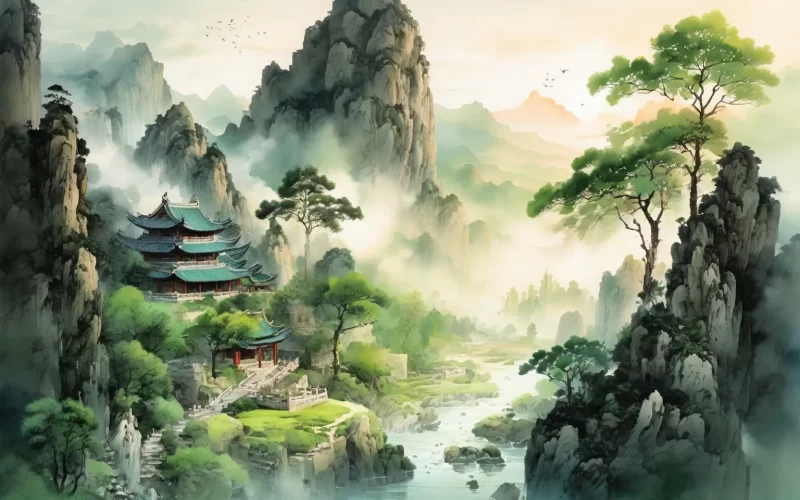
Not knowing where the Temple of Accumulated Fragrance lay,
I wandered for miles amid cloud-wrapped peaks.
Through ancient woods where no footpath is seen,
Then from a height, a temple bell’s sound speaks.

A stream sobs as it threads through jagged rocks;
Sunlight turns cold upon the pines’ deep green.
At dusk, by the bend of a placid, empty pool,
In meditation, I subdue the passions’ dragon unseen.
Original Poem
「过香积寺」
王维
不知香积寺,数里入云峰。
古木无人径,深山何处钟。
泉声咽危石,日色冷青松。
薄暮空潭曲,安禅制毒龙。
Interpretation
This poem represents the pinnacle of Wang Wei's later landscape poetry, perfectly fused with Chan (Zen) enlightenment verses. It marks the ultimate evolution of his artistic realm from the "interplay of poetry and painting" to the "oneness of poetry and Chan." Composed during his years of clarity after wholeheartedly embracing Buddhist teachings and retreating to the Zhongnan Mountains, the poet uses the act of "passing by" (visiting, traversing) as a thread. The record is not merely of a geographical journey into the mountains, but of a pilgrimage of the soul, moving from confusion to clarity, from seeking outwardly to verifying inwardly. The poem's eight lines progressively peel away the layers of the phenomenal world, ultimately arriving at the silent core of existence's essence. It is the concentrated poetic manifestation of Wang Wei's life philosophy: "where landscape is, there is the place of practice; where one walks and rests, there is the cultivation."
First Couplet: 不知香积寺,数里入云峰。
Bù zhī Xiāngjī sì, shù lǐ rù yún fēng.
Not knowing where the Temple of Fragrant Accumulation lies,
For miles I've entered cloud-wrapped peaks.
The opening line, beginning with "Not knowing," is profoundly meaningful. This denotes both geographical uncertainty and serves as a metaphor for a lack of enlightenment regarding ultimate truth (Buddhist doctrine, one's true nature). "For miles I've entered cloud-wrapped peaks" describes a process of movement without a fixed goal or preconception, symbolizing the practice of relinquishing attachment and proceeding in accordance with conditions. The poet does not advance like an eager pilgrim but enters naturally, like the clouds themselves—an approach already imbued with Chan insight.
Second Couplet: 古木无人径,深山何处钟。
Gǔ mù wú rén jìng, shēn shān hé chù zhōng.
Ancient trees, a path untrodden by man;
Deep in the mountains—from where comes the bell's toll?
This couplet presents the poem's first major perceptual reversal and spiritual jolt. "Ancient trees, a path untrodden by man" emphasizes the secluded, primeval stillness of the environment—a visual blockade and the vanishing of a path, symbolizing the failure of conventional cognition and worldly roads. Just as doubt sets in, "from where comes the bell's toll?" breaks the silence. The question "from where?" seeks not a geographical answer but expresses a startled awareness and pursuit of the sound's source—that presence which transcends form yet calls to the soul. Here, the bell symbolizes the Dharma, an opportunity for awakening. It is not seen by the eyes but resonates within the heart.
Third Couplet: 泉声咽危石,日色冷青松。
Quán shēng yè wēi shí, rì sè lěng qīng sōng.
The spring's voice chokes on perilous crags;
The sunlight chills the green pines.
This couplet is an eternal exemplar of verbal artistry in Tang poetry, elevating natural scenery to the level of synesthesia and mental imagery. In "The spring's voice chokes on perilous crags," the word "chokes" not only mimics the faint, strained sound of water struggling through rocky fissures but, more importantly, imbues nature with living emotion and tension, as if heaven and earth themselves are voicing hardship and restraint. In "The sunlight chills the green pines," the word "chills" ingeniously blends senses: the visual "sunlight" produces a tactile sensation of "chill." This is not merely the physical coolness of the mountain dusk but the pure, lofty, cleansing "cold" experienced by the poet's inner being, washing away worldly cares. Sound and color intertwine; warmth and chill arise from one another. Here, environment and mental state become completely isomorphic.
Fourth Couplet: 薄暮空潭曲,安禅制毒龙。
Bó mù kōng tán qū, ān chán zhì dú lóng.
At dusk, by a curved and empty pool,
In quiet meditation, I quell the venomous dragon.
The couplet represents the spiritual culmination and the poet’s declaration of Zen realization. "At dusk, by a curved and empty pool" is the journey’s destination and the peak of the poetic vision: "dusk" signifies the coalescence of time, the "empty pool" embodies the stillness of space, and "curved" suggests the fulfillment and completion of the path. This empty pool serves as both a tangible landscape and a metaphor for the mind as a still lake—only when the mind, like the pool, is clear and placid can it mirror the truth. The concluding line, "In meditation, I quell the venomous dragon," alludes to Buddhist scripture (the "Mahāparinirvāṇa Sūtra" where a "venomous dragon" represents mental afflictions), yet carries no hint of didacticism. "In meditation" is the method, the act of calmly entering deep contemplation by the empty pool in the present moment; "quell the venomous dragon" is the result—the pacification and transcendence of inner turmoil. The poet thus reveals that the long-sought Temple of Fragrant Accumulation is not a physical structure hidden deep within the misty peaks, but resides within the present state of mind, akin to the "curved and empty pool." True practice lies nowhere else but in the "meditative stillness" of each moment.
Holistic Appreciation
The poem is a work of enlightenment, its structure akin to a Zen koan, its artistic vision a mirror of wisdom. It traces the clear stages of Zen cultivation: doubt arises ("Not knowing"/ignorance), sound guides ("hearing the bell"/opportunity), contemplation deepens ("observing the scene"/focused awareness), and realization culminates ("entering meditation"/tranquil insight). Together, the four couplets form a complete journey of "awakening."
Wang Wei's supreme artistic achievement here lies in completely transforming a specific excursion into a symbolic narrative of spiritual metamorphosis. Every image in the poem carries dual significance: the cloud-wrapped peaks are both obscuring and sublime; the ancient trees are both obstacle and shelter; the bell is both summons and echo; the choking spring is both obstruction and persistence; the chilling sunlight is both desolation and purification; the empty, curved pool is both end and source. The poet's passage through them is, in truth, a journey through the various states of his own mind. Ultimately, he does not "find" a resplendent, golden-roofed temple but "encounters" the self-sufficient self, capable of "quelling the venomous dragon" through meditation. This aligns perfectly with the fundamental Chan tenet: "The Buddha is in your own mind; do not seek him afar."
Artistic Merits
- Progressive Internalization and Sublimation of Perception: The poem's perception evolves from visual confusion ("Not knowing," "a path untrodden by man"), to auditory awakening ("bell's toll," "chokes"), to synesthetic fusion ("sunlight chills"), finally settling into introspective silence ("quiet meditation"). This is a complete process of perceptual purification, from outward distraction to inward recollection, from scatteredness to concentration.
- Divine Empowerment of Diction and Psychological Depth: The words "chokes" and "chills" are exemplary of what Wang Guowei termed "refined diction." They not only accurately depict the state of things but, more importantly, emotionalize and psychologize the natural scenery, making the external landscape a precise correlative of the inner universe, achieving the transformative state where "all objects bear the hue of my self."
- Isomorphism of Spatial Narrative and Mental Map: The spatial movement in the poem (entering cloud-wrapped peaks, hearing the bell, by perilous crags and green pines, at the curved and empty pool) is actually the trajectory of the mind's quest. This path contracts from the outer to the inner, from confusion to clarity, from agitation to peace, ultimately arriving at that "curved" place—the deepest, most essential corner of the mind.
- Transformation of Allusion and the Unity of Theme: The allusion to the "venomous dragon" is used with seamless naturalness, devoid of any scholarly weight. It transcends abstract Buddhist doctrine to become the poet’s lived experience, personally verified in the specific time and place of the "curved and empty pool." The allusion is completely woven into the poem’s vision, serving the theme of enlightenment.
Insights
This work is like an ancient lamp of wisdom, illuminating the hidden path in the human spirit leading from "not knowing" to "quiet meditation." It reveals that true seeking often begins with letting go of attachment to the destination ("Not knowing"); true guidance may come from unexpected sounds ("from where comes the bell's toll?"); true cultivation lies in that profound perception and restraint experienced while dwelling with all things ("chokes on perilous crags," "sunlight chills"); and the true refuge and strength ultimately stem from that inner "empty pool" which can both reflect everything and cleanse everything.
In the goal-driven, efficiency-obsessed modern world, we are accustomed to "knowing" our destination and rushing straight toward it. This poem invites us to try another way of "passing by": to allow ourselves "not to know," to wander amidst "cloud-wrapped peaks," to listen for those bells tolling "from where" deep in the mountains, to feel the subtle tremors of the "choking" spring and the "chilling" sunlight. Perhaps, finally, at the hour of "dusk," we may encounter our own inner "curved and empty pool" and learn to "practice quiet meditation" there, to quell the modern "venomous dragons" named anxiety, desire, and nihilism. This is not merely poetic dwelling but a profound act of spiritual self-rescue and the art of living.
Poem translator
Kiang Kanghu
About the poet
Wang Wei (王维), 701 - 761 A.D., was a native of Yuncheng, Shanxi Province. Wang Wei was a poet of landscape and idylls. His poems of landscape and idylls, with far-reaching images and mysterious meanings, were widely loved by readers in later generations, but Wang Wei never really became a man of landscape and idylls.