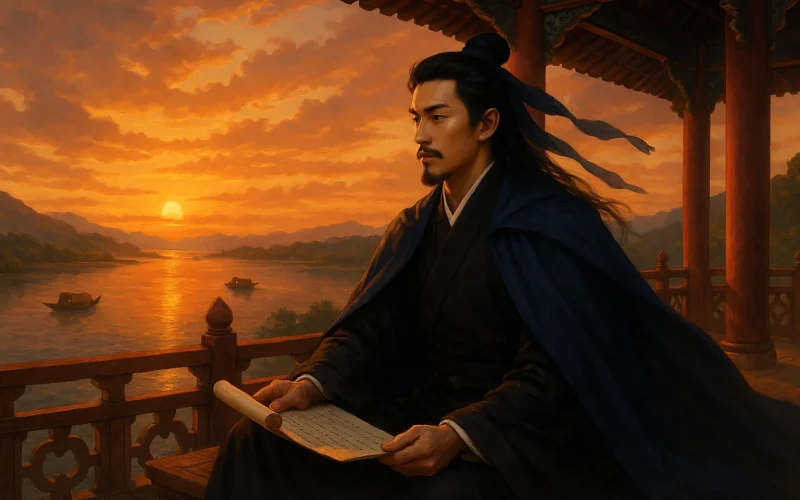



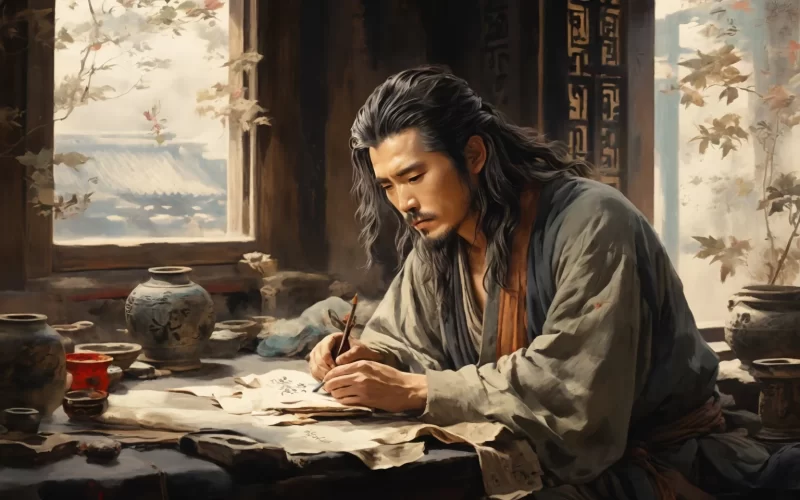
I write with ink that is mingled with tears,
To send to my people, over the miles and years.

The letter goes off; and my soul goes the same,
And I am left here, a body without a name.
Original Poem
「归信吟」
孟郊
泪墨洒为书,家寄万里亲。
书去魂亦去,兀然空一身。
Interpretation
This poem was composed by the Mid-Tang poet Meng Jiao during his wanderings far from home. Meng Jiao’s life was marked by poverty and repeated failure in the imperial examinations; he did not attain the jinshi degree until the age of forty-six and later suffered the grievous loss of a son. His poetry often dwells on hardship, loneliness, and the fickleness of the world. Renowned for his "bitter chanting" (kuyin)—a style of intense, painstaking composition—he is often paired with Jia Dao under the critical label "Meng’s chill, Jia’s gauntness" (Jiao han Dao shou). Yet, beneath his austere and rugged poetic demeanor lay a wellspring of tender feeling, deeply concealed within his longing for family.
Meng Jiao was by nature filial and emotionally refined. His line, "The threads from a kind mother’s hand / Are the wanderer’s cloak" is recited through the ages, perfectly capturing the depth of maternal love. This poem, titled Song of the Letter Home, captures the searing experience of the very moment a letter is sent home. "With tears and ink I sprinkle out this scroll" is the outpouring of emotion; "To send to my own kin ten thousand li away" speaks to the helplessness of distance; "The letter goes, and with it goes my soul" is the absolute folly of a heart that follows the letter; "I sit here, void, a body made of clay" is the emptiness left after the soul’s departure. The poet elevates the ordinary act of mailing a letter into a journey of the soul and an abandonment of the body. In just twenty characters, he exhaustively renders the ultimate experience of separation between body and spirit, of heart-stricken longing, that haunts the wanderer missing his kin. This letter sent ten thousand li home was likely intended for that very kind mother who once mended his clothes by lamplight.
First Couplet: "泪墨洒为书,家寄万里亲。"
Lèi mò sǎ wéi shū, jiā jì wàn lǐ qīn.
With tears and ink I sprinkle out this scroll, To send to my own kin ten thousand li away.
The poem opens with the image of tears mingling with ink. "泪墨洒为书" ("With tears and ink I sprinkle out this scroll")—five words that capture the unbearable emotion of writing: this is not calm, deliberate calligraphy, but a pouring forth where tears fall uncontrollably, mixing with the ink upon the page. The verb "洒" (sǎ, sprinkle, spill) is used with great force: the tears are too many to hold back; they can only spill, merging with the ink. The next line, "家寄万里亲" ("To send to my own kin ten thousand li away"), clarifies the letter’s destination and recipient. "万里" (ten thousand li) emphasizes the vast distance; "亲" (kin) encapsulates the bond of affection. This couplet freezes the moment of writing: the tear-stained paper will traverse countless rivers and mountains to reach the hands of distant family.
Final Couplet: "书去魂亦去,兀然空一身。"
Shū qù hún yì qù, wùrán kōng yī shēn.
The letter goes, and with it goes my soul; I sit here, void, a body made of clay.
This couplet is the soul of the poem, rendering the psychological state after sending the letter with startling intensity. "书去魂亦去" ("The letter goes, and with it goes my soul")—five words of utmost, foolish devotion. The letter is sent, and as if the soul too departs with it, chasing that paper and ink over ten thousand li to return to the side of kin. These three characters, "魂亦去" (with it goes my soul), materialize the intensity of longing as a spiritual departure, allowing the reader to feel keenly the poet’s state of mind at that moment: the heart is gone, only the shell remains. The next line, "兀然空一身" ("I sit here, void, a body made of clay"), concludes with the word "空" (kōng, void, empty), expressing the vacuity and bewilderment left after the soul’s departure. "兀然" (wùrán) describes the state of sitting blankly, dazed; "空一身" (kōng yī shēn) is the emptiness of the body, and even more, of the heart. The letter is sent, the cares have gone with it, and the self that remains feels hollowed out, nothing but a vacant shell sitting dumbly in place.
Holistic Appreciation
This is another powerful work among Meng Jiao’s poems of longing for family. In just four lines and twenty characters, using the act of sending a letter home as its focal point, it merges the mingling of tears and ink during writing with the departure of soul and emptiness of body after sending, revealing the wanderer’s heart-piercing longing for kin.
Structurally, the poem presents a progression from writing to sending, from emotion to state. The first couplet depicts the process of writing—tears mingling with ink, the letter completed—an outpouring of emotion. The final couplet depicts the state after sending—the soul following the letter, the body left behind—a presentation of condition. Between the two couplets, the movement is from action to stillness, from outer to inner, from emotional outburst to spiritual emptiness, deepening layer by layer into a seamless whole.
Thematically, the poem’s core lies in the contrast between the word "魂" (soul) and the word "空" (void). That "soul" which "goes" with the letter is the embodiment of longing, the vessel of emotion; that "void" left in the body after the soul’s departure is the abandoned husk, the nothingness after emotion is withdrawn. Between this "soul" and this "void" lies the wanderer’s deepest sorrow: the body is trapped in a foreign land, but the heart has long flown to the old home; the person is here, but the soul is there. This experience of separation between form and spirit is the shared fate of all wanderers, and the most heart-wrenching aspect of Meng Jiao’s poem.
Artistically, the poem’s most moving feature is its unique technique of "using form to depict spirit, using emptiness to depict substance." The poet does not directly state how deep the longing is; he only shows the image of tears mingling with ink. He does not directly state how heavy the cares are; he only shows the folly of the soul following the letter. He does not directly state how bitter the separation is; he only shows the emptiness of the body left behind. It is precisely these concrete scenes, actions, and states that materialize abstract longing into palpable experience, allowing the reader to feel as if present, to share the emotion.
Artistic Merits
- Tears in Ink, Intense Emotion: The five words "With tears and ink I sprinkle out this scroll" vividly depict the uncontrollable emotion of writing, moving the reader as if witnessing the scene.
- Separation of Form and Spirit, Startling Conception: "The letter goes, and with it goes my soul" uses the imagination of the soul journeying with the letter to materialize the intensity of longing as a spiritual departure, creating immense impact.
- Using Emptiness to Depict Substance, Lingering Resonance: "I sit here, void, a body made of clay" concludes with bodily emptiness, allowing the reader to feel the weight and helplessness of longing within that void.
- Concise Diction, Each Word Weighty: In twenty characters, there are tears, ink, a letter, a soul, and void—each word ordinary, yet each word startling.
Insights
Through a single letter home, this poem speaks to an eternal theme: Longing, in its extreme, becomes a state of distractedness, a separation of form and spirit.
First, it allows us to witness "deep feeling within the act of writing." The image of "tears and ink sprinkled" is a wanderer’s truest confession to family. In that moment where brushstrokes and tears interweave, all longing, guilt, and care transform into marks upon the page. The most profound, sincere emotions often reside not in speech, but in the tremor of the writing hand, in the teardrops that fall.
On a deeper level, the poem prompts us to contemplate the relationship between "distance and presence." The letter is sent, the heart goes with it. The body is here, the soul is there. This state of separation between form and spirit is the shared experience of all wanderers: though the person is in a foreign land, the heart has long flown home; though the body is in the present, the heart is in some moment of memory. This schism is the price of longing, and also its proof.
And most moving is the lingering resonance within that "void" left afterward. The letter is sent, the soul is gone, only an empty shell remains, blankly sitting still. This "void" is not nothingness, but the blank space left after overflowing fullness; it is not numbness, but the loss of words after emotion becomes too intense. Genuine, deep feeling is often just like this: after saying everything, one is left speechless; after giving everything, one is left empty.
This poem writes of an ancient letter home, yet allows everyone who has ever sent forth their longing to find resonance within it. The moment of "sprinkling out this scroll with tears and ink" is the true portrait of every wanderer writing a letter; the feeling that "the letter goes, and with it goes my soul" is the shared experience of everyone distracted after mailing a letter; the state of "sitting here, void, a body made of clay" is the common emptiness of all who long after sending their cares afar. This is the vitality of poetry: it writes of one poet’s experience, yet speaks to the heart’s concerns of all wanderers.
About the Poet
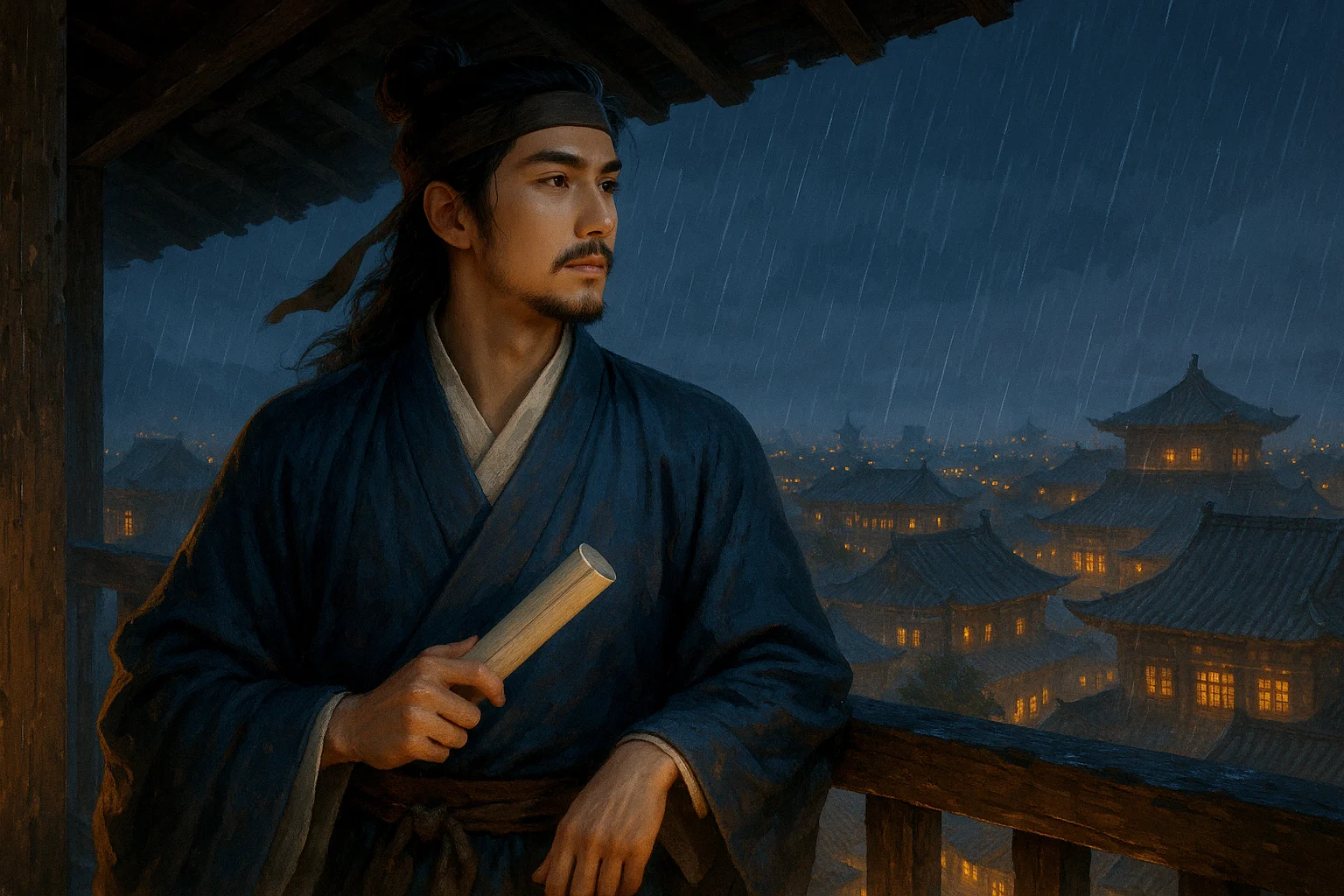
Meng Jiao (孟郊 751 - 814), a native of Deqing, Zhejiang Province, was a renowned poet of the Mid-Tang Dynasty. In his early years, he repeatedly failed the imperial examinations and only obtained the jinshi degree at the age of forty-six. He held minor posts such as Sheriff of Liyang, living a life of poverty and hardship. In his later years, he suffered the loss of his son and died while en route to a new official post. His poetry is renowned for its "bitter chanting" style, and he was often mentioned alongside Jia Dao, with Su Shi coining the famous phrase: "Jiao is lean, Jia is thin." His yuefu (Music Bureau) poems inherited the tradition of Du Fu and paved the way for Yuan Zhen and Bai Juyi, establishing a unique and distinctive place in the history of Tang poetry.