


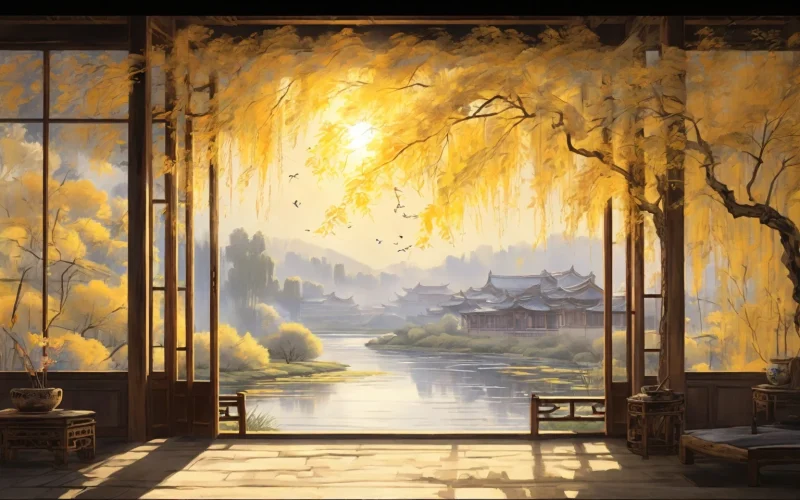
At dawn official drumbeats hasten the sunrise;
At dusk the booming drums call the moon to the skies.
When yellow willows put forth new buds in the town,
In tomb is buried the favorite of the crown.

The drums have boomed a thousand years, still shines the sun,
But ancient emperors of Qin and Han have done.
Your hair once black may turn white as reed flowers stand,
The drums with southern hills will ever guard our land.

Even immortals were buried in the sky,
The drumbeats and the water-clock will never die.
Original Poem
「官街鼓」
李贺
晓声隆隆催转日,暮声隆隆呼月出。
汉城黄柳映新帘,柏陵飞燕埋香骨。
磓碎千年日长白,孝武秦皇听不得。
从君翠发芦花色,独共南山守中国。
几回天上葬神仙,漏声相将无断绝。
Interpretation
The Official Street Drum was an institution in the capital city of Chang'an during the Tang Dynasty. Every dawn and dusk, the drumbeats would resound punctually along the main thoroughfares of the capital, serving as a signal for opening and closing the city gates, and as a timekeeper for the people's daily routines. This drumming echoed day after day, year after year; the residents of Chang'an passed their days and years to the accompaniment of its rumbling.
When Li He wrote this poem, he was a listener to these very drumbeats. Though descended from a distant branch of the Tang imperial clan, his family's fortunes had long declined. In his youth, his poetic talent brought him fame in the capital, yet because his father's name, "Jinsu," was phonetically similar to "jinshi" (the Presented Scholar degree), he was accused of violating naming taboos and forced to abandon the imperial examinations. This blow severed his only path to an official career. Thereafter, he only held a minor ninth-rank post as a Ritual Ceremonialist for a few years, remaining unfulfilled and dying young at twenty-seven. For Li He, the Official Street Drum that sounded punctually each day was not merely a marker of time; it was a measure of life's passing. Each drumbeat marked a day gone by; each year of drumbeats marked a year passed. And all those who had once lived to the sound of this drum—Zhao Feiyan of the Han, the palace maidens of the Tang, the First Emperor of Qin and Emperor Wu of Han who sought immortality—could no longer hear today's drumming. The drumbeats remain, but the people are not those of yesterday.
This poem takes this everyday phenomenon as its starting point, linking the drumbeats to time, life, and history. The poet does not linger on a simple description of the drumming; instead, he uses it as a prelude to unfold a philosophical meditation on time and life: Why can the drumbeats echo for millennia without ceasing, while human life is so fleeting? Why can even those once-overweening emperors no longer hear this ordinary drumming? Even the celestial immortals, it is said, have been buried many times over, yet the sound of the water-clock marking the hours has never ceased.
First Couplet: "晓声隆隆催转日,暮声隆隆呼月出。"
Xiǎo shēng lónglóng cuī zhuǎn rì, mù shēng lónglóng hū yuè chū.
Dawn's sound, booming, booming, urges on the turning sun;
Dusk's sound, booming, booming, summons the rising moon.
The opening uses the doubled "booming, booming" to mimic the drum's heavy, enduring sound. "Urges on the turning sun" and "summons the rising moon" attribute to the drum the divine power to command the movements of the sun and moon—as if it is not time propelling the drumbeats, but the drumbeats driving time. This inverted description gives concrete, audible form to the intangible passage of time, making the reader feel as if they can hear that eternal, unceasing rhythm dominating the universe's operation.
Second Couplet: "汉城黄柳映新帘,柏陵飞燕埋香骨。"
Hàn chéng huáng liǔ yìng xīn lián, bǎi líng fēi yàn mái xiāng gǔ.
By Han walls, willow gold gleams on newly-hung drapes;
At Cypress Mound, the Flying Swallow's fragrant bones are laid.
This couplet shifts from the cosmos to the human world, from the present to the past. "By Han walls, willow gold gleams on newly-hung drapes" describes the constancy of scenery—the willows turn fresh green each year, the window drapes are renewed each season, as if nothing has changed. Yet the next line, "At Cypress Mound, the Flying Swallow's fragrant bones are laid," uses "Flying Swallow" to refer to Empress Zhao Feiyan of Emperor Cheng of Han, the beauty whose ethereal dancing once captivated all and who held immense power, now reduced to a pile of bones, laid to rest beneath Cypress Mound. The juxtaposition of "gleams on newly-hung drapes" and "fragrant bones are laid" creates a startling contrast: the willows' color is ever new, yet the person is long gone; splendor fades easily, but time is eternal.
Third Couplet: "磓碎千年日长白,孝武秦皇听不得。"
Duī suì qiānnián rì cháng bái, Xiào Wǔ Qín Huáng tīng bù dé.
It pounds to dust a thousand years, yet the sun stays ever bright;
Filial Wu of Han, Qin's First Emperor, can hear it now no more.
"Pounds to dust a thousand years" is incredibly forceful; it is as if the drumbeats are a great hammer, shattering the ages blow by blow. Yet "the sun stays ever bright"—the sun still rises each day, bright as ever. The next line takes Emperor Wu of Han and the First Emperor of Qin as examples. These two most powerful emperors in Chinese history, who exhausted their states' resources seeking the elixir of immortality, in the end cannot even hear this ordinary Official Street Drum. "Can hear it now no more" seems plain but is utterly merciless—it is not that they do not wish to hear, but that they are in the yellow earth, having forever lost the qualification to listen.
Fourth Couplet: "从君翠发芦花色,独共南山守中国。"
Cóng jūn cuì fà lú huā sè, dú gòng Nán Shān shǒu Zhōngguó.
Let your hair change from kingfisher blue to reed-flower white,
Alone with South Mountain it guards the Middle Kingdom.
This couplet shifts from emperors to ordinary people, from the past back to the present. "Kingfisher blue" metaphorizes youth; "reed-flower white" metaphorizes old age. With the words "Let your," the poet expresses life's helplessness: you can only watch as your hair changes from black to white, unable to stop it, unable to reverse it. And the drum? It still "Alone with South Mountain guards the Middle Kingdom"—"Alone" expresses the drum's solitude and eternity; "with South Mountain" uses the mountain's permanence to symbolize the drum's permanence; "guards the Middle Kingdom" elevates the drum to an eternal presence safeguarding this land. This line juxtaposes the individual's brevity with the cosmos's eternity, and a sense of desolate sorrow spontaneously arises.
Fifth Couplet: "几回天上葬神仙,漏声相将无断绝。"
Jǐ huí tiānshàng zàng shénxiān, lòu shēng xiāngjiāng wú duàn jué.
How many times have they buried the gods in heaven above?
Yet the water-clock's sound keeps it company, never ceasing.
The final couplet pushes the poem's meaning to its extreme. "How many times have they buried the gods in heaven above"—even the deathless celestial immortals have been buried multiple times! This is a startling, breathtaking imagination. With the "death of the gods," the poet utterly dissolves humanity's fantasy of eternity: if even gods can die, how can earthly emperors and ordinary mortals escape? Yet the next line, "Yet the water-clock's sound keeps it company, never ceasing," echoes the drum with the sound of the water-clock (timekeeper), pointing out that what is truly eternal and unceasing is not the gods, not the emperors, but this merciless time itself. "Keeps it company" describes the water-clock sound accompanying the drum, and also describes time shadowing life—it is there while you live; it remains after you die. Forever, and ever.
Holistic Appreciation
This poem is one of Li He's most philosophically profound and grandly conceived works. Using the Official Street Drum that sounded daily in Chang'an as a thread, it unfolds layer upon layer: the cycle of sun and moon, the rise and fall of history, the life and death of emperors, the existence and demise of gods, culminating in the brutal contrast between the eternity of "the water-clock's sound keeps it company, never ceasing" and the transience of "How many times have they buried the gods in heaven above."
Structurally, the poem presents a progressive layering from outer to inner, from ancient to present, from human to divine. The first couplet establishes the cosmic-scale backdrop of the drum commanding the sun and moon. The second couplet introduces history through the contrast between Han willows and Feiyan's bones. The third couplet deepens the satire on emperors' pursuit of immortality with the deaths of the Qin and Han emperors. The fourth couplet shifts from the individual life of changing hair to the eternal existence of the drum with South Mountain. The final couplet concludes with the death of the gods, pushing the pathos to its extreme. Between the five couplets, the poem advances step by step, its vision continually expanding, its sorrow continually deepening.
Conceptually, the poem's core lies in the word "contrast." The contrast between ever-new willows and Feiyan's death; between the ever-bright sun and "can hear it now no more"; between kingfisher-blue and reed-flower-white hair and "alone… guards"; between buried gods and the unceasing water-clock sound—each contrast is a lament for life's brevity, an awe for time's eternity. The poet offers no answers, only questioning; no release, only confrontation.
Artistically, the poem's most moving aspect is its skillful technique of "using sound to depict silence." The drumbeats are audible; time is silent. By using the drumbeats to symbolize time, the poet gives audible, tangible form to that intangible, elusive passage. And the closing line, "the water-clock's sound keeps it company, never ceasing," further echoes the drum with the water-clock's sound, making the flow of time audible, flowing directly into the heart.
Artistic Features
- Symbolic Technique, Using Sound to Depict Time: Using the booming sound of the Official Street Drum to symbolize the unceasing passage of time, giving abstract time concrete, audible form. The conception is ingenious, the implication profound. The drumbeat is time; time is the drumbeat.
- Vivid Contrasts, Full of Tension: New willows vs. buried fragrant bones; the ever-bright sun vs. can hear no more; kingfisher-blue hair vs. reed-flower white; buried gods vs. unceasing water-clock—multiple contrasts build layer upon layer, exhaustively expressing life's brevity and time's eternity. Compassion is seen in the contrasts; depth is revealed in the tension.
- Expansive Imagery, Profound Conception: From the movements of sun and moon to the deaths of emperors, from changes in the human world to the existence of gods, the vision continually expands, the conception rises layer by layer, ultimately arriving at a cosmic-scale compassion. A great conception resides within a small poem; deep meaning is contained within a short piece.
- Condensed Language, Forceful Diction: "Pounds to dust a thousand years" pierces the page with its force; "can hear it now no more" is icy and merciless; "alone with South Mountain" is vast and remote. Each word carries immense weight; they fall with a clang.
- Philosophical Contemplation in Poetry, Profound and Lasting Truth: The entire poem uses the drumbeats as a lead, layer by layer questioning the relationship between time and life, folding fear of death, longing for eternity, and helplessness before fate entirely into philosophical contemplation. Thought is within the poetry; poetry is within the thought.
Insights
This poem, through the never-ceasing drumbeats on the towers of Chang'an, articulates the common human predicament faced with time—we will eventually pass away, but time endures forever.
First, it forces us to confront life's brevity and time's eternity. The First Emperor of Qin and Emperor Wu of Han—how overweening they were! Zhao Feiyan, Yang Yuhuan—how they toppled cities and states! Yet, in the end, it is they who "can hear it now no more," it is they whose "fragrant bones are laid." And the drum? Still "dawn's sound, booming, booming" and "dusk's sound, booming, booming," day after day, year after year, sounding for a thousand years, and it will continue to sound. It enlightens us: Before time, everyone is equal; before death, all things return to nothing. Recognizing this is not for the sake of pessimism, but to live more clearly.
The line "从君翠发芦花色" speaks to the inevitability and helplessness of life's process. The change from black hair to white is a trajectory no one can escape. Yet the poet does not linger in lament; instead, he places this process against the eternal backdrop of "Alone with South Mountain it guards the Middle Kingdom," contrasting the individual's transience with the cosmos's eternity. It tells us: The value of life lies not in its length, but in how it is lived. Even if we ultimately return to dust, the passion of the "kingfisher blue" years, the composure of the "reed-flower white" years—these are the unique traces belonging to oneself alone.
On a deeper level, this poem also prompts us to consider what "eternity" truly is. The gods are buried, the emperors are gone; only the drumbeats and the water-clock sound "keep it company, never ceasing." That drumbeat is time, is history, is the rhythm of the cosmos's operation. It pauses for no one, changes for nothing. Yet, Li He tells us through this poem: Faced with this eternal drumming, though we are insignificant, we can use poetry, thought, and feeling to perceive it, record it, question it. This act of perceiving, recording, and questioning is perhaps our only way to resist time, to transcend death. The drumbeats remain, the poet is gone, but his poem has become another kind of "water-clock sound," which, in the hearts of readers centuries later, still "keeps it company, never ceasing."
Poem translator
Xu Yuanchong (许渊冲)
About the Poet
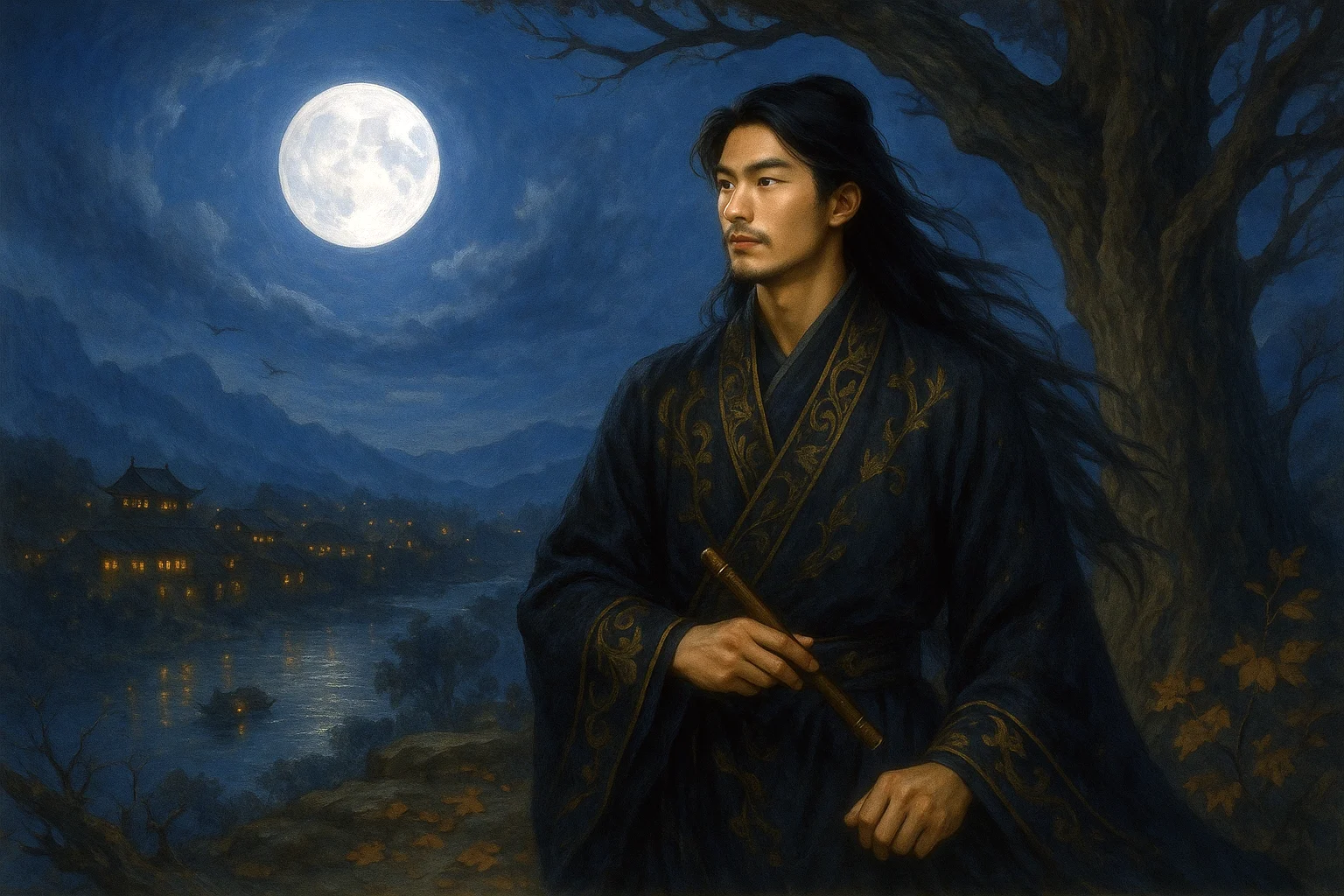
Li He (李贺 790 - 816), a native of Yiyang, Henan, was a Romantic poet of the Mid-Tang dynasty. A descendant of the Tang imperial clan, he was barred from taking the national jinshi civil service examination due to a naming taboo (his father's name contained a character homophonous with "Jin"), which led to a life of frustration and poverty. He died at the age of twenty-seven. His poetry, renowned for its bizarre grandeur, chilling elegance, and fantastical imagination, earned him the title "Ghost of Poetry." He pioneered the distinctive "Changji Style" within Tang poetry, exerting a profound influence on later poets like Li Shangyin and Wen Tingyun and on the expansion of poetic imagery in subsequent eras.