


There once was a man, sent on military missions,
A wanderer, from youth, on the Yu and Yen frontiers.
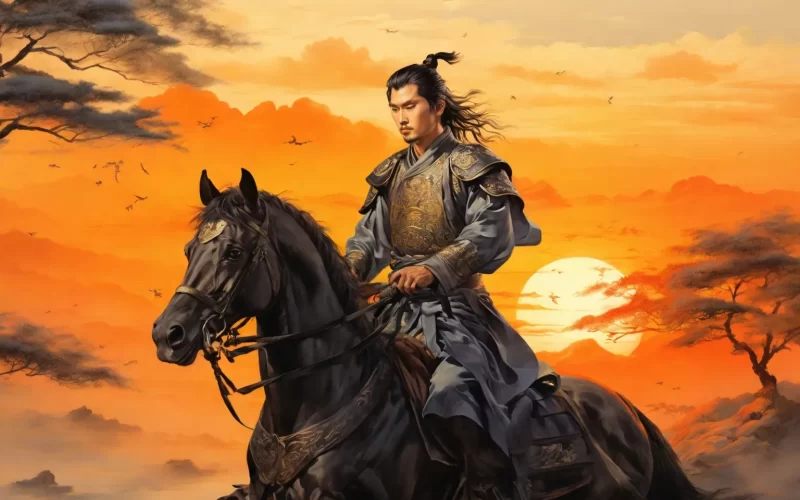
Under the horses' hoofs he would meet his foes
And, recklessly risking his seven-foot body,
Would slay whoever dared confront
Those moustaches that bristled like porcupine-quills.

...There were dark clouds below the hills, there were white clouds above them,
But before a man has served full time, how can he go back?

In eastern Liao a girl was waiting, a girl of fifteen years,
Deft with a guitar, expert in dance and song.

...She seems to be fluting, even now, a reed-song of home,
Filling every soldier's eyes with homesick tears.
Original Poem
「古意」
李颀
男儿事长征,少小幽燕客。
赌胜马蹄下,由来轻七尺。
杀人莫敢前,须如猬毛磔。
黄云陇底白云飞,未得报恩不能归。
辽东小妇年十五,惯弹琵琶解歌舞。
今为羌笛出塞声,使我三军泪如雨。
Interpretation
The region of Youyan (幽燕) was a crucial frontier commandery in the Tang Dynasty, encompassing the areas of Youzhou and Yanzhou, roughly corresponding to northern Hebei and western Liaoning today. Bordered to the north by nomadic tribes like the Khitan (契丹) and the Xi (奚), it served as the frontline between the Tang empire and northern powers, witnessing frequent warfare and fostering a locally martial culture. During the Kaiyuan and Tianbao eras, the court's continual military campaigns against the Khitan and the Turks (突厥) created a massive demand for troops. Proximity to the frontier made Youyan a key conscription zone. Many boys, as young as fifteen or sixteen, were drafted, thereafter stationed at distant garrisons for life, with little hope of return. A local saying, "Generals of Youyan grow old in the army from youth," speaks to this common fate.
Li Qi spent most of his life among the common people. Having passed the jinshi examination only around the age of fifty, he lived in seclusion in Yingyang (颍阳) prior, maintaining close contact with ordinary folk. This afforded him understanding of the soldiers returning from the frontier, the elderly awaiting sons, the women who would never see husbands again. The conscripts in his verse are not names from history books, but people he personally heard and saw.
This poem depicts precisely such a youth from Youyan. He left home "in tender youth" (少小) to "prove his valor 'neath the horses' hooves" (赌胜马蹄下) at the frontier; in battle, his beard would bristle "like a hedgehog's spines" (须如猬毛磔). Yet, on a certain night, hearing the qiang flute, his tears would fall like rain. Writing this, Li Qi celebrates no glorious deeds, nor paints grand frontier landscapes. He simply places a real soldier before us—his fierceness is real, his homesickness equally so.
First Couplet: "男儿事长征,少小幽燕客。"
Nán ér shì cháng zhēng, shào xiǎo yōu yān kè.
A proper man should serve on distant campaigns; a youth, a sojourner from Youyan's lands.
The opening establishes a tone of masculine resolve with the words "proper man" (男儿). "Serve on distant campaigns" (事长征) implies a sense of duty and active choice—not compulsion, but what a true man ought to do. "Youyan" (幽燕) denotes the ancient, martially-oriented frontier. Stating he was already "a sojourner from Youyan's lands" in his "tender youth" highlights both his early conscription and his immersion in that martial culture from childhood.
Second Couplet: "赌胜马蹄下,由来轻七尺。"
Dǔ shèng mǎ tí xià, yóu lái qīng qī chǐ.
To wager life beneath the horses' hooves, he's always held his seven-foot frame as light.
"Wager life" (赌胜) turns the battlefield's life-and-death struggle into a game. This captures the recklessness of youth—not ignorance of death, but disregard for it. "He's always held" (由来) indicates this attitude is habitual, not impulsive. "Held his seven-foot frame as light" (轻七尺) epitomizes the young warrior's daring and fearlessness.
Third Couplet: "杀人莫敢前,须如猬毛磔。"
Shā rén mò gǎn qián, xū rú wèi máo zhé.
In slaughter, none dares stand before his face; his beard spikes out like hedgehog quills, spread wide.
This couplet depicts the soldier's ferocity with extreme hyperbole. "None dares stand before his face" describes, from the enemy's perspective, the awe his aura inspires. "His beard spikes out like hedgehog quills" is a vivid close-up—his beard bristling in fury. This striking simile masterfully conveys the warrior's savage, untamed valor.
Fourth Couplet: "黄云陇底白云飞,未得报恩不能归。"
Huáng yún lǒng dǐ bái yún fēi, wèi dé bào ēn bù néng guī.
'Neath Long's ridges, yellow clouds; white clouds fly free. He cannot yet go home—his debt's unpaid.
The focus shifts from outward ferocity to inner resolve. "Yellow clouds" below Long's ridges depict the vast, oppressive frontier; "white clouds fly free" above contrast a world of freedom. This juxtaposition heightens the soldier's sense of entrapment. "He cannot yet go home—his debt's unpaid" reveals the force sustaining him: repayment of a debt. This "debt" (恩) refers to obligation to sovereign and state, the soldier's most fundamental spiritual mainstay of that era.
Fifth Couplet: "辽东小妇年十五,惯弹琵琶解歌舞。"
Liáo dōng xiǎo fù nián shí wǔ, guàn tán pí pá jiě gē wǔ.
A young Liaodong wife, just fifteen years, skilled with the lute, she knows all songs and dance.
The scene shifts abruptly from battlefield to camp, from soldier to songstress. The "young Liaodong wife" seems an abrupt intrusion, but she sets the stage for the emotional turn. "Skilled with the lute, she knows all songs and dance" sketches her youth and talent. In the harsh frontier, her presence is a spot of color, yet one most apt to stir longing for home.
Sixth Couplet: "今为羌笛出塞声,使我三军泪如雨。"
Jīn wéi qiāng dí chū sài shēng, shǐ wǒ sān jūn lèi rú yǔ.
But now she plays the qiang-flute's frontier song, and all we three-army men weep raining tears.
This couplet forms the poem's emotional climax. She abandons the lute for the qiang-flute, a nomadic instrument whose mournful tone perfectly suits the "frontier song." Its sound awakens the homesickness buried in their hearts. The warriors who "held life light" and whom "none dare face" now "weep raining tears." This turn, unexpected yet inevitable, gains its power from the prior portrayal of their fierceness, making their tears profoundly moving.
Holistic Appreciation
This poem is a masterpiece among Li Qi's frontier works. Its twelve lines divide evenly: the first six portray valor, the last six pathos; the first six individual heroism, the last six collective sorrow. This structural pivot creates potent drama.
The first four lines, through elaboration, depict the young warrior's fearless courage. "Wager life beneath the horses' hooves," "held his seven-foot frame as light," "beard spikes out like hedgehog quills"—these lines build successively, establishing a fierce, tiger-like image. The fifth line, " 'Neath Long's ridges, yellow clouds; white clouds fly free," introduces scenery, expanding space and building momentum. The sixth, "He cannot yet go home—his debt's unpaid," clarifies his reason for enduring, forming the crucial link.
The final four lines introduce the "young Liaodong wife." Through her, the qiang-flute's melody emerges, culminating in "all we three-army men weep raining tears." This turn is powerful because it strikes humanity's softest core—even those who scorn death on the battlefield harbor hidden longing for home. The flute is merely the trigger; the true cause of tears is the long-suppressed, placeless homesickness.
Artistic Merits
- Union of Strength and Tenderness, Forceful Pivot: The first six lines portray extreme fierceness; the last four pivot sharply to tears. The stark contrast creates a complex character and deepens the emotional layers.
- Vivid Imagery, Striking Simile: "His beard spikes out like hedgehog quills" uses the hedgehog's spines to describe the warrior's beard—both vivid and startlingly original, a hallmark of Li Qi's style.
- Using the Small to Reveal the Large: Through the single figure of the "young Liaodong wife" and the tune of a qiang-flute, the collective response of the "three-army men" is evoked—a masterful technique of suggesting the whole through a part.
- Concise Language, Full of Feeling: The poem's language is plain, unadorned, yet each word carries emotion. The final five characters possess immense weight.
- Tight Structure, Layered Progression: Moving from individual to group, from valor to sorrow, from the explicit to the implicit, the poem advances layer by layer into an organic whole.
Insights
This poem, through the sound of a qiang-flute, reveals the deepest vulnerability within the brave. First, it shows human complexity. The warriors who "held life light" on the battlefield are not heartless. They, too, possess tenderness; they, too, can weep at a familiar tune. This complexity is human truth. It reminds us not to simplify people; even the strongest have moments of fragility, the bravest heart its soft places.
Second, the line "未得报恩不能归" expresses the unique spiritual sustenance of soldiers of that age. They were not born war machines but took to the field with duty and purpose. This sense of duty sustained them but also caused pain. It prompts reflection: duty and emotion are not opposing ends but together constitute a whole person.
On a deeper level, the poem reveals art's power to move. How could a Liaodong wife's qiang-flute song make an entire army weep? Because music strikes directly at the heart, awakening repressed feeling. In war, in bitter cold, between life and death, it is precisely such moments of art that remind one of being human, that a home still waits afar.
About the Poet
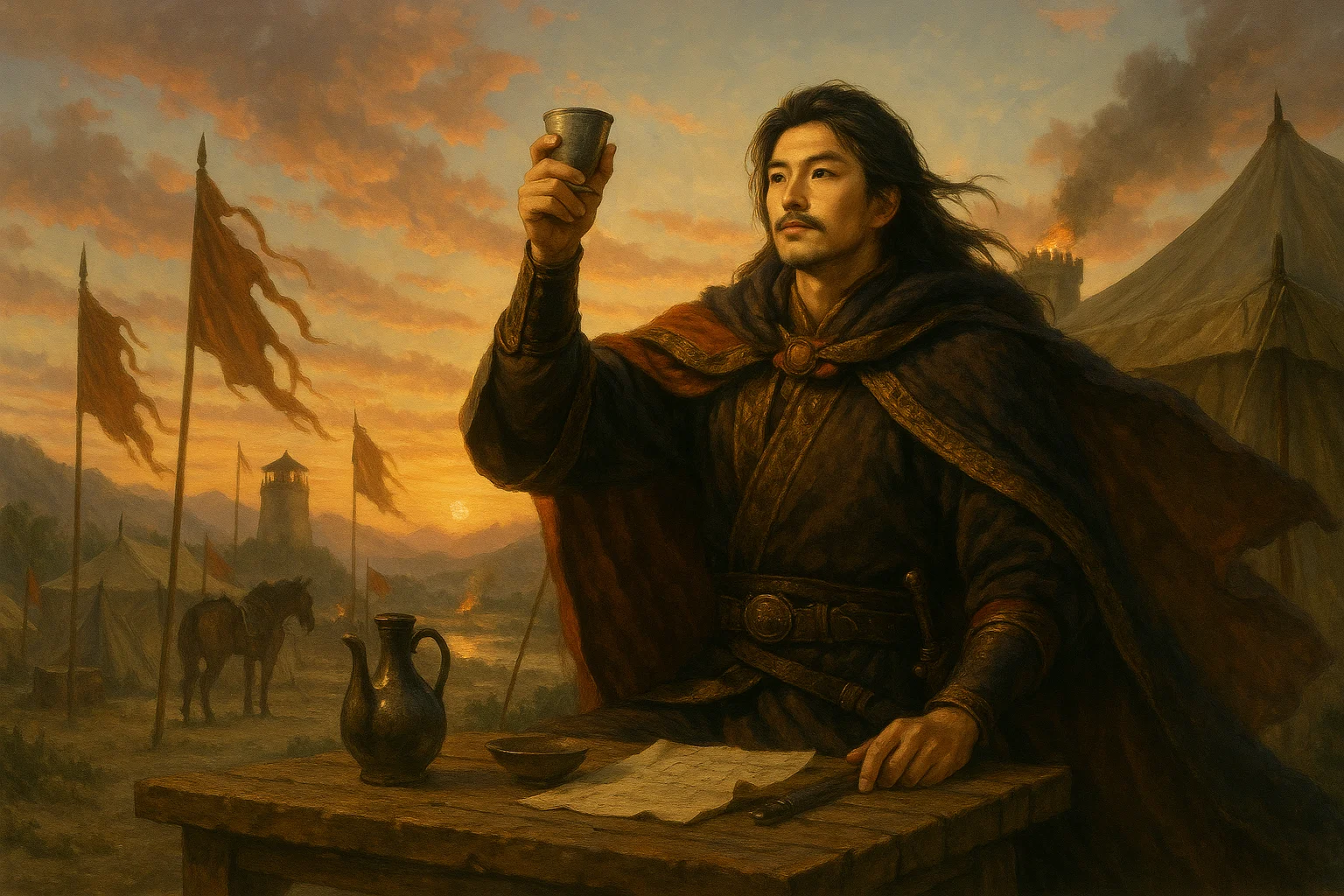
Li Qi (李颀 c. 690 – c. 751), whose ancestral home was in Zhao County, Hebei Province, was a renowned frontier fortress poet of the High Tang period. He became a jinshi (presented scholar) in the 23rd year of the Kaiyuan era (735 AD) and served as the Sheriff of Xinxiang before retiring from official life to live in seclusion. His poetry is best known for its frontier themes, and he excelled particularly in seven-character ancient verse and character portrayal. He had a gift for blending boldness with delicate emotion, and together with Gao Shi and Cen Shen, he collectively shaped the grandeur of High Tang frontier poetry.