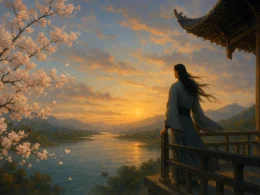
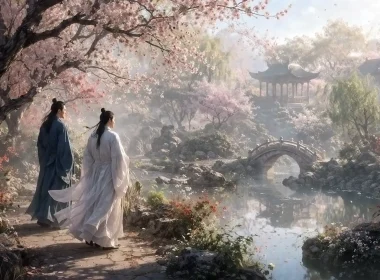

Now that the palace-gate has softly closed on its £lowers,
Ladies file out to their pavilion of jade,
Abrim to the lips with imperial gossip
But not daring to breathe it with a parrot among them.
Original Poem
「宫词」
寂寂花时闭院门,美人相并立琼轩。
含情欲说宫中事,鹦鹉前头不敢言。
Interpretation
This poem is a famous piece of palace resentment poetry by the Mid-Tang poet Zhu Qingyu. Zhu Qingyu's poetry is known for its elegance and grace, and he excels particularly in depicting female psychology with delicate brushstrokes, standing out uniquely among palace-style poetry of the Mid and Late Tang. The Tang palace system was strict, with thousands of imperial consorts and palace women. Only a rare few could gain the emperor's favor; the vast majority of women could only waste their youth and end their lives in loneliness within this gilded cage. This poem writes precisely about such a group of palace women marginalized by history. Spring blossoms should be a joyous occasion for admiration, yet the courtyard gate is "silently" closed. Beautiful women standing together could confide in each other, yet with a parrot present, they "dare not speak." The closed gate symbolizes their imprisonment; the presence of the parrot is a metaphor for their surveillance. The silence of wanting to speak yet holding back is heavier than any outcry; the fear of not daring to speak is deeper than any suffering.
In classical poetry, many write of palace women, some describing autumn nights with "dewdrops on marble steps," others the desolation of "lovebirds in the golden palace locked." Zhu Qingyu's poem, however, is uniquely conceived. It begins with the contrast between "When flowers bloom" and "the courtyard gate is closed," uses "Two beauties stand side by side" to write of shared suffering, and concludes with "Before the parrot they dare not speak out their pain." The parrot, originally a palace pet, becomes an ever-present pair of eyes and ears. The three words "不敢言" (dare not speak) exhaustively describe the palace women's precarious state of existence—it is not that they have nothing to say, but that they dare not speak; it is not that they have no feelings to express, but that they cannot voice their bitterness. The entire poem, in twenty characters, writes of the feudal palace's suppression of human nature and deprivation of freedom with subtlety and profound sorrow, a model of "conveying much with little" in Late Tang palace poetry.
First Couplet: "寂寂花时闭院门,美人相并立琼轩。"
Jì jì huā shí bì yuàn mén, měirén xiāng bìng lì qióng xuān.
When flowers bloom, the courtyard gate is closed at dead of night; Two beauties stand side by side on marble steps in vain.
The poem opens by creating a stark contrast with the juxtaposition of "寂寂" (silently/at dead of night) and "花时" (when flowers bloom). "寂寂花时" (When flowers bloom... at dead of night) writes of the pleasant spring scenery, all things full of life; "闭院门" (the courtyard gate is closed) writes of the palace gate deeply locked, isolating the outside world. This word "闭" (closed) is the closing of the gate, and also a symbol of the palace women's fate—spring belongs outside the palace; they can only grow old within this gilded cage. The next line, "美人相并立琼轩" (Two beauties stand side by side on marble steps in vain), describes two beauties standing side by side, elegant in posture, yet without joy. The two words "相并" (stand side by side) signify mutual reliance and also mutual reflection—they share similar fates, share unspoken bitterness. Within the couplet, the poet uses extremely concise strokes to write the seclusion of the deep palace and the loneliness of the palace women with penetrating depth.
Second Couplet: "含情欲说宫中事,鹦鹉前头不敢言。"
Hán qíng yù shuō gōng zhōng shì, yīngwǔ qiántou bù gǎn yán.
With yearning heart they want to talk about affairs in the palace; Before the parrot they dare not speak out their pain.
This couplet is the soul of the entire poem, pushing the oppressive atmosphere to its peak. "含情欲说宫中事" (With yearning heart they want to talk about affairs in the palace) writes that their hearts have accumulated too many grievances, too much helplessness; they long to confide, to release. The two words "欲说" (want to talk) signify surging emotion and also the torment of unfulfilled desire. The next line, "鹦鹉前头不敢言" (Before the parrot they dare not speak out their pain), concludes the whole piece in one stroke. The three words "不敢言" (dare not speak) are the "pivotal phrase" of the entire poem—it is not that they have nothing to say, but that they dare not speak; it is not that they have no feelings to express, but that they cannot voice their bitterness. The parrot, originally a palace pet, becomes an ever-present pair of eyes and ears because it can mimic speech. It is not the parrot they fear, but the omnipresent surveillance behind the parrot. This line, in an extremely plain tone, writes of an extremely deep-seated fear—a fear not of facing swords, but of having to watch one's words even in speech, of having to look around even when confiding.
Holistic Appreciation
This is a divine work among Zhu Qingyu's palace resentment poetry. The entire poem consists of four lines and twenty characters. Using the contrasts between spring flowers and a closed gate, beauties and a parrot, it writes of the secluded resentment and fear of women in the deep palace with subtlety and profound sorrow.
Structurally, the poem presents a progression from external to internal, from scene to feeling. The first couplet uses "When flowers bloom, the courtyard gate is closed" to write of the oppressive environment, and "Two beauties stand side by side on marble steps" to introduce the characters. The second couplet uses "want to talk" to write of the surging within the heart, and "dare not speak" to write of fear's suppression. Between the four lines, it moves from scene to person, from external to internal, progressing layer by layer, forming a seamless whole.
Thematically, the core of this poem lies in the three words "不敢言" (dare not speak). That "dare not speak" is the direct manifestation of the palace women's fear of the palace, and also the feudal system's suppression of human nature. It is not that they have nothing to say, but that they dare not speak; it is not that they have no feelings to express, but that they cannot voice their bitterness. This silence of "wanting to speak yet holding back" is heavier than any accusation; this fear of "daring not speak" is deeper than any suffering.
Artistically, the poem's most moving aspect lies in the subtle technique of "using objects to write of people, using scenes to write of feeling." The poet does not directly write of the palace women's pain, nor directly of the palace's cruelty. He only uses "the courtyard gate is closed" to write of their imprisonment, and "Before the parrot they dare not speak" to write of their fear. The parrot, originally a pet, becomes a symbol of fear; the "dare not speak," originally silence, becomes the loudest accusation. This technique of using objects to represent emotion, using silence to write accusation, is precisely the highest realm of Chinese classical poetry: "without a single explicit word, achieving perfect grace and resonance."
Artistic Merits
- Using Scene to Write Feeling, Vivid Contrast: Creating contrast between "When flowers bloom" and "the courtyard gate is closed." The more beautiful the spring, the colder the palace gate appears; the more abundant the blossoms, the lonelier the human heart seems.
- Using Objects to Write People, Profound Meaning: Using the parrot to write of surveillance, using "dare not speak" to write of fear, transforming intangible suppression into tangible objects, subtle and profound.
- Elegant Language, Deep Emotion: The entire poem does not directly mention resentment in a single word, yet every line is imbued with feeling, using the most restrained brush to write the most profound sorrow.
- Seeing the Large Through the Small, Understanding the Profound Through the Subtle: Using two palace women, a parrot, and a courtyard gate, refracting the cruelty and oppression of the entire palace system.
Insights
This poem, through a single parrot, speaks to an eternal theme—The deepest pain often does not come from the inability to express, but from the loss of even the freedom to express.
First, it lets us see "the weight of silence." Those palace women who "dare not speak" do not lack things to say, but cannot speak; they are not without grievances, but have nowhere to voice them. This silence is more heartbreaking than loud wailing—for loud wailing, at least, has the freedom to cry. It reminds us: True oppression is not depriving the right to speak, but making you learn fear before you even open your mouth.
On a deeper level, this poem makes us contemplate "the shape of fear." The parrot, originally a pet, becomes the embodiment of fear; the "dare not speak," originally silence, becomes the loudest accusation. It makes us understand: Fear often does not come from swords, but from ever-present eyes; not from violence, but from the daily reality of having to look around even when speaking.
And what is most moving is the poem's restraint of "wanting to speak yet holding back." The palace women "want to talk," yet ultimately "dare not speak." This restraint is not unwillingness to speak, but inability; not lack of courage, but fear engraved into the bones. True sorrow is not the inability to cry, but not daring to cry; true despair is not having nothing to say, but having something to say yet daring not to say it.**
This poem is set in the Mid-Tang deep palace, yet it allows everyone living in the shadow of power to find resonance within it. The desolation of "When flowers bloom, the courtyard gate is closed" is the world in the eyes of every prisoner. The loneliness of "Two beauties stand side by side on marble steps" is the posture of mutual reliance among all who share the same suffering. The desire of "want to talk" is the voice in the heart of every oppressed person. The fear of "Before the parrot they dare not speak" is the shared fate of everyone who dares not speak. This is the vitality of poetry: it writes of the secluded resentment of palace women, but one reads of people in all eras who have something to say yet dare not.
Poem translator
Kiang Kanghu
About the Poet
Zhu Qingyu (朱庆馀 dates of birth and death unknown), also known by his given name Kejiu, was a poet of the Mid-Tang period, a native of Yuezhou (present-day Shaoxing, Zhejiang Province). He passed the jinshi examination in the second year of the Baoli era (826 AD) and held the position of Collator in the Imperial Library. His poetry excelled in the five-character regulated verse style, characterized by a refined and subtle elegance, with particular skill in depicting the emotions of boudoir women and palace maidens. In the Complete Tang Poems, two volumes containing 177 of his works are preserved. He was adept at using allegorical and metaphorical techniques, blending everyday emotions with political aspirations. Although not many of his poems survive, his exquisite craftsmanship secures him a unique place in the history of Tang poetry, with his poem Boudoir Sentiments becoming a quintessential example of the fusion of examination-themed and boudoir poetry in later generations.