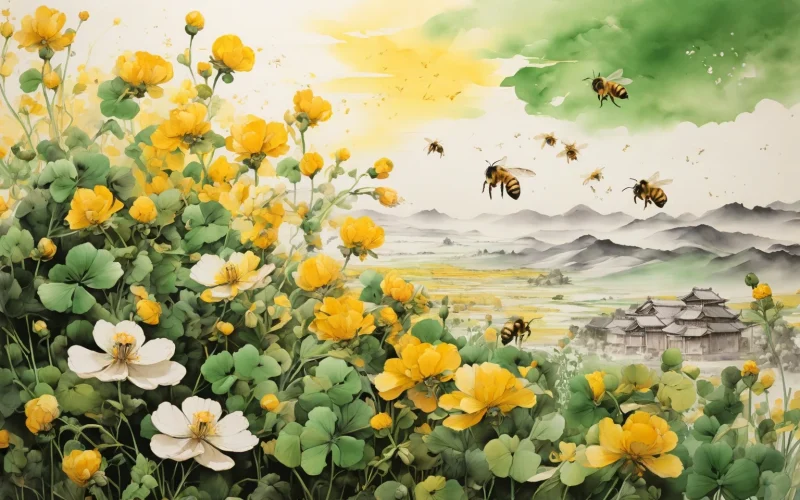
On the plain or atop the hill,
Of beauty you enjoy your fill.
You gather honey from flowers sweet.
For whom are you busy and fleet?
Original Poem
「蜂」
罗隐
不论平地与山尖,无限风光尽被占。
采得百花成蜜后,为谁辛苦为谁甜?
Interpretation
This poem is a late Tang work by Luo Yin, using an object to express his sentiments, likely composed around the thirteenth year of the Dazhong era of Emperor Xuanzong of Tang (859 CE). At that time, Luo Yin had just arrived in Chang'an to sit for the imperial examinations, filled with ambitions to aid the world. Yet, he repeatedly failed, remaining trapped within the examination system for over a decade. The phrase "ten attempts without success" almost perfectly describes the trajectory of the first half of his life. Born in the late Tang Dynasty, a period of national decline and political corruption marked by eunuch dominance, separatist warlords, and a decadent nobility, Luo Yin witnessed the common people toiling all year without achieving basic sustenance. This social reality of "the laborers not reaping the fruit, while the harvesters reap without labor" deeply pained the heart of this repeatedly unsuccessful scholar.
Renowned for his literary talent, Luo Yin was repeatedly marginalized due to his humble origins and lack of skill in flattery. He observed those in power, like bees, "take for granted all the blooming light," seizing the world's wealth, while the common people, who truly labored like bees, could only wonder, "for whom do you toil, for whom the honey sweet?" This poem superficially describes bees, but in essence describes people; ostensibly chants of an object, but in truth satirizes the world. Using the imagery of bees gathering nectar to make honey, the poet voices a deep sigh for his own unrecognized talent and, more importantly, poses a sharp, cold question to the corrupt late Tang society. The rhetorical query, "for whom do you toil, for whom the honey sweet?" transcends a millennium, its resonance still striking today.
First Couplet: "不论平地与山尖,无限风光尽被占。"
Búlùn píngdì yǔ shān jiān, wúxiàn fēngguāng jìn bèi zhàn.
On the plains or on the mountain steep,
You take for granted all the blooming light.
The poem opens, sketching a scene of "occupation" from the bee's perspective. The structure "不论……与……" (whether... or...) emphasizes the vast scope—from plains to mountain peaks, no place is beyond reach. "无限风光" (all the blooming light) highlights the abundance seized—spring scenery, floral beauty, all fragrant blossoms, taken in entirely. The three words "尽被占" (you take for granted) firmly establish this "occupation" as fact. On the surface, this seems to praise the bee's diligence and ubiquity—they traverse every hill, gather from every flower, seemingly monopolizing the world's beauty. However, this very word "占" (take/occupy) is the poem's first sharp thorn: the world's beauty should belong to all; by what right is it "taken for granted"? Using the bee as a metaphor, the poet subtly points to those powerful nobles who, by virtue of their authority and status, seize the world's wealth and beauty, claiming it for themselves. This couplet appears descriptive but actually plants the seed for the subsequent质问 (zhìwèn, questioning), exemplifying the classic technique of "praising first to criticize later."
Final Couplet: "采得百花成蜜后,为谁辛苦为谁甜?"
Cǎi dé bǎi huā chéng mì hòu, wèi shuí xīnkǔ wèi shuí tián?
Gathering from hundreds of flowers, honey you make;
For whom do you toil, for whom the honey sweet?
This couplet is the soul of the poem and a line celebrated through the ages. "采得百花成蜜" (gathering from hundreds of flowers, honey you make) emphasizes the hardship of the bee's labor—not from a single flower or stamen, but gathering from countless blossoms to produce honey. "为谁辛苦为谁甜" (for whom do you toil, for whom the honey sweet?) poses a rhetorical question, directly confronting the sentiment accumulated in the preceding lines. This question is asked with pain, with sharpness, leaving one speechless. The bee knows not for whom, just as the common people know not for whom—they toil all year, plowing in spring, tending in summer, harvesting in autumn, storing in winter, only to have their fruits stripped, encroached upon, plundered in the end. The two words "为谁" (for whom) are both an inquiry and an accusation; both a sigh and a cry. The poet does not directly speak of injustice, yet injustice is inherent; he does not directly denounce the powerful, yet they are implicitly condemned. This question is like a dagger, a spear, thrusting straight at the heart of late Tang's corrupt society.
Holistic Appreciation
This is a seminal work among Luo Yin's object-chanting poetry. The entire poem consists of four lines and twenty-eight characters. Using the bee as a starting point, it merges the laborer's toil with the fate of being deprived, revealing the poet's incisive insight and profound grief over the injustice of late Tang society.
Structurally, the poem presents a progressive layering from surface to core, first elevating then deconstructing. The first couplet vividly describes the bee's act of "taking for granted all the blooming light," seemingly in praise, but actually serving as foreshadowing. The final couplet turns abruptly to questioning, concluding with the line "for whom do you toil, for whom the honey sweet?" instantly shattering the "blooming light" of the first two lines into desolation. Between the two couplets, the tone shifts from praise to satire, from surface to essence, from object to people, creating a powerful contrast that is deeply moving.
Thematically, the core of this poem lies in the word "问" (ask/question). The poet does not directly accuse or comment; he simply asks a question that echoes through the centuries. Within this "question" lies deep sympathy for the laborer, cold satire for the powerful, painful self-reflection on his own plight, and silent protest against worldly injustice. This "question" has no answer, nor does it need one—for the answer is already written in the toil of "gathering from hundreds of flowers, honey you make," in the sigh of "for whom do you toil," and in the silent gaze of the deprived.
Artistically, the poem's most compelling feature is the double reflection of "using an object to symbolize people" and "seeing the large through the small." Writing of the bee, the poet's every stroke is about the bee, yet every stroke is about people; writing of gathering honey, every line is about the object, yet every line is about the social condition. The bee's toil is the people's toil; the bee's deprivation is the people's deprivation. This technique of writing of people through objects, perceiving the significant through the trivial, represents the highest achievement of the classical Chinese poetic tradition of "using objects to express intent." The poem's language is plain as speech, yet each word carries immense weight; it is brief and concise, yet its meaning is boundless, truly a masterpiece among object-chanting poetry.
Artistic Merits
- Object as Allegory, The Large Seen in the Small: Using the bee to represent the common people, honey-gathering to represent labor, and "for whom" to represent injustice. Within a single object and action lies profound insight into the destiny of an era.
- Elevation Precedes Critique, Stark Contrast: The first couplet emphatically describes "taking for granted all the blooming light"; the final couplet turns abruptly to questioning. Juxtaposed, praise transforms into satire, admiration turns into lament.
- Rhetorical Question as Conclusion, Lingering Resonance: "For whom do you toil, for whom the honey sweet?" concludes with a question. It answers without answering, speaks without speaking, allowing the reader to ponder and comprehend independently.
- Simple Language, Profound Meaning: The entire poem uses no allusions, no obscure words, yet every word is poignant, every line cuts to the bone. Reading it is like drinking strong liquor; the potency is felt in the aftertaste.
Insights
Using the tiny bee as a metaphor, this poem speaks to an eternal theme: Into whose hands do the fruits of the laborer's toil ultimately fall?
It first allows us to see the "silent laborer." That bee "gathering from hundreds of flowers, honey you make"—is it not the millions of farmers, artisans, and weaving women? They toil all day, creating wealth, yet often remain disconnected from that wealth. This phenomenon of "the laborers not reaping the fruit" is the oldest sorrow of human society and the most profound theme for poets of every generation.
On a deeper level, this poem prompts us to contemplate the meaning of "fairness." With the question "for whom do you toil, for whom the honey sweet?" Luo Yin pierces through all high-sounding falsehoods. This question, transcending a thousand years, remains applicable today: those who sweat on assembly lines, those who labor under sun and rain in the fields, those who give silently in city corners—for whom does their toil ultimately become sweet? This is a question all laborers should ask, and one all those in power should ask themselves.
Most moving is the poem's sense of "speaking for the common people." Luo Yin himself repeatedly failed the exams, frustrated in his official aspirations; he could have written solely of personal grievances and discontent. But he did not stop there; he turned his gaze to the broader populace, giving voice to the silent majority. This mindset of connecting personal fate with the people's fate embodies the precious tradition of Chinese scholars: "to be the first to bear the world's hardships, and the last to enjoy its comforts."
This poem writes of a late Tang bee, yet it allows laborers of every era to see their own reflection. That relentless pursuit implied in "on the plains or on the mountain steep" is the daily reality of every breadwinner; that poignant questioning of "for whom do you toil, for whom the honey sweet?" is the sigh in the heart of every deprived person. This is the vitality of poetry: it writes of a tiny bee, but it speaks to and for all those silent yet resilient hearts across the ages.
Poem translator
Xu Yuanchong (许渊冲)
About the poet
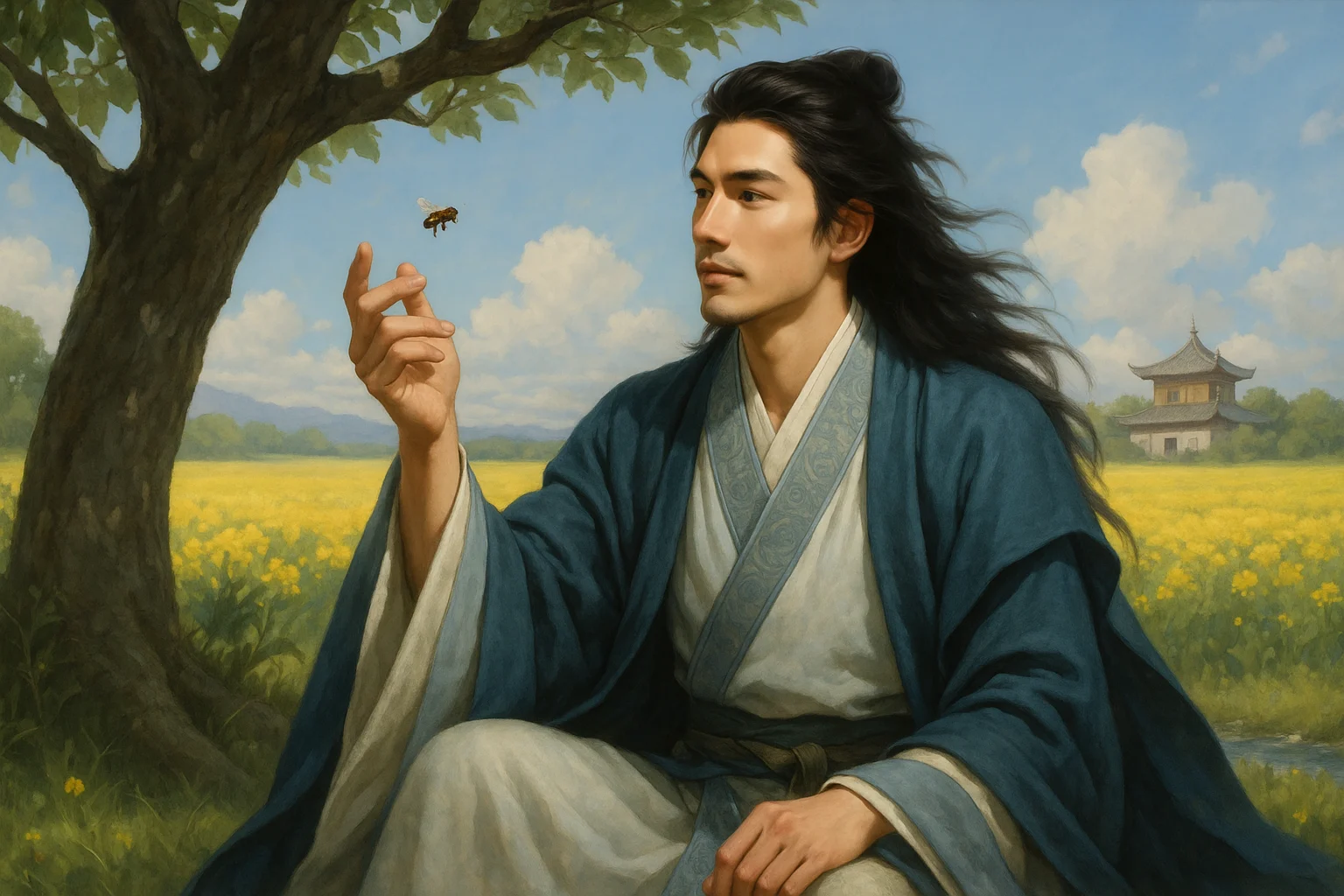
Luo Yin (罗隐 833 - 910), a native of Fuyang, Hangzhou, Zhejiang Province, was a renowned writer and thinker of the late Tang Dynasty. As a key literary figure of the late Tang period, Luo Yin was unparalleled in his time for his satirical poetry and prose. His poems often directly targeted social darkness, employing sharp and accessible language that cut straight to the heart of late Tang political corruption. With nearly 500 surviving poems, he was known alongside Du Xunhe and Luo Ye as one of the "Three Luos" in the late Tang poetic circle, standing out as a unique and powerful voice amidst the ornate and decadent trends of the era.