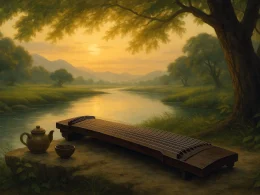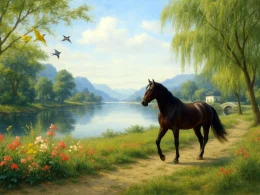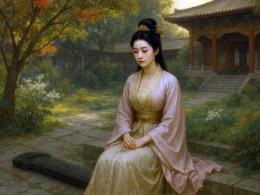



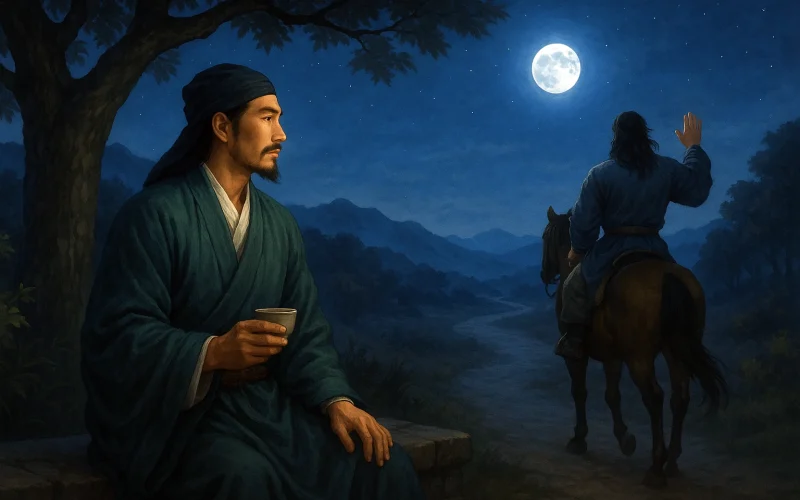
This is where your comrade must leave you,
Turning at the foot of these purple mountains...
When shall we lift our cups again, I wonder,
As we did last night and walk in the moon?
The region is murmuring farewell
To one who was honoured through three reigns;
And back I go now to my river-village,
Into the final solitude.
Original Poem
「奉济驿重送严公四韵」
杜甫
远送从此别,青山空复情。
几时杯重把,昨夜月同行。
列郡讴歌惜,三朝出入荣。
将村独归处,寂寞养残生。
Interpretation
This poem was written in the seventh month of 762 AD, as Du Fu bid farewell to his close friend Yan Wu at Fengji Station in Mianzhou. Yan Wu’s recall to the capital held particular significance for Du Fu, who, during his difficult years living in a thatched cottage in Chengdu, had relied on Yan Wu not only for poetic fellowship but also for material support and deep spiritual kinship. This parting signified, on a public level, the departure of a capable official from the Shu region; personally, it meant the journey of a cherished friend; and for the poet himself, it marked the loss of his most vital protector and companion. This work masterfully distills these layers of parting sorrow and personal grief into just four rhymed couplets. Its language is restrained, yet its emotion is profoundly mournful, making it one of the most deeply heartfelt farewell poems in Du Fu's body of work.
First Couplet: 远送从此别,青山空复情。
Yuǎn sòng cóng cǐ bié, qīng shān kōng fù qíng.
Having seen you off this far, now we must part; / The green hills, as before, just hold my vain heart.
The opening line appears direct, yet each word is heavy with meaning. "Having seen you off this far" reveals the depth of his attachment, while "now we must part" carries both a foreboding that this separation may be final and a sense of resigned acceptance. "The green hills, as before, just hold my vain heart" is a skillful instance of emotion projected onto the landscape: though inherently indifferent, the hills seem to contain the poet's boundless affection. The word "vain" describes not only the hills' passive presence but, more poignantly, the poet's own futile longing, aware of the depth of their bond yet powerless to keep his friend. Here, the permanence of nature is contrasted with human transience.
Second Couplet: 几时杯重把,昨夜月同行。
Jǐ shí bēi chóng bǎ, zuó yè yuè tóng xíng.
When will we ever raise our cups together again? / Yet just last night we walked beneath the same moon.
This couplet employs a poignant temporal shift, juxtaposing present uncertainty with recent intimacy to intensify the ache of separation. "When will we ever…" is an anxious question about a nebulous future, filled with troubled doubt. "Yet just last night…" is a sharp, vivid memory of shared joy, as clear as if it were happening now. Between this doubtful query and this cherished recollection lies a profound sense of life's impermanence and the elusive nature of reunion. The language is simple, almost conversational, yet its sincerity and this intertwining of time create a powerful emotional resonance.
Third Couplet: 列郡讴歌惜,三朝出入荣。
Liè jùn ōu gē xī, sān cháo chū rù róng.
The districts all sing, lamenting your departure; / In service to three reigns, you entered and left court with honor.
The focus turns from private sentiment to public acknowledgment of Yan Wu's merits. "The districts all sing, lamenting your departure" speaks to his effective governance and the people's genuine affection. "In service to three reigns… with honor" summarizes the distinction and steadiness of his political career across the courts of three emperors. This is the poet's sincere tribute to his friend's talent, virtue, and service, yet it also implies a deeper concern: the loss of such a worthy minister is a misfortune not only for the poet personally but for the region and the state itself. Praise here is interwoven with regret and apprehension.
Fourth Couplet: 江村独归处,寂寞养残生。
Jiāng cūn dú guī chù, jì mò yǎng cán shēng.
Alone, I turn back toward my riverside village; / In silence and solitude, to sustain my remaining days.
The poem concludes with a stark and poignant self-portrait that brings the feeling of loss to its climax. "Alone, I turn back…" echoes the opening "Having seen you off…", completing the narrative circle from escorting to returning. The words "alone," "silence and solitude," and "remaining days" deepen like gathering shadows, fully conveying the loneliness, vulnerability, and desolation that await the poet in his later years. This is more than the immediate emptiness following a farewell; it is a clear-eyed recognition of his own living conditions and spiritual state after losing Yan Wu's support, a realization that is profoundly moving.
Holistic Appreciation
This poem is a classic example of "conveying profound feeling through unadorned language." Centered on the act of farewell, its emotional arc is both clear and deeply affecting: the first couplet states the parting, with the scene embodying the mood; the second recalls the past through a shift in time; the third praises the friend, blending public and private; the fourth laments the self, leaving a lasting sorrow. Across these four couplets, the emotion moves from parting melancholy, to anxiety about the future, to admiration for the friend's achievements, and finally settles into a lament for the poet's own fate. This completes an emotional journey outward to the other and back inward to the self.
Its power lies in how seamlessly the poet weaves together genuine friendship, latent concern for the state of the world, and grief over his personal destiny. The poem contains no extravagant phrases or direct lamentations. Yet, in the space between the warm memory of "just last night we walked beneath the same moon" and the cold reality of "In silence and solitude, to sustain my remaining days," it creates a vast emotional chasm. Through this contrast, the restrained yet profound desolation of an old man bidding farewell to his sole pillar of support in a turbulent age pierces the page and strikes directly at the reader's heart.
Artistic Merits
- Unadorned Language, Heartfelt Emotion
The entire poem speaks with the simplicity of direct speech, avoiding allusion or ornate craft. Yet phrases like "vain heart," "When will we ever…," and "Alone, I turn back" carry immense weight because they spring from deep feeling, achieving that artistic ideal where "all ornament falls away to reveal pure sincerity." - Temporal Juxtaposition and Blended Perspectives
The contrast between "When will we ever…" (future doubt) and "just last night…" (past intimacy), and the parallel between "The districts all sing" (public view) and "my riverside village" (private sphere), expand the poem's sense of time and social space within a concise form, enriching its emotional texture. - A Resonant, Weighty Conclusion
The final couplet employs the three progressively deepening motifs of "alone," "silence and solitude," and "remaining days" to depict the extremity of the poet's late-life loneliness. Like the deep, lingering final note of a song, it fixes the poem's sorrow with a power that resonates long after reading. - Precise Structure with Echoing Motifs
The poem moves from "Having seen you off" to "Alone, I turn back," forming a complete narrative and emotional circle. The implied "feeling" in the green hills and the explicit "solitude" of the river village create a subtle thematic resonance between the beginning and end, resulting in a tightly coherent structure.
Insights
This work demonstrates how the most profound human emotions can flow beneath a surface of plain speech. Du Fu's farewell is more than a poet's sadness at a friend's departure; it is a solitary soul's final farewell to warmth and sustenance in an unstable world. It transcends ordinary parting grief to touch upon fundamental human conditions—dependence, separation, and solitude.
The poem offers this insight: True friendship is a light that illuminates our difficult times, and its passing makes the ensuing darkness seem all the deeper. Yet, even while foreseeing the bleak prospect of nurturing his "remaining days" in solitude, the poet chooses to record the moment with utter sincerity and to feel it deeply. This reminds us to cherish those encounters that provide us with support and understanding, while also cultivating the fortitude to face our own "riverside village"—whatever form that may take—when such support is gone. With his profoundly authentic poetic spirit, Du Fu shows us that even in destined solitude, the affection once shared and the path once walked together under the moon remain precious treasures with which to confront life's long stretches of silence.
Poem translator
Kiang Kanghu
About the poet
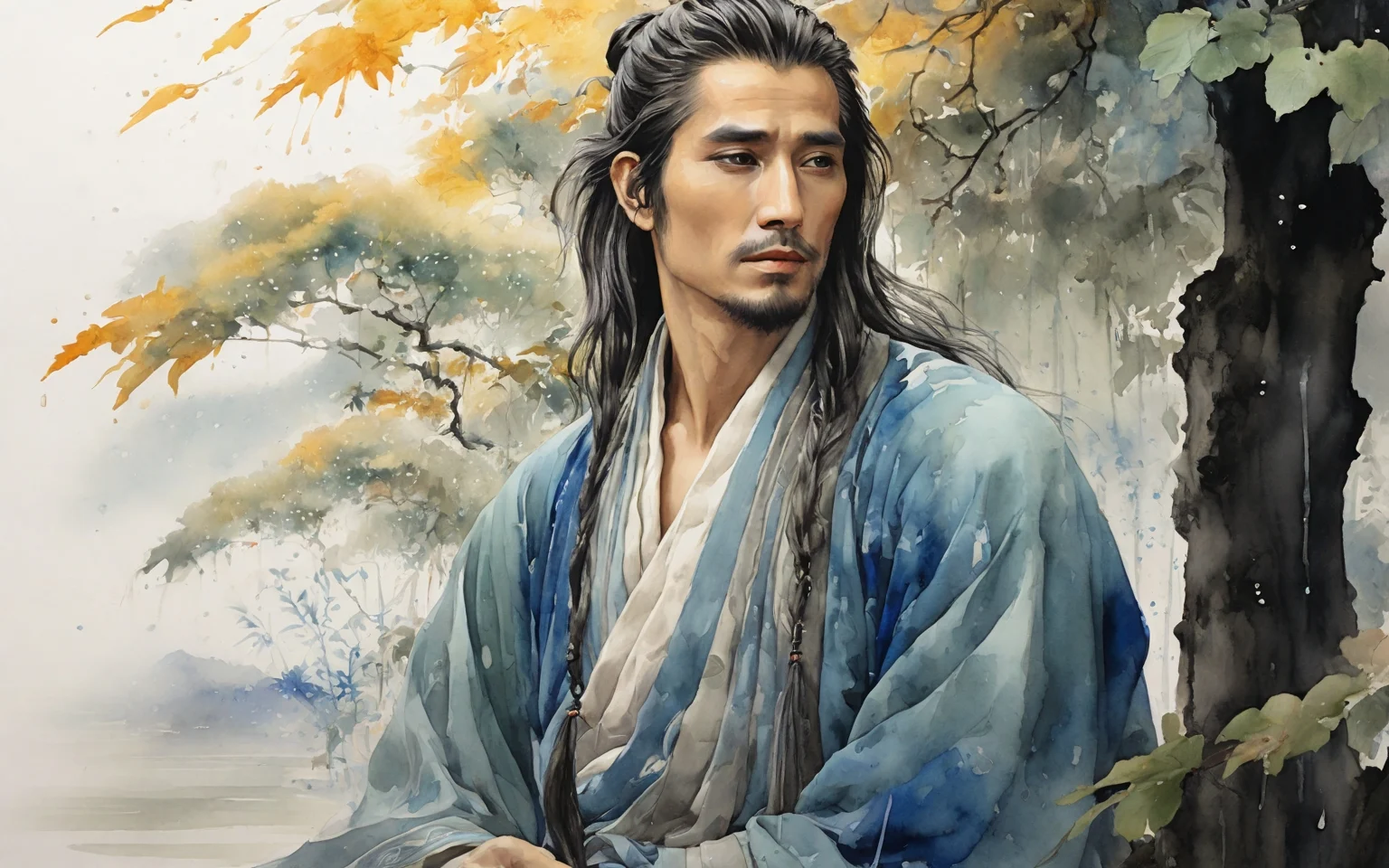
Du Fu (杜甫), 712 - 770 AD, was a great poet of the Tang Dynasty, known as the "Sage of Poetry". Born into a declining bureaucratic family, Du Fu had a rough life, and his turbulent and dislocated life made him keenly aware of the plight of the masses. Therefore, his poems were always closely related to the current affairs, reflecting the social life of that era in a more comprehensive way, with profound thoughts and a broad realm. In his poetic art, he was able to combine many styles, forming a unique style of "profound and thick", and becoming a great realist poet in the history of China.