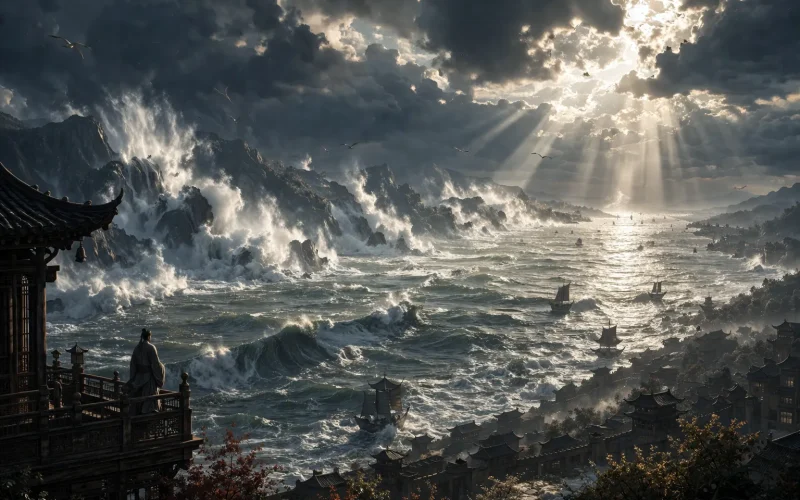

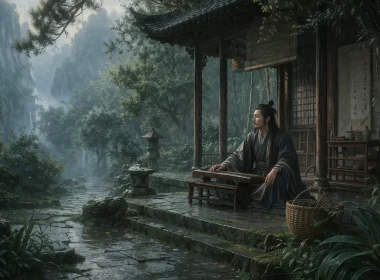
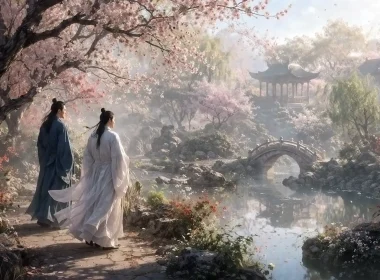


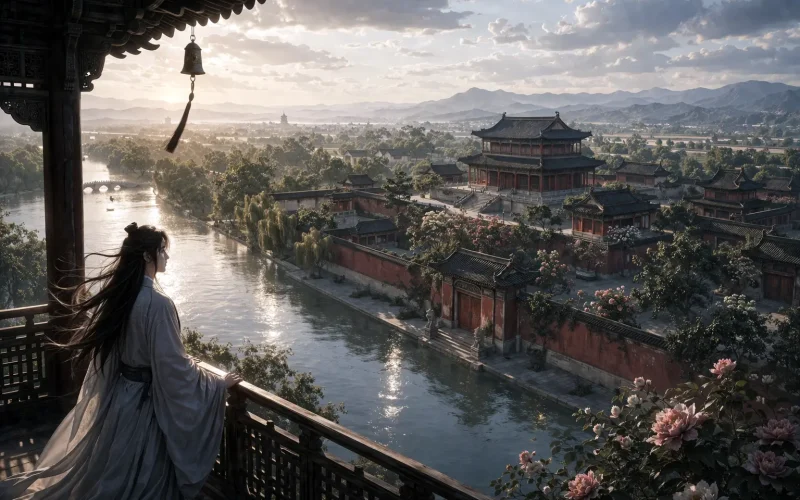
A day so clear, the wild fields’ hue
Invites the eye from this high room;
And tree‑shades, distant, bathe in cool
The moat where royal waters gloom.

The great ones’ dwellings, proud and old,
Now tenantless in silence keep;
And only see — a sight to hold —
Peonies, within red gates asleep.
Original Poem
「登玄都阁」
朱庆馀
野色晴宜上阁看,树阴遥映御沟寒。
豪家旧宅无人住,空见朱门锁牡丹。
Interpretation
This poem is a renowned allegorical work by the Mid-Tang poet Zhu Qingyu. Zhu Qingyu's poetry is known for its elegance and grace, and he excels particularly in depicting female psychology with delicate brushstrokes. However, his allegorical poems also form a distinctive style of their own, revealing a sharp edge within their plain surface. This poem was composed as Zhu Qingyu ascended the Mystic Tower in Chang'an. Located in the capital, the Mystic Tower was a famous scenic spot for climbing in the Tang dynasty, also a place for feasting and excursions for the powerful and aristocratic. During the Mid to Late Tang, social customs grew increasingly extravagant. Nobles and the powerful relied on their status to indulge in extreme pleasures, while the common people suffered hardship, and court governance gradually declined. The poet ascended to take in the view, originally to enjoy the scenery, but upon seeing the cold waters of the Royal Stream, the old mansions of the wealthy, and the peonies locked behind vermilion gates, he was moved by the scene and wrote this poem. The clear weather of "The fine-weather view of fields invites me to the tower high," the chill of "The shadow of the tree’s reflected on Royal Stream cold," the emptiness of "The lordly mansion’s left with no man living inside," and the desolation of "I see but red doors shut on peonies" progress layer by layer, writing of the impermanence of the powerful's rise and fall, and the vanity of wealth and glory, with subtlety and sharpness.
In classical poetry, many writings about climbing high express nostalgic thoughts, and many writings about prosperity lament the change between flourishing and decline. Zhu Qingyu's poem, however, is uniquely conceived. It begins with "The fine-weather view of fields invites me to the tower high," turns with "Royal Stream cold," uses "left with no man living" to write of decline, and concludes with "red doors shut on peonies." The five words "朱门锁牡丹" (red doors shut on peonies) are the pivotal brushstroke of the entire poem—peonies are the flower of wealth, vermilion gates are the mansions of the powerful; the gates are locked, the flowers unseen, where is the wealth? This word "锁"(locked/shut) is both a lock on the gate and a lock on the heart; it is both the desolation of reality and the poet's stark revelation of the impermanence of the powerful's fortunes. The entire poem does not contain a single word of direct satire, yet every line implies a sharp edge. It is a model of "using scene to convey feeling, using objects to imply meaning" in Mid-Tang allegorical poetry.
First Couplet: "野色晴宜上阁看,树阴遥映御沟寒。"
Yě sè qíng yí shàng gé kàn, shù yīn yáo yìng yù gōu hán.
The fine-weather view of fields invites me to the tower high; The shadow of the tree’s reflected on Royal Stream cold.
The poem opens with "The fine-weather view of fields invites me to the tower high," seemingly writing of the leisure of climbing high to enjoy the scenery. "野色晴宜上阁看" (The fine-weather view of fields invites me to the tower high) — the word "宜" (invites) writes of the harmony between weather and mood, and also subtly contains the deeper meaning of ascending to gain a broader perspective, intending to observe the world. The next line, "树阴遥映御沟寒" (The shadow of the tree’s reflected on Royal Stream cold), turns the brush, shifting from clear to cold. "御沟" (Royal Stream) was originally a river within the palace grounds, symbolizing imperial power and wealth. The word "寒" (cold) writes of the water's chill, and also implies the poet's detached observation of this place of power. This word "寒" is the first foreshadowing in the entire poem—it is not describing the scene, but describing the heart; not describing the water, but describing the world.
Second Couplet: "豪家旧宅无人住,空见朱门锁牡丹。"
Háojiā jiù zhái wú rén zhù, kōng jiàn zhū mén suǒ mǔdan.
The lordly mansion’s left with no man living inside; I see but red doors shut on peonies, left outside.
This couplet is the soul of the entire poem, shifting from scene to feeling, directly writing of the fickleness of the world. "豪家旧宅无人住" (The lordly mansion’s left with no man living inside) uses "旧宅" (old mansion) to write of past glory, and "无人住" (left with no man living) to write of present desolation. The poet does not directly speak of decline, only using these three words "无人住" to instantly transform the former splendor into emptiness. The next line, "空见朱门锁牡丹" (I see but red doors shut on peonies), concludes the whole piece in one stroke. "朱门" (red doors) is a symbol of the powerful; "牡丹" (peonies) is a symbol of wealth; "锁" (locked/shut) is the closed gate, and also a closed heart; "空见" (I see but) is what the poet sees, and also what the world sees. The vermilion gates are tightly locked, the peonies bloom alone; the wealth remains, but no one can enjoy it. This word "锁" is the "pivotal phrase" of the entire poem—it is both the desolation of reality and the poet's stark revelation of the impermanence of the powerful's fortunes: wealth will ultimately turn to emptiness, splendor will ultimately fade. Behind those vermilion gates lies nothing but a courtyard of peonies that no one appreciates.
Holistic Appreciation
This is a divine work among Zhu Qingyu's allegorical poems. The entire poem consists of four lines and twenty-eight characters. Using the act of climbing high to enjoy the view as a thread, it juxtaposes the clear fields and the cold stream, the old mansion and the empty gate, the vermilion gate and the peonies. Through layered contrasts, it writes of the impermanence of the powerful's rise and fall and the vanity of wealth and glory.
Structurally, the poem presents a progression from scene to feeling, from external to internal. The first couplet begins with "The fine-weather view of fields invites me," writing of the leisure of climbing high to enjoy the scenery, and turns with "Royal Stream cold," subtly containing a detached perspective. The second couplet concludes with "The lordly mansion" and "red doors shut on peonies," transforming the earlier detachment into a stark revelation. Between the four lines, it moves from scene to feeling, from external to internal, progressing layer by layer, forming a seamless whole.
Thematically, the core of this poem lies in the word "锁" (locked). That "锁" in "red doors shut on peonies" is a lock on the gate, and also a lock on the heart; it is the desolation of reality, and also the poet's stark revelation of the impermanence of the powerful's fortunes. It tells us: Wealth is like the peony, gorgeous yet ultimately destined to fade; power is like the vermilion gate, noble yet ultimately destined to be closed. This word "锁" condenses the entire poem's satirical meaning into a single point—subtle yet sharp, with lasting resonance.
Artistically, the poem's most moving aspect lies in the subtle technique of "using scene to convey feeling, using objects to imply meaning." The poet does not directly write satire, only writes of "Royal Stream cold," "left with no man living," and "red doors shut on peonies"; he does not directly express emotion, only concludes with the two words "空见" (I see but). That word "寒" (cold) is the chill of the water, and also the chill of the heart; that word "空" (but/empty) is the emptiness seen by the eye, and also the emptiness of worldly affairs; that word "锁" (locked) is the lock on the gate, and also the lock on wealth. This technique of using scene to convey feeling and using objects to imply meaning is precisely the highest realm of Chinese classical poetry: "without a single explicit word, achieving perfect grace and resonance."
Artistic Merits
- Using Scene to Convey Feeling, Subtle and Profound: Using "Royal Stream cold" to write of the chill of power, "left with no man living" to write of the speed of decline, and "red doors shut on peonies" to write of the emptiness of wealth. The language of scene is the language of feeling; the images of objects are images of the heart.
- Vivid Contrast, Powerful Antithesis: Clear fields and cold stream, old mansion and empty gate, vermilion gate and peonies—layered contrasts make the impermanence of rise and fall ever more apparent.
- Precise Diction, Each Word Carries Weight: The word "宜" (invites) writes of the harmony of mood, "寒" (cold) writes of a detached view of the world, "锁" (locked) writes of the vanity of wealth—each word is plain, yet each word is startling.
- Satire Without Exposure, Cool Yet Profound: The entire poem does not contain a single word of direct satire, yet every line implies a sharp edge, using the most restrained brush to write the most profound critique.
Insights
This poem, through an act of climbing high, speaks to an eternal theme—Splendor fades easily, glory is hard to last; wealth is like a flower, ultimately destined to wither.
First, it lets us see "the impermanence of rise and fall." That "lordly mansion"—how splendid it once was, yet now it is "left with no man living"; those "peonies" behind the vermilion gate—once so wealthy, yet now they are "shut" within the courtyard, appreciated by none. It reminds us: The world's splendor is but a passing cloud; wealth and glory will ultimately return to dust.
On a deeper level, this poem makes us contemplate "the value of clarity." The poet ascends to take in a broad view; he sees the clear fields, and also the cold stream; he sees the old mansion, and also the empty gate; he sees the peonies, and also the lock. He is not deceived by appearances, not swayed by glory, always maintaining a clarity of detached observation. It makes us understand: True wisdom is not chasing splendor, but seeing the truth behind the splendor.
And what is most thought-provoking is the warmth behind the poem's "detached observation." The poet observes the world with a cool eye, yet his heart towards people is not cold. He writes of "Royal Stream cold," "left with no man living," and "red doors shut on peonies" not to mock, but to warn—to warn those chasing wealth, and also to warn those eras intoxicated with splendor. This posture of "cool eye, warm heart" is precisely the best embodiment of the Chinese literati's "spirit of allegory."
This poem is set in Mid-Tang Chang'an, yet it allows everyone who remains clear-headed amidst splendor, who maintains self-possession amidst a floating world, to find resonance within it. The climbing high for "The fine-weather view of fields" is the posture of every clear-sighted person. The detached view of "Royal Stream cold" is the gaze of every insightful person. The "old mansion" that is "left with no man living" is the ending of every story of rise and fall. The vermilion gate that "shut[s] on peonies" is the final footnote of every era of splendor. This is the vitality of poetry: it writes of Zhu Qingyu's climb, but one reads of people in all eras who maintain clarity amidst splendor and uphold self-possession amidst the floating world.
About the Poet
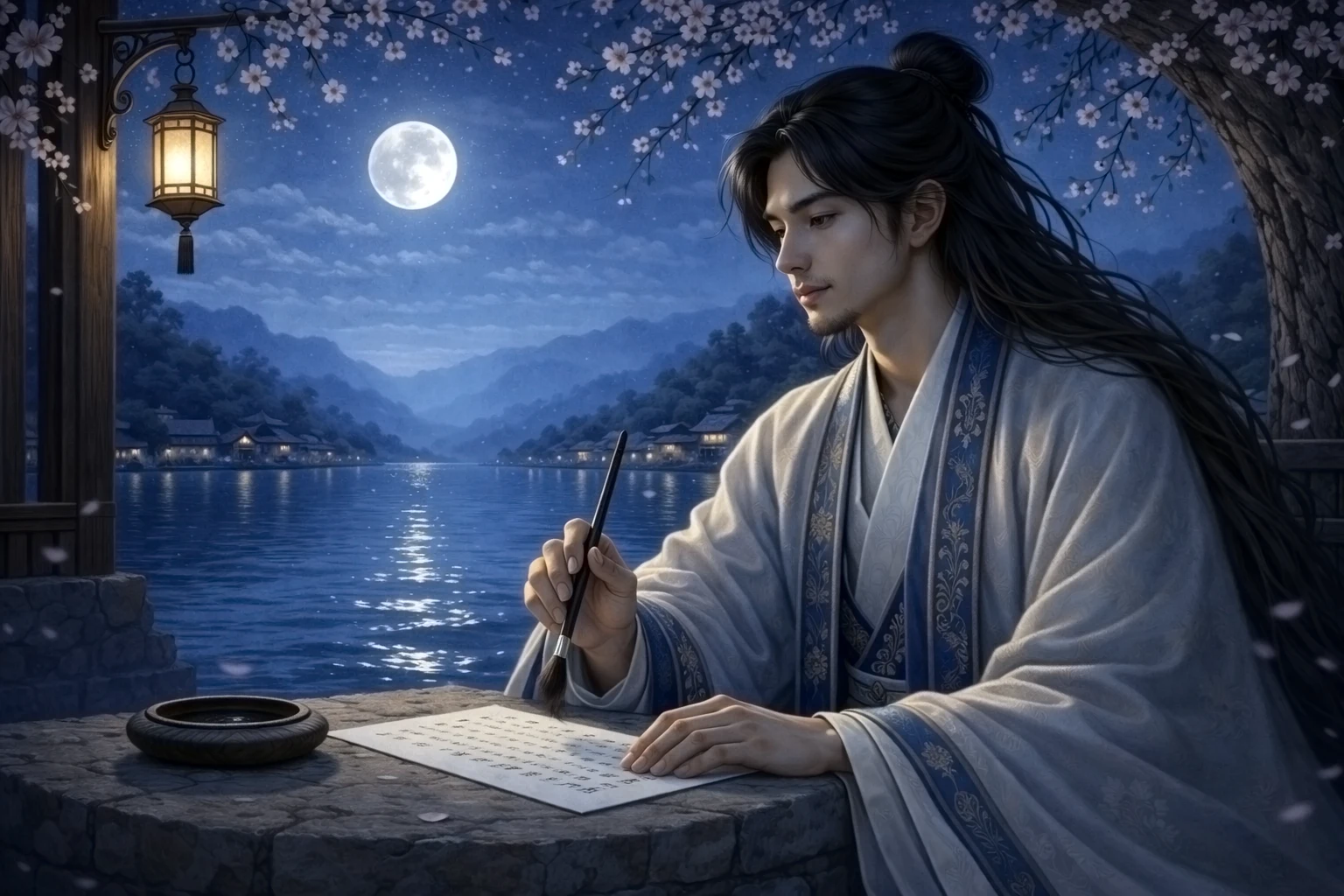
Zhu Qingyu (朱庆馀 dates of birth and death unknown), also known by his given name Kejiu, was a poet of the Mid-Tang period, a native of Yuezhou (present-day Shaoxing, Zhejiang Province). He passed the jinshi examination in the second year of the Baoli era (826 AD) and held the position of Collator in the Imperial Library. His poetry excelled in the five-character regulated verse style, characterized by a refined and subtle elegance, with particular skill in depicting the emotions of boudoir women and palace maidens. In the Complete Tang Poems, two volumes containing 177 of his works are preserved. He was adept at using allegorical and metaphorical techniques, blending everyday emotions with political aspirations. Although not many of his poems survive, his exquisite craftsmanship secures him a unique place in the history of Tang poetry, with his poem Boudoir Sentiments becoming a quintessential example of the fusion of examination-themed and boudoir poetry in later generations.