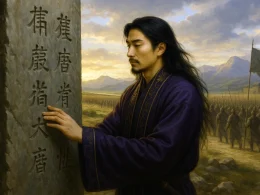



Gone are all my past woes! What more have I to say?
My body and my mind enjoy their fill today.
Successful, faster runs my horse in vernal breeze;
I've seen within one day all flowers on the trees.
Original Poem
「登科后」
孟郊
昔日龌龊不足夸,今朝放荡思无涯。
春风得意马蹄疾,一日看尽长安花。
Interpretation
This renowned poem by the Mid-Tang poet Meng Jiao was composed upon his passing the jinshi (presented scholar) examination, the highest and most prestigious level of the imperial civil service exams. Meng Jiao’s life was marked by poverty and repeated academic failure; it was not until the age of forty-six that his name finally appeared on the golden list of successful candidates. Having previously failed twice and endured protracted hardship in the capital Chang'an, he knew intimately the bitterness of wòchuò—a term describing both the squalor of material deprivation and the spiritual oppression of frustrated ambition. His sudden success swept away a lifetime's accumulated gloom; his mind expanded with newfound freedom, and his untrammeled joy spilled over into this celebrated poetic expression.
Meng Jiao is famed for his "bitter chanting" (kǔyín), a style often desolate and austere, which earned him the joint epithet with Jia Dao: "Meng’s chill, Jia’s gauntness" (Jiāo hán Dǎo shòu). This poem, however, is a striking and brilliant departure. Written with exhilarating fluency and radiant high spirits, it stands as the definitive poetic illustration of the adage, "Joyful events refresh the spirit." The buoyancy of "In vernal winds of triumph, swift my steed" and the audacious claim to see "All Chang’an’s flowers in one glance" represent the poet’s total, ecstatic release after half a lifetime of repression, giving voice to the shared sentiment of all who persevere through hardship to eventual triumph. The poem not only marks the pivotal turn in Meng Jiao’s personal fortune but has immortalized the phrases "spring winds of triumph" (chūnfēng déyì) and "gallop past flowers" (zŏu mă guān huā) in the Chinese language.
First Couplet: "昔日龌龊不足夸,今朝放荡思无涯。"
Xīrì wòchuò bùzú kuā, jīnzhāo fàngdàng sī wú yá.
Those squalid years are not worth praise today; Unchained, my thoughts now boundless range and stray.
The poem opens with a sharp, declarative contrast that immediately frames a life transformed. The two words "昔日龌龊" (xīrì wòchuò, those squalid years) encapsulate the indignity and struggle of his entire past—the shame of repeated failure, the strain of poverty and dependency. Their dismissal as "不足夸" (bùzú kuā, not worth praise) is a deliberate, almost cavalier act of willful forgetting. It is not that the suffering was absent, but that with bitterness now past, it is deemed utterly unworthy of recollection. The second line pivots dramatically to liberation. The word "放荡" (fàngdàng, Unchained) is masterfully reclaimed—here, it implies not dissolution, but a mind and spirit finally free of all shackles, unfettered. The phrase "思无涯" (sī wú yá, thoughts now boundless) expresses the limitless flight of his imagination and the infinite expansion of his joy. This couplet moves from decisive negation to boundless affirmation, compressing a lifetime’s reversal into fourteen characters and establishing the poem’s tone of unbridled exultation.
Final Couplet: "春风得意马蹄疾,一日看尽长安花。"
Chūnfēng déyì mǎtí jí, yī rì kàn jìn Cháng'ān huā.
In vernal winds of triumph, swift my steed— All Chang’an’s flowers in one glance I’ll read.
This couplet forms the poem’s radiant, iconic heart. The four words "春风得意" (chūnfēng déyì, vernal winds of triumph) perfectly fuse the external season with the internal state. The spring breeze is both the literal breath of the season and the metaphorical zephyr of his newfound fortune; the "triumph" or "satisfaction" (déyì) stems from both his academic success and the exhilarating release of decades of pent-up frustration. The three words "马蹄疾" (mǎtí jí, swift my steed) vividly capture his exhilarated posture—not a trot, but a swift, eager gallop, as if the horse’s speed itself is propelled by the rider’s overflowing heart. The concluding line delivers the poem’s most famous hyperbole. "一日看尽" (yī rì kàn jìn, in one glance I’ll read) presents an impossible, glorious ambition. The vast capital’s countless blossoms could never truly be seen in a day. Yet this very impossibility magnifies his ecstatic state—it feels as if the entire world has opened up, all its beauty awaiting his instantaneous, all-encompassing embrace. The verb "看尽" (to see completely) signifies both a visual feast and a spiritual consummation. This couplet transforms inner exhilaration into a kinetic, iconic scene, pushing the expression of joy to its imaginative peak.
Holistic Appreciation
This poem is a unique and refreshing masterpiece within Meng Jiao’s oeuvre. The entire quatrain, using the moment of examination success as its focal point, masterfully merges a wretched past with a jubilant present, channeling the euphoric release of a lifetime’s stifled ambition into twenty-eight perfectly balanced characters.
Structurally, the poem presents a flawless progression from negation to affirmation, and from internal feeling to externalized action. The first couplet contrasts "those squalid years" with being "unchained," establishing the transformative framework. The final couplet then expands this liberated state into a vivid, dynamic tableau of speed and sensory conquest. The movement is from recollection to sensation, from statement of being to spectacle of action, executed in a single, breathless arc.
Thematically, the poem’s core is the celebration of exhilarating speed and completeness. The horse’s "swift" pace mirrors the poet’s racing heart and liberated spirit; the desire to "see all... in one glance" reflects a desperate, joyful urge to reclaim lost time and consume all worldly beauty in a single, triumphant moment. This speed embodies a compensatory ecstasy for past suffering, a maximalist savoring of present victory, and a boundless optimism for the future. It captures the universal impulse, after long struggle, to compress all fulfillment into a glorious, instantaneous now.
Artistically, the poem’s genius lies in its externalization of abstract emotion through concrete, hyperbolic imagery. The poet never states "I am overjoyed." Instead, the spring wind carries his delight, the horse’s speed conveys his impatience, and the city’s flowers become the object of his conquering gaze. This technique of embodying inner feeling in outward action and spectacle represents a pinnacle of classical Chinese poetic expression.
Artistic Merits
- Potent Antithesis, Dramatic Turn: The stark juxtaposition of "squalid years" and "unchained" present condenses a life’s dramatic reversal into a forceful, uplifting momentum.
- Vivid, Fused Imagery: Scenes like the triumphant spring wind, the swift horse, and Chang’an’s blossoms transform internal elation into a tangible, iconic, and immersive tableau.
- Exuberant Rhythm, Unbridled Tone: The poem’s brisk, flowing cadence and declarative voice perfectly transmit the poet’s irrepressible, almost frantic high spirits.
- Expressive Hyperbole, Enduring Resonance: The exaggerated claim of seeing all blossoms in a glance, precisely through its glorious impossibility, pushes the expression of joy to its limit and creates a timeless, resonant image.
Insights
Through the lens of a single, personal triumph, the poem speaks to a timeless human truth: perseverance through hardship can lead to transformative release, and such moments of triumph deserve unfettered celebration.
It first reveals the psychological power of radical contrast. The poet’s present, boundless joy derives its intensity precisely from the depth of the "squalid years" it negates. It reminds us that the magnitude of liberation is often measured by the weight of the chains that were broken.
Furthermore, it presents a compelling archetype of authentic triumph. The poet’s response is not muted gratitude or humble deflection, but unrestrained, kinetic exuberance. This authenticity is moving because it is earned and real. The poem suggests that genuine, hard-won success needs no performative moderation; it can, and perhaps should, be celebrated with full-throated, embodied joy.
Most memorably, it captures the unique, expansive psychology of a long-deferred victory. The desire to compress experience—to see everything in one glance—is the exhilaration of release, an attempt to reclaim lost time, and a voracious embrace of life’s possibilities now suddenly unlocked. It is a reminder to savor such moments of culmination without reserve, for they are the rare, sweet harvest of prolonged perseverance, worthy of a lifetime’s remembrance.
While chronicling a specific Tang Dynasty examination success, the poem resonates with anyone who has endured and overcome. The "squalid years" are every striver’s past; the "vernal winds of triumph" are the longed-for breath of change; the desire to "see all in one glance" is the shared, expansive catharsis of every hard-won breakthrough. This is the power of poetry: it records one individual’s specific joy, yet gives timeless voice to the heart of all who finally witness their long-awaited spring.
Poem translator
Xu Yuanchong (许渊冲)
About the Poet
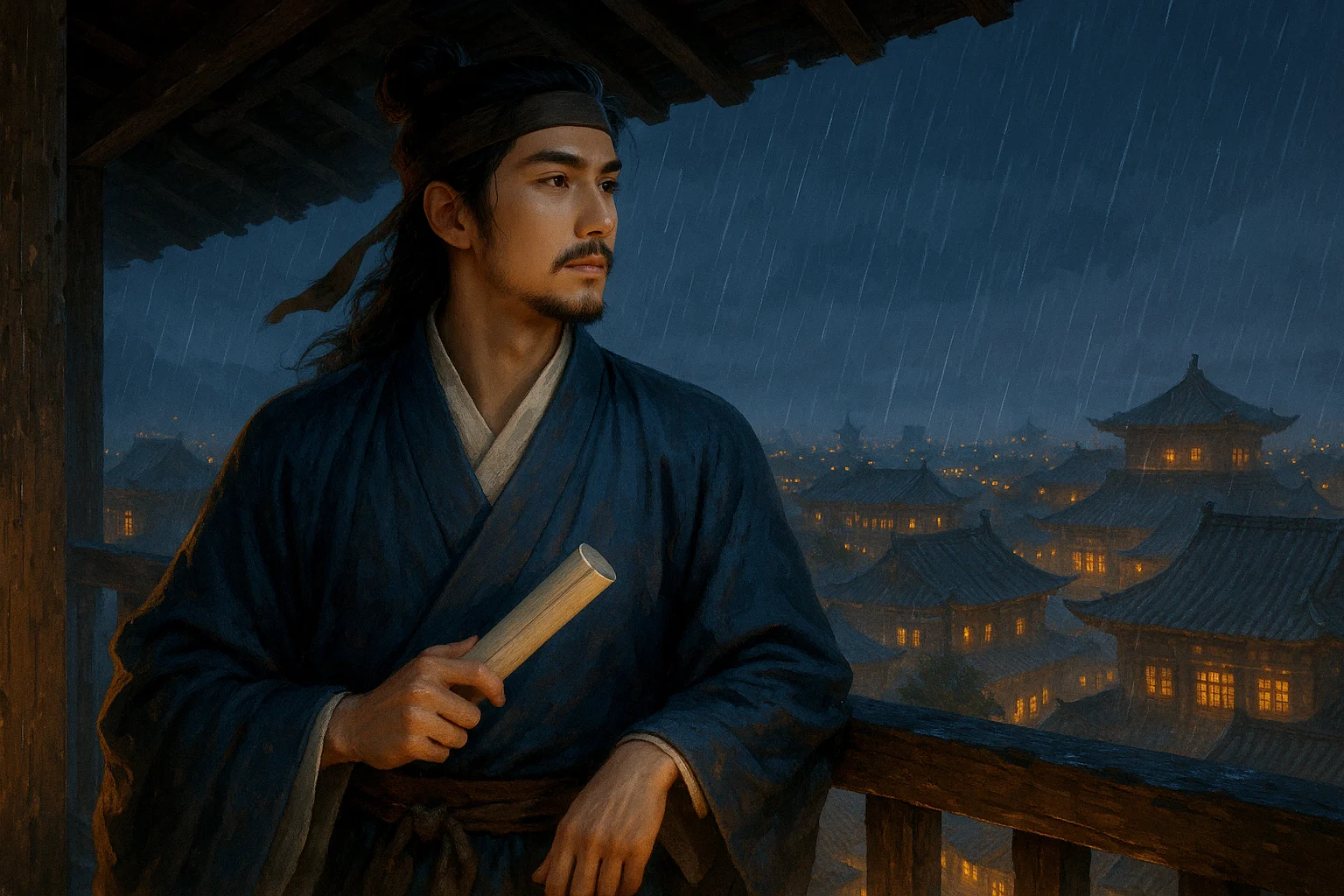
Meng Jiao (孟郊 751 - 814), a native of Deqing, Zhejiang Province, was a renowned poet of the Mid-Tang Dynasty. In his early years, he repeatedly failed the imperial examinations and only obtained the jinshi degree at the age of forty-six. He held minor posts such as Sheriff of Liyang, living a life of poverty and hardship. In his later years, he suffered the loss of his son and died while en route to a new official post. His poetry is renowned for its "bitter chanting" style, and he was often mentioned alongside Jia Dao, with Su Shi coining the famous phrase: "Jiao is lean, Jia is thin." His yuefu (Music Bureau) poems inherited the tradition of Du Fu and paved the way for Yuan Zhen and Bai Juyi, establishing a unique and distinctive place in the history of Tang poetry.