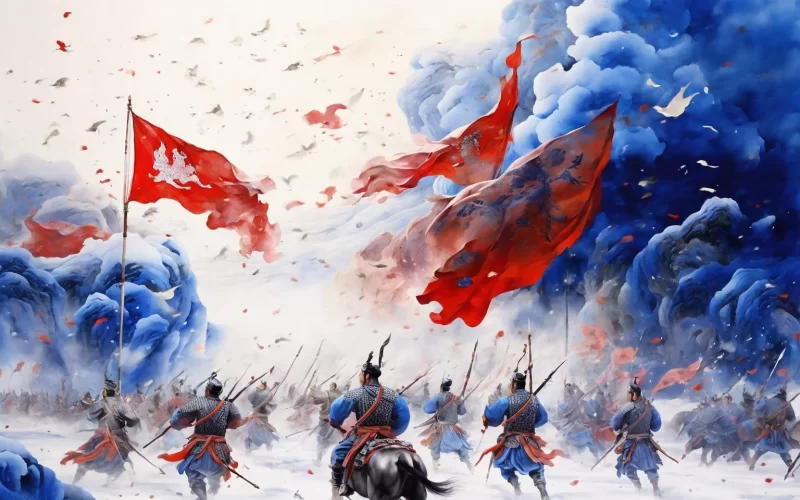



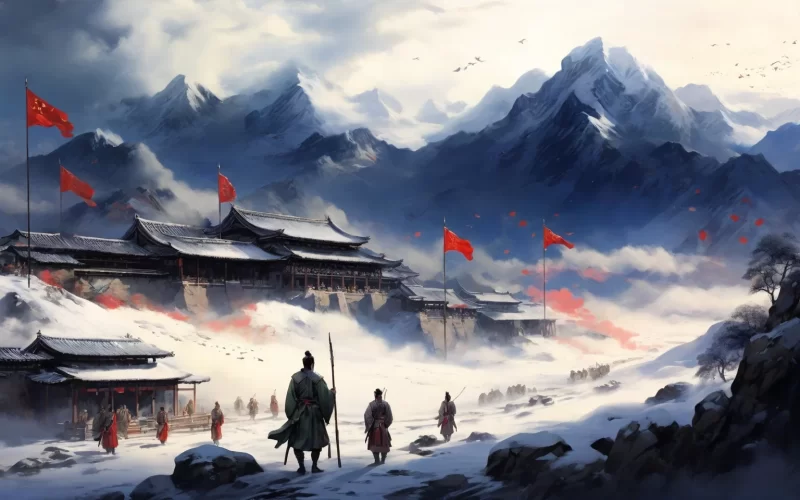
Clouds on frontier overshadow mountains clad in snow;
A lonely town afar faces Pass of Jade Gate.
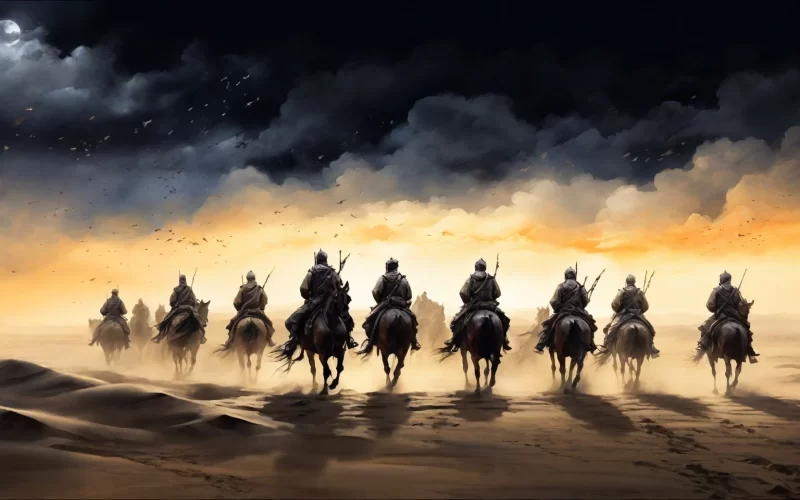
Our golden armor pierced by sand, we fight the foe;
We won't come back till we destroy the hostile State.
Original Poem
「从军行 · 其四」
王昌龄
青海长云暗雪山,孤城遥望玉门关。
黄沙百战穿金甲,不破楼兰终不还。
Interpretation
Wang Changling lived during the High Tang period, an era of the empire's greatest military strength and most illustrious frontier achievements. From Emperor Taizong to Emperor Xuanzong, the Tang dynasty engaged in a century-long struggle with neighboring peoples like the Tibetans and Turks along the northwestern frontier. The region stretching from Qinghai Lake to the Jade Gate Pass was precisely where fighting was most frequent. Wang Changling traveled extensively in the northwestern frontier regions in his youth, experiencing frontier life firsthand. The seven poems of the "Poems on Army Life" series are the fruit of his frontier experiences. This poem, the fourth in the series, expresses the soldiers' resolve to serve and defend the nation to the death, speaking in their voice. Place names like "Qinghai," "Snow Mountain," and "Jade Gate Pass" sketch the vastness and desolation of the northwestern frontier; images like "layer upon layer of dark clouds," "gold armor worn through," and "Loulan" encapsulate the hardships of garrison life and the brutality of battle.
It is worth noting that when Wang Changling wrote frontier poetry, he never shied away from the hardships of war, nor did he sensationalize its horrors. The soldiers in his poems, while acknowledging the hardships, still choose to hold fast, choose to fight. This conscious heroism is precisely the most moving quality of High Tang frontier poetry.
First Couplet: "青海长云暗雪山,孤城遥望玉门关。"
Qīnghǎi cháng yún àn xuěshān, gū chéng yáo wàng Yùmén Guān.
Layer upon layer of dark clouds o'er Lake Qinghai dim the snow-clad mountain;
The lonely town looks far away toward the Jade Gate Pass.
The opening uses grand geographical imagery to sketch the vastness and desolation of the northwestern frontier. "Lake Qinghai," in present-day Qinghai Province, was the frontline of contention between the Tang and Tibet; "Snow Mountain" refers to the Qilian Mountains, perpetually snow-capped; "Jade Gate Pass," west of present-day Dunhuang, Gansu, was the strategic fortress leading to the Western Regions. Three place names spanning thousands of li are compressed by the poet into a single picture, creating a sense of spatial compression and boundless desolation.
"Layer upon layer of dark clouds o'er Lake Qinghai dim the snow-clad mountain"—dense clouds darken the snowy peaks. This describes the scene, but also subtly suggests the tension of warfare, the gloom of the times. "The lonely town looks far away toward the Jade Gate Pass"—a solitary town gazes into the distance toward the Jade Gate Pass. The word "lonely" conveys the town's isolation and lack of support; the phrase "looks far away" conveys the soldiers' fixed gaze toward the interior, toward home. This couplet uses an expansive vista to express feelings of solitude; the vaster the realm, the deeper the solitude.
Second Couplet: "黄沙百战穿金甲,不破楼兰终不还。"
Huángshā bǎi zhàn chuān jīn jiǎ, bú pò Lóulán zhōng bù huán.
Our golden armor pierced through in desert warfare, we've fought a hundred fights;
We'll not go home until we beat the foe on Yumeng Mountain.
This couplet shifts from description to lyrical expression of resolve, the climax of the poem. "Our golden armor pierced through in desert warfare, we've fought a hundred fights"—these four words encapsulate all the hardships of frontier life: the swirling yellow sand is the harshness of the environment; "fought a hundred fights" is the frequency of battle. "Pierced through"—even the hard iron armor is worn through! The word "pierced" signifies both physical erosion and the attrition of life. It tells us these soldiers fought not for a day or two, but year after year, in this yellow sand, until their armor wore through, until their lives were spent.
Yet immediately following: "We'll not go home until we beat the foe on Yumeng Mountain"—"Loulan" was a kingdom in the Western Regions during the Han dynasty; here it metaphorically refers to the Tibetans. The soldiers declare: We will not return home until we defeat the enemy. This oath, firm and resolute, brims with heroic spirit. It lets us see that despite "desert warfare, we've fought a hundred fights," despite "golden armor pierced through," they remain unchanged in their resolve, still pledge to serve the nation unto death. This heroism, which acknowledges hardship yet still chooses to persevere, is more moving than any facile optimism.
Holistic Appreciation
The first two lines of this poem describe the scene, the last two express emotion; the structure is clear, the progression distinct. The first two lines, with grand geographical imagery, sketch the vastness and desolation of the northwestern frontier, providing the backdrop for the heroic oath in the last two lines. The last two lines, with concise language, proclaim the soldiers' resolve to serve unto death, giving the desolate vista of the first lines a spiritual destination.
The poem's language is condensed, its imagery vivid. "Lake Qinghai," "layer upon layer of dark clouds," "Snow Mountain," "lonely town," "Jade Gate Pass," "yellow sand," "golden armor," "Loulan"—eight images, each bearing the profound tradition of frontier poetry, together constitute a desolate yet majestic poetic realm. Particularly the line "Our golden armor pierced through in desert warfare, we've fought a hundred fights" uses a concrete detail (armor worn through) to express an abstract spirit (unyielding perseverance)—a stroke of genius.
Unlike works that sensationalize the horrors of war or glorify its violence, this poem neither avoids the hardships of war nor sensationalizes its brutality; instead, it focuses on the soldiers' perseverance amidst hardship, their oath amidst brutality. This conscious heroism is the most precious quality of High Tang frontier poetry.
Artistic Merits
- Spatial Compression, Expansive Realm: Placing the three distant place names—Lake Qinghai, Snow Mountain, Jade Gate Pass—within the same picture creates a sense of spatial compression and boundless desolation; the realm is expansive yet bleak.
- Using Scene to Convey Feeling, Fusing Scene and Emotion: The desolate vista of the first two lines provides the emotional backdrop for the heroic oath in the last two; scene and emotion are highly unified.
- Condensed Language, Vivid Imagery: The seven characters "Our golden armor pierced through in desert warfare, we've fought a hundred fights" encapsulate all the hardships of frontier life; the seven characters "We'll not go home until we beat the foe" express the soldiers' complete resolve.
- Precise Parallelism, Resonant Rhythm: Between the couplets, the first describes scene, the second expresses emotion; within each couplet, the parallelism is precise, the rhythm resonant and powerful, complementing the content perfectly.
Insights
This poem first illuminates for us what constitutes true heroism. Those soldiers who fought "a hundred fights" in the "yellow sand" were not unaware of the hardship, not unaware of the danger. They knew the armor would wear through, life would be spent, yet they still chose "We'll not go home until we beat the foe." This heroism is not blind optimism, not ignorant impulse, but choosing to persevere after clearly recognizing the cost. It tells us: True courage is not the absence of fear, but moving forward despite fear; true perseverance is not the absence of difficulty, but not giving up amidst difficulty.
The "looks far away" in "孤城遥望玉门关" also leads us to consider the supporting role of faith. That lonely town, isolated and unsupported, yet the soldiers still "look far away" toward the Jade Gate Pass, toward the direction of home. This "looking far away" is their reason for living, their motivation for fighting. It reveals: No matter how dire the situation, one must have a direction to "look far away" toward—a future worth anticipating, a belief worth holding onto. With this direction, the bitterest days can be endured; with this belief, the most difficult circumstances can be weathered.
The word "dim" in "青海长云暗雪山" also leads us to consider the choice of perspective in adversity. Those snowy mountains should be white, but under the cover of "layer upon layer of dark clouds," they are "dimmed." This is objective reality, and also a subjective perspective. The poet does not avoid this "dimness," but neither does he dwell in it. He follows with "Our golden armor pierced through in desert warfare, we've fought a hundred fights" and "We'll not go home until we beat the foe," letting this "dimness" become the backdrop for the heroes' appearance. It reveals: Adversity is real, but we can choose how to face it. You can see only the "dimness," or you can see, within the "dimness," those figures who still persevere, hear those oaths that still ring clear.
Finally, the oath "不破楼兰终不还" is especially moving. It is not blind confidence in victory, but a promise to oneself—I am here, until the mission is complete; I persevere, until the last moment. This loyalty to one's own promise is more precious than any victory. It teaches us: True success is not the outcome, but the process; true value is not victory, but perseverance. Even if the "golden armor" will eventually be "pierced through," even if "Loulan" may not be "beaten," that oath of "never will we turn back" already defines who you are.
Poem translator
Xu Yuanchong (许渊冲)
About the poet
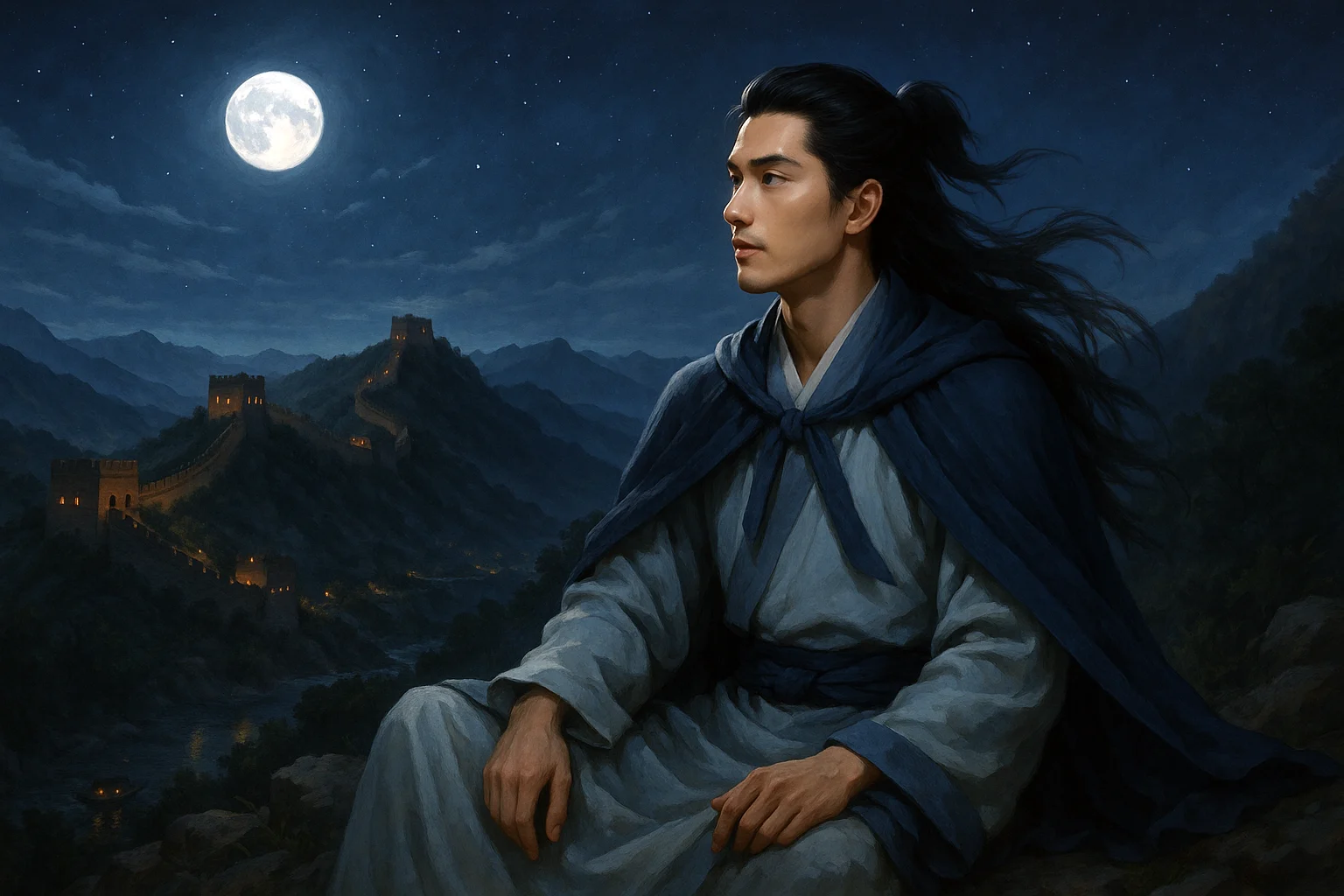
Wang Changling (王昌龄), circa A.D. 690 - 756, was a native of Xi'an, Shaanxi Province. Wang Changling's poems were mostly about the Border Places, love affairs and farewells, and he was well known during his lifetime. His seven poems are equal to those of Li Bai, and he is known as the “Master of seven lines”.