


Good rain knows its time right,
It will fall when comes spring.
With wind it steals in night;
Mute, it wets everything.
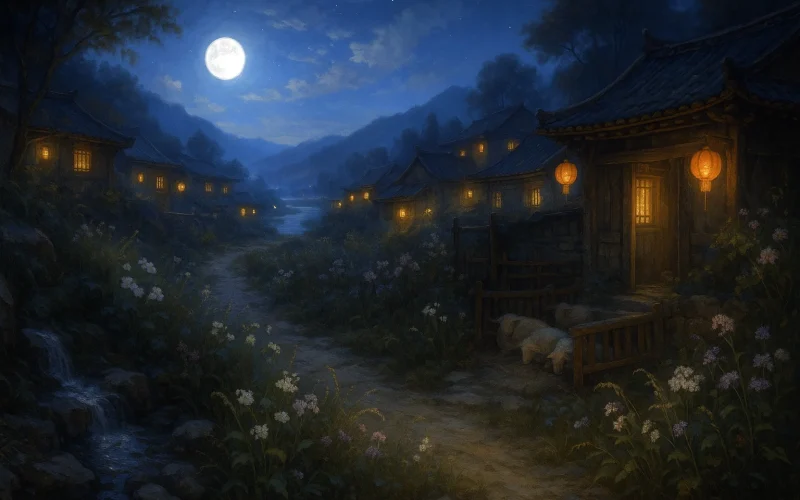
Over wild lanes dark cloud spreads;
In boat a lantern looms.
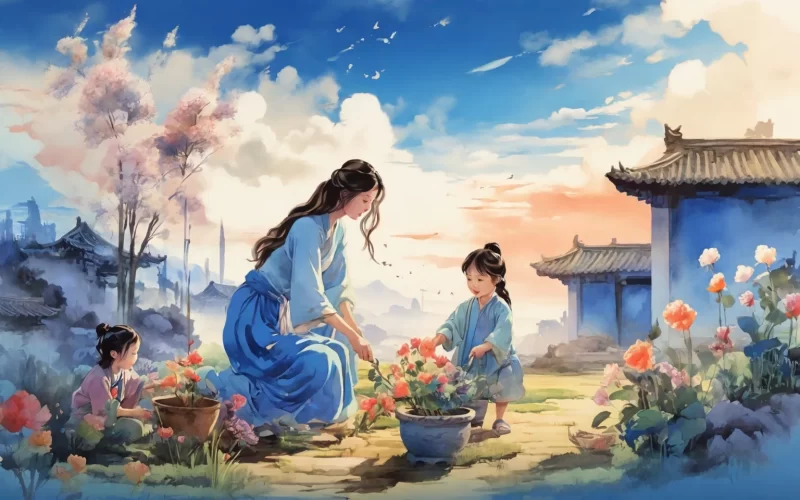
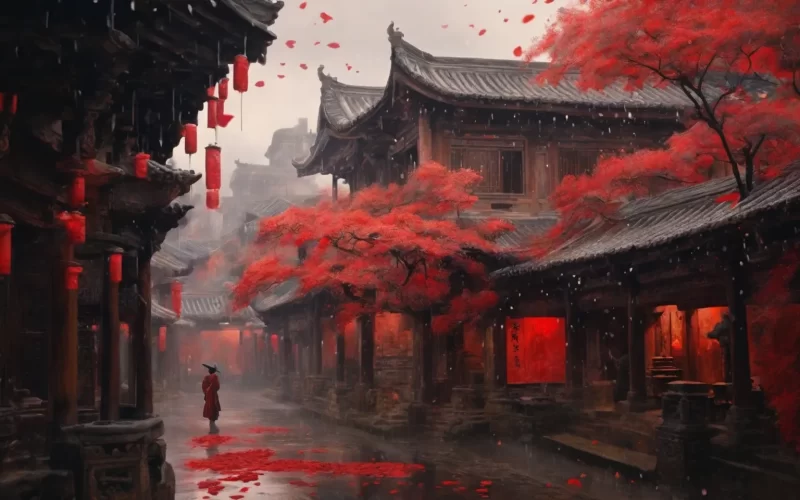
Dawn sees saturated reds;
The town's heavy with blooms.
Original Poem
「春夜喜雨」
杜甫
好雨知时节,当春乃发生。
随风潜入夜,润物细无声。
野径云俱黑,江船火独明。
晓看红湿处,花重锦官城。
Interpretation
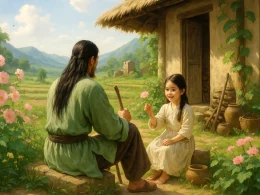
This poem was written in the spring of 761 AD, during Du Fu’s settled life at his thatched cottage by Huanhua Stream in Chengdu. The An Lushan Rebellion still raged elsewhere, but the Shu region was relatively stable. Aided by friends and family, the poet had built this cottage and now enjoyed a period of peaceful, rustic life. Freed from his earlier years of wandering and hardship, he could draw close to nature and observe its subtle seasonal changes. It was with a heart full of appreciative joy that he witnessed and recorded this timely, seasonable rainfall. Though the word "delight" never appears, the entire poem radiates the poet’s admiration for the rhythms of nature, his hope for burgeoning life, and a rare inner tranquility and contentment.
First Couplet: 好雨知时节,当春乃发生。
Hǎo yǔ zhī shíjié, dāng chūn nǎi fāshēng.
Good rain knows the season, arrives with spring in flight; / It awakens life, coming on a timely night.
The opening couplet employs personification, endowing the spring rain with awareness and intent. The word “Good” states the poet’s heartfelt approval directly, setting the tone of joyful praise. “Knows the season” is the pivotal phrase, personifying the rain as a considerate friend who understands nature’s need for renewal and arrives precisely when required. “Arrives with spring” specifies the time, emphasizing its “timely” quality. This is not seen as mere natural coincidence but as a benevolent, purposeful act of “awakens life.” This couplet introduces the poem’s central theme, revealing why this rain is deemed “good.”
Second Couplet: 随风潜入夜,润物细无声。
Suí fēng qián rù yè, rùn wù xì wú shēng.
With the wind, it slips in by night, unseen, so fine; / Nourishing all things gently, with no design.
This couplet focuses on subtle sensation to depict the manner of the rain’s descent. The word “slips in” is exquisitely chosen. It captures the rain’s light, wind-borne arrival under cover of darkness, unseen and unnoticed, while also suggesting a quality of humility and restraint. “Nourishing all things” is its purpose; “gently, with no design” is its method. The poet captures the rain’s most admirable trait: it is not a dramatic downpour, but a pervasive, nurturing presence. This “unseen” and “fine” quality is precisely what allows life to be nourished silently. These lines depict the rain’s tenderness and selflessness with deep insight, showcasing Du Fu’s meticulous powers of observation.
Third Couplet: 野径云俱黑,江船火独明。
Yě jìng yún jù hēi, jiāng chuán huǒ dú míng.
Field paths and clouds are merged in one deep black; / A river boat’s lone lantern glimmers back.
The poet’s gaze shifts from the immediate sensation of rain to the broader night scene. He does not describe the rain directly but instead paints the visual atmosphere heavy with its promise. “Field paths and clouds are merged in one deep black” uses the profound “black” to depict low-hanging clouds, abundant moisture, and a merging of earth and sky, foretelling a thorough, lasting rain. Against this pervasive darkness, the warm point of light from “A river boat’s lone lantern” appears strikingly bright, warm, and poetic. The stark contrast between “black” and “bright” creates the deep, quiet mood of a night-rain scene and, through its visual tension, hints at the poet’s own inner peace, clarity, and subdued delight as he watches from his cottage.
Fourth Couplet: 晓看红湿处,花重锦官城。
Xiǎo kàn hóng shī chù, huā zhòng Jǐnguān chéng.
At dawn we’ll see saturated reds where flowers cluster; / The blooms of Brocade Town will hang heavy, a lush muster.
The final couplet makes a sudden leap, moving from the present night rain to envision the splendid scene at dawn, shifting the poem’s atmosphere from auditory quiet to visual splendor. The phrase “saturated reds” is brilliantly conceived: “reds” signifies the blossoms (visual color); “saturated” connects to the earlier “nourishing” (tactile moisture). Combined, they vividly portray flowers fresh, dripping, and vibrant after the rain. The word “heavy” in “hang heavy” is inspired. It describes the flowers’ pendulous, weighty posture from being water-laden, while also suggesting richly saturated color and texture. This single word conveys the fullness and abundance of life. The imagined “Brocade Town” transformed into a sea of blossoms expands the poet’s personal joy to the whole city. The vision of nature flourishing after the spring rain provides a perfect, fulfilling conclusion.
Holistic Appreciation
This is an exquisitely crafted yet naturally flowing five-character regulated verse, rich in lasting charm. The poem closely follows the “delight” of its title without ever stating it directly, conveying the emotion entirely through the depiction of the rain and the mood evoked. The structure is masterful: the first couplet introduces the theme, praising the rain’s timeliness; the second details its action, portraying its nourishing virtue; the third expands the scene, painting the depth of night; the fourth looks forward, imagining the beauty of dawn. The temporal sequence flows seamlessly from arrival, to descent, to the coming dawn. The emotional thread progresses from admiration, to observation, to joyful anticipation, culminating in the vision of blooming flowers. It perfectly expresses the poet’s tribute to nature’s vitality and his contentment with a peaceful life.
Artistic Merits
- Personification and Emotional Projection: Words like “knows,” “slips in,” and “nourishing” endow the spring rain with human awareness, action, and virtue, making it a natural embodiment of a benevolent, humble spirit in the poet’s view.
- Multi-faceted, Subtle Depiction: Engaging multiple senses—sound (“with no design”), sight (“deep black,” “lone lantern,” “saturated reds”), and touch (“nourishing,” “saturated,” “heavy”)—the poet creates a remarkably full, three-dimensional, and vivid image of the rain.
- Artistic Conception Blending the Actual and the Imaginative: The first six lines describe the actual night rain; the last two imagine the dawn. This blend of real and envisioned scenes shows the rain’s full process from arrival to effect while greatly expanding the poetic space, leaving endless room for the reader’s imagination.
- Use of Precise, Evocative Diction: Words like “knows,” “slips in,” “fine,” and “heavy” are exceptionally precise and potent. They vividly convey both the spirit of the scene and the poet’s thought, embodying Du Fu’s famed dedication to crafting startling, perfect language.
Insights
Happy Rain on a Spring Night reveals the fresh, vivid, and exquisitely observant side of Du Fu’s poetic art. It shows that a great poet can not only give voice to an era’s suffering and indignation, but also, with a heart of pure sensitivity, capture and celebrate nature’s gifts and life’s quiet moments of peace. The “good rain” in the poem is a timely nourishment for all things, and it also symbolizes all positive forces that work “gently, with no design”—be it imperceptibly shaping education, quiet acts of care, or the vital signs of a society’s recovery.
This poem teaches us that true joy springs from living in harmony with nature’s rhythms and appreciating the quiet growth of life. The peace Du Fu found at his Chengdu cottage after years of wandering allowed him to observe a night rain quietly and perceive within it a humble, dedicated, patient philosophy of life. It reminds us that in a troubled world, maintaining a sensitive and grateful heart to discover and cherish those beautiful forces that “know the season” and work “gently” to nourish all things is, in itself, a deep wisdom and a source of happiness.
Poem translator
Xu Yuanchong (许渊冲)
About the poet
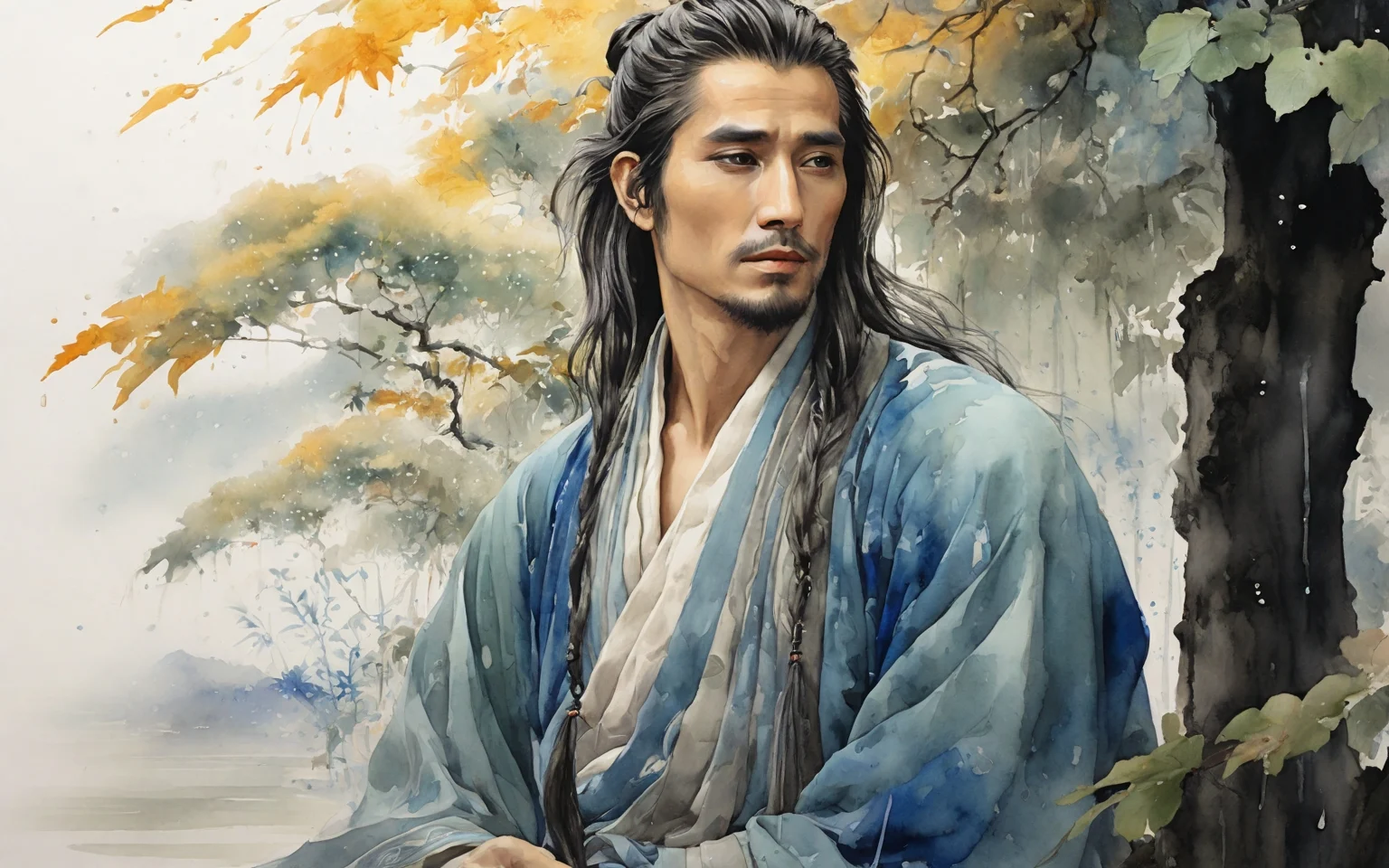
Du Fu (杜甫), 712 - 770 AD, was a great poet of the Tang Dynasty, known as the "Sage of Poetry". Born into a declining bureaucratic family, Du Fu had a rough life, and his turbulent and dislocated life made him keenly aware of the plight of the masses. Therefore, his poems were always closely related to the current affairs, reflecting the social life of that era in a more comprehensive way, with profound thoughts and a broad realm. In his poetic art, he was able to combine many styles, forming a unique style of "profound and thick", and becoming a great realist poet in the history of China.