


Li Bai is unrivalled in verse;
He towers in the universe.
Fresher than Yu on northern shore;
Brighter than Bao, poet of yore.

I long for him as longing tree;
At sunset will he think of me?
When may we drink a cup of wine
And talk about prose and verse fine?
Original Poem
「春日忆李白」
杜甫
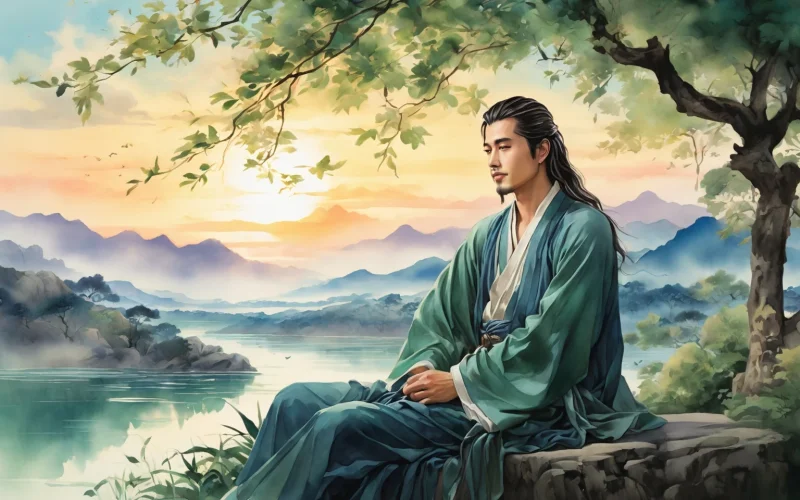
白也诗无敌,飘然思不群。
清新庾开府,俊逸鲍参军。
渭北春天树,江东日暮云。
何时一樽酒,重与细论文。
Interpretation
This poem was composed in the spring of 746 or 747 CE, during the Tianbao era of Emperor Xuanzong of the Tang Dynasty, while Du Fu was living in Chang’an. In 744 CE, Du Fu and Li Bai first met in Luoyang, where they became close friends at once. They journeyed together through Liang and Song, forging a deep bond described as “drunk, we shared one quilt to sleep; hand in hand, we roamed by day.” After parting, Li Bai wandered east of the Yangtze, while Du Fu returned west to Chang’an, with mountains and rivers now keeping them apart. Written on a vibrant spring day in Chang’an, this poem channels Du Fu’s profound admiration and solitary longing for his faraway friend onto the page.
First Couplet: “白也诗无敌,飘然思不群。”
Bái yě shī wúdí, piāorán sī bù qún.
Li Bai’s verse stands without peer; / Soaring, his thoughts rise free and clear.
The opening lines establish the tone with an unwavering judgment. The address “Bái yě” (O, Li Bai) carries both intimacy and boundless admiration. “Without peer” is an ultimate assertion, placing Li Bai at the pinnacle of Du Fu’s—and the era’s—poetic pantheon. “Soaring, his thoughts rise free and clear” further explains the source of this peerlessness: it lies not only in technical mastery but in the transcendent originality of his mind. This couplet builds an image of an extraordinary poet through the dual dimensions of “poetry” and “thought.”
Second Couplet: “清新庾开府,俊逸鲍参军。”
Qīngxīn Yǔ Kāifǔ, jùnyì Bào Cānjūn.
Fresh as Yu Xin’s best‑inspired line, / Gallant as Bao Zhao’s airs divine.
Here, poetry itself becomes the subject, with the past illuminating the present. Rather than describing directly, Du Fu summons two poetic peaks from the Six Dynasties—Yu Xin (who held the title Kaifu) and Bao Zhao (who served as a Canjun)—as aesthetic benchmarks. “Fresh” and “gallant” represent two distinct styles of poetic beauty. By bestowing both upon Li Bai, Du Fu suggests that his style is not mere imitation but a new creation born of synthesizing and transcending past masters. This is a subtle and profound act of artistic judgment.
Third Couplet: “渭北春天树,江东日暮云。”
Wěi běi chūntiān shù, Jiāngdōng rìmù yún.
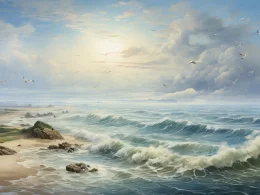
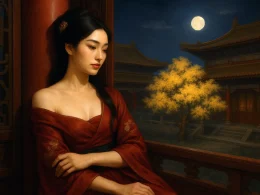
Here, north of Wei, spring trees grow; / There, south of Yangzi, twilight clouds flow.
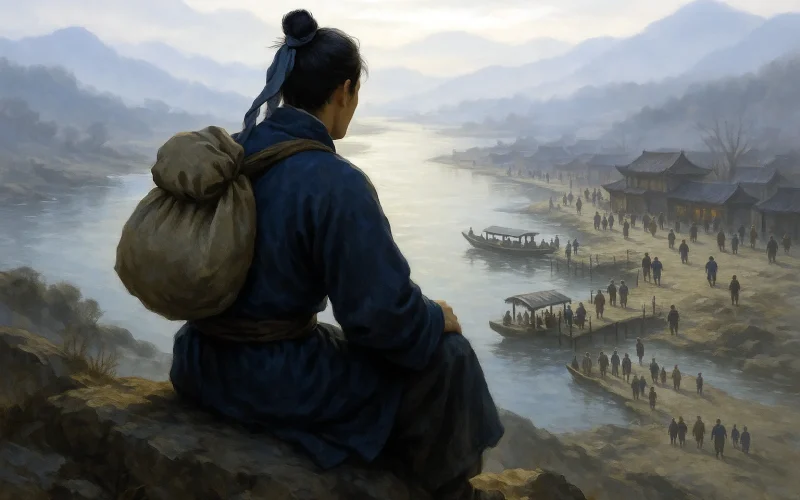
The brush turns sharply from historical appraisal to real‑world space, and the emotion shifts from fervent praise to quiet longing. The poet selects the most evocative temporal and spatial images: “North of Wei, spring trees” is the actual scene before Du Fu in Chang’an—full of life and patient stillness; “south of Yangzi, twilight clouds” is the imagined distant view where Li Bai wanders, tinged with travel‑weariness and vastness. The couplet is perfectly parallel. Though the places are far apart and the scenes distinct, the shared sense of passing time in “spring” and “twilight” gives tangible form to the poets’ intangible mutual longing, rendering it as two separate yet connected vistas. Deep feeling resides in the unspoken.
Fourth Couplet: “何时一樽酒,重与细论文。”
Héshí yī zūn jiǔ, chóng yǔ xì lùn wén.
When shall we share a cup of wine, / And pore on verse, your art and mine?
Moving from scene to feeling, the poet speaks his heart directly, bringing the poem’s emotion to its peak. “When” is filled with uncertain yearning and life’s inherent wistfulness. “A cup of wine” is the ritual of a reunion between kindred spirits; “pore on verse” is the substance of their soul‑to‑soul conversation. This is not merely a wish for friends to meet again but a deep desire for two supreme poetic minds to engage once more in dialogue and artistic exchange. The poem closes with an open question, its resonance lingering—all the admiration, longing, solitude, and hope are contained within it.
Holistic Appreciation
This poem perfectly illustrates what it means to be “remembered by a poet.” It is no ordinary ode to friendship but a spiritual dialogue conducted across time and space within the hall of poetry itself.
The structure is exquisite, unfolding in clear, progressive layers:
From the man to his poetry (direct praise in the first couplet) → From the poetry to its style (historical comparison in the second) → From style to shared space (geographic mirroring in the third) → From that shared space to ardent hope (direct expression of longing in the fourth).
The first two couplets are grounded in the macro‑assessment of poetic art, shining with rational light; the final two immerse themselves in the micro‑contemplation of personal emotion, warm with feeling. Reason and sensibility intertwine; praise and longing share a single form.
The poem’s core conception lies in a “twofold solitude and reflection.” Du Fu’s solitude in Chang’an’s spring arises from missing his peerless friend; Li Bai’s genius and his “rising free and clear” are themselves a form of supreme solitude. “North of Wei, spring trees” and “south of Yangzi, twilight clouds” are precisely the poetic projection of these two solitudes upon the world. They stand apart, yet in Du Fu’s lines they reflect each other across the distance, composing one of the most moving scenes in Chinese literary history.
Artistic Merits
- Fusion of Emotion and Criticism: Blends intense personal friendship with serious poetic judgment. The praise for Li Bai springs from genuine affection as well as impartial artistic assessment, making the emotion weighty through its depth and the criticism moving through its sincerity.
- Creation of Atmosphere through Spatial‑Temporal Correspondence: “North of Wei” vs. “south of Yangzi,” “spring trees” vs. “twilight clouds”—these are not only perfectly parallel but construct a vast emotional space. Longing flows within it, transforming intangible psychological distance into a tangible landscape of sky and earth.
- Adaptation and Sublimation of Allusion: The references to Yu Xin and Bao Zhao are not simple comparisons but are used as benchmarks of aesthetic categories to measure the breadth and height Li Bai’s poetry achieved, showcasing Du Fu’s exceptional vision as a poetic critic.
- Highly Condensed Language with Rich Tension: Words like “without peer,” “free and clear,” “fresh,” and “gallant” possess great summarizing power. The space between “when” and “once more” holds immense temporal emptiness and emotional tension. The language is concise yet infinitely resonant.
Insights
This work transcends ordinary poems of friendship. It reveals the highest level of kindred‑spirit relationships: it is not merely an alignment of affection but a mutual illumination of soul and intellect, becoming each other’s coordinate and mirror in a shared, ultimate pursuit (such as the art of poetry).
Du Fu’s longing for Li Bai is, in essence, a search for a spiritual homeland. In a world where “this man alone rises free and clear,” how fortunate, how precious it is to have a fellow traveler whom you can sincerely declare “without peer” and with whom you yearn to “pore on verse.” This poem is an eternal engraving of that preciousness.
It reminds us that great friendships are often born from great shared pursuits. Whether in art, science, or any ideal, when two individuals can see and call out to each other from the summits of spirit, their friendship becomes immortal alongside their shared cause. Through the separated clouds and trees and the poetry they shared in heart, Du Fu and Li Bai exemplify the highest meaning of “If you’ve a friend who knows your heart, / Distance can’t keep you apart.”
Poem translator
Xu Yuanchong (许渊冲)
About the poet
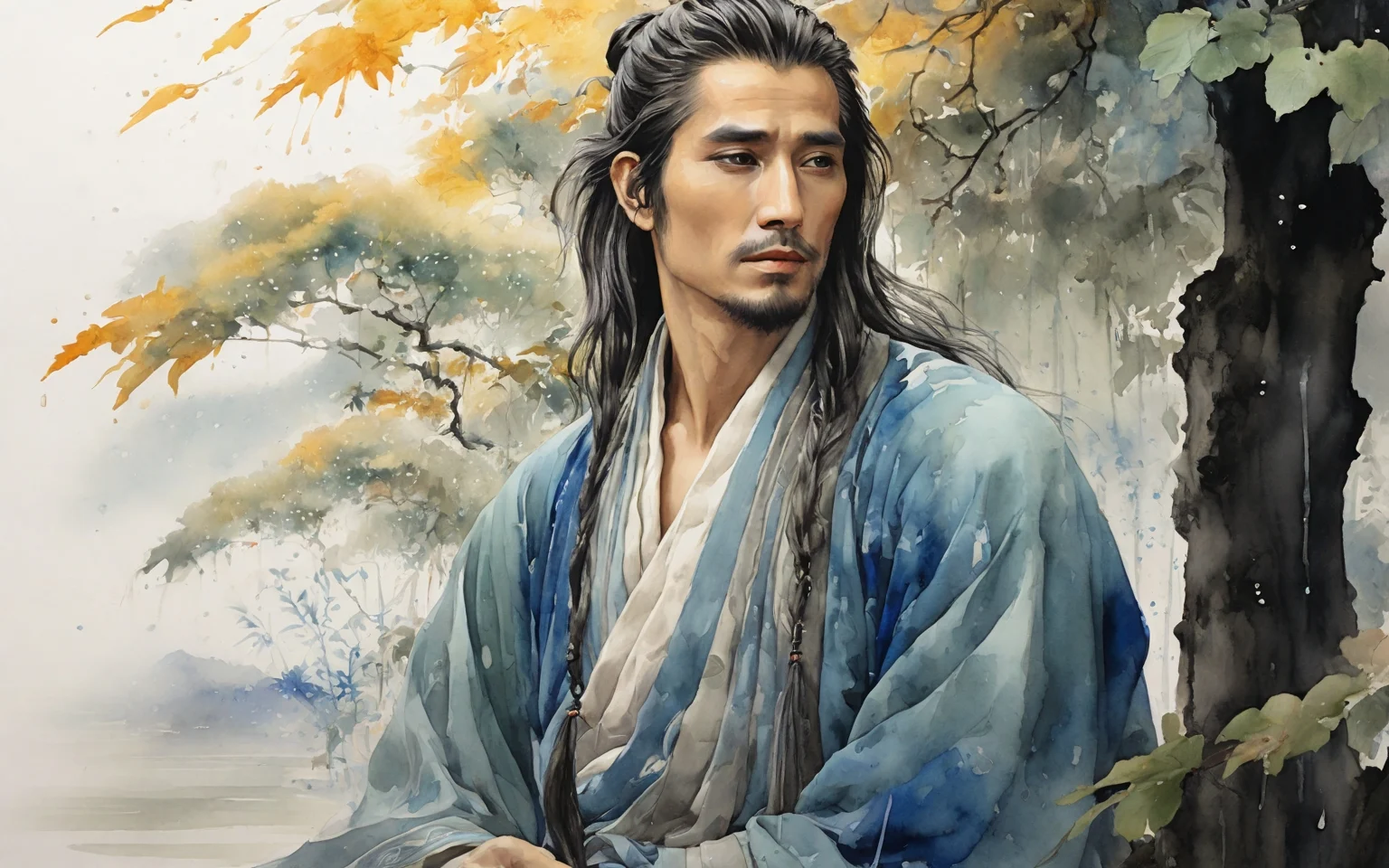
Du Fu (杜甫), 712 - 770 AD, was a great poet of the Tang Dynasty, known as the "Sage of Poetry". Born into a declining bureaucratic family, Du Fu had a rough life, and his turbulent and dislocated life made him keenly aware of the plight of the masses. Therefore, his poems were always closely related to the current affairs, reflecting the social life of that era in a more comprehensive way, with profound thoughts and a broad realm. In his poetic art, he was able to combine many styles, forming a unique style of "profound and thick", and becoming a great realist poet in the history of China.