I clean my teeth in water drawn from a cold well;
And while I brush my clothes, I purify my mind;
Then, slowly turning pages in the Tree-Leaf Book,
I recite, along the path to the eastern shelter.

...The world has forgotten the true fountain of this teaching
And people enslave themselves to miracles and fables.
Under the given words I want the essential meaning,
I look for the simplest way to sow and reap my nature.

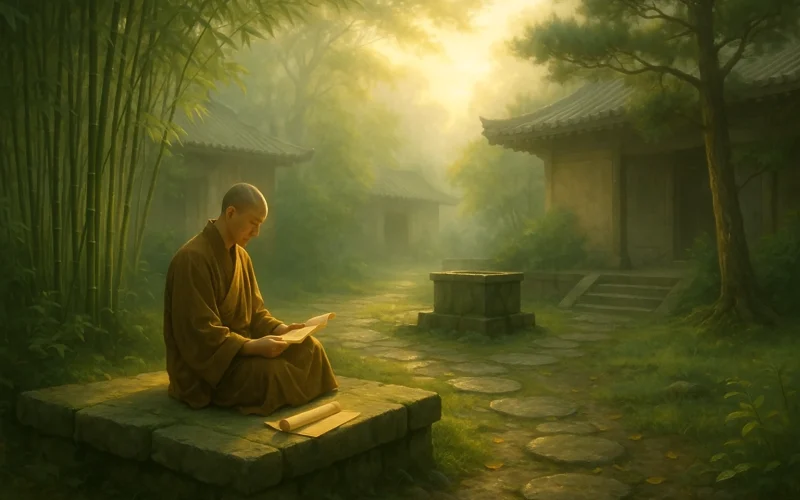
Here in the quiet of the priest’s templecourtyard,
Mosses add their climbing colour to the thick bamboo;
And now comes the sun, out of mist and fog,
And pines that seem to be new-bathed;
And everything is gone from me, speech goes, and reading,
Leaving the single unison.
Original Poem
「晨诣超师院读禅经」
柳宗元
汲井漱寒齿,清心拂尘服,
闲持贝叶书,步出东斋读。
真源了无取,忘迹世所逐;
遗言冀可冥,缮性何由熟?
道人庭宇静,苔色连深竹;
日出雾露余,青松如膏沐。
澹然离言说,悟悦心自足。
Interpretation
This poem was composed during Liu Zongyuan's exile in Yongzhou. After the failure of the Yongzhen Reforms, he was demoted from a ministry official to a minor post in Yongzhou, his political ideals shattered, his life's trajectory abruptly altered. During the long years of exile, he began seeking spiritual solace and a way out—besides immersing himself in landscapes, he also associated with Buddhist monks, studied sutras, trying to find mental liberation through Buddhist teachings. "Chao" in the title was a monk, whose temple was likely in the outskirts of Yongzhou. One morning, the poet went to the temple to read sutras and wrote this poem. The entire poem follows a chronological order, from rising and preparing at dawn, going to read sutras, contemplating Buddhist principles, viewing the temple scene, to the final "I found joy in the truth, my heart now is content." It records a complete journey of spiritual pilgrimage.
Liu Zongyuan's relationship with Buddhism was not one of blind faith, but rather a rational affinity. Lines like "The true source is ignored; men pursue worldly traces" and "I hoped the Words would bring me light; How can I perfect my nature?" are filled with questioning and reflection on Buddhist teachings, showing that even while seeking solace, he maintained a clear mind and independent thinking. This is the self-redemption of a tormented soul, and the spiritual exploration of a rationalist.
First Stanza: "汲井漱寒齿,清心拂尘服。闲持贝叶书,步出东斋读。"
Jí jǐng shù hán chǐ, qīng xīn fú chén fú. Xián chí bèi yè shū, bù chū dōng zhāi dú.
I draw well-water and rinse my mouth, the cold cleansing my teeth;
I purify my heart and brush the dust from my clothes.
Calmly, I take the palm-leaf book,
And walk from the East Lodge to read.
The opening uses a series of actions to describe the preparations before reading the sutra. "I draw well-water and rinse my mouth, the cold cleansing my teeth"—the well-water at dawn is cold; rinsing not only cleanses the mouth but also symbolizes washing body and mind. "I purify my heart and brush the dust from my clothes"—"purify my heart" is internal cleansing; "brush the dust" is external cleaning. Cultivating both inside and out creates a solemn atmosphere for the reading.
"Calmly, I take the palm-leaf book"—"palm-leaf book" refers to Buddhist scriptures, named after the talipot palm leaves used for writing in ancient India. The word "calmly" describes the poet's state of mind at this moment: unhurried, composed. "And walk from the East Lodge to read"—walking slowly out of the study to begin reading. These four lines, with their slow rhythm and imagery of purity, outline a devotee's morning ritual.
Second Stanza: "真源了无取,忘迹世所逐。遗言冀可冥,缮性何由熟?"
Zhēn yuán liǎo wú qǔ, wàng jì shì suǒ zhú. Yí yán jì kě míng, shàn xìng hé yóu shú?
The true source is ignored;
Men pursue worldly traces.
I hoped the Words would bring me light;
How can I perfect my nature?
This couplet shifts from narration to philosophical discourse, exploring the true meaning of Buddhist principles and the perplexities of spiritual practice. "The true source is ignored"—Zen Buddhism emphasizes "not establishing words, directly pointing to the mind"; the true source is fundamentally ungraspable, unspeakable. "Men pursue worldly traces"—people, however, disregard the root and chase after the trivial "traces" (words, forms, external practices), forgetting the "true source."
"I hoped the Words would bring me light"—the poet says he hopes to directly apprehend the Buddha's words, i.e., to transcend the text and directly grasp the meaning. "How can I perfect my nature?"—but how can the cultivation of one's nature easily reach perfection? This question reveals both self-doubt and a clear awareness of the difficulty of spiritual practice. The poet does not hide his confusion, nor does he feign a profound sudden enlightenment; he simply honestly confronts his own limitations.
Third Stanza: "道人庭宇静,苔色连深竹。日出雾露余,青松如膏沐。"
Dào rén tíng yǔ jìng, tái sè lián shēn zhú. Rì chū wù lù yú, qīng sōng rú gāo mù.
The monk's courtyard is quiet;
Moss-green joins with the deep bamboo.
The sun rises; mist and dew remain;
Green pines look anointed, washed clean.
This couplet shifts from discourse to scene description, using the scene before the eyes to reflect the inner state. "The monk's courtyard is quiet"—Monk Chao's courtyard is quiet. This "quiet" is both environmental and internal. "Moss-green joins with the deep bamboo"—the green of the moss connects with the deep bamboo, the colors serene, the conception profound.
"The sun rises; mist and dew remain"—the sun has just risen; morning mist and dew have not yet completely dissipated; the light is soft, the air fresh. "Green pines look anointed, washed clean"—the green pines seem anointed, fresh and vibrant, full of life. These four lines, with their extremely serene and pure scenery, write of an extremely clear and tranquil heart. The poet does not directly say, "My heart is peaceful now," but through this moss-green, deep bamboo, mist, dew, and green pines, the reader can already feel the clarity and peace within him.
Fourth Stanza: "澹然离言说,悟悦心自足。"
Dàn rán lí yán shuō, wù yuè xīn zì zú.
Serenity beyond all words,
I found joy in the truth, my heart now is content.
The final couplet is the poem's emotional destination and philosophical culmination. "Serenity beyond all words"—that serene state of mind can no longer be expressed in words. This is not the limitation of language, but the state itself transcends words—some experiences can be known but not spoken; some realizations can be inwardly understood but not conveyed.
"I found joy in the truth, my heart now is content"—the poet does not say, "I have attained enlightenment," but says, "joy in the truth"—a joy born from understanding. This joy is not ecstasy, not bliss, but a light, self-sufficient contentment. The word "self" in "my heart now is content" shows that this satisfaction does not depend on external things or other people; it is a state naturally arising from within. This line brings the poem to its climax, yet within that climax returns to calm—he has found a temporary spiritual peace, even if only for a moment.
Holistic Appreciation
Following a chronological order, this poem records a complete journey of spiritual pilgrimage. The first four lines describe the preparation before reading, using actions like "draw well-water," "purify my heart," "calmly take," and "walk from" to create a solemn, devout atmosphere. The next four lines describe the contemplation while reading, using questioning about "the true source," "worldly traces," "the Words," and "perfect my nature" to show the poet's rational thinking about Buddhist principles. The following four lines describe viewing the scene in the courtyard, using imagery like "moss-green," "deep bamboo," "mist and dew," and "green pines" to reflect inner clarity. The last two lines describe the post-understanding state of mind, concluding with "serenity" and "joy in the truth" to clarify the main theme.
The poem's structure is clear, advancing layer by layer. From outside to inside (cleansing the body → purifying the heart), from thought to scene (discussing principles → viewing scenery), from movement to stillness (reading → understanding joy), the sections are interlinked, forming a coherent whole. The language is simple and plain, yet the meaning is profound; the emotion is restrained, yet feels genuine and tangible. Compared to Liu Zongyuan's more anguished and resentful works, this poem possesses a greater sense of tranquility and detachment. Yet, upon close reading, one can still sense the confusion and anxiety of "缮性何由熟?"—he is not a born Zen master, but a mortal seeking liberation in pain. Precisely this "mortal's sincerity" allows this poem to transcend the category of religious poetry, becoming a work that anyone seeking a spiritual way out in hardship can resonate with.
Artistic Merits
- Clear Structure, Layered Progression: Following a chronological order, from bodily cleansing to sutra reading, from contemplation to viewing scenery, from scenery to understanding joy, the sections are interlinked, forming a coherent whole.
- Fusion of Feeling and Scene, Unity of Object and Self: Lines like "苔色连深竹" and "青松如膏沐" describe both the scene and the heart, with scene and feeling, object and self highly fused.
- Simple Language, Profound Meaning: The entire poem uses no difficult or obscure words, yet contains deep contemplation on Buddhist principles and life, finding true purity within plainness.
- Implicit Ending, Lingering Resonance: The ten words "澹然离言说,悟悦心自足" concentrate the poem's emotion and philosophy, yet return to calm, leaving endless aftertaste.
Insights
This poem first illuminates for us how to find a spiritual way out in hardship. Liu Zongyuan, banished to Yongzhou, his political ideals shattered, his life at a low point, did not succumb. Instead, he turned to Buddhist teachings, to nature, trying to find mental solace and transcendence. This active attitude of seeking a spiritual way out is something everyone facing hardship should learn. It tells us: Even if the external world collapses, the internal world can still be rebuilt; even if reality seems hopeless, the spirit can still find a place to dwell.
The philosophical reflection of "真源了无取,忘迹世所逐" in the poem also leads us to consider the relationship between essence and appearance. What the world chases are "traces"—those superficial, formal, external things—while ignoring the "true source"—the essence of things, the true nature of life. Liu Zongyuan's reflection is a warning to himself and a reminder to the world. It reveals: Do not be deceived by appearances, do not be bound by forms. Constantly ask: What I am pursuing, is it the "true source," or the "traces"?
Looking deeper, the confusion of "缮性何由熟?" also leads us to consider the difficulty of spiritual practice and growth. Liu Zongyuan does not pretend to have sudden enlightenment, nor feign profundity, but honestly asks: How can the cultivation of one's nature reach perfection? This question voices the shared confusion of all seekers—we desire growth, desire transcendence, yet often do not know the way. It reveals: There are no shortcuts to growth, no instant success in practice. Accepting this difficulty, accepting one's own limitations, is itself a form of growth.
Finally, the state of "澹然离言说,悟悦心自足" described in the poem is especially worthy of longing. It is not ecstasy, not bliss, but a light, self-sufficient joy; not a sudden enlightenment to Buddhahood, but a momentary clarity and peace. It reveals: True spiritual satisfaction need not be complete liberation. Amidst prolonged pain, occasional moments of clarity are already precious enough; amidst endless confusion, occasional "joy in the truth" is already enough to sustain us to move forward.
Poem translator
Kiang Kanghu
About the poet
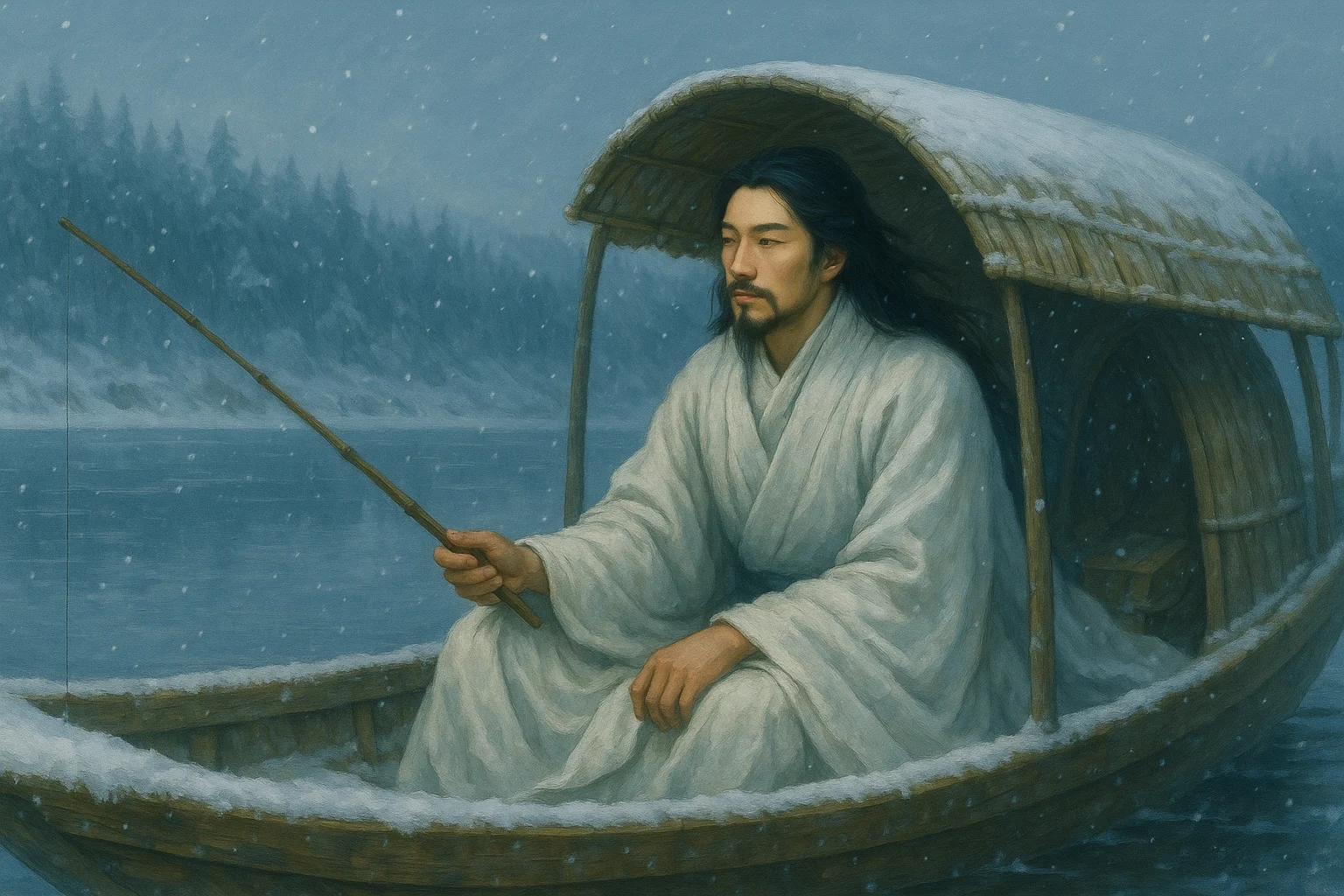
Liu Zongyuan (柳宗元), 773 - 819 A.D., a native of Yongji, Shanxi, was a progressive thinker, brilliant writer, and revolutionary statesman of the Tang Dynasty. Nineteen years before he was born, the An Shi Rebellion broke out, which dramatically changed the Tang Dynasty from prosperity to decline. The subsequent failure of the Yongzhen Reform was a historical tragedy that cut short Liu Zongyuan's political future, but made him one of the leading thinkers and literary figures of the Tang Dynasty.