


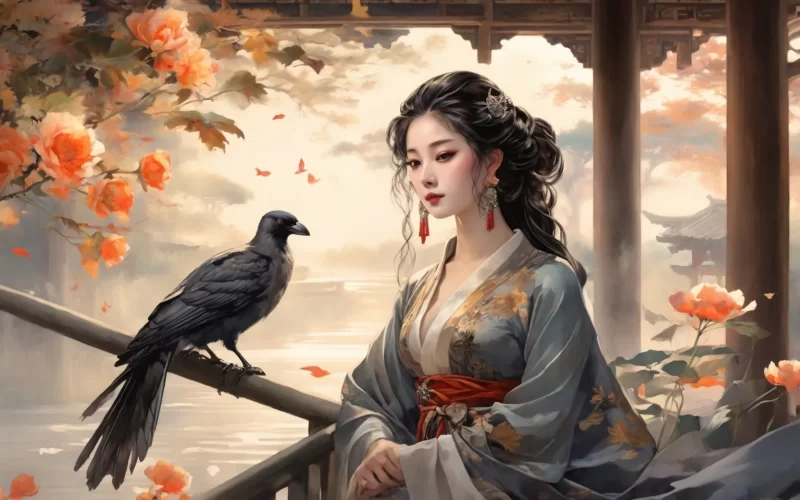
She brings a broom at dawn to the Golden Palace doorway
And dusts the hall from end to end with her round fan,
And, for all her jade-whiteness, she envies a crow
Whose cold wings are kindled in the Court of the Bright Sun.
Original Poem
「长信怨」
王昌龄
奉帚平明金殿开,且将团扇共徘徊。
玉颜不及寒鸦色,犹带昭阳日影来。
Interpretation
Wang Changling lived during the High Tang period, an era when palace lament poetry flourished. Emperor Xuanzong of Tang's harem housed three thousand beauties; many of these women never once laid eyes on the sovereign in their entire lives. Their youth, beauty, and deep affection were locked behind the high walls of the inner palace, ultimately dissolving into endless waiting and sorrow. This series of five poems takes the story of Han Dynasty's Lady Ban Jieyu as its subject. A consort of Emperor Cheng of Han, Lady Ban was both talented and beautiful. Initially favored, she later lost the emperor's affection after the arrival of the Zhao Feiyan sisters. She requested to move to the Palace of Everlasting Faith to serve the Empress Dowager, spending her remaining years in solitude. Her experience became a classic archetype for later palace lament poetry.
The third poem captures a morning in the Palace of Everlasting Faith after Lady Ban's fall from favor. At dawn, the doors to the golden halls swing open, and she takes up a broom to sweep—a task beneath her former station, yet all that remains for her to do. In her idle hours, she holds a round fan, pacing alone.
First Couplet: "奉帚平明金殿开,且将团扇共徘徊。"
Fèng zhǒu píngmíng jīn diàn kāi, qiě jiāng tuánshàn gòng páihuái.
At dawn, as the golden palace doors open, I reverently take up the broom;
And for now, I wander, keeping company with this round fan alone.
The opening portrays the profound loneliness of palace life through mundane routine. "奉帚平明"—At first light, she must dutifully take up the broom to sweep the golden halls. The word "奉" (to reverently hold/perform) conveys her subservience and humility; "平明" (dawn) underscores the monotonous, daily repetition. These golden halls, once a place of hopeful expectation, now represent only the duty to clean. "且将团扇共徘徊"—The "团扇" (round fan) alludes to the典故 from Lady Ban's own "Song of Resentment": "Fashioned into a fan of shared joy, round as the bright moon… / I often fear the coming of autumn's chill, / The cool wind that drives the heat away. / Discarded in a box or case, / Favor and affection cut off mid-way." The round fan, used in summer and cast aside in autumn, serves as a metaphor for a woman who has lost favor. "且将团扇共徘徊"—she can only wander the cold palace, accompanied by this fan that symbolizes her own fate. The word "且" (for now/moreover) expresses utter helplessness: with nothing else to do and no one else for company, this is all that remains.
This couplet employs "奉帚" to depict her lowly status, "团扇" to symbolize her fate, and "徘徊" to convey her solitude. The layering of these three images masterfully renders a disfavored palace lady's morning.
Second Couplet: "玉颜不及寒鸦色,犹带昭阳日影来。"
Yù yán bùjí hán yā sè, yóu dài zhāoyáng rì yǐng lái.
My jade-like face cannot compare to the cold crow's hue,
Which still carries on its wings the sunlight from Zhaoyang Hall.
This couplet forms the poem's emotional crescendo and is an immortal, celebrated line. "玉颜不及寒鸦色"—She laments and pities herself: My face, fair as jade, is not even the equal of a crow's dark feathers. This is not a true comparison but an extreme expression of self-pity—even a crow can fly freely, can pass by the Zhaoyang Palace, can be touched by its sunlight, while she is forever imprisoned in this neglected palace. "犹带昭阳日影来"—"昭阳" (Zhaoyang) was the palace where Emperor Cheng of Han lived with his favorite, Zhao Feiyan, symbolizing the seat of favor; "日影" (sunlight/sun's shadow) metaphorically represents the emperor's grace. That crow flies from Zhaoyang Palace, its wings still bearing traces of that place's sunlight, warmth, and imperial favor. She, however, cannot even glimpse Zhaoyang Hall, let alone be touched by its "日影".
The couplet's brilliance lies in using "不及" (cannot compare to) to express extreme injustice, and "犹带" (still carries) to convey a profound yearning. The crow, an inauspicious creature, is more fortunate than she; sunlight, which shines upon all things, does not reach her in the Palace of Everlasting Faith. This contrast elevates the palace lady's resentment to its peak, allowing the reader to feel a sorrow that cuts to the bone.
Holistic Appreciation
The poem's first two lines depict the palace lady's morning routine. Using the three images of "奉帚", "团扇", and "徘徊", it outlines her humble, lonely, and aimless existence. The final two lines employ the contrast between "玉颜" and "寒鸦" to bring her inner resentment to a climax, forcing the reader to feel the profound sorrow of the forgotten through extreme juxtaposition.
The entire poem is economical in language yet rich with deep feeling. It contains no direct accusation, yet makes the reader feel the deepest resentment; it uses no vehement words, yet conveys the most poignant heartache. Particularly the line "玉颜不及寒鸦色", with its extreme metaphor and stark contrast, merges the lady's self-deprecation and self-pity into a single, timeless utterance. Compared to Wang Changling's stirring and solemn frontier poems, this work is more introspective and subtle. Yet it possesses equal power and poignancy—the figure "奉帚平明", the lonely wandering with the fan ("且将团扇"), the self-pity of "不及寒鸦"—all reveal the poet's deep insight into human nature and his compassion for the injustices of fate.
Artistic Merits
- Natural Use of Allusion, Deepening Meaning: The "团扇" alludes to Lady Ban's own story, while "昭阳" references Zhao Feiyan. Both典故 are woven seamlessly into the poem, adding historical depth and cultural resonance without seeming forced.
- Potent Contrast, Amplifying Sorrow: The contrast between "玉颜" (jade-like face) and "寒鸦" (cold crow) merges the lady's self-abasement with her longing for imperial favor, creating intense emotional tension.
- Using Objects to Represent People, Implicit and Profound: Instead of stating directly "I have lost favor," the poem says "团扇共徘徊" (wander with the round fan). Instead of saying "I am inferior to others," it states "不及寒鸦色" (cannot compare to a crow's hue). This technique of symbolism makes the emotion more restrained and, consequently, more profound.
- Vivid Details, Strong Imagery: The details "奉帚平明" and "团扇共徘徊" paint a vivid picture of a disfavored palace lady's morning, bringing the scene palpably before the reader's eyes.
Insights
This poem first illuminates the psychological state of the forgotten. This palace lady is not lacking in beauty or talent; she is simply forgotten. She sweeps the golden halls each day, keeps company with a round fan, watches crows fly from Zhaoyang Palace—the self-pity of "玉颜不及寒鸦色" represents the most profound pain of the overlooked. It tells us: To remain unseen is a deep injury. For any person, to be needed, seen, and remembered constitutes a basic dignity of existence. When we hold power or opportunity, we must not forget those who are forgotten; when we ourselves become the forgotten, we must also learn to coexist with ourselves, maintaining dignity in solitude.
The word "且" in "且将团扇共徘徊" also prompts reflection on self-consolation in the face of helplessness. "且" means "for the time being" or "let it be." She has no other recourse, can only "且" keep the fan company, "且" wander the cold palace. This "且" signifies helpless acceptance, yet it is also a form of self-consolation—since nothing can be changed, one must make do for now. It reveals: In predicaments beyond our control, learning this 'for now' attitude is a wisdom for survival. It is not surrender, but acceptance; not fatalism, but learning to coexist with one's circumstances.
The contrast in "玉颜不及寒鸦色" further encourages us to consider the pain of comparison. The lady's suffering stems not only from losing favor but also from the fact that even a crow can be touched by Zhaoyang's sunlight, while she cannot. This "comparison" multiplies the pain. It reveals: Much suffering originates not from the situation itself, but from comparing oneself to others. When we compare ourselves to those more fortunate, our pain intensifies; when we learn to stop comparing and focus inward, our suffering lessens.
The image of the palace lady "奉帚平明" is especially poignant. She rises at dawn each day, takes up the broom, and sweeps the golden halls. Day after day, year after year. She knows she may never wait for that person again, yet she still sweeps, still wanders, still watches the crows fly from Zhaoyang. This posture of maintaining daily routine amidst despair is itself a form of strength. It teaches us: Even without hope, live each day well; even if forgotten, maintain your own dignity. That broom, that round fan, those golden halls—they are all testament to her existence.
Poem translator
Kiang Kanghu
About the poet
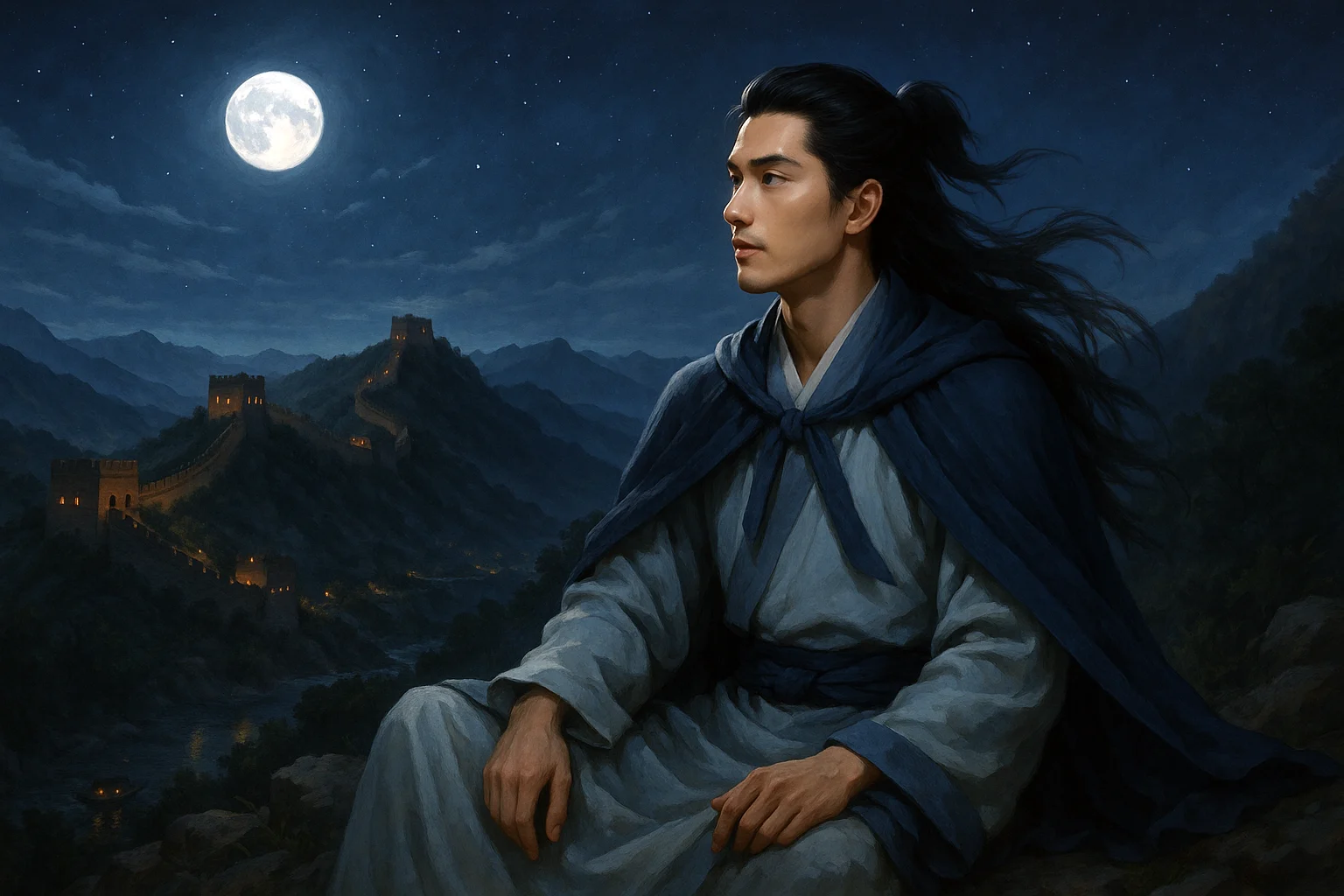
Wang Changling (王昌龄), circa A.D. 690 - 756, was a native of Xi'an, Shaanxi Province. Wang Changling's poems were mostly about the Border Places, love affairs and farewells, and he was well known during his lifetime. His seven poems are equal to those of Li Bai, and he is known as the “Master of seven lines”.