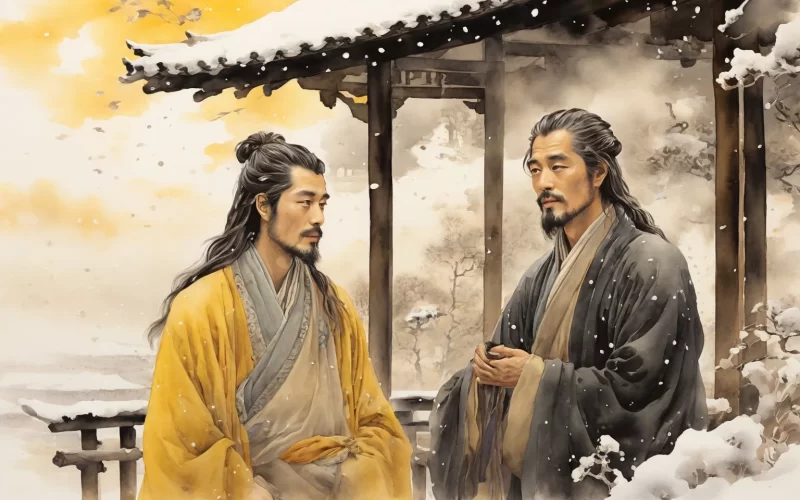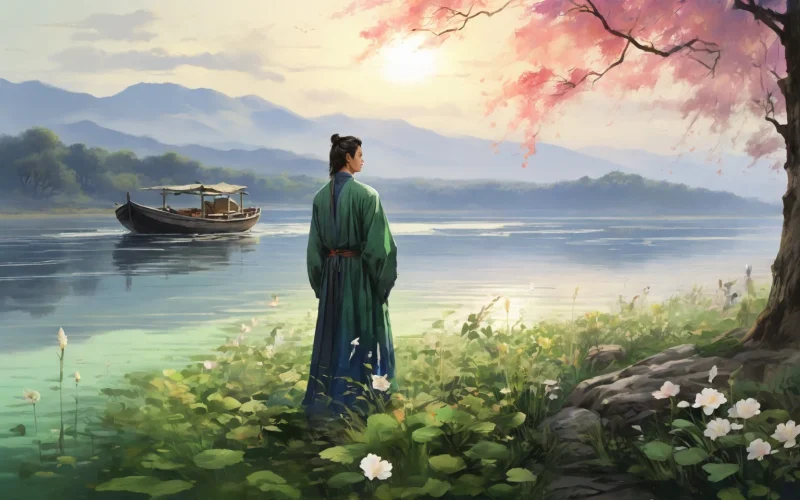



At twenty years, accomplished in the book and blade,
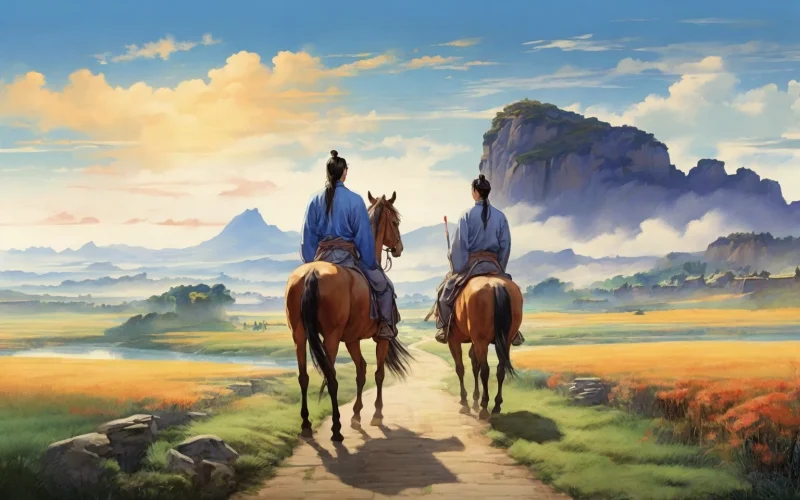
I westward took my road where Changan’s towers made
Their promise. I looked up — the Imperial Gate
Shone, and on my fingers I computed the high state
Of dukes and ministers, that soon should be my own.

A public spirit, generous, the age had known,
Surpassing the Three Kings, the Five. The Court’s delight
Filled the wide world. “White jade,” they said, “shall alight
On those the throne holds near.” The man in hempen dress
Might not approach. I turned, in my sheer helplessness.

To Luoyang, with no fields; through Liang, Song — no ground
Was mine. At the Hare Garden, when the thin soil frowned
And harvest failed; beside the Goose Pool, when the line
Hung slack, and bitterness was all I could define —

Then most men saw in me but one of many men.
You only saw the friend, and took me to you then.
And I give thanks that through the long, demanding year
Your heart refused to count my poverty, or fear.

We played at chess, struck music from the string, till day
Had closed; we drank, and raised our voice to greet the May
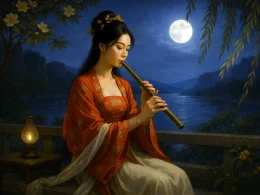
By willows. Now, before our joy is full, we part —
And a deep trouble settles on the inmost heart.

A man should not take leave as children do, in tears;
Yet here, where the roads divide, the sudden tide appears
And wets my sleeve — a tribute, friend, to what is gone,
And to the long road onward I must tread alone.
Original Poem
「别韦参军」
高适
二十解书剑,西游长安城。
举头望君门,屈指取公卿。
国风冲融迈三五,朝廷欢乐弥寰宇。
白璧皆言赐近臣,布衣不得干明主。
归来洛阳无负郭,东过梁宋非吾土。
兔苑为农岁不登,雁池垂钓心长苦。
世人遇我同众人,唯君于我最相亲。
且喜百年见交态,未尝一日辞家贫。
弹棋击筑白日晚,纵酒高歌杨柳春。
欢娱未尽分散去,使我惆怅惊心神。
丈夫不作儿女别,临岐涕泪沾衣巾。
Interpretation
This poem was composed around 734 AD, during the Kaiyuan era of Emperor Xuanzong of Tang, when Gao Shi was about thirty years old, living in a period of hardship, drifting between the regions of Liang and Song, and finding no entry into officialdom. Gao Shi's family fell into decline during his youth. In his early years, he journeyed west to Chang'an seeking an official career, but returned in failure because of the sentiment expressed in «布衣不得干明主» (bùyī bùdé gān míngzhǔ)—although the Tang had the imperial examination system, the process was dominated by the powerful nobility, and scholars from humble backgrounds, without recommendations from high officials, often studied for a decade without success. This failure deeply affected the young Gao Shi. Afterwards, he left Chang'an, returned east to Luoyang, and then drifted to the Liang-Song region (modern-day Kaifeng and Shangqiu in Henan).
Although the Liang-Song area was prosperous in the Central Plains, it was not Gao Shi's homeland. There, he lived the life described in «兔苑为农» (tù yuàn wéi nóng) and «雁池垂钓» (yàn chí chuídiào), actually living a wandering life, dependent on others and struggling for livelihood. Rabbit Park and Wild Goose Pond were originally gardens built by Prince Xiao of Liang during the Han dynasty, once resorts frequented by literati, but now they had become places where the poet barely eked out a living—this geographical contrast inherently contained a deep sense of history and the helplessness of personal fate. It was precisely during these years of extreme material deprivation and profound spiritual solitude that he formed a deep friendship with Aide Wei. Little is known about Aide Wei's life; he was likely a low-ranking official or staff member serving in the Liang-Song area, who shared Gao Shi's temperament. He not only did not reject the poet for his poverty but, as the poem states, «未尝一日辞家贫» (wèi cháng yī rì cí jiāpín), and offered him sincere solace and companionship.
This period was a crucial stage in the formation of Gao Shi's poetic style. From the early «别韦参军» (Bié Wéi Cānjūn) to the later «燕歌行» (Yàngēxíng), we can clearly trace a development from personal lyricism to writing about state and society. Although the poet had not yet turned his pen to the frontier as in later lines like «汉家烟尘在东北» (Hànjiā yānchén zài dōngběi), the bold spirit of «二十解书剑» (èrshí jiě shūjiàn) and the deep feeling of «临歧涕泪沾衣巾» (lín qí tìlèi zhān yījīn) in this poem already foreshadow the heroic and tragic inner character of his later frontier poetry. Aide Wei's departure triggered not just the sorrow of parting with a friend but also a concentrated retrospective and deep sigh by the poet over the first half of his own life—a life of wandering without achievement.
Stanza One: «二十解书剑,西游长安城。举头望君门,屈指取公卿。国风冲融迈三五,朝廷欢乐弥寰宇。白璧皆言赐近臣,布衣不得干明主。»
Èrshí jiě shūjiàn, xī yóu Cháng'ān chéng. Jǔtóu wàng jūnmén, qūzhǐ qǔ gōngqīng. Guófēng chōngróng mài sānwǔ, cháotíng huānlè mí huányǔ. Báibì jiē yán cì jìnchén, bùyī bùdé gān míngzhǔ.
At twenty, I put aside my books and sword, / Westward I roamed, to Chang'an city bound.
I lifted my head toward the sovereign's gate, / Counting on my fingers, dukes and ministers I'd soon attain.
They say the state's ethos, harmonious, surpassed the Three and Five Sovereigns; / The court's joy filled the whole realm. But white jade discs, they say, are bestowed only on those near the throne; / A commoner in simple cloth cannot approach an enlightened lord.
The opening unfolds in a reminiscent tone. The first two lines describe the high spirits of youth: «解书剑» (jiě shūjiàn) is meaningful—Tang scholars often prided themselves on being accomplished in both civil and martial arts; the word «解» (jiě) implies both farewell and confidence in his own talents. The phrase «屈指» (qūzhǐ) in «屈指取公卿» (qūzhǐ qǔ gōngqīng) is excellent, vividly depicting the naive arrogance of youth—as if rank, wealth, and honor were all within grasp. The next four lines abruptly shift tone, using praise for «国风冲融迈三五» (guófēng chōngróng mài sānwǔ) to ironically underscore the harsh reality. «白璧皆言赐近臣» (báibì jiē yán cì jìnchén) exposes the exclusivity of the power core, while «布衣不得干明主» (bùyī bùdé gān míngzhǔ) is a heavy sigh, declaring the complete shattering of his dream for an official career.
Stanza Two: «归来洛阳无负郭,东过梁宋非吾土。兔苑为农岁不登,雁池垂钓心长苦。»
Guīlái Luòyáng wú fùguō, dōng guò Liáng Sòng fēi wútǔ. Tùyuàn wéi nóng suì bù dēng, yànchí chuídiào xīn cháng kǔ.
Returned to Luoyang, with no fields near the city wall; / Eastward past Liang and Song—these are not my native soil. Farming at Rabbit Park, the harvest fails each year; / Fishing at Wild Goose Pond, my heart is ever bitter.
This section turns to the practical hardship of survival. «无负郭» (wú fùguō) alludes to the story of Su Qin, contrasting the poet's own state of utter poverty, lacking even basic landholdings. «非吾土» (fēi wútǔ) expresses the spiritual loneliness of a wanderer—though Liang and Song offered shelter, they could never be home. The latter two lines use historical sites to express his feelings: Rabbit Park was originally the hunting ground of Prince Xiao of Liang of the Han, and Wild Goose Pond was also a scenic spot of the Liang gardens; now the poet «为农» (wéi nóng) and «垂钓» (chuídiào) here, creating a stark contrast between the site of past splendor and his present impoverished self. «岁不登» (suì bù dēng) describes the lack of agricultural gain; «心长苦» (xīn cháng kǔ) describes the spiritual torment—the dual hardship of material and spiritual struggle intertwines into an inescapable net.
Stanza Three: «世人遇我同众人,唯君于我最相亲。且喜百年见交态,未尝一日辞家贫。弹棋击筑白日晚,纵酒高歌杨柳春。»
Shìrén yù wǒ tóng zhòngrén, wéi jūn yú wǒ zuì xiāngqīn. Qiě xǐ bǎinián jiàn jiāo tài, wèi cháng yīrì cí jiāpín. Tánqí jīzhú báirì wǎn, zòngjiǔ gāogē yángliǔ chūn.
The world treats me the same as any other man; / Only you, sir, are closest to my heart.
And I rejoice that through our long acquaintance your true friendship is seen, / Not for a single day shunning my family's poverty. Playing pitch-pot, striking the zhu, till daylight fades; / Drinking freely, singing loud, 'midst willows in spring.
After vividly portraying hardship, the poet's tone turns warm. «世人遇我同众人» (shìrén yù wǒ tóng zhòngrén) speaks volumes about the fickleness of human relationships; «唯君于我最相亲» (wéi jūn yú wǒ zuì xiāngqīn) highlights the preciousness of Aide Wei through contrast. The next two lines deepen this further: «未尝一日辞家贫» (wèi cháng yīrì cí jiāpín) is a concrete illustration of the previous line—true friendship withstands the test of poverty. Then, with two dynamic scenes—«弹棋击筑» (tánqí jīzhú) and «纵酒高歌» (zòngjiǔ gāogē)—he immortalizes the joyous gatherings of the past as beautiful, eternal memories. The sounds of the zither, the images of the game, the aroma of wine, and the colors of spring intertwine, becoming the brightest backdrop in a somber life.
Stanza Four: «欢娱未尽分散去,使我惆怅惊心神。丈夫不作儿女别,临歧涕泪沾衣巾。»
Huānyú wèi jìn fēnsàn qù, shǐ wǒ chóuchàng jīng xīnshén. Zhàngfū bù zuò érnǚ bié, lín qí tìlèi zhān yījīn.
Before our joy is spent, we part and go our ways; / Leaving me disconsolate, startling my heart and soul.
A real man should not part like children, weeping; / Yet at the fork, tears soak my robe and scarf.
The conclusion returns to the farewell scene, emotions oscillating intensely between restraint and release. The four words «欢娱未尽» (huānyú wèi jìn) express utter regret—it is not parting after fulfillment but a necessary separation, adding to the helplessness. The five words «惆怅惊心神» (chóuchàng jīng xīnshén) progress layer by layer: first melancholy, then heart-startling—the pain of parting surges like a tide. The last two lines are especially moving: the poet first tries to console himself, forcing a heroic tone with «丈夫不作儿女别» (zhàngfū bù zuò érnǚ bié), but at the moment of «临歧» (lín qí) completely breaks down; the detail «涕泪沾衣巾» (tìlèi zhān yījīn) shatters all pretense. This emotional truth—wanting to be heroic but ultimately unable—is far more powerful than straightforward weeping.
Holistic Appreciation
«别韦参军» (Bié Wéi Cānjūn) is a foundational work of Gao Shi's early poetry. Its core value lies in perfectly fusing the authentic depiction of personal fate with a profound exploration of the theme of friendship. The whole poem takes "farewell" as its title but uses two-thirds of its length to trace the past—from the disillusionment of seeking office in Chang'an, to the hardship of drifting in Liang-Song, to the warmth of friendship forged in adversity. With this layered foundation, the final parting appears profoundly heavy. This structure of "using narrative for lyricism" gives the poem a depth surpassing ordinary farewell poetry: it is not only a paean to friendship but also a personal testimony about youth, ideals, and loss.
The two images shaped in the poem, «我» (wǒ) and «君» (jūn), are highly representative: «我» is the epitome of countless frustrated scholars of that era—embracing both civil and martial talents but having no way to serve the state, drifting endlessly without finding a home; «君» is a beam of light in the darkness—amidst the indifference of «世人遇我同众人» (shìrén yù wǒ tóng zhòngrén), only he treated the poet with genuine heart. This contrast elevates the poem beyond personal sentiment, giving it broader social critical significance. The struggle of «丈夫不作儿女别» (zhàngfū bù zuò érnǚ bié) and the loss of control in «涕泪沾衣巾» (tìlèi zhān yījīn) at the end complete the portrayal of a three-dimensional personality—boldness and fragility, strength and deep feeling coexisting in one person. This is precisely the inherent seed of Gao Shi's later poetic style moving towards the heroic and tragic.
Artistic Merits
- Seamless Fusion of Autobiographical Narrative and Lyricism
The entire poem unfolds the poet's personal history in chronological order, yet it is not dry chronicle. Through representative scenes and detailed portrayal, it transforms narrative into a vehicle for emotion. This technique allows the reader to understand the poet's experiences while naturally entering his inner world. - Layered Progression Through Multiple Contrasts
The poem constructs multiple sets of contrasts: the contrast between youthful high spirits and the blow of reality, revealing the gap between ideal and reality; the contrast between the world's indifference and Aide Wei's closeness, highlighting the preciousness of friendship; the contrast between the forced heroism earlier and the genuine outpouring at the end, depicting the complex psychological turmoil at parting. These contrasts surge like layered waves, continuously impacting the reader's emotions. - Naturalized and Everyday Use of Allusions
The poet uses allusions like «无负郭» (wú fùguō), «兔苑» (tùyuàn), and «雁池» (yànchí) without appearing forced, instead integrating them into his own experience, creating resonance between history and the present. «垂钓» (chuídiào) subtly contains the idea of Jiang Ziya waiting for his time, also forming a delicate tension with the actual situation of «心长苦» (xīn cháng kǔ). This skill of "using allusions as if using ordinary words" reflects the maturity of Gao Shi's early poetry. - Precise Control of Emotional Rhythm
The poem's emotional undulations are like the ebb and flow of tides: the first eight lines are somber and oppressive; the next four shift to recounting hardship; the four lines on friendship gradually become warm and bright; the final four lines suddenly plunge into the sadness of parting. Especially at the end, the distance between the self-consolation of «丈夫不作…» (zhàngfū bù zuò…) and the emotional loss of control in «涕泪沾…» (tìlèi zhān…) is only ten characters—this design of sharp rises and falls possesses great dramatic tension.
Insights
The first revelation this poem offers the contemporary reader is about how to recognize true affection amidst hardship. In the worldly indifference expressed in «世人遇我同众人» (shìrén yù wǒ tóng zhòngrén), Gao Shi recognized the precious friendship of Aide Wei in «未尝一日辞家贫» (wèi cháng yīrì cí jiāpín). This reminds us: true friends are not those who add embellishments in times of prosperity, but those who choose to remain by your side in adversity. The memory of «弹棋击筑» (tánqí jīzhú) and «纵酒高歌» (zòngjiǔ gāogē) in the poem appears exceptionally warm and moving precisely because it occurred against the backdrop of «岁不登» (suì bù dēng) and «心长苦» (xīn cháng kǔ).
Secondly, the enormous gap between ideal and reality presented in the poem remains an unavoidable subject in everyone's growth. Gao Shi's «屈指取公卿» (qūzhǐ qǔ gōngqīng) at twenty, and his later hardships of «兔苑为农» (tùyuàn wéi nóng), constitute the microcosm of the fate of countless scholars of that era. What is valuable is that the poet, disillusioned, did not become cynical or self-exiling. Instead, amidst difficulties, he maintained his appreciation for friendship, his memory of beauty, and the sincerity of his feelings. This ability to preserve inner softness in adversity is perhaps more respectable than the achievement of fame and success.
Finally, the sincere depiction of the pain of parting at the end possesses eternal emotional value. The poet did not use the magnanimity of «海内存知己,天涯若比邻» (Hǎinèi cún zhījǐ, tiānyá ruò bǐlín) to dissolve the sorrow, nor the consolation of «无为在歧路,儿女共沾巾» (Wúwéi zài qílù, érnǚ gòng zhān jīn) to conceal tears. Instead, he allowed the heroism of the «丈夫» (zhàngfū) and the loss of control of the «涕泪» (tìlèi) to coexist. This complexity tells us: true strength is not about not crying, but about moving forward after crying; true maturity is not about having no weakness, but about daring to admit, at the crossroads of parting, that moment of «惆怅惊心神» (chóuchàng jīng xīnshén).
About the poet
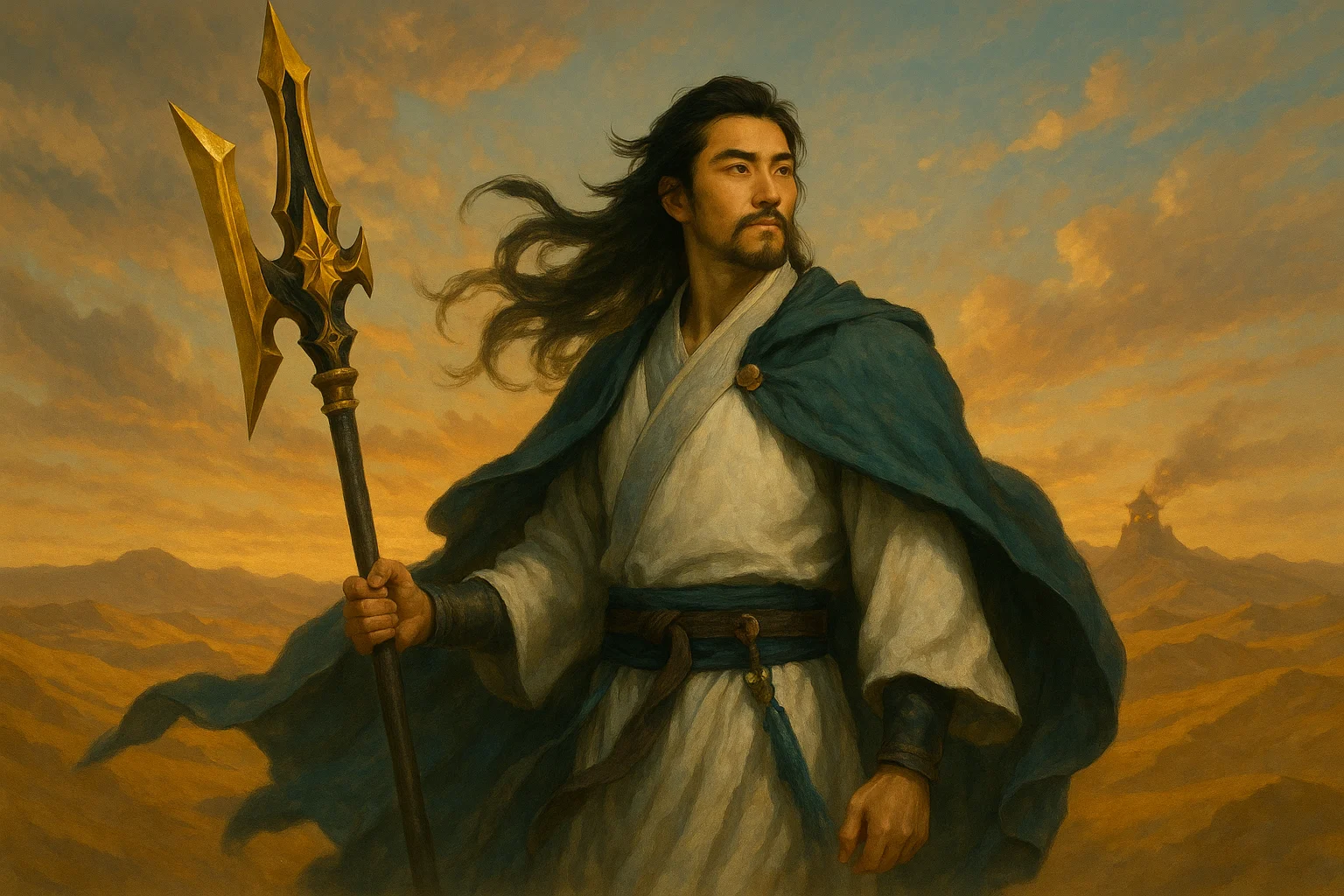
Gao Shi (高适 704 - 765), a native of Jingxian County, Hebei Province, he was a representative poet of the Frontier Fortress School in the High Tang period. In his early years, he lived in poverty and hardship, associating with Li Bai and Du Fu. After the age of fifty, he rose through successive official posts from Prefect of Songzhou to Chief Steward of the Court, and was ennobled as Marquis of Bohai County. Gao Shi excelled in the seven-character ancient verse, with a vigorous and solemn style. He pioneered a new realm of frontier poetry by incorporating a political and military perspective, exerting a profound influence on frontier poetry of the Mid and Late Tang dynasties as well as on patriotic poets like Lu You.