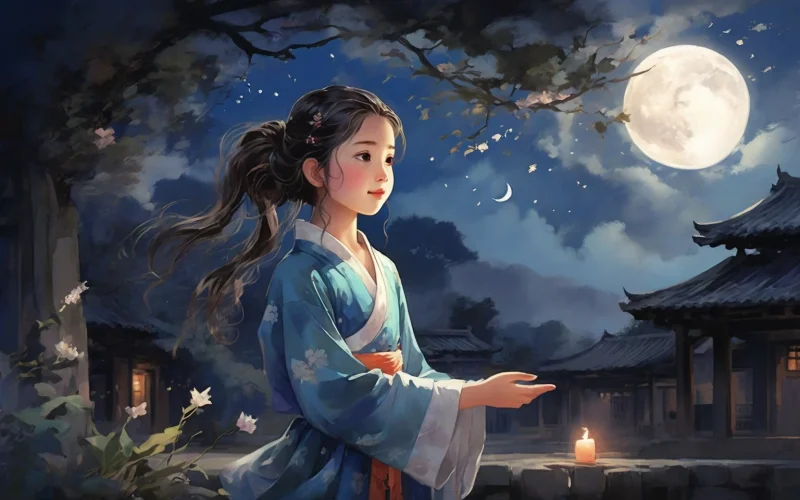



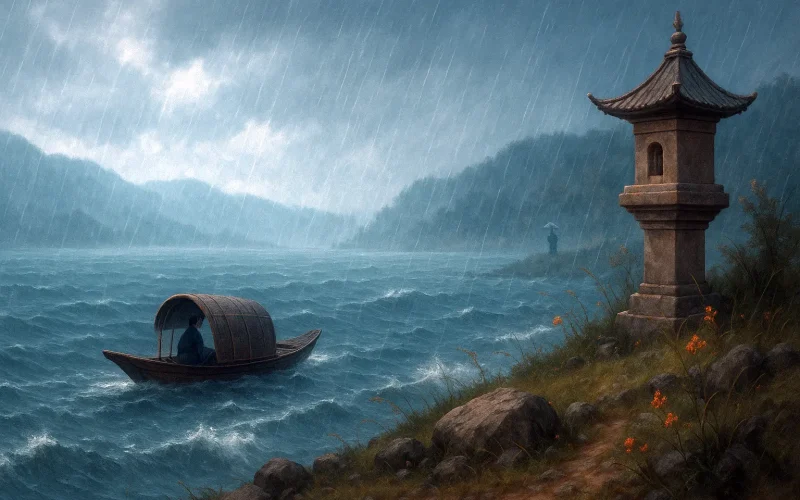
Lonely, I feel more gloomy when I part with you;
Standing by riverside, we shed tears of adieu.
I am banished from home thousands of miles away;
Not dead for twelve long years, in the west land I stay.

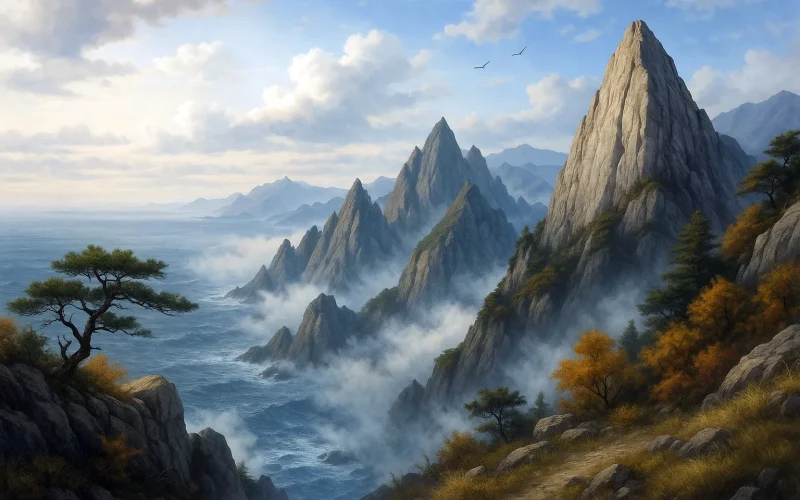
Miasmic clouds darken the southern mountains high;
When spring ends on East lake, water blends with the sky.
From now on I would think of you and you of me;
I'd haunt in dreams our native land from tree to tree.
Original Poem
「别舍弟宗一」
柳宗元
零落残魂倍黯然,双垂别泪越江边。
一身去国六千里,万死投荒十二年。
桂岭瘴来云似墨,洞庭春尽水如天。
欲知此后相思梦,长在荆门郢树烟。
Interpretation
This poem was composed in the late spring or early summer of 816 AD, during the Yuanhe era of Emperor Xianzong, while Liu Zongyuan served as Prefect of Liuzhou. By then, twelve years had passed since the failure of the Yongzhen Reforms, and over three years since his further demotion from Yongzhou to Liuzhou. "Zongyi" in the title refers to Liu Zongyuan's cousin, Liu Zongyi. That year, Zongyi was about to depart from Liuzhou for the Jing-Chu region. For Liu Zongyuan, this was another heart-wrenching farewell—another cousin, Zongzhi, had already died of illness in exile; now, Zongyi too would leave, condemning Liu to utter solitude in Liuzhou.
Twelve years of exile, cast away a myriad li into the wilds, kin scattered, ideals turned to dust. His very soul had been worn down to a state of "shattered desolation," and this parting plunged that broken spirit into even deeper gloom. Using the brothers' separation as its thread, the poem pours forth the anguish of twelve years in exile, the suffering of wandering countless miles from home, and the sorrow of severed familial bonds. It stands as one of the most profoundly sorrowful works from Liu Zongyuan's later years.
First Couplet: "零落残魂倍黯然,双垂别泪越江边。"
Líng luò cán hún bèi àn rán, shuāng chuí bié lèi Yuè jiāng biān.
My spirit, shattered, desolate, sinks deeper into gloom;
By the River Yue we stand, shedding tears of parting doom.
The opening strikes an intensely heavy note to convey the pain of separation. The phrase "shattered, desolate spirit" is the poet's summation of his own existence—twelve years of exile have eroded his very soul, leaving his vitality spent. The word "deeper" ("倍") reveals how this parting compounds his existing wretchedness: already plunged in gloom, he now sinks further.
"By the River Yue we stand, shedding tears of parting doom"—the image is vivid and poignant. Two brothers face one another, twin streams of tears falling. The "twin streams" ("双垂") is both literal and carries a subtle contrast between the "pair" in this moment and the impending "solitude"—for now they weep together, but henceforth only solitary longing remains. This couplet begins directly with raw emotion, unadorned, yet every word is imbued with grief, thrusting the reader immediately into the sorrowful scene of farewell.
Second Couplet: "一身去国六千里,万死投荒十二年。"
Yì shēn qù guó liù qiān lǐ, wàn sǐ tóu huāng shí èr nián.
*Alone I left the capital, six thousand *li* away;*
A thousand deaths survived, twelve years in exile I stay.
This couplet employs stark numerical contrast to lay bare the hardships of twelve years in exile. "Alone" contrasts with "six thousand li," emphasizing the solitude of the individual and the vastness of the distance; "a thousand deaths" contrasts with "twelve years," conveying endless peril and the interminable stretch of time.
"Alone I left the capital"—he departed not with family or honor, but cast out solo to a land six thousand li away. "A thousand deaths survived, twelve years in exile"—not a single blow, but countless brushes with mortality; not a brief banishment, but twelve long years of torment. These fourteen characters form a condensed summary of a dozen exilic years and a poignant indictment of an unjust fate. The precision of the numbers serves instead to intensify the emotional weight—behind each figure lie years too painful to recount.
Third Couplet: "桂岭瘴来云似墨,洞庭春尽水如天。"
Guì lǐng zhàng lái yún sì mò, Dòng tíng chūn jìn shuǐ rú tiān.
From Laurel Ridge, miasmic clouds like ink unfold;
At Dongting Lake, where spring has died, waves merge with skies, I'm told.
This couplet uses scenery to convey emotion, employing the landscapes of two regions to symbolize the brothers' parting. "Laurel Ridge" lies near Liuzhou, the poet's place of dwelling; "miasmic clouds like ink" depicts the harsh environment of Lingnan—pestilential vapors, clouds black as ink, oppressive and fearsome. This is the harsh reality the poet must continue to face, and a reflection of his own state of mind.
"Dongting Lake" in Hunan lies on Zongyi's northward journey; "where spring has died, waves merge with skies" paints the vast, boundless expanse of the lake—spring ended, water and sky as one. It is both a real scene and subtly suggests the open prospects awaiting Zongyi. One image is restrained and dark, the other expansive and bright: the poet places himself amidst the oppressive "clouds like ink," while situating his brother under the limitless "waves merge with skies." This contrast holds both blessings for his brother's future and pity for his own plight, while hinting at the sorrow of their impending separation by a great distance, unlikely to meet again.
Fourth Couplet: "欲知此后相思梦,长在荆门郢树烟。"
Yù zhī cǐ hòu xiāng sī mèng, cháng zài Jīng mén Yǐng shù yān.
If you would know where my dreams of you will henceforth softly roam,
'Mid mist-veiled trees of Yingmen they will drift, and find no home.
The final couplet concludes with dreams, elevating longing into a realm of hazy, profound distance. "Jingmen" and "Ying" are in modern Hubei, Zongyi's destination. The phrase "mist-veiled trees of Yingmen" is ethereal and dreamlike, both an actual scene (mist-shrouded riverside trees) and evoking the indistinct quality of dreams.
The poet says: Henceforth, my longing can only be entrusted to dreams; and my dreams will long linger amidst the mist-veiled trees of Jingmen and Ying. The word "long" ("长") expresses the enduring, persistent nature of this longing; the word "mist" ("烟") captures the elusive, intangible essence of dreams. This couplet concludes with imagery, masterfully blending scene and emotion, allowing the entire poem to fade out within a haze of mist, leaving a lasting, melancholic resonance.
Holistic Appreciation
This regulated verse (seven-character, eight-line poem) takes fraternal parting as its main thread, weaving within it the pain of twelve years of exile. The emotion is profound, the meaning rich. The first couplet sets the scene of parting, using "shattered spirit" to establish the poem's tragic tone. The second couplet employs numerical elaboration to review the tribulations of exile, full of pent-up indignation. The third couplet uses contrasting landscapes to symbolize the brothers' separation—one restrained, one expansive—creating a vivid juxtaposition. The final couplet concludes with dreams, sublimating longing into a misty, distant artistic conception.
The poem's structure is tight, with emotion building layer upon layer. It moves from the immediate parting, to the hardships of the past, to the future longing, intertwining time and space, extending the thread of emotion. The poet places his personal tragedy against the vast backdrop of space (six thousand li) and time (twelve years), lending this grief historical weight and a sense of fatalistic depth.
Compared to Liu Zongyuan's more subtle, restrained poems, the emotion here is more exposed, the lament more direct. "Alone I left the capital, six thousand li away; / A thousand deaths survived, twelve years in exile I stay"—lines such as these are nearly a cry, an accusation, the accumulated eruption of twelve years of stifled feeling. Yet even amidst such intense emotion, the poet maintains restraint—the final couplet closes with the word "mist," allowing the powerful emotion to dissolve into vagueness, transforming lament into a lingering resonance.
Artistic Merits
- Numerical Juxtaposition, Concise and Forceful: "Alone," "six thousand li," "a thousand deaths," "twelve years"—four numerical elements appear in close succession, condensing twelve years of hardship into fourteen characters with immense impact.
- Fusion of Emotion and Scene, Vivid Contrast: The third couplet contrasts "Laurel Ridge's miasmic clouds" with "Dongting's merging water and sky"—one dark, one bright; one oppressive, one expansive—describing both scenery and emotion, and even fate.
- Poignant Diction, Intense Emotion: Phrases like "shattered, desolate spirit" and "a thousand deaths survived" carry profound weight, expressing the poet's inner grief, indignation, and despair to the fullest.
- Evanescent Conclusion, Lingering Resonance: Ending with "mist-veiled trees of Yingmen," the intense longing is blended into a hazy conception, allowing the poem to conclude within a veil of mist, leaving endless room for reflection.
Insights
This poem first prompts us to consider how to confront separation in life. After twelve years of exile, Liu Zongyuan faced parting from his last remaining close kin, thereafter to be utterly alone. This separation was yet another blow from fate. Yet he was not crushed; he transmuted this pain into poetry, rendering it eternal art. It teaches us: Separation is the constant in life, but we can use words, memory, and longing to maintain a connection across the divide.
Furthermore, the poignant retrospection in "一身去国六千里,万死投荒十二年。" invites us to ponder the weight of time and the injustice of fate. Twelve years is sufficient for a youth to approach middle age, for an idealist to confront disillusionment. Liu Zongyuan used numbers to precisely mark these years, inscribing all he endured. This reveals: In the face of unjust fate, we have the right to anger, the right to voice our grievance. Not all suffering must be "accepted"; not all grievances must be "released." Sometimes, to declare aloud "a thousand deaths survived" is itself an act of defending one's dignity.
On a deeper level, the imaginative leap in "欲知此后相思梦,长在荆门郢树烟。" leads us to contemplate the nature and transcendence of longing. Unable to travel in body, the poet sends forth his dream-soul; denied a real meeting, he meets in dreams. This capacity to transcend reality through dreams is among humanity's most precious endowments. It shows us that even when severed by time and space, even when a real reunion is impossible, we can still use longing, memory, and dreams to sustain a bond with those we love. That dream-soul drifting amidst the "mist-veiled trees" is more enduring, more ethereal than any physical encounter.
Finally, the image of the two figures by the River Yue, "shedding tears of parting doom," is profoundly moving. Two men weeping, bidding a sorrowful farewell by the river—this is not weakness, but testament to deep feeling. Liu Zongyuan did not conceal his tears nor affect stoicism. He shows us that a man who has survived "a thousand deaths" can still weep for parting; a man repeatedly broken by fate can still hold fast to deep familial love. These tears are not weakness, but the final, enduring light of humanity. It teaches us that true strength lies not in an absence of tears, but in the ability—even with tears falling—to still inscribe lines as poignant and beautiful as these.
Poem Translator
Xu Yuanchong (许渊冲)
About the Poet
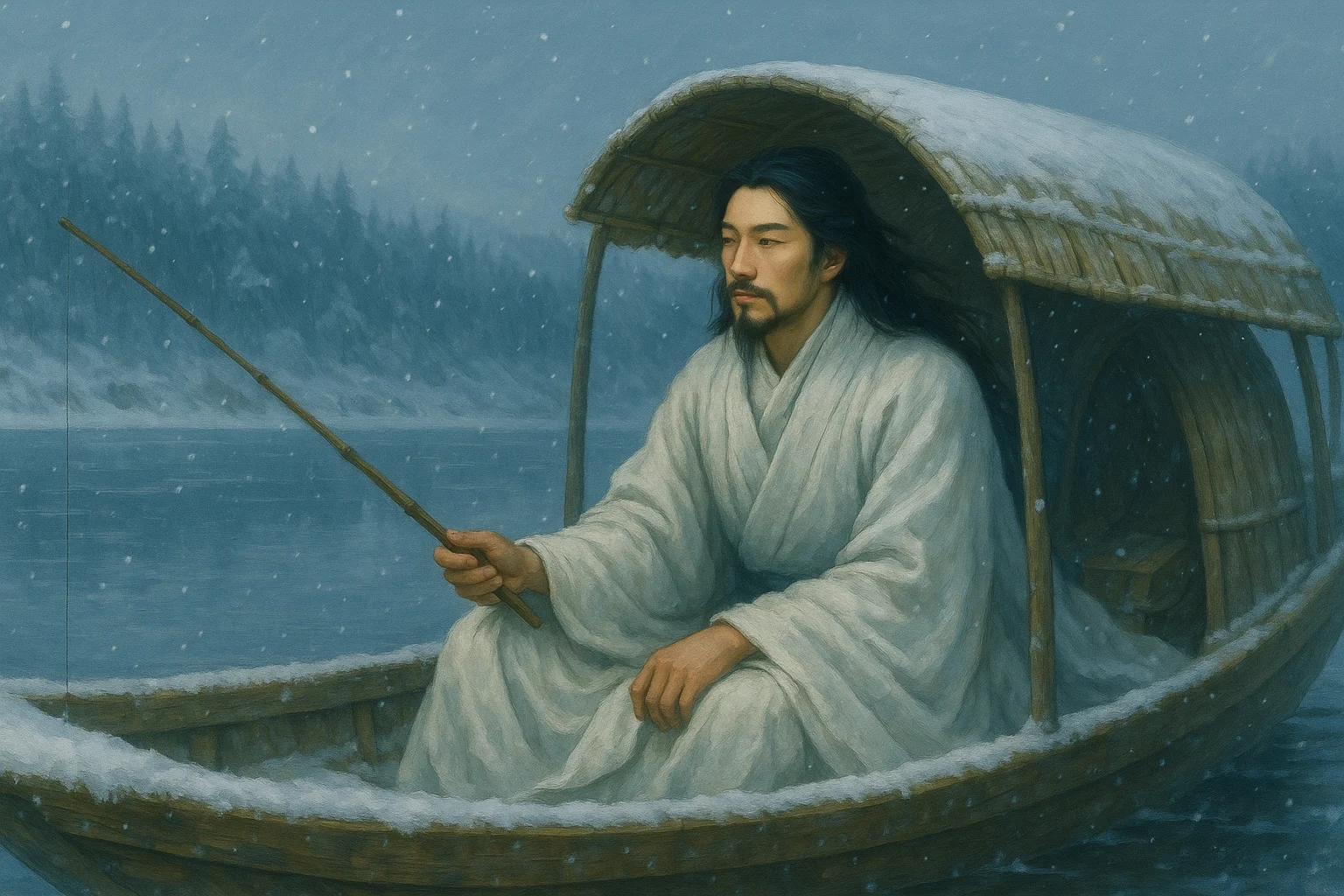
Liu Zongyuan (柳宗元, 773 - 819), a native of Yuncheng in Shanxi province, was a pioneering advocate of the Classical Prose Movement during China's Tang Dynasty. Awarded the prestigious jinshi degree in 793 during the Zhenyuan era, this distinguished scholar-official revolutionized Chinese literature with his groundbreaking essays. His prose works, remarkable for their incisive vigor and crystalline purity, established the canonical model for landscape travel writing that would influence generations. As a poet, Liu mastered a distinctive style of luminous clarity and solitary grandeur, securing his place among the legendary "Eight Great Masters of Tang-Song Prose" - an honor reflecting his enduring impact on Chinese literary history.