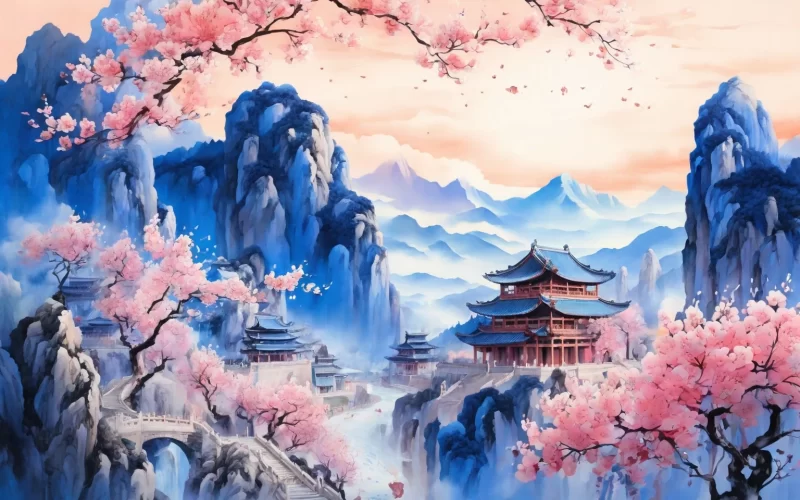



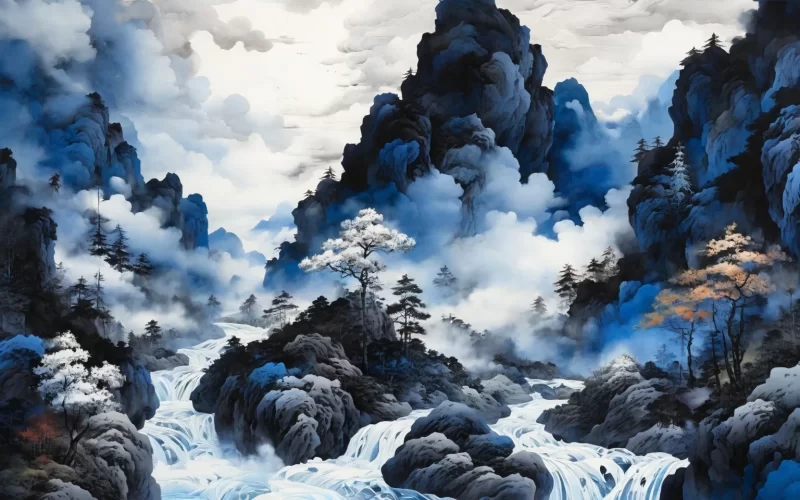
Behold the White Cloud Fountain on the sky-blue Mountain!
White clouds enjoy pleasure while water enjoys leisure.
Why should the torrent dash down from the mountain high
And overflow the human world with waves far and nigh?
Original Poem
「白云泉」
白居易
天平山上白云泉,云自无心水自闲。
何必奔冲山下去,更添波浪向人间。
Interpretation
This poem was composed between 825 and 826 CE, during Bai Juyi’s tenure as Governor of Suzhou. The poet, now in his fifties, had weathered the vicissitudes of official life. The sharp idealism of his youth, dedicated to serving the world, had mellowed, while thoughts of personal cultivation and integrity grew clearer. Though serving as a regional governor, the realities of the mid-Tang dynasty—with its powerful military governors and court intrigues—made him acutely aware of the limits of an individual’s power and the ultimate vanity of a bureaucratic career. The "unconcerned" nature of the white cloud and the "inherent leisure" of the spring water on Mount Tianping mirrored his own profound longing to break free from the snares of officialdom and return to nature. This heptasyllabic quatrain, with its supremely simple language and serene mood, stands as a philosophical declaration on the choice between public service and reclusion, and on how to find peace in one's life.
First Couplet: "天平山上白云泉,云自无心水自闲。"
Tiānpíng shān shàng báiyún quán, yún zì wúxīn shuǐ zì xián.
On Mount Tianping lies White Cloud Spring, a scene; / The cloud, of itself, is unconcerned; the water, of itself, at leisure, serene.
The opening identifies the place and subject in a tone as calm as casual speech. "Mount Tianping" is the actual location, yet also carries symbolic connotations of "heavenly balance and peace." "White Cloud Spring" names the subject, its very name rich with poetic suggestion—a spring that mirrors white clouds, sharing their hue. The second line follows closely, using two iterations of "of itself" to reveal the intrinsic nature of cloud and water: "unconcerned" and "at leisure." This is not personification, but the poet’s distillation of their essential qualities after deep contemplation. The cloud’s "unconcern" is its natural disposition, gathering and scattering without aim or intention; the water’s "inherent leisure" is its unhurried, unforced rhythm of flow. Together, they form a vision of a universe that is self-sufficient, self-contained, and perfectly at ease, establishing a clear standard against which worldly human affairs are measured.
Second Couplet: "何必奔冲山下去,更添波浪向人间。"
Hébì bēn chōng shān xià qù, gèng tiān bōlàng xiàng rénjiān.
Why must it rush and charge its way down the mountainside, / Only to add more waves and ripples to the world outside?
This couplet shifts from description to reflection, forming the core idea of the poem. Through a rhetorical question and admonition directed at the spring, the poet voices his inner thoughts. The phrase "Why must" expresses a clear-sighted doubt, a shift to a more detached perspective. In the poet’s view, the spring water could remain on the mountain like the white cloud, enjoying its essential state of "leisure"; once it chooses to "rush and charge its way down the mountainside," it enters the realm of the "world outside," and its flow is no longer a state of "inherent leisure" but transforms into "waves and ripples," becoming a force that stirs up contention and adds to the world’s troubles. Here, the "world outside" clearly stands for the dusty realm of mundane affairs and the arena of fame and gain; the "waves and ripples" symbolize disputes, strife, toil, and vexation. By admonishing the spring, the poet is really questioning and reflecting upon himself and all like-minded individuals: Are we not also like this spring? Could we maintain a spirit of "unconcern" and "inherent leisure," yet we insist on "rushing and charging" into the world, with the result only of "adding more waves," troubling both others and ourselves?
Holistic Appreciation
The charm of this brief poem lies in its remarkable clarity: it expresses profound truth through simple language, using nature’s essence to reflect the human heart. Its structure is crystalline: the first two lines "establish an ideal," presenting a paradigm of existence that is natural, harmonious, and free from external demands (the cloud’s unconcern, the water’s leisure). The last two lines offer a "reflection," using this ideal as a mirror to reconsider and question the potential burdens and alienation brought by the active pursuit of "entering the world" and "acting" (adding waves). The four lines form a complete philosophical circuit, revealing a central tenet of Bai Juyi’s later thought: True wisdom lies not in actively "adding" to the world (through achievement or fame) but in knowing how to "subtract" unnecessary striving and attachment, returning to life’s natural state of being at ease with itself. The White Cloud Spring in the poem is thus both an object of aesthetic appreciation and a philosophical symbol, representing an ideal way of being that transcends utility and communes with the spirit of the natural world.
Artistic Merits
- Rhythmic Beauty through Repetition: The line "The cloud, of itself, is unconcerned; the water, of itself, at leisure" uses two iterations of "of itself," not only emphasizing the autonomous nature of things but also creating a rhythmic, unhurried cadence that perfectly matches the poem’s theme of leisure.
- A Concise yet Profound Symbolic System: The poem builds a richly layered symbolic world using only a few core images—"cloud," "water," "mountain," "the world outside," "waves and ripples." Cloud and water symbolize a transcendent, self-sufficient mind; the world below the mountain symbolizes the bustling secular realm; waves symbolize the troubles stirred by worldly engagement. The relationships are clear, the meaning deep.
- Intellectual Tension in the Rhetorical Question: The question "Why must…?" does not seek an answer but uses its imperative tone to express a moment of insight and resolve. It forces the reader (and the poet himself) to re-examine the value and meaning of the seemingly inevitable act of "rushing down the mountainside" (a metaphor for pursuing office and action).
- A Return-to-Simplicity in Style: The poem uses no obscure words or allusions, relying only on plain description and colloquial reflection to achieve the highest artistic state of "ultimate splendor returning to plainness." This is the hallmark of Bai Juyi’s late poetic style at its most refined.
Insights
This work is the poetic crystallization of Bai Juyi’s philosophy of "reclusion within society." It expresses a profound wisdom: Alongside the cultural tradition of zealous "action" and "worldly engagement," there exists a noble value in "non-action" and "inherent leisure." This "leisure" is not idleness but the freedom of a mind unenslaved by external things; this "unconcern" is not indifference but an attitude of living in accord with one’s true nature, free from deliberate striving.
The poem’s insight holds particular resonance for modern life. In a society that venerates competition, efficiency, and constant "rushing and charging," should we not occasionally ask ourselves: "Why must we rush and charge our way down the mountainside, only to add more waves and ripples to the world outside?" Have we, in our endless pursuits, lost the inherent "leisure of cloud and water" that life originally possesses? Bai Juyi reminds us that true peace and strength may lie not in conquering external "waves," but in whether we can safeguard and return to that "White Cloud Spring" on the "Mount Tianping" within our hearts, to rediscover that original state of being "unconcerned" and "at leisure."
It encourages us, on life’s journey, to preserve moments for pause and reflection, to examine the direction and meaning of our own "rushing and charging," and, when necessary, to find the courage and wisdom to choose "not to go down the mountain." In doing so, we might let life have fewer futile "waves" and more of the tranquil "leisure of clouds." This insight from a millennium ago remains a clear and gentle antidote for the anxieties and alienation of modern existence.
Poem translator
Xu Yuanchong (许渊冲)
About the Poet
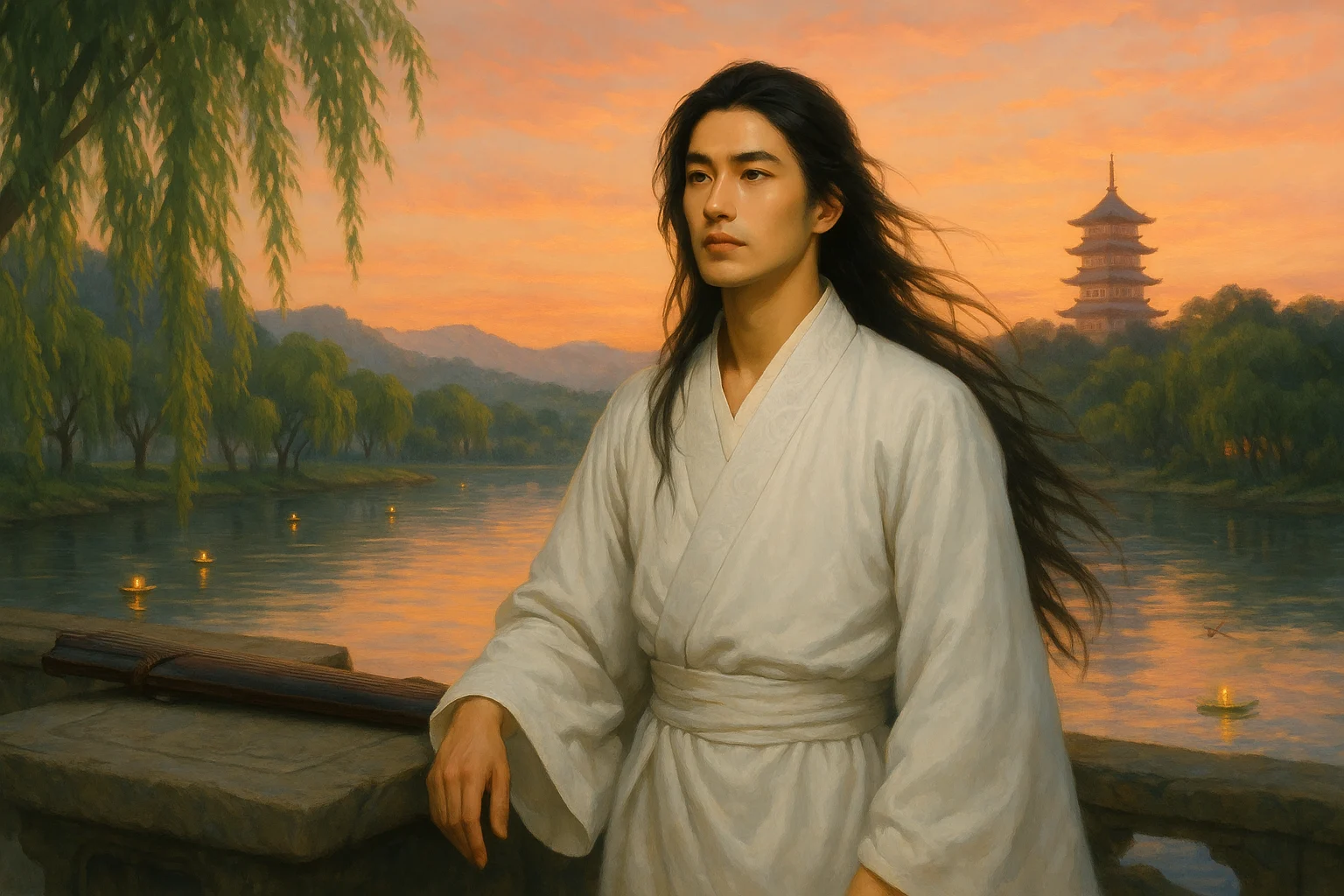
Bai Juyi (白居易), 772 - 846 AD, was originally from Taiyuan, then moved to Weinan in Shaanxi. Bai Juyi was the most prolific poet of the Tang Dynasty, with poems in the categories of satirical oracles, idleness, sentimentality, and miscellaneous rhythms, and the most influential poet after Li Bai Du Fu.