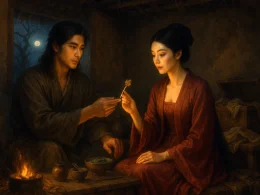



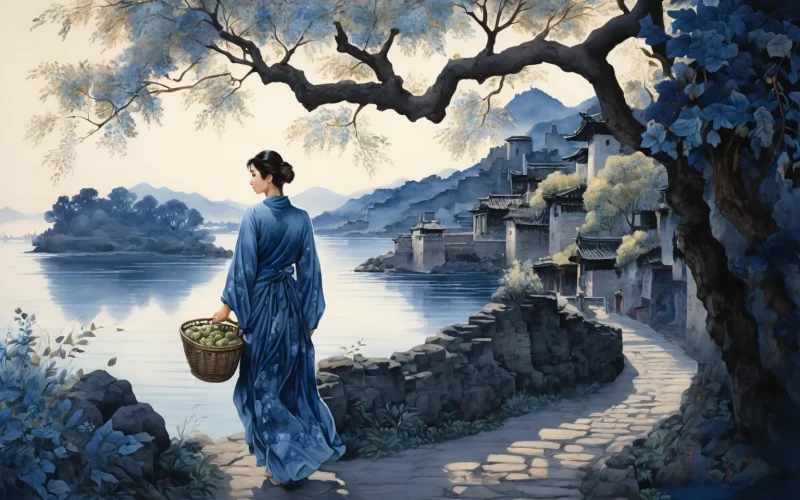
The willows by the town in breezes faintly sigh,
The mulberries along the lane are green and high.

She bears her basket, but the leaves she does not pull —

For oh, her heart is full, is full,
And all her thoughts are where the dream did lie:
Last night she dreamed of Yuyang, and the cry
Of lonely watch-towers ‘neath a northern sky.
Original Poem
「春闺思」
张仲素
袅袅城边柳,青青陌上桑。
提笼忘采叶,昨夜梦渔阳。
Interpretation
This work is one of the representative poems of the Mid-Tang poet Zhang Zhongsuh. Zhang Zhongsuh was an important poet and politician of the Mid-Tang period. He passed the imperial examination in the fourteenth year of the Zhenyuan era and later rose to the position of Zhongshu Sheren (Secretary of the Central Secretariat). His literary talent was outstanding; he was especially renowned for his yuefu ballads and "palace lyrics." Along with Wang Ya and Linghu Chu, he was considered a master of the yuefu form. His poetic conceptions are novel, his language refined, revealing deep meaning within grace and beauty. He was particularly adept at portraying delicate psychological states and capturing vignettes of the era within themes of boudoir lament and the frontier frontier. This poem is the first of his "Two Poems on Spring Grief in the Women’s Quarter." Though brief, it has been regarded by later generations as a model of Tang dynasty quatrains on boudoir lament.
The creation of this poem is rooted in the specific social realities of the Mid-Tang period. After the An-Shi Rebellion, the Tang Empire shifted from prosperity to decline. Central authority weakened, provincial military governors consolidated their power, and border conflicts and internal turmoil occurred frequently. To maintain rule and cope with warfare, the court long implemented an extensive conscription and garrison system. A vast number of men were forced to leave their families for distant frontier service, often for extremely long periods or never to return. This not only created profound social problems but also gave rise to the close integration and emotional resonance of the two major poetic themes: "boudoir lament" and "the frontier." The era in which Zhang Zhongsuh lived was precisely a time when the suffering caused by this conscription became a widespread social trauma. With his characteristic sensitivity, the poet shifted his gaze from the vast battlegrounds of the frontier to the lonely springtime women’s quarters, capturing the silent emotional rupture and the long waiting endured by individual families beneath the grand historical narrative. He is not writing about an occasional longing, but depicting the epitome of an era. The "Yuyang" in the poem is not an abstract reference; it is a typical representative of the war-torn northern frontier during the Mid-Tang period, bearing the concern and fear of countless families.
First Couplet: "袅袅城边柳,青青陌上桑。"
Niǎo niǎo chéng biān liǔ, qīng qīng mò shàng sāng.
Slender, slender by city walls, the willows sway; Green, green along the path, mulberry leaves are seen.
The poem begins with a neatly antithetical depiction of spring scenery. "袅袅" (Slender, slender) describes the soft, swaying willow branches, portraying a visual image and subtly suggesting the lingering nature of tender thoughts. "青青" (Green, green) describes the lush, bright mulberry leaves, spreading out a scene of vibrant vitality. The poet skillfully selects two images: "willows by the city wall" and "mulberries along the path." "Willow" is a homophone for "to stay" and has been a symbol of parting since ancient times. "Mulberries along the path" subtly alludes to the Han yuefu poem "Mulberries Along the Path," borrowing the tale of Luo Fu picking mulberries to implicitly endow the woman in the poem with qualities of beauty and constancy. The bright, beautiful scenery contrasts with the inner loneliness of the figure, establishing a gentle yet melancholy tone for the entire poem.
Second Couplet: "提笼忘采叶,昨夜梦渔阳。"
Tí lóng wàng cǎi yè, zuó yè mèng Yúyáng.
Basket in hand, she forgets to pick mulberries today; She dreams of the far-off northern frontier last night.
This couplet shifts from scene to person, revealing the poem's heart. "提笼忘采叶" (Basket in hand, she forgets to pick mulberries today) is a highly dramatic frozen moment: holding the tool for picking mulberries, she is lost in a daze; the pause in action externalizes the inner turmoil. The single word "forgets" is the pivotal word of the entire poem, transforming intangible longing into a visible state of absorption, carrying immense weight. Subsequently, the poet directly states the reason for this "forgetting" with "昨夜梦渔阳" (She dreams of the far-off northern frontier last night). "Yuyang" was a crucial frontier garrison town in the north at that time, representing the husband's place of garrison duty. Dream and reality interweave here—the more vivid the journey in the dream, the more desolate the emptiness upon waking. The first line presents the "effect" (forgetting to pick leaves), the second line supplies the "cause" (dreaming of Yuyang). This inverted expression of cause and effect makes the longing seem even more sudden and deeply engraved upon the heart.
Holistic Appreciation
The entire poem consists of four lines and twenty characters. Centered on the word "forgets," it sketches a deeply emotional picture of "spring scene—stagnation—cause of the dream." Within a vast temporal and spatial span (from the springtime path before her eyes to the distant frontier in last night's dream), it condenses the subtle yet immense pain of individual emotion against the backdrop of war.
Structurally, the poem employs the classic technique of "scene-emotion reversal." The first couplet presents a fresh, bright "pleasant scene"; the second couplet, through the figure's unusual behavior, sharply introduces the sorrowful "sad emotion." The flourishing vitality of the "slender willows and green mulberries" forms a sharp contrast with the purposeless action of "forgetting to pick leaves." The bright spring colors not only fail to dispel sorrow but instead become a catalyst and witness to that melancholy. Moving from scene to emotion, from external to internal, the rhythm is compact, the transition natural, creating a powerful artistic tension.
Thematically, the poem's brilliance lies in its concrete capture of the abstract emotion of "longing." It does not directly state "how she longs," but describes "how she appears when longing." That woman, holding an empty basket, oblivious to the green mulberries all around—her world is completely occupied by the dream of "Yuyang." This sense of being torn—"body in the spring scene, heart at the frontier"—is deeper and more powerful than any direct outcry. It reveals a universal emotional state: the most profound concern is enough to make a person momentarily "disappear" from the present physical world.
Artistically, this poem is a model of "subtle suggestion, saying much with little." Using only the single detail of "forgetting to pick leaves" and the simple statement of "dreaming of Yuyang," the poet opens up a vast emotional space. The reader not only sees her distraction in this moment but can also imagine her day-after-day worry, her night-after-night dreams, and the long, hopeless wait. This longing appears especially protracted because it is not fully spoken, especially resilient because it is not wept aloud.
Artistic Merits
- Vivid Contrast, Strong Juxtaposition: The vibrant spring colors of "slender, green" form a stark contrast with the figure's dazed "forgetting to pick." Using a pleasant scene to write of sorrow doubles the sorrow.
- Vivid Detail, Meaning Beyond Words: Using only the five characters "Basket in hand, she forgets to pick mulberries," it accurately captures the moment of the figure's distracted state of mind. The stillness of action surpasses a thousand words of lyrical expression.
- Seamless Allusion, Dual Meaning: The adapted use of "mulberries along the path" endows the mulberry-picking woman with a classical image of constancy, enriching the figure's spiritual connotation and making the poetic meaning subtle yet profound.
- Inverted Cause and Effect, Focus on the Instant: It first presents the result ("forgets to pick leaves") and then reveals the cause ("dreams of Yuyang"), firmly locking the reader's attention on that instant of emotional eruption, creating strong narrative tension.
Insights
This poem is an emotional lens traversing a millennium, allowing us a glimpse into a tiny corner shrouded by the shadow of war—a place with no clashing arms, only a wisp of sorrow scattered by the spring breeze.
First, it lets us see "the shape of longing." The deepest longing is often not wailing, but a sudden interruption of daily action, a momentary "absence" of the soul. "Basket in hand, she forgets to pick mulberries"—in that moment, her body is on the springtime path, but her soul has traveled a thousand miles to the frontier of last night's dream. It reminds us that humanity's heaviest emotions often manifest in the lightest ways.
On a deeper level, this poem allows us to taste "the texture of loneliness." This loneliness is not the solitude of having no company, but a sense of alienation, "feeling separated from the world by a pane of frosted glass, even while bathed in bright spring light." The more vibrant the surroundings (slender, green), the more startling the inner desolation and stagnation (forgetting to pick leaves) becomes. This is the individual loneliness of someone swept along by the tide of the era (war) yet forgotten by it.
And what is most moving is the kind of "wordless resilience" in the poem. The entire poem contains not a single word of complaint, not a cry of anguish. There is only silent distraction and a calm statement about a dream. This silent endurance is the resilience of life displayed by ordinary individuals within countless folds of history—they digest the immense pain of the era into the subtle, daily-chewed worries of the personal heart.
This poem is set in a Mid-Tang spring, yet it resonates with anyone who has experienced waiting, longing, or a sense of not belonging. The "slender, slender willows by the city wall" are the gentle yet irresolvable backdrop of any era. The moment of "forgetting to pick mulberries" is a true portrayal of any moment when the heart is occupied by a powerful emotion. The statement of "dreaming of Yuyang" is the most honest proof of existence for all unattainable concerns. It tells us that history is not only grand narratives but also woven from countless moments of "distraction" like this.
About the poet

Zhang Zhongsu (张仲素 c. 769 - c. 819), a native of Hejian City, Hebei Province, was a renowned poet of the Mid-Tang period. He passed the jinshi examination in the fourteenth year of the Zhenyuan era (798 AD) and also succeeded in the Boxue Hongci (Erudite Scholar) examination. He held official positions including Hanlin Academician and Drafter of the Central Secretariat. His poetry excelled in the yuefu (Music Bureau) style, particularly in depicting the sentiments of women longing for their absent husbands. His poetic style is characterized by a delicate, refreshing clarity combined with a touch of heroic vigor. Together with Linghu Chu and Wang Ya, both also Drafter of the Central Secretariat, he engaged in poetic exchanges, forming a triumvirate that stood alongside Bai Juyi’s popular school and Han Yu’s unconventional school in the literary landscape of the time.