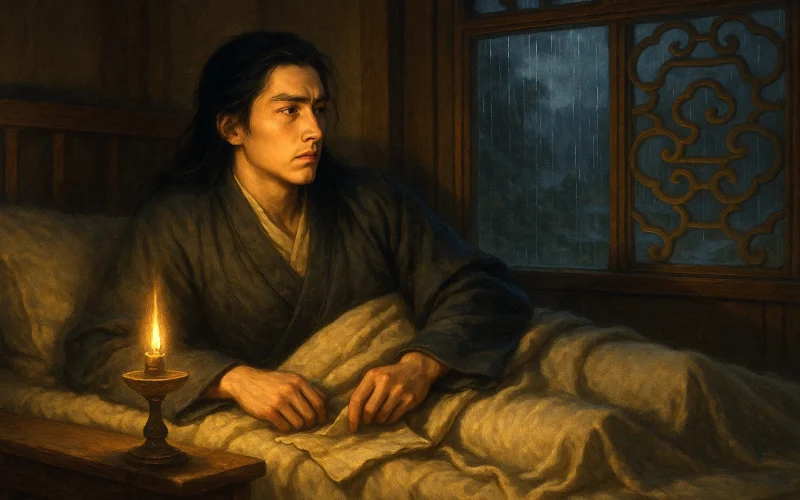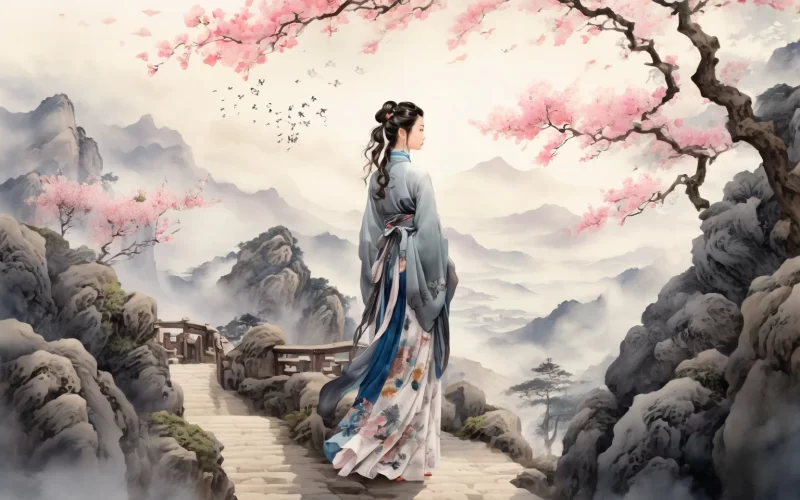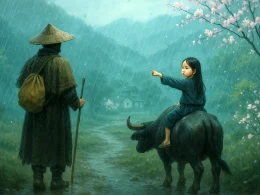

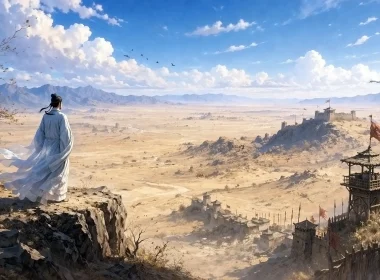
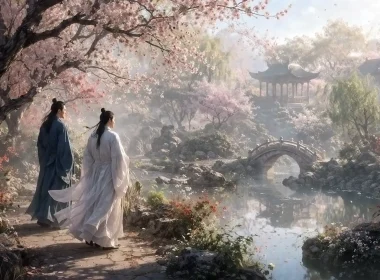
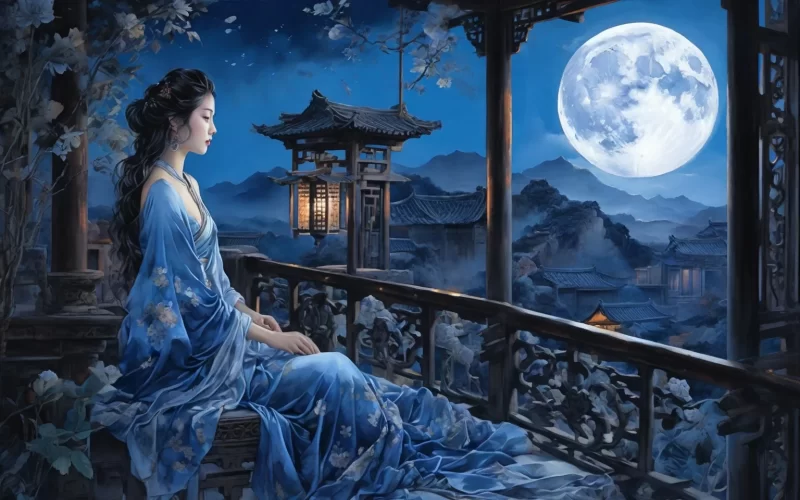
Ever since the day you went away,
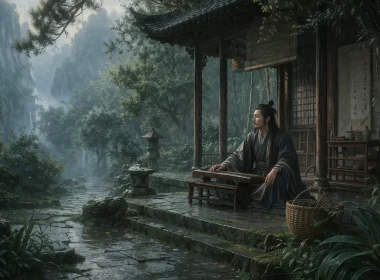
I’ve left the half‑done loom just as it lay.
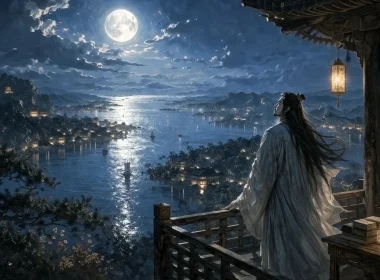
Missing you is like the full moon, round and bright,
That loses a little of its glow each night.
Original Poem
「赋得自君之出矣」
张九龄
自君之出矣,不复理残机。
思君如满月,夜夜减清辉。
Interpretation
This poem is a work in the ancient style by the High Tang poet Zhang Jiuling, written from a woman's perspective to express feelings of longing, full of tender emotion and melancholic beauty. Zhang Jiuling, styled Zishou, was a native of Qujiang, Shaozhou (present-day Shaoguan, Guangdong). He served as a famous chancellor during the Kaiyuan era of Emperor Xuanzong of Tang, known for his uprightness and outspoken admonishments. His poetic style is elegant, refined, and serene, with his twelve Reflections being the most famous, making important contributions to sweeping away the ornate style of the Six Dynasties poetry and ushering in the High Tang's imagery and spirit.
This poem is in the "fu de" (赋得) style, meaning composing a poem based on a line or phrase from ancient poets. The title line, "Ever Since the Day You Left" (自君之出矣), originally comes from a line in Xu Gan's (Han Dynasty) poem Thoughts in the Chamber: "Ever since the day you left, the bright mirror is dark, I do not tend to it." Since the Six Dynasties, there have been many imitations using this line as the title, and Zhang Jiuling's poem is one of the most outstanding among them. Using the images of the loom and the full moon, the poet writes of a woman's longing for her faraway husband with subtlety and depth. The abandonment in "I’ve left the loom unused" reflects her disordered state of mind; the wasting away in "Which wanes each night, diminishing its light" depicts the toll of her longing. The entire poem, with its extremely concise brushstrokes, writes of extremely deep emotion, standing out uniquely among the many imitations of "Ever Since the Day You Left" and becoming a timeless, celebrated piece on longing.
First Couplet: "自君之出矣,不复理残机。"
Zì jūn zhī chū yǐ, bú fù lǐ cán jī.
Ever since the day you left, I’ve left the loom unused, though silk’s unwoven.
The poem opens with "自君之出矣" (Ever since the day you left), establishing the fact of separation. These five words are stated plainly yet contain infinite feeling—ever since you left, everything has changed. The next line, "不复理残机" (I’ve left the loom unused), uses the abandonment of the loom to depict the disorder of her mind. The loom was an instrument of daily labor for ancient women, the center of their lives; "I’ve left... unused" (不复理) means she has lost the heart to work, even too listless to touch the unfinished weaving on the loom. The two words "残机" (the loom unused) signify both the loom's disuse and the incompleteness of her life, and more profoundly, the incompleteness of her state of mind. In this couplet, the poet uses the most ordinary detail of daily life to write of the deepest solitude and sorrow after parting.
Second Couplet: "思君如满月,夜夜减清辉。"
Sī jūn rú mǎn yuè, yè yè jiǎn qīng huī.
Missing you, I am like the full moon bright, Which wanes each night, diminishing its light.
This couplet is the soul of the entire poem, using the full moon as a metaphor to make abstract longing tangible as perceptible moonlight. "思君如满月" (Missing you, I am like the full moon bright) writes of the completeness and brightness of her longing—that longing is like the moon on the fifteenth day: full, plump, radiant. However, the next line, "夜夜减清辉" (Which wanes each night, diminishing its light), leads this complete longing towards an ending of gradual diminishment. The word "减" (wanes/diminishing) is the "key word" of the entire poem: the moon waxes and wanes, but her longing, with each passing night, wanes and withers along with the diminishing moonlight. The longing does not lessen, but the person within this longing daily grows thinner; the moonlight does not dim, but the moonlight in her eyes dims because of sorrow. With the contradictory contrast between the "full moon" and "diminishing its light," the poet writes of the torment of longing and the wasting of body and spirit to the marrow. This couplet, with its extremely beautiful metaphor writing of extremely deep sorrow, becomes one of the most moving famous lines in ancient Chinese longing poetry.
Holistic Appreciation
This is a divine work among Zhang Jiuling's ancient-style longing poems. The entire poem consists of four lines and twenty characters. Beginning with "Ever since the day you left" and concluding with "Missing you, I am like the full moon bright," it writes of a woman's solitude and longing after parting with subtle depth, sorrowful but not wounded.
Structurally, the poem presents a progression from the external to the internal, from action to emotion. The first couplet writes of external behavior—"I’ve left the loom unused"—using the abandonment of the loom to depict the stagnation of life. The second couplet writes of the inner world—"Missing you, I am like the full moon bright, / Which wanes each night, diminishing its light"—using the waning moonlight to depict the wasting of body and spirit. Between the two lines, the poem moves from action to emotion, from external to internal, each layer deepening, forming a seamless whole.
Thematically, the core of this poem lies in the word "减" (wanes/diminishes). The abandonment in "不复理" (left... unused) is the "diminishing" of life; the wasting in "夜夜减清辉" (wanes each night, diminishing its light) is the "diminishing" of body and spirit. This word "减" exhaustively writes of how, after parting, the woman's life and emotions are slowly consumed bit by bit in the long wait. Yet the poet does not directly speak of growing thin, does not directly speak of wasting away, but only conveys it through the moon's gradual dimming, allowing the reader to feel the endless sorrow and helplessness within the beautiful imagery.
Artistically, the poem's most moving aspect lies in the metaphorical technique of "using objects to convey emotion, using scenery to symbolize the person." The poet uses the "unused loom" to write of life's abandonment, the "full moon" to write of longing's completeness, and "diminishing its light" to write of the wasting of body and spirit. Every image is a vehicle for emotion; every scene reflects a state of mind. The loom that is "left... unused" is the materialization of the woman's state of mind; the moonlight that "wanes each night" is the embodiment of her wasting away. With extremely concise brushstrokes, the poet transforms abstract emotion into perceptible imagery, allowing the reader to feel the deepest sorrow within beautiful scenes.
Artistic Merits
- Exquisite Metaphor, Beautiful Imagery: Using the "full moon" to metaphorize longing, and "diminishing its light" to metaphorize wasting away, transforming abstract emotion into perceptible imagery, subtly deep, with a lasting resonance.
- Using Objects to Convey Emotion, Scene and Feeling Fused: Using "left the loom unused" to write of a disordered mind, and "wanes each night, diminishing its light" to write of a wasting body and spirit, where the object is the mind's image, and the description of scene is the language of emotion.
- Concise Language, Rich Meaning: The entire poem has twenty characters, without a single ornate or showy word, yet every character carries feeling, expressing the deepest longing in the simplest language.
- Progressive Emotion, Clear Layers: Moving from external behavior to the inner world, from the abandonment of life to the wasting of body and spirit, each layer deepens, striking directly at the heart.
Insights
This poem, through a long process of longing, speaks to an eternal theme—The deepest affection is often not a grand and sweeping declaration, but the life and emotions that are gradually worn away bit by bit in the day-after-day waiting.
First, it lets us see "deep affection within the ordinary." The abandonment in "left the loom unused" is the woman's deepest longing for her husband—it is not that she does not want to weave, but that she cannot bring herself to weave; it is not that she does not want to live, but that life has lost its meaning. It reminds us: True deep affection is often hidden within the most ordinary daily life, within those details of "leaving unused."
On a deeper level, this poem makes us contemplate "the cost of longing." The wasting away in "wanes each night, diminishing its light" is the cost of longing—she grows thinner day by day within the longing, slowly aging within the waiting. It makes us understand: Longing is never light; it has a heavy weight; it is not intangible; it tangibly consumes life.
And what is most moving is the restraint in the poem of being "sorrowful but not wounded." The woman does not wail, does not complain against heaven and fate; she merely quietly "left the loom unused" and silently endures the "wanes each night, diminishing its light." This restraint is the highest realm of deep affection—it is not heartlessness, but rather affection so deep that it becomes wordless.
This poem writes of a scene of longing from the High Tang, yet allows everyone who has experienced parting and tasted longing to find resonance within it. The helplessness of "left the loom unused" is the shared powerlessness of every person who longs. The wasting away in "wanes each night, diminishing its light" is the shared fate of every person who waits. The contrast between the "full moon" and the "light" is the most beautiful pain in the heart of everyone tormented by longing. This is the vitality of poetry: it writes of the woman from Zhang Jiuling's brush, but one reads of people in all eras who, in waiting, long, and in longing, grow old.
About the Poet
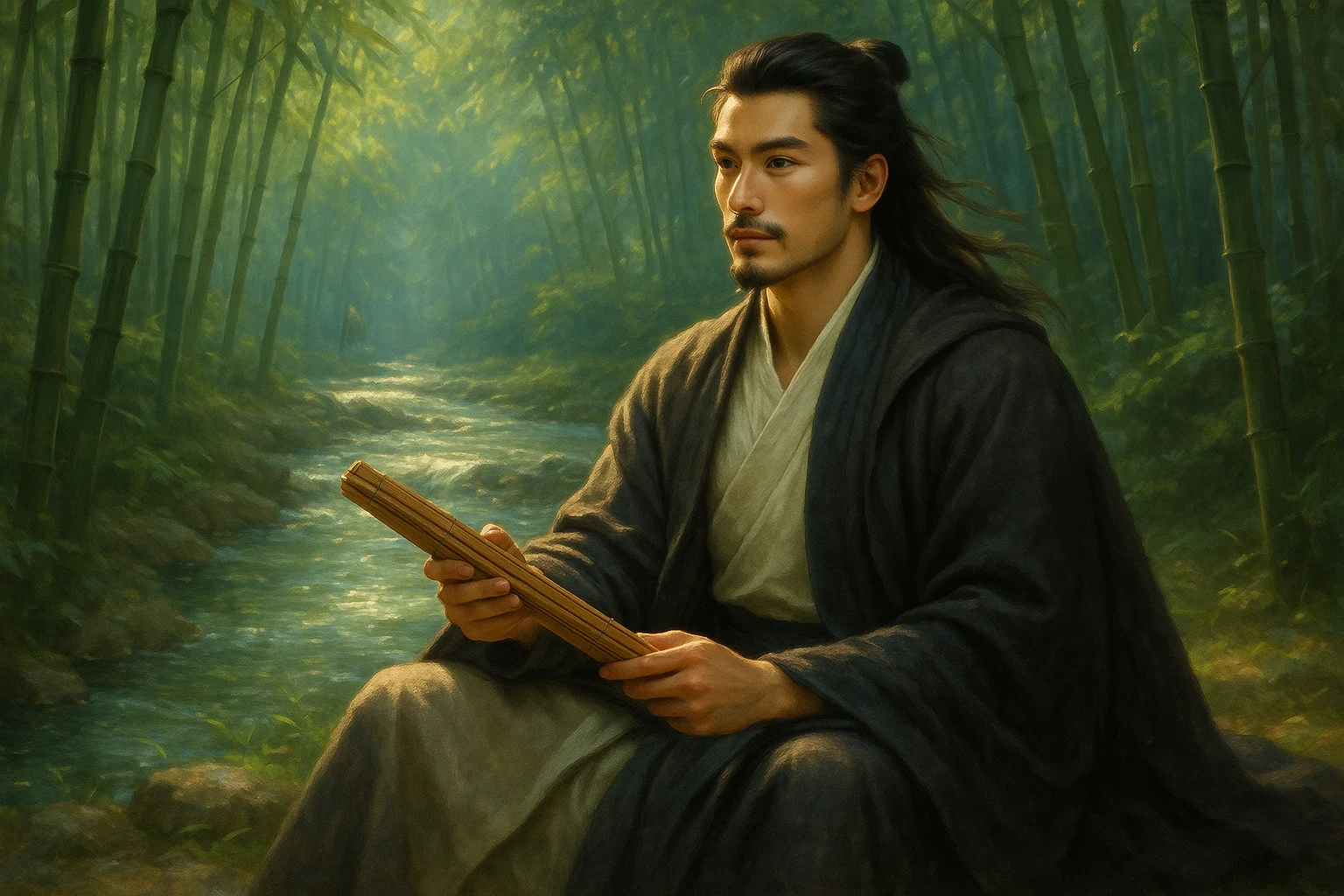
Zhang Jiuling (张九龄 678 - 740), a native of Shaoguan, Guangdong Province, was an outstanding statesman and literary figure during the transitional period from the Early Tang to the High Tang Dynasty. Born into a humble family in Lingnan, he rose to the position of Chancellor (Zhongshu Ling) during the Kaiyuan era, becoming the last virtuous chancellor of Emperor Xuanzong’s reign. He was renowned for his refined demeanor and his willingness to offer frank remonstrances. His poetic style is pure, natural, subtle, and profound, with particular excellence in five-character ancient verse. As a statesman with great vision, he mentored and promoted younger talents such as Wang Wei and Meng Haoran, holding a milestone position in the history of Tang poetry as a link between preceding and succeeding generations.