

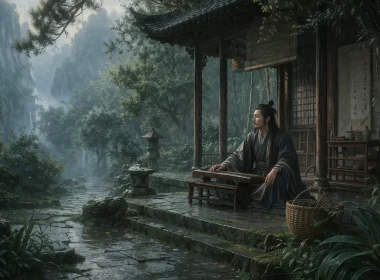
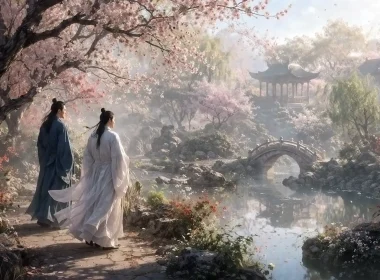

Match my tears with yours, and let them fall
Apart, into the garden pool, and all.
Then mark the lotus blossoms where they blow —
For which one’s sake they perish, you shall know.
Original Poem
「怨诗」
孟郊
试妾与君泪,两处滴池水。
看取芙蓉花,今年为谁死。
Interpretation
This is an archaizing or "old-style" lament by the Mid-Tang poet Meng Jiao, also titled An Olden Lament (Gu Yuan). Meng Jiao’s life was marked by poverty and repeated failure in the imperial examinations; he did not attain the jinshi degree until the age of forty-six and later suffered the loss of a son. His poetry frequently dwells on hardship, loneliness, and the fickleness of the world. Renowned for his "bitter chanting" (kuyin)—a style of intense, painstaking composition—he is often paired with Jia Dao under the critical label "Meng’s chill, Jia’s gauntness" (Jiao han Dao shou). A man of solitary integrity and deep sincerity, his verses often reveal an almost obsessive intensity of emotion.
The poem adopts a female persona to express the anguish of longing, yet it abandons the conventional tropes of boudoir laments, such as the "lonely empty room" or "tear-filled eyes." Instead, it opens with a startling conceit: testing the depth of yearning by whose tears, shed into separate ponds, will kill the lotus flowers. This concretization and extreme dramatization of emotion is a hallmark of Meng Jiao’s "bitter chanting" ethos—his refusal to settle for cliché, striving for startling originality to articulate a love that is bone-deep. The challenge to "test my tears against your own," the expectation in "look upon the lotus blooms," and the plaintive question "for whom they die" portray a woman’s fidelity and anxiety for her distant husband in a manner both strikingly novel and profoundly poignant. The poem’s willingness to measure love by death is also Meng Jiao’s own fierce affirmation and pursuit of the utmost sincerity in human emotion.
First Couplet: "试妾与君泪,两处滴池水。"
Shì qiè yǔ jūn lèi, liǎng chù dī chí shuǐ.
Let’s test my tears against your own, I say, In separate pools where they may fall today.
The poem begins with a hypothetical scenario introduced by the word "试" (shì, test/try). "试妾与君泪" ("Let’s test my tears against your own") is the woman’s challenge to her distant husband, a proposition to compare whose longing is deeper. Tears, the intangible medium of emotion, are made concrete, measurable, and comparable by the act of dripping them into a pond. This premise is startlingly original, instantly materializing abstract feeling and arresting the reader’s attention. The next line, "两处滴池水" ("In separate pools where they may fall"), establishes their physical separation; each must shed tears into their own local pond. The phrase "两处" (two places/locations) underscores the spatial distance and sets the stage for the comparison to follow. Though the woman cannot be with her husband, she resolves, in imagination, to complete this contest of love—a fixation that itself stands as the ultimate proof of her profound feeling.
Final Couplet: "看取芙蓉花,今年为谁死。"
Kàn qǔ fúróng huā, jīnnián wèi shuí sǐ.
Then look upon the lotus blooms, and see For whom they die this year—for you or me.
This couplet is the soul of the poem, pushing the strange conceit to its logical extreme. "看取芙蓉花" ("Then look upon the lotus blooms") directs the gaze toward the lotus flowers in the ponds. The furong (lotus/ hibiscus) serves a dual purpose: it is a real flower, but its name (furong) is also a near-homophone for "husband’s countenance" (fu rong), symbolizing the beloved’s visage and affection. The next line, "今年为谁死" ("For whom they die this year"), concludes the poem with the most extreme proposition: whose tears are more copious, whose love is deeper, will be proven by which pond’s lotuses wither and die. The word "死" (sǐ, die) is used with devastating, extreme force—so many tears that they can kill flowers; a love so deep it must be measured by death. This hyperbole is no mere emotional embellishment; it is the ultimate expression of amorous fidelity: I will cry so many tears for you they could drown the lotuses; I will prove my love even if the proof requires this lethal measure.
Holistic Appreciation
This is an extraordinary piece among Meng Jiao’s boudoir laments. In just four lines and twenty characters, spoken in a female voice, it expresses longing yet abandons convention, using a bizarre hypothetical to materialize and intensify emotional depth. It showcases the poet’s profound insight into, and fierce commitment to, genuine human feeling.
Structurally, the poem progresses from proposition to verification, from abstraction to concrete result. The first couplet, opening with "test," proposes the "tears-in-ponds" conceit, transforming intangible longing into measurable liquid. The final couplet, with "look upon," shifts focus to the lotuses, concluding with the question "for whom they die," pushing the emotional contest to its extreme. The movement is from hypothesis to action, from process to outcome, each step logically and tightly linked.
Thematically, the poem’s core lies in the shocking force of the word "die." The poet does not describe how the woman misses her love, nor how she weeps. He only shows her willingness to kill lotuses with her tears—a seemingly absurd notion that speaks precisely to the truest state of deep emotion: Genuine passion is never rational, but mad; never moderate, but extreme. The question "for whom they die" is both a test for the husband and the woman’s own affirmation of her feeling: I would die for you. Would you? This question is startling, haunting, and ultimately unanswerable.
Artistically, the poem’s most striking feature is its originality of conception—using extremity to express depth. Dissatisfied with traditional lyrical modes, Meng Jiao forges a new path, employing a near-fairy-tale metaphor to concretize emotional depth into measurable, comparable tears and flowers. This "bitterly chanted" flight of fancy is precisely what distinguishes Meng Jiao. The double meaning of furong and the lethal question make this brief poem shine within the vast ocean of Tang verse, unforgettable upon a single reading.
Artistic Merits
- Startling Conception, Novel Premise: The core idea of "measuring love by tears in ponds" brilliantly materializes abstract emotion, refreshing the reader’s sensibility.
- Skillful Symbolism, Meaningful Doubling: "Lotus" (furong) refers to the flower while homophonically suggesting "husband’s countenance" (fu rong), using the plant to represent the person and mortality to express passion, with profound implications.
- Intense Emotion, Potent Tension: The extreme image of tears killing lotuses pushes the anguish of longing to its limit, creating a startling, visceral impact.
- Lucid Diction, Subtle Resonance: Not a single word directly states "I miss you," yet every line is imbued with longing, revealing deep feeling through subtlety and achieving startling effect through apparent simplicity.
Insights
Through a contest of tears, this poem speaks to an eternal theme: Genuine, profound feeling often demands the most extreme forms of expression.
First, it shows us the "measurement of emotion." The woman wishes to measure the depth of longing by tears and verify the fidelity of love by the death of lotuses. This measurement seems absurd, yet it speaks to a psychology common to all who have loved deeply: we long to prove our love is deeper, to make the other know the bitterness of our longing. This desire to be seen, to be confirmed, is the truest shape of love.
On a deeper level, the poem prompts us to consider the "sincerity behind extremity." Tears drowning lotuses is, of course, impossible. Yet it is this very impossibility that reveals the extremity of the woman’s feeling—she is not stating a fact but expressing a desire: I would shed my last tear for you, even if those tears could drown the world. This extreme expression is, in fact, the most sincere avowal.
Most moving of all is the poem’s "pledge unto death" resoluteness. The question "for whom they die" is both a test for the husband and a declaration of self: My love is something I would prove with my life. In a fickle, shallow world, such resoluteness is especially precious. It reminds us: what is truly worth cherishing in emotion is never mere embellishment in good times, but the determination to give one’s all for the other.
The poem writes of an ancient longing, yet allows anyone who has ever loved earnestly, obsessively, to find resonance within it. The invitation to "test my tears against your own" is a question every longing heart wishes to ask; the expectation in "look upon the lotus blooms" is the shared watch of every soul who waits; the plaintive "for whom they die" is the deepest soliloquy in every devoted heart. This is the vitality of poetry: it writes of one woman’s heart, yet speaks for all, in every age, who are willing to give everything for love.
About the Poet
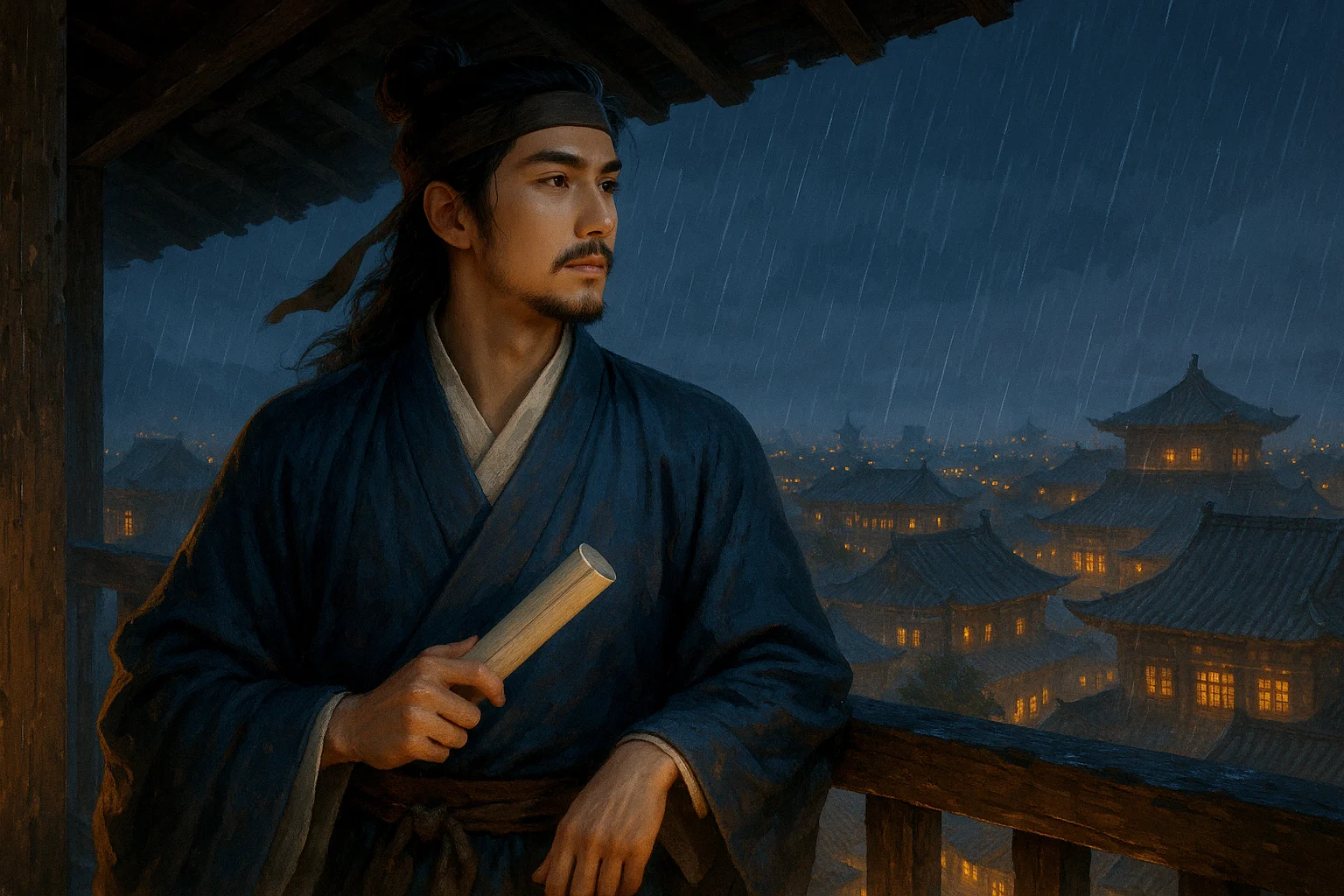
Meng Jiao (孟郊 751 - 814), a native of Deqing, Zhejiang Province, was a renowned poet of the Mid-Tang Dynasty. In his early years, he repeatedly failed the imperial examinations and only obtained the jinshi degree at the age of forty-six. He held minor posts such as Sheriff of Liyang, living a life of poverty and hardship. In his later years, he suffered the loss of his son and died while en route to a new official post. His poetry is renowned for its "bitter chanting" style, and he was often mentioned alongside Jia Dao, with Su Shi coining the famous phrase: "Jiao is lean, Jia is thin." His yuefu (Music Bureau) poems inherited the tradition of Du Fu and paved the way for Yuan Zhen and Bai Juyi, establishing a unique and distinctive place in the history of Tang poetry.