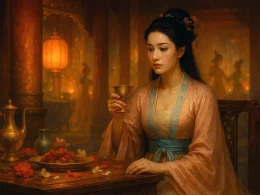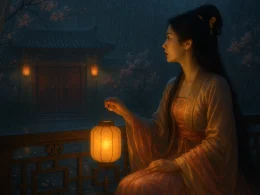

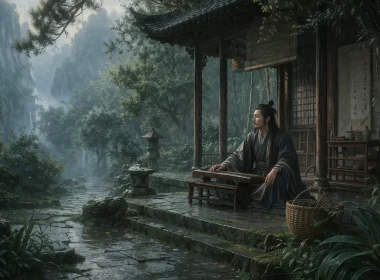
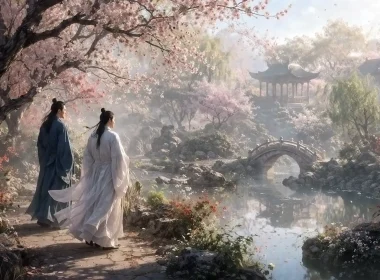
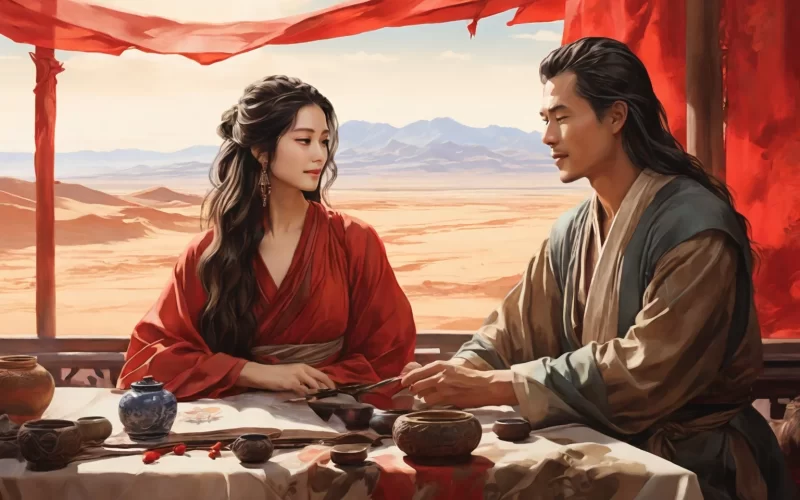
At Zhongling we parted, wine-heavy, a dozen springs fled.
I find you again, light as a shape on a palm, it is said.

I have got no fame; you have got no man.
Can it be we’ve both lacked what the world calls a plan?
Original Poem
「赠妓云英」
罗隐
钟陵醉别十余春,重见云英掌上身。
我未成名卿未嫁,可能俱是不如人。
Interpretation
This poem was composed by the late Tang poet Luo Yin for an old acquaintance, the songstress Cloud-Maid. The late Tang era was a time of social upheaval, political decay, eunuch dominance, and warlord separatism. The imperial examinations, too, were mired in corruption, often leaving talented individuals stranded in lowly posts or unrecognized for a lifetime. Drifting from one patron to another, Luo Yin lived a rootless existence, which granted him a profoundly intimate understanding of worldly fickleness and the cruel twists of fate. The "Cloud-Maid" in the poem was likely a songstress Luo Yin met in his youth in Zhongling (present-day Jinxian, Jiangxi). Then, the poet was just beginning his journey, ambitious and spirited, his literary fame budding but not yet tempered by the deep wounds of examination failure. Cloud-Maid, in the bloom of her youth, was a gifted dancer, celebrated for both her beauty and her art, a radiant presence in the taverns and pleasure houses. That "drunken farewell" was a feast of youthful days, a parting in the warm haze of wine, with neither knowing what path lay ahead for the other.
More than ten springs passed in the snap of a finger. In that decade, Luo Yin wandered between the capital and various provincial courts, time and again entering the examination halls full of hope, time and again leaving in silent dejection. His literary reputation grew, yet the injustice in his heart deepened; his poems spread throughout the land, yet success and recognition remained perpetually out of reach.
Over a decade later, the poet passed again through the old place and once more encountered Cloud-Maid. By then, Luo Yin's temples were touched by frost, yet he still wore the robes of a commoner, his ambitions unfulfilled. Cloud-Maid, though her grace remained, was still adrift in the life of a courtesan, never having found a worthy match. That moment of reunion was like a mirror, reflecting a shared tragedy for them both—one, of great talent unrecognized; the other, of beauty and skill finding no home. One cast aside by the examination halls; the other, forgotten by marital fortune. They were both the "superfluous ones" of their age, souls left behind in the corners by fate. Gazing at Cloud-Maid's still-lithe form, recalling the scene of their drunken farewell, and contrasting it with their present circumstances, the poet's heart was filled with a complex mix of emotions. Through his praise and lament for Cloud-Maid, he voiced his own deep-seated grief and indignation at his unrecognized talent. And with the self-mocking line, "Can it be we both fall short of other men?", he levels a cool, piercing challenge at the unfairness of that world.
First Couplet: "钟陵醉别十余春,重见云英掌上身。"
Zhōnglíng zuì bié shí yú chūn, chóng jiàn Yún Yīng zhǎng shàng shēn.
Drunk, we parted in Zhongling more than ten springs ago;
Meeting again, I see you light as on a palm, Cloud-Maid.
The poem opens with the words "drunken farewell," evoking the tender affection of the past. That parting, done in a haze of intoxication, held both the fervor of youth and the confusion of unknown futures. "十余春" (more than ten springs)—three words that capture the full flow of time. Not merely "over ten years," but "more than ten springs," each spring a hope for reunion, each spring also a forgetting. The next line, "重见云英掌上身" (Meeting again, I see you light as on a palm), alludes to the dancer Zhao Feiyan, famed for being so light she could dance on a man's palm, describing Cloud-Maid's enduring grace and lightness. The phrase "掌上身" (light as on a palm) is both praise and sigh—she can still dance, yet still only in the banqueting hall; she remains beautiful, yet still has found no home. This couplet moves from then to now, from parting to reunion. Within its lingering warmth, the cruelty of time already shows through.
Final Couplet: "我未成名卿未嫁,可能俱是不如人。"
Wǒ wèi chéng míng qīng wèi jià, kěnéng jù shì bù rú rén.
Fame has not come to me; you are not yet wed.
Can it be we both fall short of other men?
This couplet is the soul of the poem, an immortal line through the ages. "我未成名" (Fame has not come to me) is the poet's summation of his own life—brimming with talent, yet repeatedly failing the exams; aspiring to aid the age, yet stranded in minor posts. "卿未嫁" (you are not yet wed) is a portrait of Cloud-Maid's fate—possessing both beauty and skill, yet remaining in the dusty world, with no one to entrust her life to. Placed side by side, the two statements bind their destinies tightly together: one, of supreme talent yet unrecognized; the other, of great beauty yet finding no home—both cast out by worldly standards. The following line, "可能俱是不如人" (Can it be we both fall short of other men?), is posed as a rhetorical question. Superficially self-mocking and self-deprecating, it is in fact sharp-edged. The phrase "不如人" (fall short of other men) is irony, an accusation, a cold laugh—Are we truly lacking? Or are the world's standards themselves inverted? The poet gives no answer, nor needs one. This single question condenses within it all the grief, the resentment, the self-mockery, and the challenge, its echoes lingering, shaking the ages.
Holistic Appreciation
This is a masterpiece among Luo Yin's poems addressed to others. In just four lines and twenty-eight characters, taking a reunion with a former songstress as its starting point, it merges the poet's own lack of recognition with the woman's unmarried state, revealing the poet's profound lament and cool challenge regarding the injustice of fate.
Structurally, the poem shows a progression from past to present, from the other to the self. The first couplet uses "drunken farewell" to recall the past and "meeting again" to return to the present. The allusion "light as on a palm" describes Cloud-Maid's enduring grace, setting the stage for what follows. The final couplet shifts from praising Cloud-Maid to sighing over their shared fate. The parallel structure of "Fame has not come to me" and "you are not yet wed" juxtaposes their twin tragedies, culminating in the rhetorical question, "Can it be we both fall short of other men?", which releases the emotion accumulated in the preceding lines. Between the couplets, the movement from then to now, from her to me, deepens layer by layer, forming a seamless whole.
Thematically, the poem's core lies in the irony of the phrase "不如人" (fall short of other men). The poet and Cloud-Maid—one a man of talent, the other a beauty—by all rights should have been among society's elite, yet both were excluded from "success." This "falling short" is not real, but a judgment by worldly standards. Through self-mockery, the poet exposes the absurdity of these standards: those who "measure up" are merely the cunning, the sycophants, the unprincipled profit-seekers; while those of true talent and character are instead classed as "lacking." This technique of conveying true meaning through irony, of expressing indignation through self-mockery, is the poem's most profound aspect.
Artistically, the poem's most moving feature is its clever conception of "using the secondary figure to highlight the primary, with dual narratives unfolding in parallel." In writing of Cloud-Maid, the poet writes both of her and of himself. Praising her lightness also hints at his own unrecognized talent; lamenting her unmarried state also grieves his own lack of success. Cloud-Maid's fate becomes a mirror of the poet's own; sympathy for her becomes compassion for himself. This method of "using another's wine to drown one's own sorrows" keeps the emotion from becoming too direct, instead rendering it deeper and more poignant through its subtlety.
Artistic Merits
- Using the Secondary to Highlight the Primary, Dual Threads in Parallel: Using Cloud-Maid's fate to reflect his own predicament. Compassion for her is self-compassion; singing of her is singing of himself.
- Concluding with Irony, the Blade Sheathed: "Can it be we both fall short of other men?" is phrased as self-mockery, but is in truth a cool questioning of worldly standards. It conveys resentment without rage, satire without exposure.
- Allusion Used Aptly, Vivid Imagery: The "light as on a palm" allusion to Zhao Feiyan not only describes Cloud-Maid's grace but implies her continued, helpless existence in the pleasure quarters. The allusion is charged with feeling and deep meaning.
- Concise Diction, Enduring Resonance: Twenty-eight characters contain reminiscence, praise, lament, and rhetorical questioning. The words end, but the meaning is boundless.
Insights
This poem, through a single reunion, speaks to an eternal theme: Talent and beauty are not necessarily passports to fortune; worldly success often bears little relation to true worth.
First, it lets us see the "illusion of success." Luo Yin had talent; Cloud-Maid had beauty. Yet both were categorized as "lacking." This "lack" was not their failure, but the world's—when talent goes unrecognized, when beauty becomes a commodity, when true value is trampled, who is truly the one who "falls short"? With this question, the poet unmasks the hypocrisy of all doctrines of success.
On a deeper level, the poem prompts us to contemplate the resonance of "fellow sufferers adrift in the world." Poet and songstress, different in station, yet alike in plight: one, talented but unrecognized; the other, beautiful and gifted but homeless. One repeatedly failed in the examination halls; the other drifted in the dusty world. Their reunion is a mutual reflection of two souls abandoned by fate. This sentiment of "shared sorrow" elevates the poem beyond personal lament, granting it a universal human compassion.
And most moving is the poem's sense of "dignity in the face of neglect." The poet does not grovel, does not rail against heaven. He merely states calmly the fact: "Fame has not come to me; you are not yet wed." Then he glosses it over lightly with, "Can it be we both fall short of other men?" Within that light question lies self-mockery, resentment, anger, but never self-abasement. True nobility lies not in worldly recognition, but in the clarity and unyielding pride one maintains when faced with injustice.
This poem writes of a reunion in the late Tang, yet it allows everyone who has faced injustice in reality, who has been cast aside by mainstream values, to find an answering chord within it. The sigh of "Fame has not come to me" is the shared sentiment of countless talented scholars; the compassion in "you are not yet wed" is a portrait of all those let down by fortune; the challenge of "Can it be we both fall short of other men?" is the most profound riposte every clear-sighted soul makes to this world. This is the vitality of poetry: it writes of the fate of two, but it speaks to the secret heart of all.
About the poet
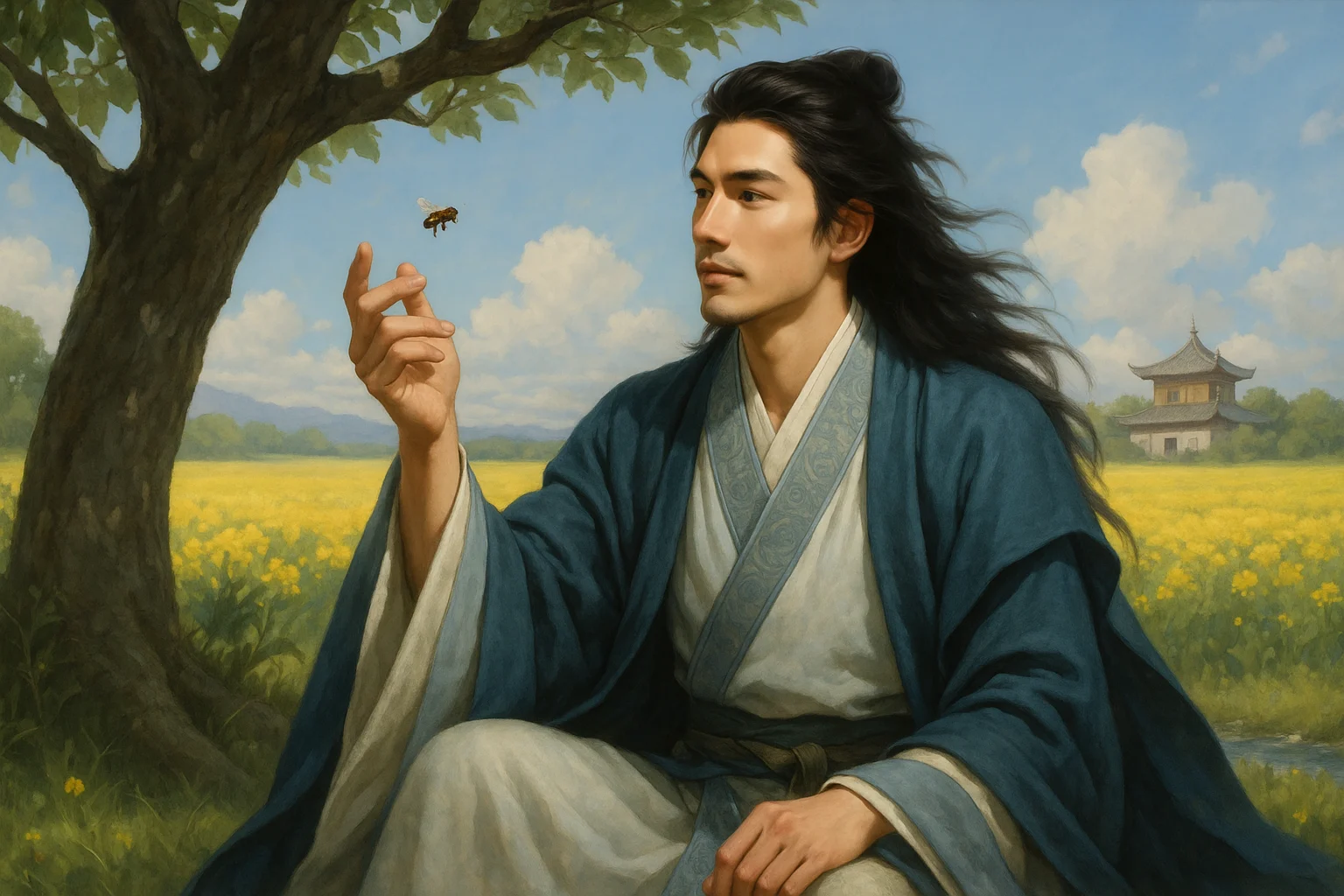
Luo Yin (罗隐 833 - 910), a native of Fuyang, Hangzhou, Zhejiang Province, was a renowned writer and thinker of the late Tang Dynasty. As a key literary figure of the late Tang period, Luo Yin was unparalleled in his time for his satirical poetry and prose. His poems often directly targeted social darkness, employing sharp and accessible language that cut straight to the heart of late Tang political corruption. With nearly 500 surviving poems, he was known alongside Du Xunhe and Luo Ye as one of the "Three Luos" in the late Tang poetic circle, standing out as a unique and powerful voice amidst the ornate and decadent trends of the era.