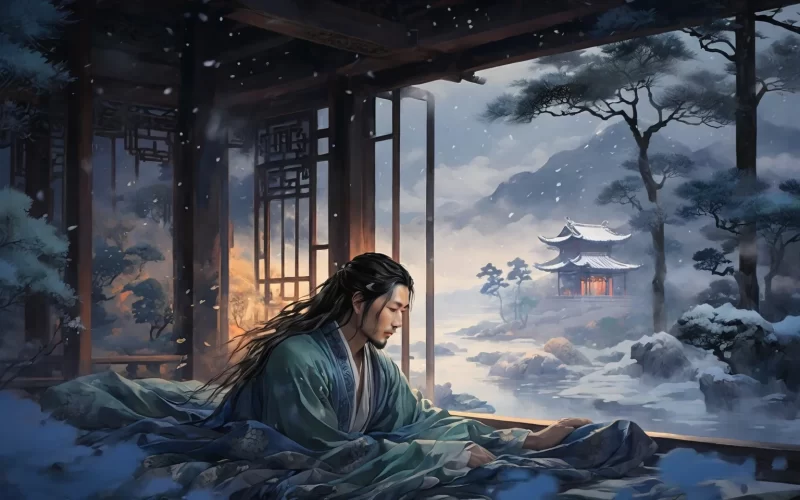

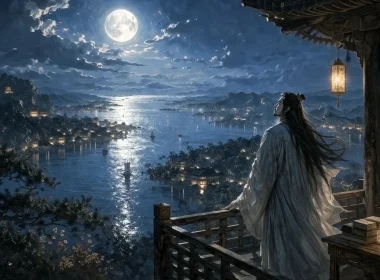
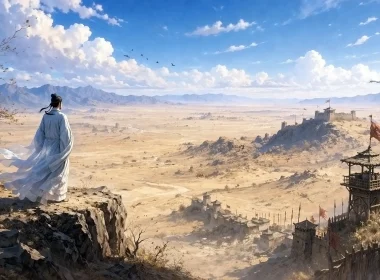
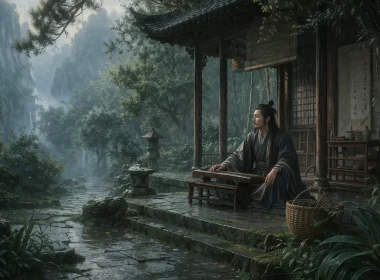
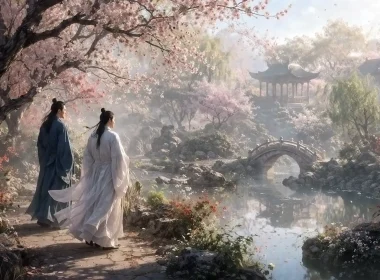
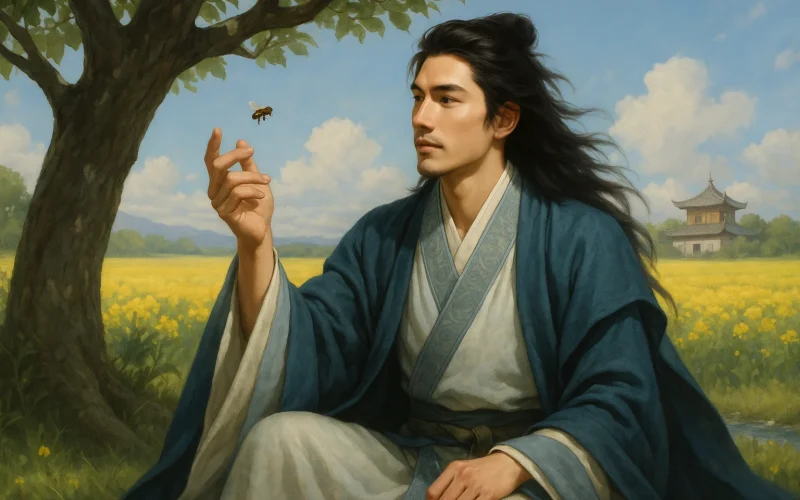
Luo Yin (罗隐 833 - 910), a native of Fuyang, Hangzhou, Zhejiang Province, was a renowned writer and thinker of the late Tang Dynasty. As a key literary figure of the late Tang period, Luo Yin was unparalleled in his time for his satirical poetry and prose. His poems often directly targeted social darkness, employing sharp and accessible language that cut straight to the heart of late Tang political corruption. With nearly 500 surviving poems, he was known alongside Du Xunhe and Luo Ye as one of the "Three Luos" in the late Tang poetic circle, standing out as a unique and powerful voice amidst the ornate and decadent trends of the era.
Major Works


Life
Luo Yin, originally named Luo Heng, courtesy name Zhaojian, art name Jiangdongsheng, was a native of Xincheng, Hangzhou (present-day Fuyang District, Hangzhou City, Zhejiang Province). He was born in the seventh year of the Taihe era of Emperor Wenzong of the Tang dynasty (833 AD) and died in the fourth year of the Kaiping era of Emperor Taizu of the Later Liang dynasty (910 AD). He was a renowned satirical poet and essayist of the Late Tang dynasty, distinguished in literary history for his sharp writing style and profound social criticism. He was known as one of the "Three Luos," together with Luo Qiu and Luo Ye.
Luo Yin was born into a declining official family. His grandfather had served as a county magistrate, and his father had also entered officialdom, but the family fortunes had declined, and by Luo Yin's time they were quite impoverished. He was intelligent and studious from a young age, with a vast memory and extensive knowledge, excelling especially in poetry and prose. In his youth, he was already known for his talent in his hometown. However, he was ugly in appearance; historical records state that he had "an ancient and ugly countenance." This defect repeatedly became an obstacle in his subsequent examination career.
In the thirteenth year of the Dazhong era of Emperor Xuanzong (859 AD), at the age of twenty-seven, Luo Yin went to Chang'an for the first time to take the imperial examinations, thus beginning a grueling examination journey lasting more than twenty years. From the end of the Dazhong era to the Qianfu era of Emperor Xizong, he took the Jinshi examination ten times but failed each time, a historical fact known as "ten attempts without success." This experience was rare even in the examination history of the Tang dynasty and became the most indelible trauma of Luo Yin's life.
The reasons for Luo Yin's repeated failures were quite complex. First, his ugly appearance was indeed a disadvantage in the Tang officialdom, which valued appearance. According to legend, the daughter of Chancellor Zheng Tian loved Luo Yin's poetry and often recited his works. Zheng Tian thus invited Luo Yin to his mansion, and his daughter peeked at him from behind a curtain. Seeing his ugliness, she never recited his poems again. Second, Luo Yin had an arrogant and unyielding personality, disliked currying favor, and his writing style was sharp and caustic, fond of satirizing current politics. This naturally made him unwelcome in the examination arena. Third, the late Tang politics were corrupt, the examination system was dark, and the practice of soliciting influence was rampant. Poor scholars without connections or influence found it very difficult to stand out.
In the eleventh year of the Xiantong era (870 AD), Luo Yin met Wei Zhuang, Sikong Tu, and others who were also taking the examinations that year in Chang'an. They drank and composed poetry together, temporarily alleviating the distress of his failures. He also submitted his writings to influential figures at court such as Linghu Tao and Zheng Tian, hoping for recommendations, but ultimately nothing came of it. During the more than ten years he spent in Chang'an, he witnessed the corruption of officialdom, the extravagance of the powerful, and the suffering of the common people. The pent-up indignation in his heart grew daily, all of which became material for his later creations.
During the Qianfu era of Emperor Xizong (874-879 AD), the rebellions of Wang Xianzhi and Huang Chao broke out, plunging the realm into chaos. In the first year of the Guangqi era (885 AD), at the age of fifty-three, Luo Yin had no choice but to leave Chang'an and return south to his hometown. Thereafter, he traveled through the provinces of Huai and Run, successively seeking refuge with Gao Pian, the Military Governor of Huainan, and Zhou Bao, the Military Governor of Zhenhai, among other regional warlords, but all without success. While in Huainan, he wrote "Inscribed on the New List" to satirize Gao Pian's superstition in immortals and narrowly escaped death.
In the third year of the Guangqi era (887 AD), at the age of fifty-five, Luo Yin returned east to Hangzhou and sought refuge with Qian Liu, the Prefect of Hangzhou. Qian Liu came from a humble background but was a man of great talent and strategy, later establishing the Wuyue Kingdom and becoming a powerful ruler during the Five Dynasties and Ten Kingdoms period. Qian Liu had long heard of Luo Yin's fame and treated him with great respect. First, he recommended him as Magistrate of Qiantang, then appointed him as his Secretary, and later promoted him to Administrative Assistant and Salt and Iron Transport Commissioner. In Qian Liu's headquarters, Luo Yin was highly valued and finally ended decades of wandering, living a relatively stable life.
In Qian Liu's headquarters, Luo Yin not only participated in military and political affairs but also used his literary talent to draft memorials and write epitaphs for Qian Liu. He advised Qian Liu to raise troops against the Later Liang dynasty. Although his advice was not adopted, it demonstrated his moral integrity. He also wrote poems advising Qian Liu to reduce taxes and be considerate of the people's strength, showing his concern for the people's hardships. Qian Liu held him in high esteem, addressing him as "Master Luo Yin" rather than by his name.
In the fourth year of the Tianyou era of Emperor Ai of Tang (907 AD), Zhu Wen usurped the Tang throne and established the Later Liang dynasty. Qian Liu was enfeoffed as the King of Wuyue, and Luo Yin subsequently entered the service of the Wuyue Kingdom. In the fourth year of the Kaiping era of the Later Liang (910 AD), Luo Yin died of illness in Hangzhou at the age of seventy-eight. Qian Liu was deeply grieved, personally composed a eulogy, and buried him with full honors.
Looking at his life as a whole, Luo Yin went from a down-and-out scholar who "failed ten examinations" to a staff member appreciated by Qian Liu in his later years, enjoying honor and respect. Such dramatic turns of fate are rare even among Tang dynasty poets. It was precisely these坎坷 experiences that shaped his sharp and profound satirical style, making him one of the most acute critics of late Tang society.
Stylistic Characteristics
Luo Yin's literary achievements are mainly reflected in two aspects: poetry and satirical essays. His poetry reached its highest distinction in seven-character regulated verse and seven-character quatrains, while his essays are most famous for his collection Chan Shu (Book of Slander). Stylistically, his work is characterized by pungent satire and profound incisiveness, establishing a unique place for him in the late Tang poetic scene.
Satirical Poetry
Luo Yin is one of the most outstanding satirical poets of the Tang dynasty. He inherited the tradition of Du Fu's concern for reality and Bai Juyi's principle of "singing only of the people's suffering," but with his unique sharp style and profound social insight, he pushed satirical poetry to new heights. His satirical poems cover a wide range of themes, encompassing various aspects of late Tang society: from the corruption of the court and the darkness of the examination system, to the extravagance of the powerful and the fickleness of the world, to the cruelty of war and the suffering of the common people – all became targets of his satire.
His satirical techniques are diverse and superb. He excels at using contrast to reveal the essence of things through stark juxtaposition. For example, in "Snow" (雪), the lines "长安有贫者,为瑞不宜多" contrast the traditional notion of timely snow as an auspicious omen with the reality that the poor cannot withstand the severe cold. With a light touch, he exposes class opposition. He excels at using irony, concealing profound criticism beneath superficial praise. For instance, in "Presented to the Courtesan Yunying" (赠妓云英), the lines "我未成名君未嫁,可能俱是不如人" express indignation at the injustice of the examination system through self-mockery, and the word "可能" is a masterstroke of irony. He also excels at using historical allusions, employing the past to satirize the present, endowing his satire with a sense of historical weight.
The most representative of his satirical poems are those on historical themes. For example, in "Xi Shi" (西施), the lines "家国兴亡自有时,吴人何苦怨西施" refute the cliché of "beauty as the cause of national ruin" with clear historical consciousness, defending Xi Shi while actually criticizing rulers who shirk responsibility. Similarly, in "Emperor Yang's Mausoleum" (炀帝陵), the lines "君王忍把平陈业,只换雷塘数亩田" contrast Emperor Yang of Sui's achievements with his desolate posthumous state, satirizing the obsession of emperors through the ages.
Historical Poetry
Luo Yin's historical poems are closely related to his satirical poems but have their own unique characteristics. He often selects specific figures or events from history, using his sharp style to reveal the lessons within, thereby satirizing the present. The characteristic of his historical poems is not simply nostalgia for the past, but the juxtaposition of past and present, making history a mirror for reality.
For example, in "The Book-Burning Pit" (焚书坑), the lines "坑灰未冷山东乱,刘项原来不读书" take the historical fact of Qin Shi Huang's burning of books and burying of scholars as a starting point, pointing out that tyranny cannot prevent rebellion, and that Liu Bang and Xiang Yu, who overthrew the Qin dynasty, were precisely those who did not read books – the satirical intent is extremely strong. Similarly, in "Wang Jun's Tomb" (王浚墓), the lines "男儿未必尽英雄,但到时来命即通" contrast Wang Jun's achievement in conquering Wu with his posthumous obscurity, expressing reflections on the unpredictability of fate, which is actually a critique of the late Tang society where "heroes have no use."
Object-Poetry
Luo Yin's object-poetry often expresses his feelings and ambitions through objects, imbuing seemingly ordinary things with profound reflections on life. For example, the famous "Bee" (蜂): "不论平地与山尖,无限风光尽被占。采得百花成蜜后,为谁辛苦为谁甜?" Using the image of bees gathering honey, this poem depicts the social reality that laborers work hard but do not enjoy the fruits of their labor. The meaning is profound, and it has become a timeless masterpiece.
Similarly, in "Parrot" (鹦鹉), the lines "莫恨雕笼翠羽残,江南地暖陇西寒。劝君不用分明语,语得分明出转难" use the parrot as a metaphor to express the fear of saying too much and getting into trouble in a chaotic era. It is both a self-warning and a helpless reflection on the political situation.
Language Style
Luo Yin's poetic language is generally characterized by popularity and fluency. He does not pursue obscure allusions and difficult diction, but excels at expressing profound thoughts in simple language. This style made his poems easy to recite and widely circulated. However, within this simplicity lies a sharp edge; seemingly plain sentences often conceal a penetrating wit, inviting reflection.
At the same time, Luo Yin's poems often express a cynical sentiment and an unyielding personality. This individuality, combined with his sharp language, forms a unique artistic charm.
Essays
Luo Yin was not only a poet but also a renowned prose writer of the late Tang. His collection of essays, Chan Shu, in five volumes containing over sixty pieces, is a famous collection of satirical prose in Chinese literary history. In his own preface, Luo Yin states: "If there is something that can be slandered, then I slander it; this is also in line with the principle that saying more is not harmful." The title Chan Shu, meaning "Book of Slander," indicates that the book's purpose is satire and criticism.
The essays in Chan Shu are mostly short and pithy satirical pieces with a wide range of themes and diverse forms, including arguments, fables, and miscellaneous reflections. He excels at using fables to allegorically criticize social ills. For example, "On the Heavenly Rooster" (说天鸡) uses the story of a man surnamed Zu raising a "heavenly rooster" to satirize those who are all show and no substance. "Words of Heroes" (英雄之言) uses the story of Liu Bang and Xiang Yu expressing their feelings upon seeing Qin Shi Huang to expose that so-called heroes are merely those who covet the possessions of others. These essays, with their sharp style and profound meaning, stand out in the late Tang literary scene.
Lu Xun, in "The Crisis of the Essay," highly praised Chan Shu, stating: "Luo Yin's Chan Shu is almost entirely composed of words of struggle and indignation." This evaluation accurately points out the essential characteristic of Luo Yin's essays.
Literary Influence
Luo Yin occupies an important position in the late Tang poetic scene, and his influence spans the Tang, Five Dynasties, and Song dynasties, establishing a unique place for him in Chinese literary history.
Representative Figure of Late Tang Satirical Poetry
Luo Yin, together with Du Xunhe and Nie Yizhong, represents the realist school of poetry in the late Tang. They inherited the tradition of the "New Music Bureau" movement initiated by Bai Juyi in the mid-Tang, using poetry to reflect social reality and expose the suffering of the people. With his sharp satire and profound social insight, Luo Yin became the most incisive poet of this school. His satirical poems reached unprecedented depth and intensity in exposing social darkness and criticizing political corruption.
Influence on Song Dynasty Poetry
Luo Yin's poetic style had a profound influence on Song dynasty poets. Wang Yucheng and Mei Yaochen of the Northern Song advocated for poetry to reflect reality, a creative orientation that was in line with Luo Yin's. The influence of Luo Yin can also be seen in the satirical poems of Lu You and Fan Chengda of the Southern Song. Particularly, Luo Yin's popular, fluent, incisive, and profound language style had a certain impact on the Song poetic tendency of "using prose as poetry."
Pioneering Contribution to the Essay
Luo Yin's Chan Shu occupies an important position in the history of Chinese prose. It inherited the tradition of fable and satire from Liu Zongyuan and initiated the late Tang satirical essay. In "The Crisis of the Essay," Lu Xun grouped Luo Yin with Pi Rixiu and Lu Guimeng, calling them the "brilliance and sharpness in the muddy pond" of the late Tang. This evaluation accurately points out the unique position of Luo Yin and others in the late Tang literary scene. The essays in Chan Shu had a profound influence on the development of satirical literature in later generations.
Image in Folklore
Luo Yin holds a special place in folklore. Due to his坎坷 experience of "ten failures" and his sharp satirical talent, the legend of "Luo Yin the Scholar" gradually formed among the people. Legend has it that Luo Yin had the "bones of a beggar but the mouth of a sage." Although he lived in poverty all his life, whatever he said came true as prophecy. Such legends are widespread in Zhejiang, Jiangxi, and other areas, reflecting the sympathy and respect of the common people for this talented but unrecognized scholar. This folk image also makes Luo Yin a rare case among Tang poets who entered the folk belief system.
In summary, Luo Yin was the most outstanding satirical poet and essayist of the late Tang. His life was full of frustrations; he "failed ten examinations," but with his sharp pen and unyielding spirit, he left behind a large body of works that profoundly reflect social reality. The warning of "长安有贫者,为瑞不宜多" in "Snow," the question "为谁辛苦为谁甜" in "Bee," the insight "家国兴亡自有时" in "Xi Shi," and the mockery "刘项原来不读书" in "The Book-Burning Pit" all embody his keen insight and profound critical spirit. His Chan Shu* is a model of late Tang satirical prose, praised by Lu Xun as the "brilliance and sharpness in the muddy pond." He carried on the realist tradition of Bai Juyi and paved the way for the satirical poetry of the Song dynasty, occupying a unique and important position in Chinese literary history. His poetry and his person, even after a thousand years, still allow us to envision his unyielding spirit and his world-weary defiance.