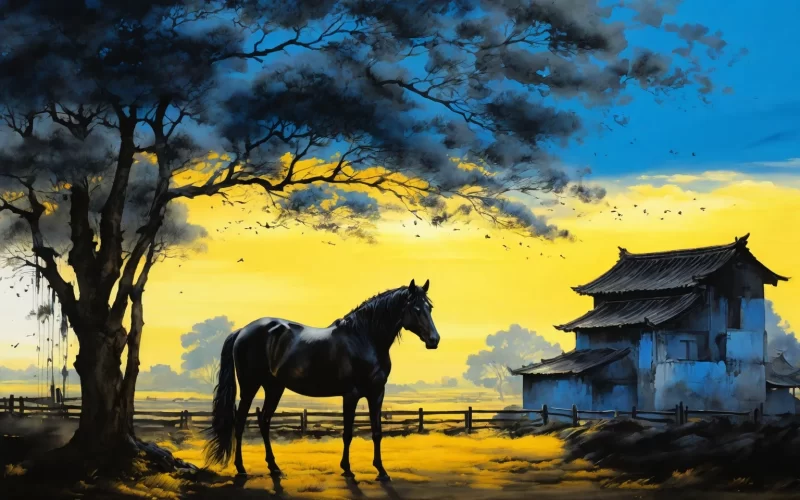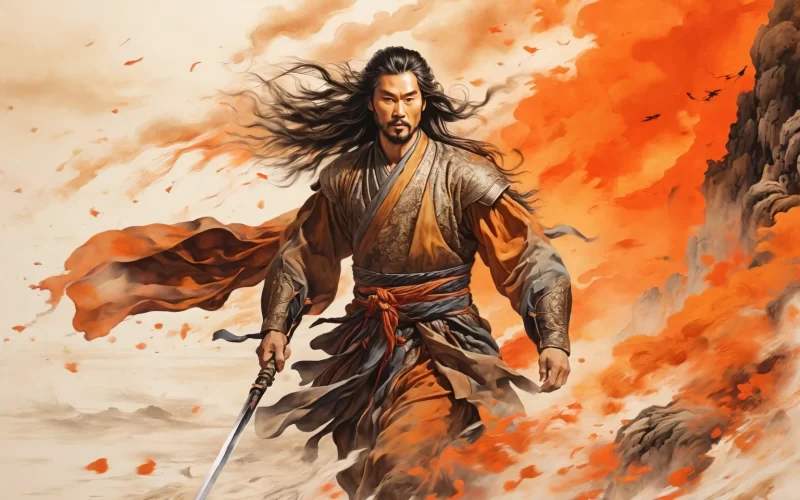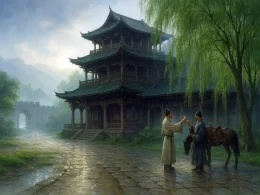
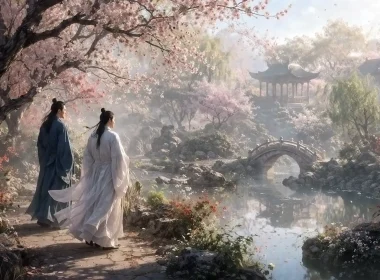
For gods and immortal things the Emperor did pine;
He burned his gold, and won but violet smoke for sign.

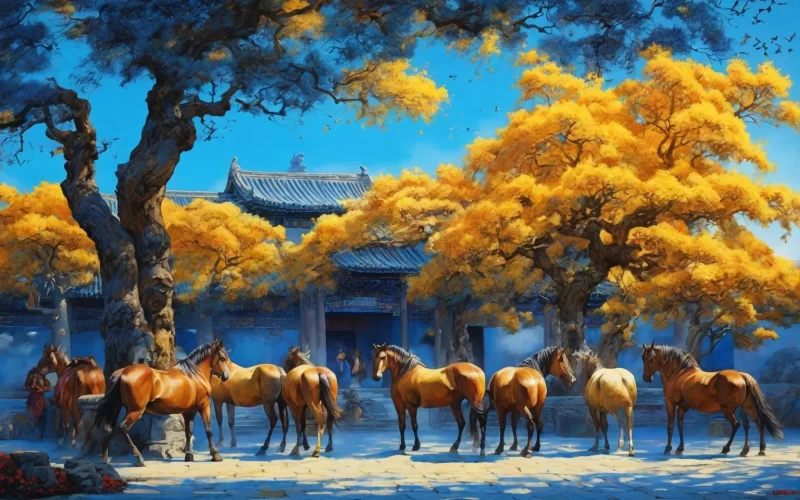
And in his halls, what steeds are fed and stabled there?
Great fleshly horses, dreaming on their straw and air —

Who have no skill, no dream, no wing to climb the steep
Where the high heaven’s azure hangs, profound and deep.
Original Poem
「马诗 · 其二十三」
李贺
武帝爱神仙,烧金得紫烟。
殿中皆肉马,不解上青天。
Interpretation
"Horse Poems" comprises twenty-three poems; this is the final one. Unlike the previous poems, which used the horse as a metaphor for unrecognized talent, this one takes a sharp turn, directly targeting an emperor. Emperor Wu of Han's (汉武帝, Hàn Wǔdì) quest for immortality is a famous episode in history. Credulous of the magicians Li Shaojun and Luan Da, he sent expeditions overseas in search of Penglai, the fabled isle of immortals, personally oversaw alchemical practices and sacrifices, exhausting the state's resources, all to no avail. The line "Smelting gold, he got but violet smoke" (烧金得紫烟, shāo jīn dé zǐ yān) sums up the farcical outcome—prodigious expenditure yielded only a wisp of ethereal smoke, intangible and fleeting.
But was Li He writing only of Emperor Wu of Han? Not necessarily. During the Yuanhe era in which Li He lived, Emperor Xianzong of Tang (唐宪宗, Táng Xiànzōng) was similarly obsessed with immortality, repeatedly summoning magicians and consuming alchemical elixirs. He ignored his ministers' admonitions and felt no remorse even when suffering from elixir poisoning. Serving in the Court of Imperial Sacrifices, Li He could not have been unaware of these affairs. The "Martial Emperor" in the poem most likely alludes to the reigning sovereign. The latter half of the poem shifts from the quest for immortality to the matter of employing talent. To obtain the famed "Heavenly Horses," Emperor Wu of Han dispatched Li Guangli on a distant campaign against Dayuan, resulting in countless casualties. Yet, no matter how divine these horses were, they could not carry a man to heaven. More laughable still, the imperial stables were filled with nothing but plump, ordinary "flesh-horses" (肉马, ròu mǎ), who knew only to eat grass, had no understanding of galloping, let alone flying to heaven. Is this merely about horses? Clearly, it is a critique of the mediocre officials who filled the court—occupying positions yet incapable of any real achievement.
First Couplet: "武帝爱神仙,烧金得紫烟。"
Wǔdì ài shénxiān, shāo jīn dé zǐ yān.
The Martial Emperor loved gods and immortals;
Smelting gold, he got but violet smoke.
The opening word "loved" (爱, ài) points to the emperor's obsession. "Smelting gold" (烧金, shāo jīn) refers to alchemy; magicians claimed that refining gold into elixirs could grant immortality. The three words "got but violet smoke" (得紫烟, dé zǐ yān) are deeply ironic—after immense expenditure of resources and labor, the result? Merely a wisp of smoke. Smoke is visible, intangible, and dissipates in an instant. The word "got" (得, dé) is used with bitter precision: he did not gain immortality, nor an elixir; he "got" only smoke.
Second Couplet: "厩中皆肉马,不解上青天。"
Jiù zhōng jiē ròu mǎ, bù jiě shàng qīngtiān.
His stables held all flesh-horses,
Who could not gallop up to the blue sky.
This couplet shifts from seeking immortality to the use of horses, seemingly a new topic but logically connected. "Flesh-horses" (肉马, ròu mǎ) refers to ordinary horses, fat and sturdy, fit only for pulling carts or plowing fields, incapable of charging across battlefields, much less flying to become immortals. "Could not gallop up to the blue sky" (不解上青天, bù jiě shàng qīngtiān) carries a double meaning: literally, horses cannot ascend to heaven; metaphorically, these mediocre individuals fundamentally fail to comprehend what true ambition or significant enterprise entails. The Martial Emperor sought immortality his whole life, yet was surrounded by nothing but "flesh-horses"—this is both satire and sigh.
Holistic Appreciation
This poem's approach differs entirely from the previous ones. The earlier poems used the horse primarily as a metaphor for the self, expressing the plight of unrecognized talent. This one, however, uses the past to satirize the present, criticizing the folly of the ruler and the mediocrity of the court.
The poem's twenty characters form two layers. The first two lines describe the absurdity of the emperor's quest for immortality; the last two lines describe the failure in employing talent. The logical connection is clear: precisely because the emperor focused his mind on the intangible "violet smoke," he ended up surrounded by "flesh-horses" filling the posts. These two matters seem unrelated but are in fact cause and effect.
Linguistically, Li He employs a form of cold humor. "Smelting gold, he got but violet smoke"—the word "got" is stated matter-of-factly, describing the most absurd outcome. The term "flesh-horses" is even more blunt and unceremonious. This austere tone is more powerful than loud condemnation.
It is noteworthy that while the poem satirizes Emperor Wu of Han, its critique likely targets the contemporary court. When Li He wrote this series, Emperor Xianzong of Tang was obsessed with elixirs, and many court ministers were complacent and opportunistic. The poet, witnessing this, could not speak directly, so he borrowed the wine cup of the ancients to pour out his own pent-up frustrations.
Artistic Merits
- Using the Past to Satirize the Present, Employing Double Entendre: Superficially about Emperor Wu of Han, it actually alludes to the contemporary emperor. This method is both safe and sharp.
- Cold Mockery and Satire, Delivered Deadpan: "Smelting gold, he got but violet smoke" states the absurd matter with a straight face, the austere tone concealing the sharpest satire.
- Vivid Contrast, Tight Logic: The first couplet describes the emptiness of the emperor's quest; the second describes the reality of court appointments. Placed side by side, cause and effect become self-evident.
- Concise Language, Profound Meaning: The two images, "violet smoke" and "flesh-horses," thoroughly convey absurdity and mediocrity; twenty characters equal a political treatise.
- Forceful Conclusion, Enduring Resonance: The five words "Could not gallop up to the blue sky" describe horses and also people; they are both a sigh and a critique.
Insights
In twenty characters, this poem punctures two myths: the myth of immortality and the myth of employing the mediocre. It allows us to see the delusion behind the "quest for immortality." Whether Emperor Wu of Han or Emperor Xianzong of Tang, they sought to transcend life's limits but applied their efforts in the wrong direction. Smelting gold and refining elixirs yielded only a wisp of smoke. This reminds us: the pursuit of transcendence is noble, but if the direction is wrong, the more one invests, the more one loses.
The line "厩中皆肉马" speaks to the essence of employing talent. No matter how well-fed, flesh-horses cannot run a thousand li; mediocrities occupying posts cannot accomplish great deeds. The question is, why can flesh-horses enter the stables? Because the master is busy with other things—busy seeking immortality, busy refining elixirs, busy pursuing intangible phantoms. This teaches us: the quality of an organization often depends on where the leader's mind is focused.
On a deeper level, the poem also reveals Li He's courage and insight. He was merely a minor ninth-rank official, yet dared to use poetry for remonstrance, directly pointing out the emperor's failings. This kind of courage is even rarer than his literary talent.
About the Poet
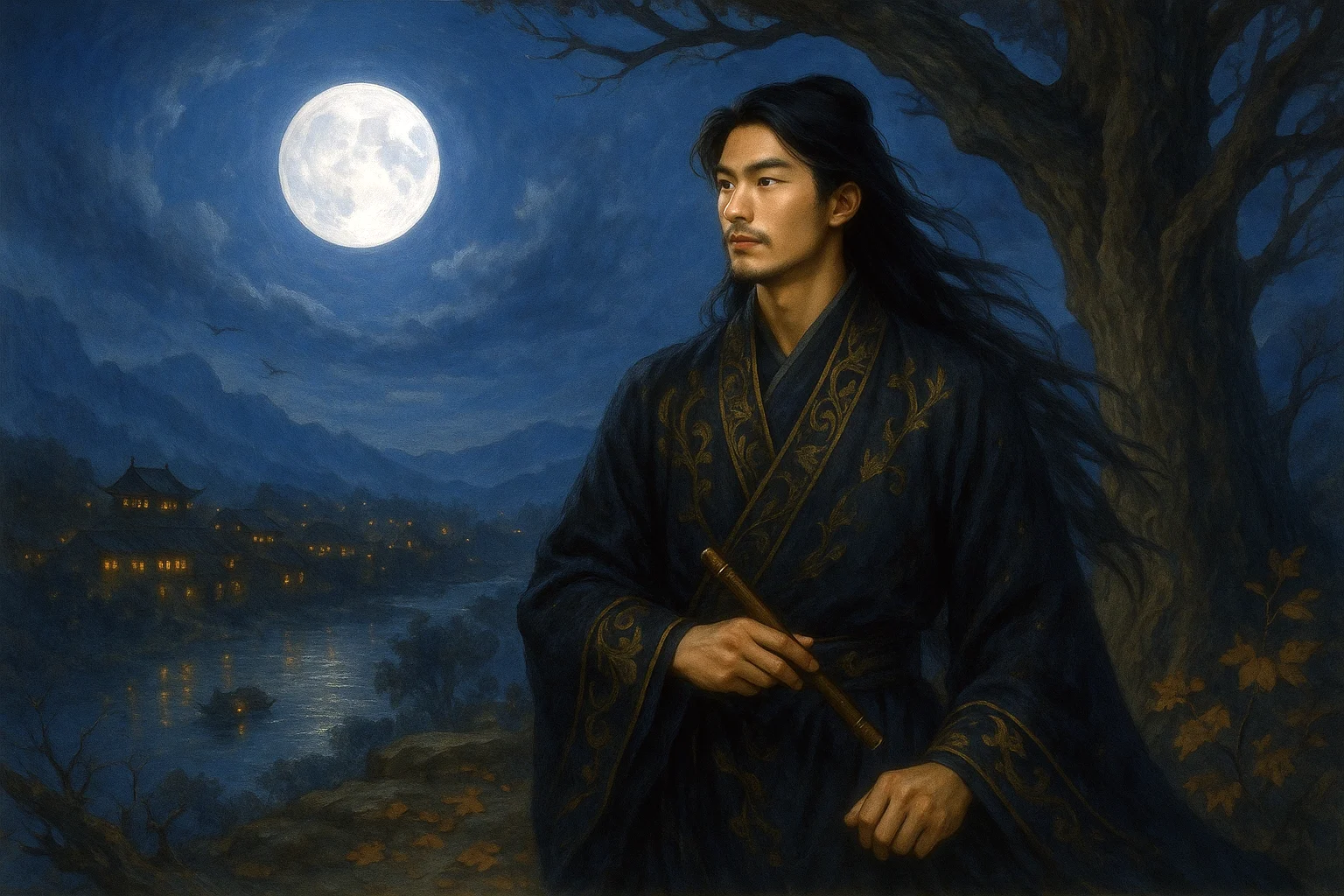
Li He (李贺 790 - 816), a native of Yiyang, Henan, was a Romantic poet of the Mid-Tang dynasty. A descendant of the Tang imperial clan, he was barred from taking the national jinshi civil service examination due to a naming taboo (his father's name contained a character homophonous with "Jin"), which led to a life of frustration and poverty. He died at the age of twenty-seven. His poetry, renowned for its bizarre grandeur, chilling elegance, and fantastical imagination, earned him the title "Ghost of Poetry." He pioneered the distinctive "Changji Style" within Tang poetry, exerting a profound influence on later poets like Li Shangyin and Wen Tingyun and on the expansion of poetic imagery in subsequent eras.