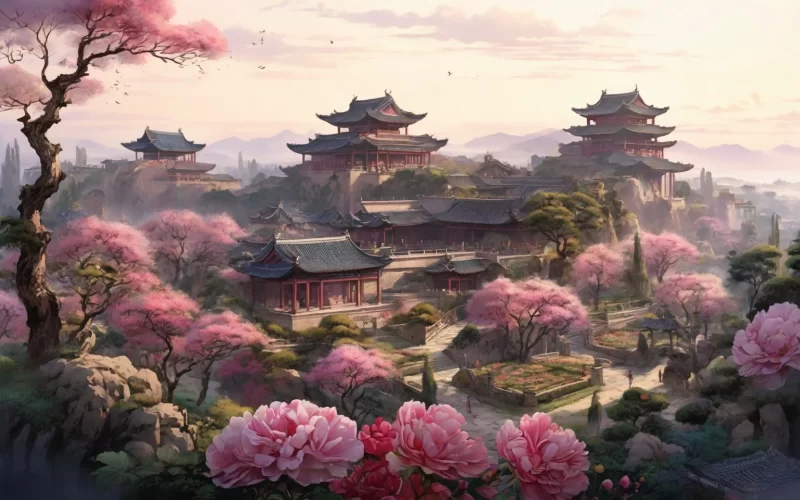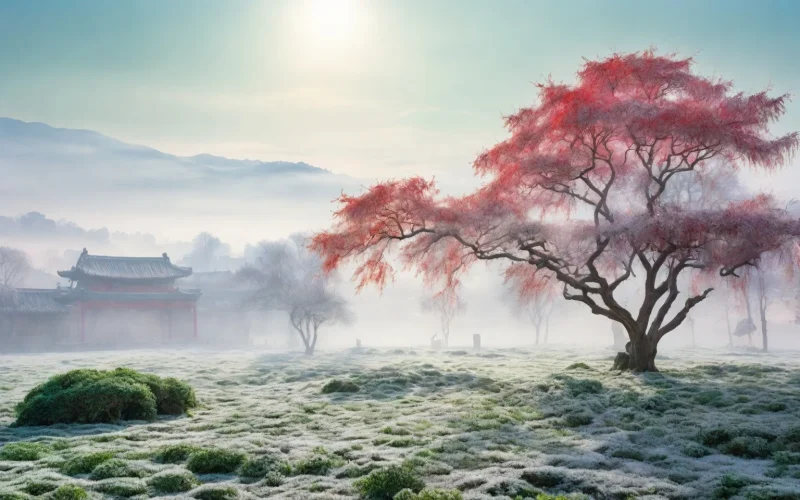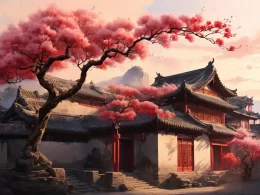
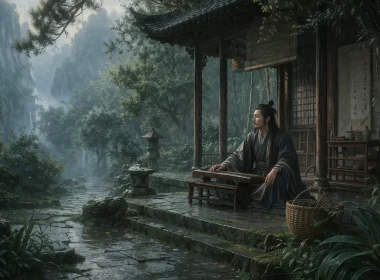
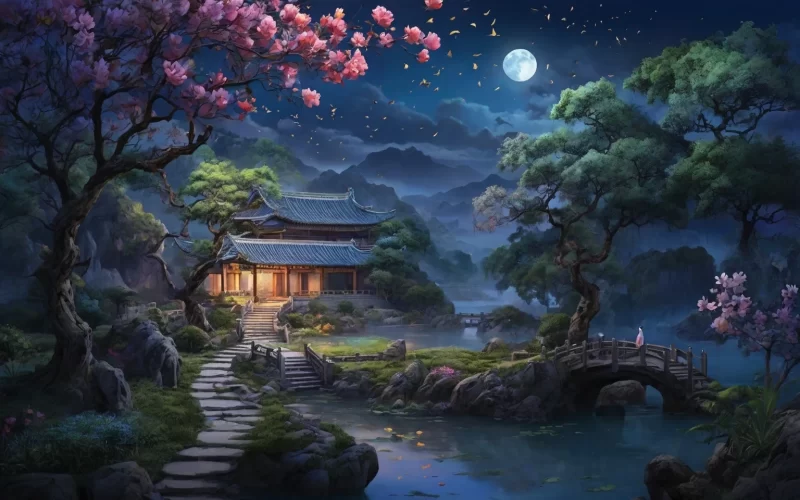
A quiet house, with scarcely a neighbor near;
A path through grasses to a garden left to sere.

Birds in the trees beside the pool are now at rest;
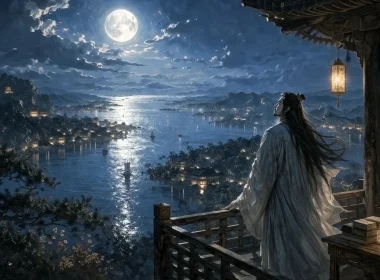
A monk knocks at the door, under the moon’s pale crest.

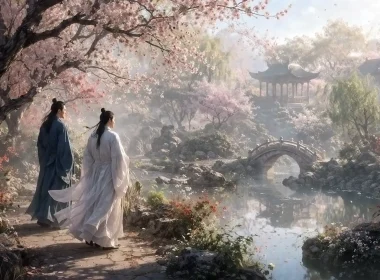
I cross the little bridge — the land’s wide hue I share;
I move a stone — the very roots of clouds stir there.

I go, but I shall come again. This be our vow,
Kept in the heart’s deep silence, as I leave you now.
Original Poem
「题李凝幽居」
贾岛
闲居少邻并,草径入荒园。
鸟宿池边树,僧敲月下门。
过桥分野色,移石动云根。
暂去还来此,幽期不负言。
Interpretation
This poem was composed by the Tang Dynasty poet Jia Dao, likely during his period of hardship in Chang'an after returning to secular life. Jia Dao became a monk in his youth, taking the Dharma name "Wuben" (Without Origin). Later, he returned to secular life encouraged by Han Yu, but his official career was fraught with difficulty, marked by repeated examination failures and a life of poverty. He harbored a deep longing for a life of secluded dwelling in mountains and forests, often expressing his admiration for a reclusive existence in his poetry. The "Li Ning" in the poem's title was a hermit friend of Jia Dao's who lived in a secluded wilderness area outside Chang'an. The two were kindred spirits, often visiting each other; Li Ning's secluded dwelling became a spiritual refuge for Jia Dao amidst the clamor of the worldly realm. The poet went to visit but did not find his friend at home. Walking alone on the overgrown garden path, seeing the clear moonlight and birds roosting in the trees by the pond, he was filled with deep emotion. Although he did not meet his friend, in this tranquility he found harmony with nature and an encounter with the realm of reclusion. Upon returning, he wrote this poem, which is both a depiction of Li Ning's secluded environment and an expression of his own inner yearning for a reclusive life.
Regarding this poem, the most celebrated anecdote is the legend of "tui qiao" ("pushing" and "knocking")—it is said that Jia Dao initially wrote "a monk pushes the gate under the moon" (僧推月下门) but hesitated over whether to change "pushes" (推) to "knocks" (敲). So absorbed was he in this dilemma that he accidentally collided with Han Yu's procession on a Chang'an street. Han Yu, far from punishing him, helped him settle on the word "knocks," and the two became close friends despite their age difference. This debate over a single character not only created a famous literary anecdote, making "tui qiao" synonymous with the meticulous polishing of text, but also, because of this one word, the line "a monk knocks at the gate under the moon" gains a distant resonance within the silent night.
First Couplet: "闲居少邻并,草径入荒园。"
Xián jū shǎo lín bìng, cǎo jìng rù huāng yuán.
A quiet dwelling, with few neighbors close at hand;
A grassy path leads to a garden, wild and unmanned.
The opening line introduces the theme with "a quiet dwelling," describing both Li Ning's reclusive state and hinting at the poet's own longing for such a life. "With few neighbors close at hand" emphasizes its distance from worldly bustle and sparse population, highlighting the hermit's detached independence. The next line, "A grassy path leads to a garden, wild and unmanned," outlines the hermitage's environment with visual imagery—an overgrown path, a desolate garden, precisely portraying the hermit's quiet, solitary life. The word "wild" here does not mean dilapidated, but a kind of unadorned natural beauty, a serenity free from worldly strife.
Second Couplet: "鸟宿池边树,僧敲月下门。"
Niǎo sù chí biān shù, sēng qiāo yuè xià mén.
Birds roost in trees beside the pond;
A monk knocks at the gate under the moon beyond.
This couplet is the eternally celebrated famous line, capturing the tranquility and Zen-like quality of the night scene. "Birds roost in trees beside the pond" is a still scene—the birds have returned to their nests to sleep, all things are silent. "A monk knocks at the gate under the moon" is a scene of motion—the sound of knocking is especially clear in the silent night, yet it conversely sets off an even deeper silence. The word "knocks" (敲) not only conveys the gentleness of the action but also hints at the poet's regret at not finding his friend during his nighttime visit. Legend says Jia Dao agonized over using "push" (推) or "knock" (敲), and Han Yu ultimately settled on "knock," creating this timeless anecdote. This word "knock" is not only phonetically resonant but also creates a distant reverberation in the quiet night, bringing the entire scene to life.
Third Couplet: "过桥分野色,移石动云根。"
Guò qiáo fēn yě sè, yí shí dòng yún gēn.
Crossing the bridge, the wild scene unfolds, hues part;
Moving a stone seems to stir the clouds' very heart.
This couplet describes what the poet sees and feels on his return journey. "Crossing the bridge, the wild scene unfolds, hues part": the poet crosses a small bridge, his view suddenly opening up; the scenery of the wilderness spreads out before him, colorful and full of life. "Moving a stone seems to stir the clouds' very heart" describes the scene with a strange imagination—the roots of the stones seem connected to the roots of the clouds; moving a stone feels like disturbing the clouds in the sky. This exaggerated technique describes both the height of the mountain rocks and the nearness of the misty clouds, while also hinting at the poet's reverence for and closeness to nature. Clouds shift, stones move—the subtle changes between heaven and earth are all transformed into poetic imagination in the poet's eyes.
Fourth Couplet: "暂去还来此,幽期不负言。"
Zàn qù huán lái cǐ, yōu qī bù fù yán.
For now I leave, but I shall to this place return;
Our tryst in seclusion, I promise, will not spurn.
The final couplet clarifies the poem's intent, expressing the poet's feelings directly. "For now I leave" speaks of the present departure; "but I shall to this place return" speaks of a future revisit, expressing the poet's deep attachment to this secluded place. "Our tryst in seclusion, I promise, will not spurn" concludes with a vow, which is both a promise to Li Ning and an affirmation of his own reclusive heart. Although the poet did not meet his friend, in this seclusion he found a spiritual home; therefore, this "promise… will not spurn" is, even more, a promise not to betray his own inner yearning for reclusion.
Holistic Appreciation
This poem is a representative work among Jia Dao's landscape and reclusion poetry. The entire poem, eight lines and forty characters, uses a visit to a friend as its thread and the hermitage environment as its backdrop, perfectly blending the tranquil beauty of the night with the poet's inner yearning for reclusion, showcasing the uniquely serene, cool, and quiet beauty characteristic of Jia Dao's poetry.
Structurally, the poem presents a clear progression of "visit—see—return—vow." The first couplet describes entering the wild garden, pointing out the hermitage's environment. The second couplet describes the unsuccessful nighttime visit, using "birds roost" and "a monk knocks" to outline the quiet beauty of the night. The third couplet describes the sights on the return journey, using "crossing the bridge" and "moving a stone" to display nature's liveliness. The final couplet describes the vow upon parting, using "will not spurn" to conclude the poem. Between the four couplets, the scene changes with each step, each layer builds upon the last, elevating a simple unsuccessful visit into a dialogue of the soul.
Conceptually, the core of this poem lies in the character "幽" (secluded, quiet, deep). Secluded dwelling (幽居), secluded path (幽径), secluded night (幽夜), secluded tryst (幽期)—the entire poem is enveloped in an atmosphere of seclusion and quiet. Yet this "seclusion" is not dead stillness; it contains boundless vitality within its quiet: the birds roosting is stillness, the sound of knocking is movement; the wild scenery is stillness, the shifting clouds are movement. It is precisely within this interaction of movement and stillness that the poet finds harmony with nature and resonates with the realm of reclusion.
Artistically, the most moving aspect of this poem lies in the power of its "using simplicity to control complexity." In just forty characters, it describes both the environment and the state of mind; both the actual scene and the imagination; both the present moment and the future. With extremely concise strokes, the poet sketches a picture of visiting a friend by moonlight with a profound artistic conception, allowing the reader to feel, between the lines, that transcendent Zen-like quality and poetic sentiment.
Artistic Merits
- Using Scene to Convey Feeling, Subtle and Lasting: The entire poem does not express emotion directly in a single word, yet through imagery like "grassy path," "wild garden," "birds roost," and "a monk knocks," it contains the poet's longing for a reclusive life and his faint melancholy at not meeting his friend entirely within the scene. Not a word of explicit emotion, yet its charm is fully captured.
- Movement and Stillness Interact, Creating a Tranquil and Profound Artistic Conception: The stillness of "birds roost in trees beside the pond" and the movement of "a monk knocks at the gate under the moon" play off each other delightfully; the silence of the night and the crispness of the knocking sound set each other off, making the artistic conception even more profound. Between movement and stillness, poetic feeling abounds.
- Meticulous Word Choice, Natural and Inspired Charm: The use of the word "knock" is both a timeless anecdote and the finishing touch of the poem. This single word, "knock," gives sound to the quiet night and concrete form to the intangible Zen-like quality. The success of one word brings the entire poem to life.
- Tight Structure, Clear Layers: From entering the path to visiting the gate, from the return journey to the vow, the four couplets are interlocked, each layer building upon the last, writing a brief visit with twists and turns and lasting resonance. Introduction, elaboration, transition, and conclusion are seamless and natural.
- Concise Language, Rich Connotation: The poem contains no superfluous words, yet it melds the hermitage's environment, the process of the nighttime visit, the sights on the return journey, and the inner vow into one. Brevity yields comprehensiveness; each word is a polished gem.
Insights
Using an unsuccessful visit as its subject, this poem speaks of the deep dialogue between humanity and nature, and between a person and their inner self, offering profound insights. It allows us to see the unexpected gains found within "not meeting." The poet went to visit his friend full of anticipation but failed to see him. An ordinary person might feel disappointment, might complain. But Jia Dao, in this "not meeting," encountered the tranquility of the night, encountered the poetry of nature, and encountered his own inner yearning for reclusion. It enlightens us: Many of life's "unmet" moments may be the beginning of another kind of "encounter." Missing a person, one might encounter a landscape; missing an event, one might encounter a more authentic self.
The tranquility and sound in the lines "鸟宿池边树,僧敲月下门" lead us to contemplate the dialectical relationship between "movement" and "stillness." True tranquility is not dead silence, but a quietude set off by subtle movement. That knocking sound does not破坏 (disrupt) the night's stillness; on the contrary, it makes that stillness more palpable, more profound. It tells us: The disturbances in life, if faced with a peaceful heart, can instead become the background against which inner tranquility is set. One need not pursue absolute calm, but should learn to maintain stillness within movement, to preserve inner peace amidst clamor.
This poem also shows us the true meaning of reclusion. Li Ning's "secluded dwelling" is not an escape, but a choice; not passive, but active. Within the wild garden and the grassy path, he found a way of life in harmony with his soul. And although Jia Dao could not live there long-term, in this brief visit he felt a deep resonance with this way of life. It enlightens us: Reclusion does not necessarily mean retiring to mountains and forests; true reclusion is the ability to preserve that inner quiet and clarity even amidst the clamor of the dusty world. Wherever one is, if the heart holds a "secluded dwelling," then everywhere can be a "secluded dwelling."
About the Poet
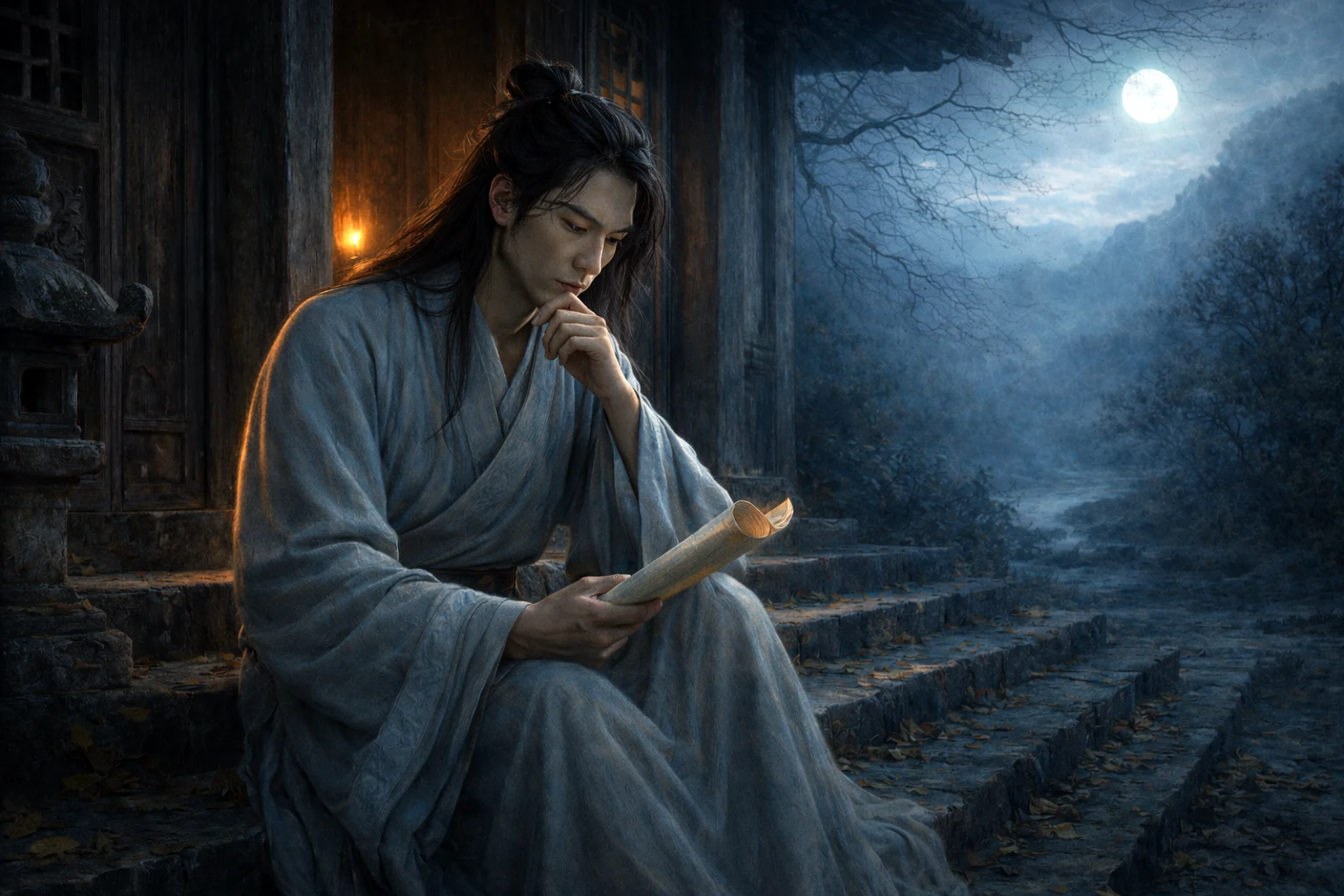
Jia Dao (贾岛 779 - 843), a native of the vicinity of present-day Beijing, was a renowned poet of the Mid-Tang dynasty. In his early years, he became a Buddhist monk under the dharma name Wuben. Later, he returned to lay life to sit for the imperial examinations, but never passed them throughout his life. In his later years, he served as Registrar of Changjiang County, earning him the sobriquet "Jia Changjiang." He was famous for his "painstaking composition" (ku yin), and together with Meng Jiao, they were known as "Meng's cold, Jia's thinness." His poetry pursued meticulous refinement of every word and line. His poems often depict desolate, barren, and lonely landscapes, excelling in the five-character regulated verse form. He exerted a profound influence on later "painstaking" poets such as Li Dong of the Late Tang and the "Four Lings" of the Southern Song.