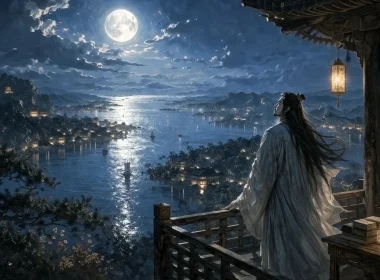
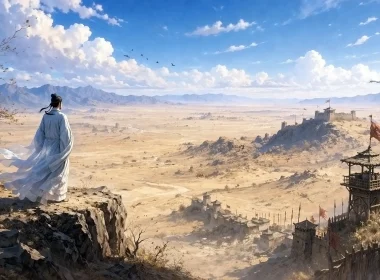
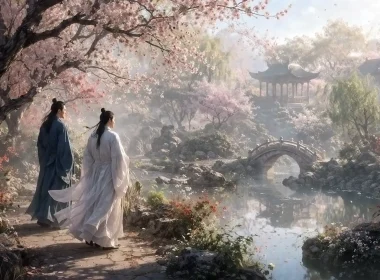
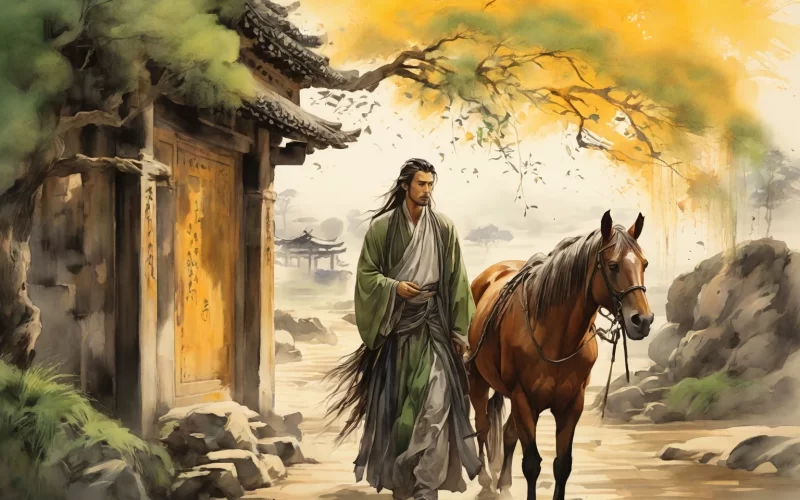
Why should our human affairs, so perverse, delight in parting’s strife?
Yet Longmian has caught, and fixed in form, the poem’s aching life.

What has the hue of Willows by Wei Town to do with this smart?
The grief is all the traveller’s own, projected from his heart.
Original Poem
「题阳关图二首 · 其二」
黄庭坚
人事好乖当语离,龙眠貌出断肠诗。
渭城柳色关何事?自是离人作许悲。
Interpretation
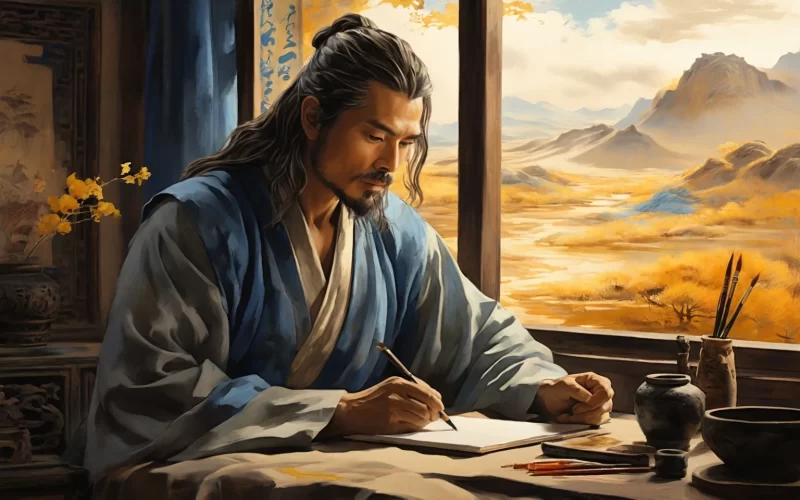
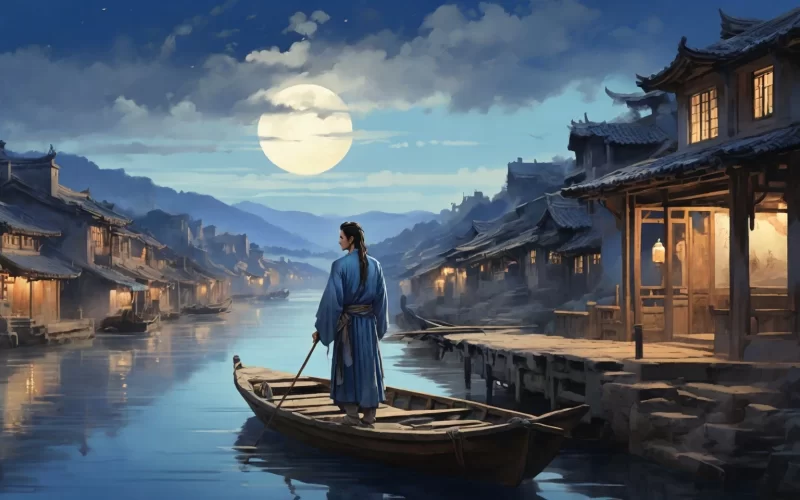
This is the second of two poems inscribed by Huang Tingjian on Li Gonglin's "Picture of Yang Pass." Li Gonglin (sobriquet: Lay Buddhist of the Sleeping Dragon) created the painting based on Wang Wei's "Song of Weicheng," depicting the parting mood evoked by the line "West of Yang Pass you'll find no old friend." Huang Tingjian's official career was fraught with hardship, marked by repeated demotions, which gave him an especially profound understanding of separation. When he faced this painting, the silent scene of farewell resonated powerfully with the accumulated sense of wandering in his own heart.
The first poem of the set focused on exploring the theme of "artistic expressiveness," revealing that though music and painting differ in form, they are equally capable of conveying heart-wrenching emotion. This second poem goes a step further, delving into the philosophical relationship between "feeling" and "object"—where does the sorrow of parting truly originate? How can the indifferent green hue of willows stir the grief of the one departing? The poet begins with the philosophical insight from Tao Yuanming that "human affairs often go awry," layer by layer tracing the source, and finally arrives at the profound conclusion that "it is the parting one himself who creates this grief." This elevates the inscribed poem from a mere lyrical exclamation to a philosophical meditation on the very nature of emotion.
First Couplet: "人事好乖当语离,龙眠貌出断肠诗。" (Rén shì hǎo guāi dāng yǔ lí, Lóng mián mào chū duàn cháng shī.)
Human affairs often go awry, and speaking of parting is hardest to bear; Longmian, with his brush, has given form to this heart-wrenching verse.
The opening line adapts the sentiment from the preface to Tao Yuanming's "In Reply to Adjutant Pang": "Human affairs often go awry; that is precisely when we must speak of parting." "Awry" (guāi) here means going against one's wishes, being contrary. The poet begins from the lofty perspective of a philosophy of life—in worldly matters, most things do not go as one wishes, and among all such adversities, parting is the most heart-wrenching. This line establishes the poem's meditative tone: the pain of parting stems from the contrariness of human affairs, from the unpredictability of fate. The following line, "Longmian, with his brush, has given form to this heart-wrenching verse," uses "give form to" (mao) as a verb, meaning to depict, to render. Li Gonglin transformed Wang Wei's heart-wrenching poem "Farewell to Yuan Second on His Mission to Anxi" into a visual image with his brush, making the silent painting bear the emotion of the voiced verse. This couplet moves from philosophy to art, from the universal human emotional experience to the specific creation of a painting, with rigorous logic and progressive layers.
Second Couplet: "渭城柳色关何事?自是离人作许悲。" (Wèichéng liǔ sè guān hé shì? Zì shì lí rén zuò xǔ bēi.)
What has the willows' green hue at Weicheng to do with anything? It is the parting one himself who creates this grief.
This couplet is the soul of the entire poem. It begins with a question and concludes with an answer, elevating the poetic sentiment to a peak of philosophical inquiry. "What has the willows' green hue at Weicheng to do with anything?"—The poet feigns a naïve, almost obtuse inquiry, questioning what connection the indifferent green of the willows could possibly have with human parting. The willows are simply green, year after year; they know nothing of parting sorrow, understand nothing of farewell regret. By what right are they burdened with the weight of human emotion? This question is asked with seeming naïveté, yet with profound depth. It probes the root of the age-old, entangled association between "willow" and "parting" in countless poets' works throughout the centuries. The following line, "It is the parting one himself who creates this grief," answers with definitive certainty: It is, in fact, the parting one who projects his own inner sorrow onto the willow's hue. Thus, the indifferent willow acquires feeling; the unrelated scene becomes a symbol of grief. With this single line, the poet unveils the secret: Objects are inherently without feeling; it is people who possess intent. The person with intent imposes his feeling upon the object, thereby causing the originally unrelated willow to seem, of itself, to possess feeling. Precisely because of this, those facing parting are moved to sorrow by the sight of willows, and shed tears upon hearing the flute tune "Breaking the Willow Branch."
Holistic Appreciation
This is an excellent inscribed poem that combines poetic beauty with philosophical thought. In its four lines and twenty-eight characters, it begins with Tao Yuanming's philosophical insight that "human affairs often go awry," moves to the artistic rendering of Li Gonglin's painting, then proceeds to a deep inquiry into the relationship between the "willows of Weicheng" and the sorrow of parting, finally concluding with the statement "it is the parting one himself who creates this grief." It advances layer by layer, its thought profound and enduring.
Structurally, the poem exhibits a clear progression of "introduction, elaboration, turn, and resolution." The first line introduces the theme with Tao Yuanming's words, stating that parting stems from the contrariness of human affairs—this is the "introduction." The second line elaborates on this, saying Li Gonglin used this as a subject for his painting—this is the "elaboration." The third line makes a sudden "turn," breaking conventional thought with the seemingly obtuse question "what has it to do with anything?" The final line provides the "resolution" with the definitive conclusion "creates this grief." The four lines are tightly linked, logically rigorous, elevating the inscribed poem from a simple lyrical exclamation to a philosophical meditation on the nature of emotion.
In terms of conception, the core of this poem lies in its deep insight into the relationship between "feeling" and "object." The poet's question, "What has the willows' green hue at Weicheng to do with anything?" is, in fact, an inquiry into an aesthetic problem that has troubled poets and readers for millennia: Do natural scenes and objects possess feeling in themselves? Or is it human emotional projection that endows them with feeling? The poet answers with "it is the parting one himself who creates this grief," taking a clear stance on the side of the "theory of empathy" (移情说)—it is not that the willow hue is sorrowful, but that the parting one is sorrowful; it is not that the scene possesses feeling, but that the human heart possesses feeling. This conclusion is both a deep-level interpretation of Wang Wei's line "The willows by the inn look so fresh and green" and a revelation of the aesthetic essence of all works that use scenery to express emotion.
Artistically, the most exquisite aspect of this poem lies in its use of "seemingly obtuse language to enter the poem." The third line, "What has the willows' green hue at Weicheng to do with anything?" appears foolishly naïve, yet in fact contains a profound philosophical inquiry. It is precisely this "obtuseness" that breaks the habitual acceptance of the association between "willow" and "parting," forcing readers to reconsider: Does that willow truly have anything to do with parting? This technique of using obtuse language to shatter fixed notions, and using questions to spark deep thought, is precisely where Huang Tingjian's brilliance as the leading figure of the Jiangxi School of poetry lies.
Artistic Merits
- Philosophical Meditation, Penetrating Insight: Beginning with Tao Yuanming's "human affairs often go awry," it traces the source layer by layer, finally arriving at the profound conclusion that "objects are inherently without feeling; it is people who possess intent." Philosophy is seen within the poetry; emotion is contained within the reasoning.
- Using a Question as the Turn, an Answer as the Resolution: The third line makes a sudden turn with the obtuse question "what has it to do with anything?"; the fourth line provides resolution with the definitive statement "creates this grief." Between the question and answer, the poetic rhythm is modulated and full of variation. The subtlety of the turn and resolution lies in the mind of the poet.
- Seamless Adaptation of Allusions: The first line adapts the meaning of Tao Yuanming's writing without leaving a trace. The word "creates" (作 zuò) in the final line subtly implies "intentional creation" or "artifice," covertly aligning with the poem's theme of "empathy" or emotional projection. It uses allusion without being enslaved by it; transforms the ancient to create something new.
- Plain Language, Harmonious Rhythm: The entire poem uses no abstruse or difficult phrases; it reads aloud smoothly and harmoniously, entirely free of the deliberate quest for the strange and obscure found in some of Huang Tingjian's other works. Mastery is seen in the plainness; talent is revealed in the harmony.
- Seeing the Great in the Small, Profound and Lasting Thought: Beginning with a single painting, a single poem, a single willow, it explores the nature of human emotion—truly "containing Mount Sumeru within a mustard seed." Great vistas are contained within a small scene; deep philosophy is held within a minor object.
Insights
Through a single "Picture of Yang Pass" and the "willows of Weicheng," this poem articulates the deep relationship between emotion and the world, offering profound insights for later generations. It leads us to contemplate the projective relationship between "feeling" and "object." The poet asks, "What has the willows' green hue at Weicheng to do with anything?" The answer is, "It is the parting one himself who creates this grief." This reveals a universal psychological phenomenon: the world we see is never the objective world, but a world suffused with our own emotions. When happy, the landscape smiles; when sad, the wind and rain seem sorrowful. It enlightens us: Rather than lamenting the world's indifference, it is better to turn inward and examine our own hearts. Very often, it is not our circumstances that determine our state of mind, but our state of mind that determines what circumstances we see.
The lament in the line "Human affairs often go awry, and speaking of parting is hardest to bear" allows us to see the poet's clear-eyed recognition of life's essence. In worldly matters, most things do not go as one wishes; and among all such adversities, parting is the hardest to bear. This clarity is not pessimism, but a direct facing of life's truth. It tells us: Acknowledging life's shortcomings and helplessness is precisely the beginning of maturity; only by facing the pain of parting squarely can we understand the preciousness of reunion more deeply.
On a still deeper level, this poem also allows us to see the secret of "empathy" in artistic creation. Li Gonglin's painting, Wang Wei's poem, and Huang Tingjian's poetic critique together constitute a dialogue about "feeling" and "object." The indifferent hue of the willows, because of the parting one's sorrow, becomes an image chanted for a thousand years; the silent picture, because of the viewer's resonance, becomes a heart-wrenching work. It reveals to us: Great art is never a mechanical reproduction of the objective world, but a process in which the artist projects the feeling in his/her heart onto an object, and then presents this feeling-endowed object to the world. And we, as appreciators, also, precisely in this process of "empathy" and "resonance," complete a spiritual dialogue with the artist and the characters within the work.
About the Poet
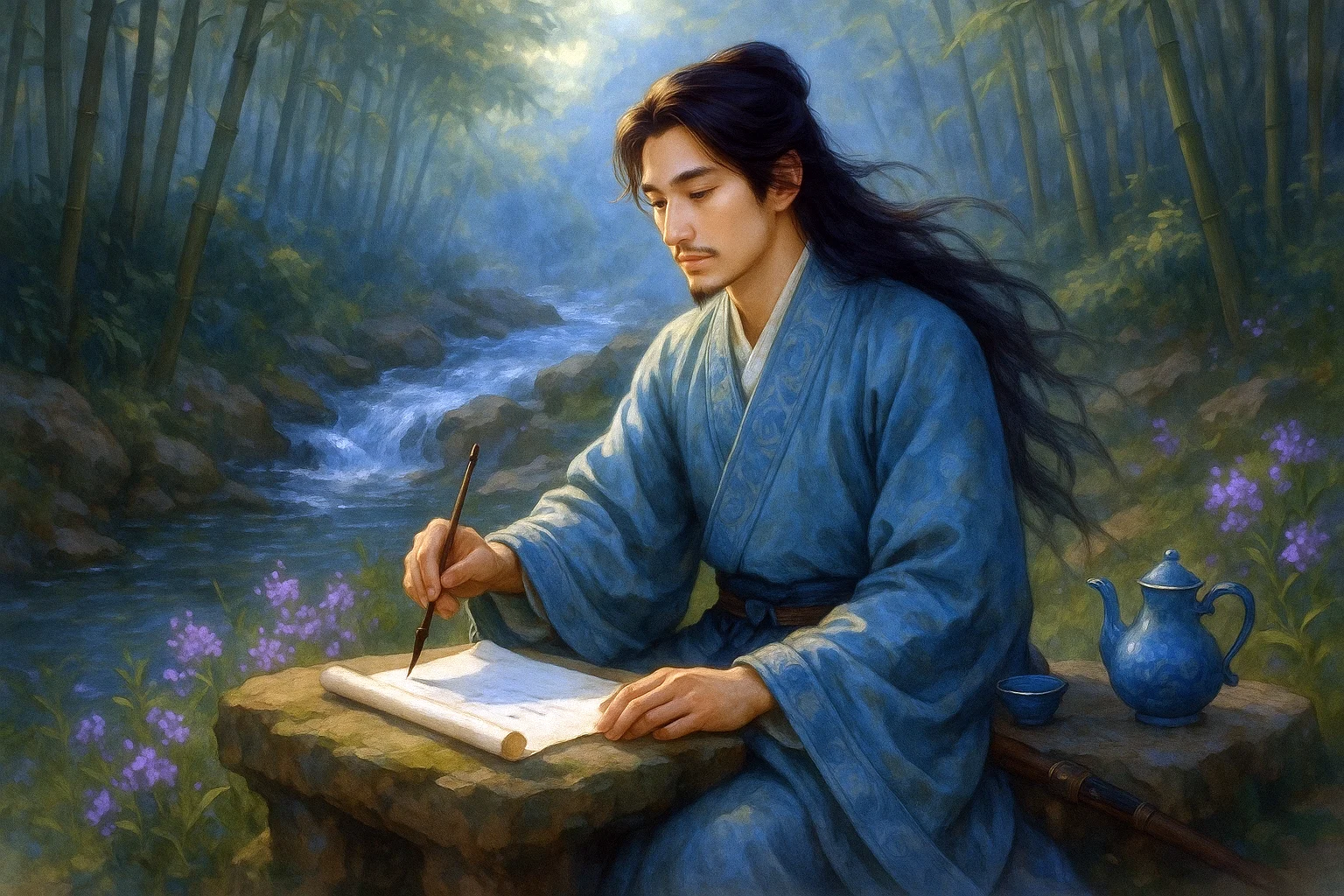
Huang Tingjian (黄庭坚 1045 - 1105), a native of Xiushui, Jiangxi Province, was a renowned poet and calligrapher of the Northern Song Dynasty. He became a jinshi (presented scholar) in the fourth year of the Zhiping era (1067 AD) and held various official posts, including Professor at the Imperial Academy and Secretary to the Imperial Archives. Later, he became entangled in the political strife between the conservative and reformist factions, suffering repeated demotions. As the foremost of the "Four Scholars of the Su School," he was often paired with Su Shi as "Su-Huang" in literary circles. Modeling his poetry on Du Fu, he founded the "Jiangxi School of Poetry" and proposed the influential creative theory of "transforming the bones and seizing the embryo, turning iron into gold," emphasizing that every word in poetry should have its origin. His work established a new paradigm for Song Dynasty poetics, exerting a profound and lasting influence on subsequent generations.