
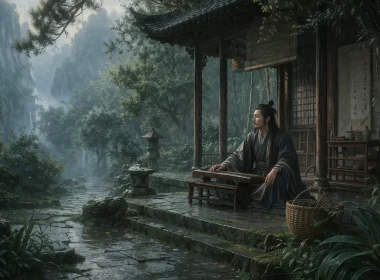
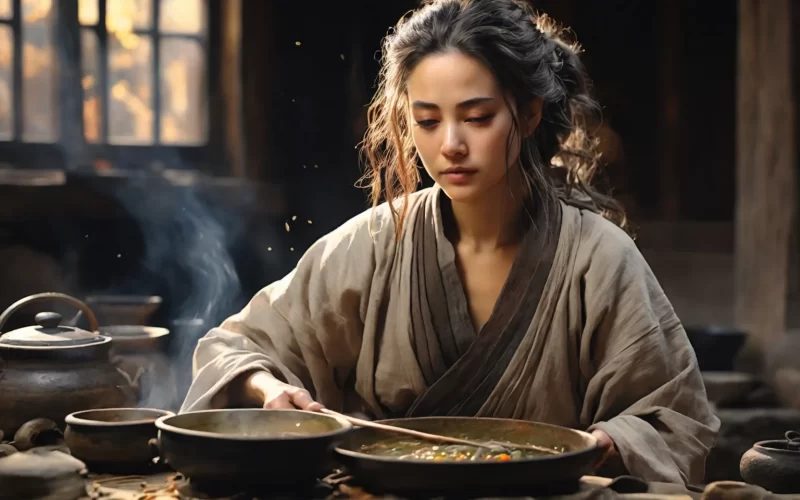
Her man the war took. She abides
In a roof of reed. Hemp‑cloth her wear;
Her hair is thistledown the wind dries.

The mulberry‑trees are gone. The tax
Stands. Fields are waste. The levy
Of grain grows. She grubs herbs, with the root‑sax;
She breaks green wood, leaf‑smoke to heavy.

Go deeper in. Still deeper. None
Goes deep enough to miss the tally‑man
Or the conscripting‑lot. It is not done.
Original Poem
「山中寡妇」
杜荀鹤
夫因兵死守蓬茅,麻苎衣衫鬓发焦。
桑柘废来犹纳税,田园荒后尚征苗。
时挑野菜和根煮,旋斫生柴带叶烧。
任是深山更深处,也应无计避征徭。
Interpretation
This poem was composed by the late Tang poet Du Xunhe. Born into humble circumstances, Du repeatedly failed the imperial examinations in his youth, finally passing the jinshi at the age of forty-six. However, his official career remained troubled due to the turbulent times, and he ultimately never gained significant recognition. He spent most of his life in hardship and poverty, living long among the lowest social strata, which gave him a profound understanding of the people's suffering. It was precisely this background and experience that made him a representative figure of realist poetry in the late Tang, inheriting Du Fu's tradition of "poetic history" by turning his lens onto the common people and recording the most authentic hardships of his era.
The late Tang period was marked by corrupt governance, dominance by eunuchs, separatist military governors, and frequent warfare. After Emperor Xuanzong's Dazhong reign period, the Tang Empire was already teetering on the brink. Regional military governors, holding their own troops, fought amongst themselves. During Emperor Xizong's Qianfu reign, the uprisings led by Wang Xianzhi and Huang Chao successively erupted, spreading war across more than half of China. To raise enormous military funds, the court continuously increased taxes, and local officials seized the opportunity to extort to the bone, plunging the common people into abysmal misery. After the Huang Chao Rebellion was suppressed, the Central Plains lay in ruins. The rural economy had completely collapsed, and countless families were torn apart by war—some died by the sword, some starved in ditches, and some became displaced refugees.
The poet witnessed with his own eyes the devastation of the countryside and the people's unbearable suffering in the war's aftermath: fields lay barren, mulberry and paper mulberry trees were destroyed, survivors were clad in rags and starving, yet they still faced the government's endless demands for taxes. Widows who had lost their husbands were left utterly helpless, struggling for survival on the brink of death. Indignation festered in Du Xunhe's heart, leading him to use poetry as a weapon to pierce the darkness of society. He did not write of romantic scenes or personal melancholy; instead, he extended his brush to those forgotten corners, giving voice to the common people at the bottom of society.
Through the tragic experience of a widow in the mountains, this poem deeply exposes the twin disasters brought upon the people by war and oppressive governance. The figure of the widow in the poem is a microcosm of the countless common people at the bottom; her suffering is the shared tragedy of the entire era. The poet recorded all this with a stern brush, ensuring that later generations would forever remember the figure "keeping her thatched hut." The poignant indictment in the lines, "Even if you flee to the remotest mountain depths, / There is no way to escape the tax collector's reach," stands as the most powerful critique of the dark society of the late Tang and an eternal warning against all tyranny. This creative spirit of confronting reality and pleading for the people made Du Xunhe unique in the late Tang poetic landscape and established this poem as a masterpiece of ancient Chinese realist poetry.
First Couplet: "夫因兵死守蓬茅,麻苎衣衫鬓发焦。"
Fū yīn bīng sǐ shǒu péng máo, má zhù yī shān bìn fà jiāo.
My man died in the wars; I keep this thatched hut;
Hemp robe, hair scorched on the temples.
The opening paints a heartbreaking portrait. The four words, "My man died in the wars," reveal the source of the tragedy—war. The word "keep" conveys the desolation of the widow alone, keeping her dilapidated hut. The next line, "Hemp robe, hair scorched on the temples," further depicts her through two details of clothing and appearance: the robe is of coarse hemp, showing her poverty; her temples are "scorched," a result of both the hardships of life and the grief within. This word "scorched" refers both to the literal scorching from smoke and fire and, more profoundly, to the exhaustion of her spirit. In just fourteen characters, the image of a lonely, helpless widow leaps from the page.
Second Couplet: "桑柘废来犹纳税,田园荒后尚征苗。"
Sāng zhè fèi lái yóu nà shuì, tián yuán huāng hòu shàng zhēng miáo.
Mulberry, paper mulberry gone, yet I must pay the tax;
Land lies waste, yet they demand the tender shoot levy.
This couplet shifts from the person to her circumstances, directly targeting the oppressive governance. "Mulberry, paper mulberry gone" and "Land lies waste" describe the complete destruction of the means of production—no one tends the mulberry trees, no one tills the land. However, the words "yet" in "yet I must pay" and "yet they demand" reveal the rulers' heartlessness: they care not whether the people live or die, nor that production is ruined; they press for taxes and levies as before. This is not merely economic plunder but a deprivation of the very right to survive. With a calm brush, the poet exposes this cruel reality, each word saturated with blood and tears.
Third Couplet: "时挑野菜和根煮,旋斫生柴带叶烧。"
Shí tiāo yě cài hé gēn zhǔ, xuán zhuó shēng chái dài yè shāo.
Sometimes I gather wild herbs, boil them root and all;
Cut green wood, burn it fresh with the leaves still on.
This couplet uses two details of daily life to depict the widow's poverty with piercing clarity. "Boil them root and all"—wild herbs are already hard to swallow, but boiling them with the roots shows there is truly nothing more to eat; not a single thing that can fill the belly can be wasted. "Burn it fresh with the leaves still on"—green wood is hard to burn, and burning it with leaves produces more smoke and less flame, yet she cannot bear to strip the branches, for every piece of firewood is hard-won. These two details represent a mode of survival found only in extreme poverty. By capturing them, the poet makes the abstract notion of "poverty" tangible and palpable.
Fourth Couplet: "任是深山更深处,也应无计避征徭。"
Rèn shì shēn shān gēng shēn chù, yě yīng wú jì bì zhēng yáo.
Even if you flee to the remotest mountain depths,
There is no way to escape the tax collector's reach.
The final couplet moves from the specific to the universal, raising the poem's meaning to its climax. The hypothetical "Even if" and the inevitable "There is no way" construct a tone of inescapable despair. The widow has already fled deep into the mountains, already cut off from the world, yet she still cannot escape the tax collector's grasp. This final line is an indictment of the entire age: oppressive governance is fiercer than a tiger, omnipresent, penetrating everywhere; the people have nowhere to flee. The poet does not linger on sympathy for an individual fate but elevates it to a critique of the system, giving the poem a soul-shaking power.
Overall Appreciation
This is a masterpiece of late Tang realist poetry. Taking the tragic experience of a widow in the mountains as its entry point, the poem layer by layer reveals the twin devastations inflicted upon the people by war and oppressive governance.
Structurally, the poem exhibits a rigorous logic moving from the surface to the core, from the individual to the universal. The first couplet paints the widow's portrait, giving an immediate impression with "Hemp robe, hair scorched on the temples." The second couplet describes the oppressiveness of the taxes, revealing the root of her poverty. The third couplet depicts the harshness of her life, deepening the reader's perception with the details of boiling "root and all" and burning wood "with the leaves still on." The final couplet then elevates the individual case to the universal, issuing the poignant indictment that "There is no way to escape." The four couplets advance layer upon layer, step by step tightening the focus, ultimately converging into a single, soul-stirring cry.
Artistically, the poem's greatest success lies in the power of its details. The poet does not vaguely lament the people's hardships but selects the most expressive details: the "Hemp robe" shows her poverty; "hair scorched" shows her suffering; "boil them root and all" shows her hunger; "burn it fresh with the leaves still on" shows her cold. It is precisely these tangible, felt details that make the abstract suffering palpable, allowing the reader to seemingly see the widow in the mountains with their own eyes.
Particularly valuable is the profound humanistic sentiment the poem contains. The poet does not look down with condescending pity but gazes at this woman of the lower strata with an equal eye, writing of her as a "person" and according her dignity. The tenacity in "keep this thatched hut," the will to survive in "boil them root and all" and "burn it fresh with the leaves still on"—all reveal the stubborn vitality of the common people at the bottom, persisting even in desperate straits. The poet writes of both her suffering and her resilience, making this figure more full-bodied and more moving.
Artistic Features
- Vivid Details, Suggesting the Large through the Small: Selecting typical details like "Hemp robe," "hair scorched," "boil them root and all," and "burn it fresh with the leaves still on" to concretize abstract suffering. The spirit is seen in the details; depth is found in the minute.
- Progressive Layers, Careful Structure: Moving from portrait to taxes, from taxes to daily life, from daily life to having nowhere to flee, the four couplets are tightly interlocked, with emotion deepening step by step. The structure of introduction, development, turn, and conclusion is seamless and natural.
- Poignant Language, Striking to the Heart: The entire poem uses no ornate diction, yet every word is saturated with blood and tears. The use of particles like "yet," "still," "Even if," and "There is no way" expresses that inescapable despair to the fullest. Poignancy is found in the plain; power is found in the质朴 (simple and unadorned).
- Using One Point to Represent the Whole, Profound Exposure: Reflecting the darkness of the entire era through the experience of a single widow. Behind the individual fate lies the shared tragedy of countless common people at the bottom.
- Emotion and Reason Fused, Critique and Compassion Coexist: It contains both ruthless exposure of the rulers and profound sympathy for the people. Stern critique and warm humanism achieve unity within the poem.
Insights
Through the tragic experience of a widow in the mountains, this poem exposes the twin devastations inflicted upon the people by war and oppressive governance. It remains profoundly shocking to this day.
First, it awakens in us a deep concern for individual suffering. The poet does not speak vaguely of the people's hardships but focuses his lens on a specific "person"—does she have a name? No. But she has a portrait, a life, struggles, and despair. She is the one with the "麻苎衣衫鬓发焦"; she is also the one who must "和根煮" and "带叶烧" It is precisely this specificity that prevents the reader from seeing her merely as a symbol, forcing us to confront her dignity and suffering as a "human being." It teaches us: no grand narrative can obscure the voices of individuals; the tragedies of any era are ultimately borne by living, breathing people.
Second, it warns us: oppressive governance is fiercer than a tiger; the evil of a system is enough to devour everything. The widow in the poem has already fled deep into the mountains, already cut herself off from the world, yet she still cannot escape the tax collector's grasp. "任是深山更深处,也应无计避征徭"—these fourteen characters are the most powerful indictment against all tyranny. It reminds later generations: the degree of a society's civilization lies not in how many tall buildings it erects, but in how it treats its most vulnerable people; the legitimacy of a regime lies not in its power, but in whether it allows its people to live with dignity.
On a deeper level, this poem also shows us the power of literature. Over a thousand years have passed. Those rulers who oppressed the widow have long turned to dust, yet this poem survives, ensuring that later generations forever remember the figure "keeping her thatched hut." Literature cannot directly change the world, but it can make suffering seen, justice called for, and conscience awakened. This is the timeless value of "The Widow in the Mountains," transcending its era.
In any age, concern for the disadvantaged, compassion for the weak, and critique of injustice are the conscience and responsibility intellectuals ought to bear.
About the Poet
Du Xunhe (杜荀鹤 846 - 904), a native of Shitai, Anhui, was a realist poet of the late Tang Dynasty. He became a jinshi (presented scholar) in the second year of the Dashun era (891 AD). During the Later Liang Dynasty, he was appointed to the Hanlin Academy but passed away just five days later. His poetry carried forward the spirit of the new yuefu (Music Bureau) tradition established by Du Fu and Bai Juyi, focusing exclusively on the sufferings of the common people. His poetic style was simple, unadorned, and deeply poignant. He often employed a relatively free metrical form, later known as the "Du Xunhe Style," which stood out as a unique and powerful voice amidst the ornate and decadent poetic trends of the late Tang period.