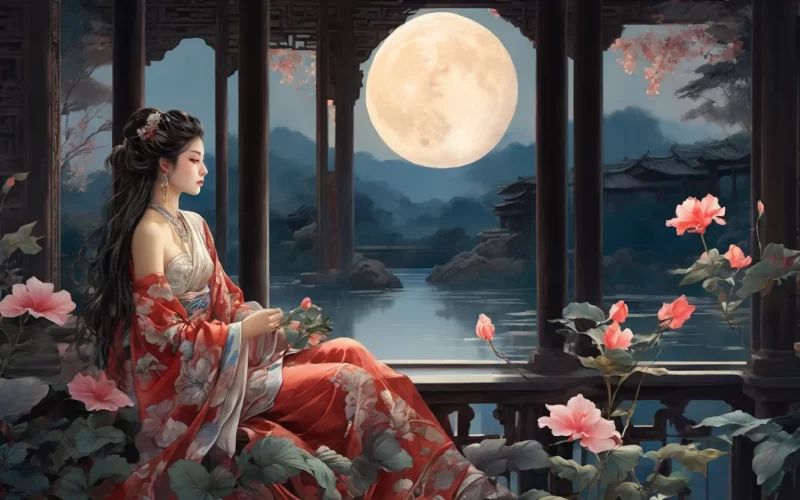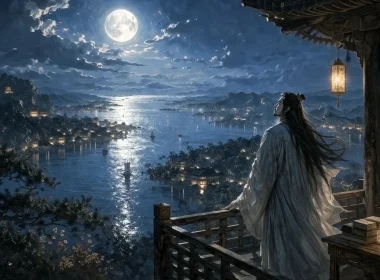
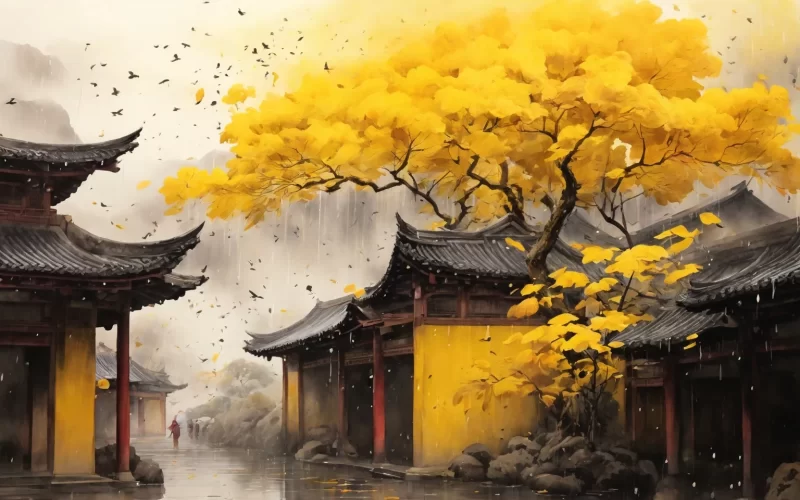
An exile’s lot, a stranger’s brooding — one bleak stain;
Spring at the half turns autumn‑wise, and clouds the brain.

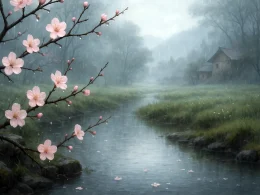
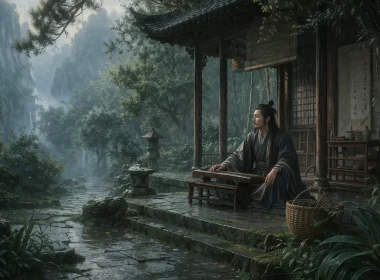
Rain crossed the mountain town, and all the blooms lie slain;
The banyan leaves heap the court where orioles cry in vain.
Original Poem
「柳州二月榕叶落尽偶题」
柳宗元
宦情羁思共凄凄,春半如秋意转迷。
山城过雨百花尽,榕叶满庭莺乱啼。
Interpretation
This poem was composed in the spring of around 817 AD, during Liu Zongyuan's tenure as Prefect of Liuzhou. By then, twelve years had passed since the failure of the Yongzhen Reforms, and over three years since his further demotion from Yongzhou to Liuzhou. Liuzhou, located in the Guangnan West Circuit, possessed a climate drastically different from the Central Plains. The second lunar month was mid-spring, yet in Liuzhou, after a spring rain, all flowers withered, and banyan leaves carpeted the courtyard—a scene that resonated with and confirmed the poet's inner feeling that it was "spring that feels like autumn." The words "Written Impromptu" in the title indicate this is a spontaneous work, sparked by a startling sight and penned as the feeling arose.
However, behind this "impromptu" writing lies the heavy accumulation of twelve years of exile. "Thoughts of office"—attachment to and disillusionment with an official career; and "feelings of a wanderer"—the loneliness and sorrow of life in a strange land. These two, intertwined, "together sad and drear," collectively shaped the poet's state of mind at this time. At this moment, the sight before him of "spring that feels like autumn" was merely the externalization of an inner "autumnal mood." This poem is a twenty-eight-character spiritual portrait Liu Zongyuan drew of his twelve years of exile.
First Couplet: "宦情羁思共凄凄,春半如秋意转迷。"
Huàn qíng jī sī gòng qī qī, chūn bàn rú qiū yì zhuǎn mí.
Thoughts of office, feelings of a wanderer, together sad and drear;
Mid-spring that feels like autumn bewilders soul and sense.
The opening expresses feelings directly, without concealment. "Thoughts of office" and "feelings of a wanderer" are two deep sources of pain in the poet's heart: the former is the shattering of political ideals, the latter the loneliness of being far from home. They are "together sad and drear"; the word "together" shows they are not isolated but intertwined and intensify each other.
"Mid-spring that feels like autumn bewilders soul and sense"—this line is the poetic core of the entire poem. The second month is mid-spring, a time that should be lush and vibrant, yet the poet says "feels like autumn." This is not a visual illusion but an inner truth: when a person's heart is filled with sadness, even spring will appear to him as autumn. The word "bewilders" expresses both the confusion of mood and a disorientation about fate. This couplet merges the inner state with external perception, establishing the poem's overall tone of melancholy and confusion.
Second Couplet: "山城过雨百花尽,榕叶满庭莺乱啼。"
Shān chéng guò yǔ bǎi huā jìn, róng yè mǎn tíng yīng luàn tí.
A mountain town after rain: of flowers, not one remains;
The courtyard's strewn with banyan leaves, with orioles' messy strains.
This couplet turns outward, describing the scene before the eyes, yet every phrase echoes the "sad and drear" and "bewilders" of the previous lines. "A mountain town after rain: of flowers, not one remains"—spring rain should nourish all things, yet here it brings the result of "not one remains." The word "remains" conveys utter destruction and the poet's inner despair: if even spring is so cruel, what is left to hope for?
"The courtyard's strewn with banyan leaves, with orioles' messy strains"—banyan trees shedding leaves in spring is a unique phenomenon of the Lingnan climate, but in the poet's eyes, the courtyard "strewn" with leaves is proof positive of "spring that feels like autumn." The "orioles' messy strains" adds further vexation. Orioles, traditionally heralds of spring, should sing sweetly, but the poet uses "messy" to convey his inner agitation—even birdsong becomes a noise that disturbs the heart. This couplet concludes with the scene conveying emotion, allowing the reader to feel the poet's ineffable sorrow through the images of flowers gone, courtyard strewn with leaves, and messy birdsong.
Holistic Appreciation
This heptasyllabic quatrain contains only twenty-eight characters, yet with the most concise brushstrokes, it paints feelings of the utmost depth. The first couplet directly expresses emotion, pointing to the intertwining of "thoughts of office, feelings of a wanderer" and the illusion of "spring that feels like autumn." The second couplet concludes with the scene conveying emotion, using the three images of "flowers… not one remains," "courtyard's strewn with banyan leaves," and "orioles' messy strains" to externalize the inner melancholy and confusion into a visible, audible picture.
The poem's structure is tight, its emotion intense. The first two lines are internal, the last two external; the first two are abstract (emotion), the last two concrete (scene). Inner and outer resonate, abstract and concrete give birth to each other, together forming a complete emotional world. The poet does not express feeling again in the final couplet but lets the scene speak for itself—the withering of "flowers… not one remains," the desolation of the "courtyard's strewn" with leaves, the vexation of the "orioles' messy strains"—each image speaks of the poet's state of mind. Compared to Liu Zongyuan's longer lyrical works, this short poem is more condensed and more implicit. It lacks the direct indictment of lines like "一身去国六千里,万死投荒十二年," yet it allows the reader to feel, from the sensation of "spring that feels like autumn," the profound change that twelve years of exile wrought upon a man's heart.
Artistic Merits
- Fusion of Feeling and Scene, Inner and Outer Resonance: The first couplet describes the inner "sad and drear" and "bewilder[ment]," the second the outer "remains," "strewn," and "messy." Inner and outer resonate, forming a seamless whole.
- Contrary Description, Heightened Contrast: Describing an "autumn" feeling during "mid-spring," writing of "not one [flower] remains" when flowers should bloom—the strong contrast emphasizes the depth of sorrow.
- Simple Language, Profound Meaning: The poem uses no difficult or obscure words, yet each character carries weight: "together sad and drear," "bewilders soul and sense," "not one remains," "messy strains"—every word bears the weight of heavy emotion.
- Scene Concluding Emotion, Lingering Resonance: The final couplet does not directly express feeling but concludes with three images, letting the scene speak for itself. The words end, but the meaning is endless.
Insights
This poem first illuminates for us how state of mind alters the world we see. Faced with the same second month, an optimist sees radiant spring scenery, while Liu Zongyuan feels that it is "spring that feels like autumn." The world has not changed; what changed is the heart perceiving it. This is not an illusion but a truth—when a person's heart is filled with sadness, the world in his eyes is sorrowful. It tells us: Our feelings are real; do not doubt them, do not deny them. If spring feels like autumn to you, then it is like autumn; if flowers seem all gone to you, then they are gone. Acknowledging one's own feelings is the first step in facing oneself.
Secondly, the candor of "宦情羁思共凄凄" prompts us to consider how to face the intertwining of multiple adversities. Liu Zongyuan's pain was not singular—there was both career disappointment and the suffering of displacement; both shattered ideals and the loneliness of reality. These pains intertwined, intensifying each other, forming an inextricable "together sad and drear." It reveals to us: Hardships in life are often compounded; single solutions are often ineffective. Facing compounded pain, what we need is acceptance, acknowledgment, and, like Liu Zongyuan, writing it down, making it something that can be seen and understood.
Looking deeper, the sensation of "春半如秋" also leads us to contemplate the subjectivity of temporal perception. For Liu Zongyuan, twelve years of exile distorted his sense of time—even spring was perceived as autumn. This sense of temporal displacement is a shared experience of the exiled, the dispossessed. It enlightens us: Time does not flow uniformly; it speeds up, slows down, and distorts with our state of mind. Acknowledging this subjectivity is to acknowledge our agency as feeling beings.
Finally, the figure of the poet standing in the courtyard strewn with banyan leaves, listening to the orioles' messy strains, is profoundly moving. He did not flee, did not shut his door, but stood there, watching the "百花尽," watching the "榕叶满庭," listening to the "莺乱啼." He used his own eyes, his own ears, to bear it all. This posture of bearing is itself a form of strength. It teaches us: Even if the world turns to autumn in your eyes, even if birdsong becomes a vexation, stand there, watching, listening, and then write it down. For to write is to resist; to write is to exist.
About the poet

Liu Zongyuan (柳宗元), 773-819 A.D., a native of Yongji, Shanxi, was a progressive thinker, brilliant writer, and revolutionary statesman of the Tang Dynasty. Nineteen years before he was born, the An Shi Rebellion broke out, which dramatically changed the Tang Dynasty from prosperity to decline. The subsequent failure of the Yongzhen Reform was a historical tragedy that cut short Liu Zongyuan's political future, but made him one of the leading thinkers and literary figures of the Tang Dynasty.