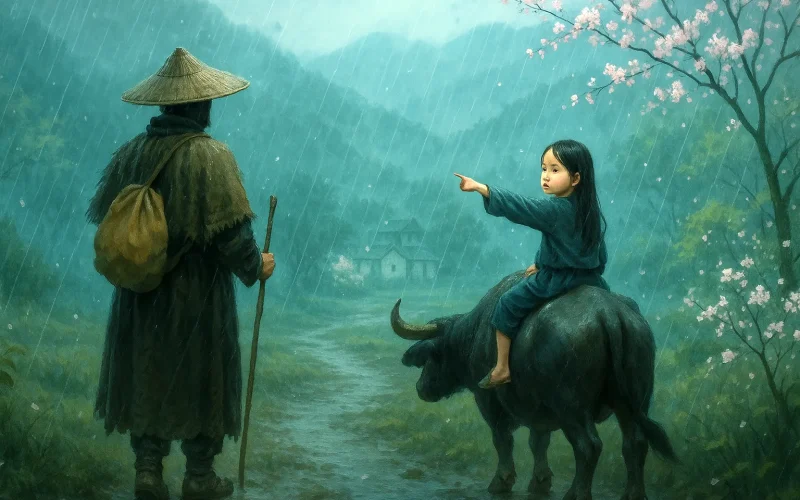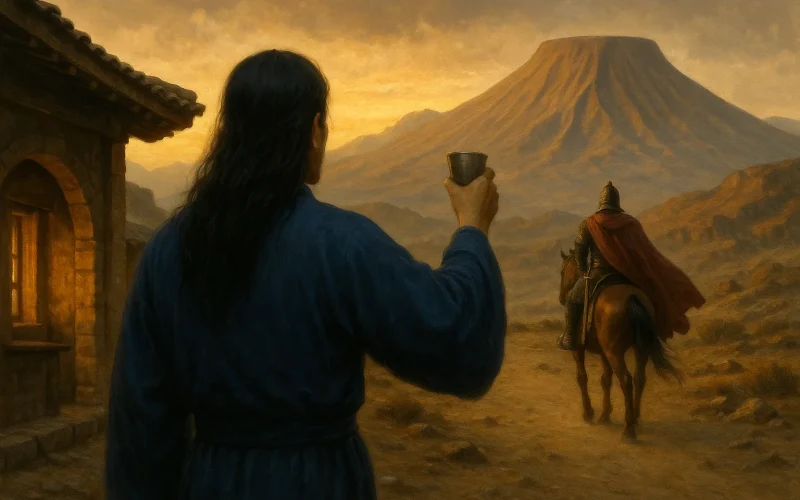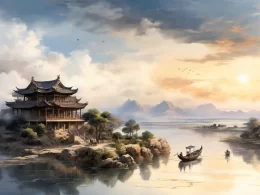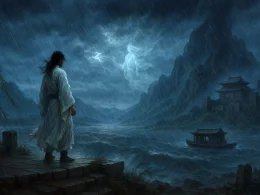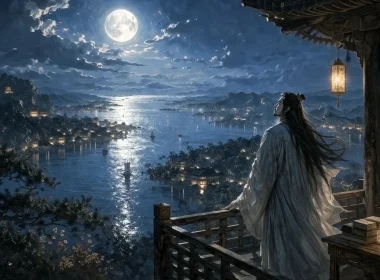
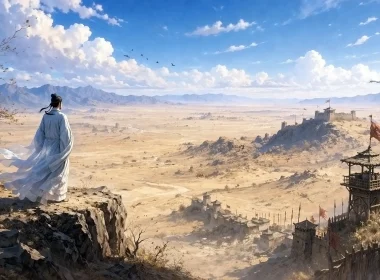
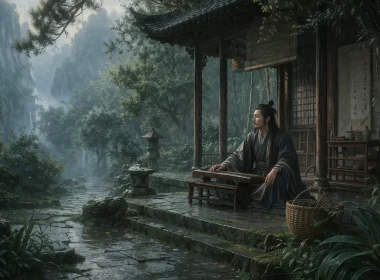
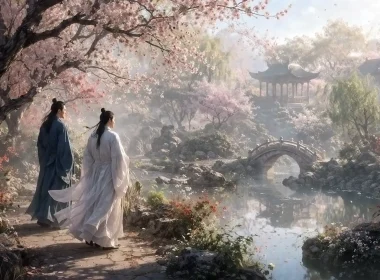
Last night spring wind in inner room did blow;
My friend’s beyond the River Xiang’s long flow.
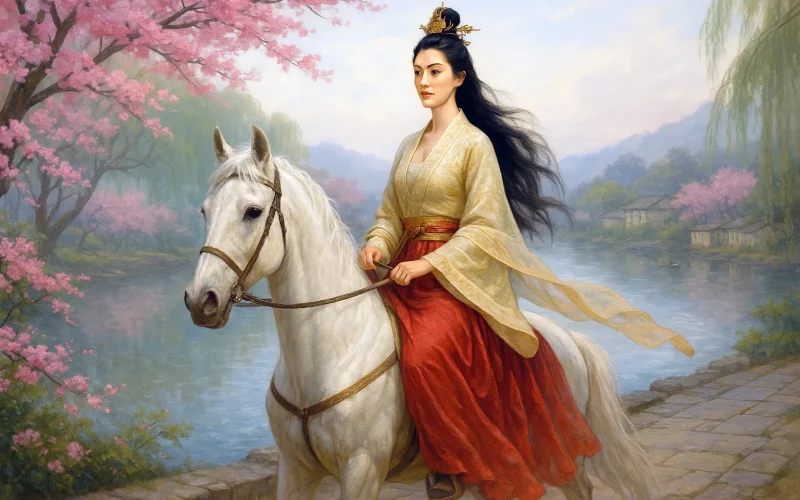
Upon my pillow, in a dream’s short lease,
I roamed the southern miles, and found no peace.
Original Poem
「春梦」
岑参
洞房昨夜春风起,故人尚隔湘江水。
枕上片时春梦中,行尽江南数千里。
Interpretation
This poem is a stylistically unique work within Cen Can's collected oeuvre, its date of composition difficult to ascertain—likely from his early period or from beyond his frontier themes. As a frontier poet renowned for such striking images as "火山六月应更热" (The Volcano in the sixth month must be even hotter) and "忽如一夜春风来" (As if overnight a spring wind came), Cen Shen here reveals another pole of his artistic range—extreme tenderness, subtlety, and dreamlike delicacy. This creative phenomenon exemplifies the High Tang poet's comprehensive artistic capabilities and emotional richness: they could gallop across desert sands and also linger in boudoir spring reveries.
The title "Spring Dream" points directly to the poem's core mechanism: using spring as a catalyst and dream as a bridge. In the tradition of classical Chinese poetry, both "spring" and "dream" are classic vehicles for longing. Spring, when all things stir, is most apt to awaken the emotions; while dreams can transcend physical limits, enabling the instant arrival of feeling. Cen Shen's poem is a masterful elaboration and high concentration of the lyrical mode "spring wind stirs dreams, dreams cross mountain passes"—constructing a complete and moving emotional circuit within twenty characters, making it an enduring gem among Tang quatrains on dreams and longing.
First Couplet: "洞房昨夜春风起,故人尚隔湘江水。"
Dòng fáng zuó yè chūn fēng qǐ, gù rén shàng gé xiāng jiāng shuǐ.
Last night in the bridal chamber, the spring wind arose;
My old friend is still separated by the waters of the Xiang River.
The opening establishes a specific temporal-spatial node: the moment when the spring wind first arose "last night." "洞房" (bridal chamber) refers to a deep inner room, suggesting the quiet, enclosed space of the protagonist (implied to be a woman). The "rising" of the spring wind signals the change of seasons in the outer world; it intrudes into the "bridal chamber," breaking the inner stillness and awakening dormant longing. "故人尚隔湘江水" directly states the object of longing and the insurmountable distance. The "Xiang River" is both a concrete geographical barrier and, due to its literary associations with poignant emotion (such as the Xiang River goddesses weeping on bamboo), lends this longing an enduring and beautiful undertone of sorrow. The spring wind and the river waters—one near, one far, one touching, one flowing—together pluck the strings of emotion.
Final Couplet: "枕上片时春梦中,行尽江南数千里。"
Zhěn shàng piàn shí chūn mèng zhōng, xíng jìn jiāng nán shù qiān lǐ.
In the brief moment of a spring dream upon my pillow,
I have traveled the full thousands of li of Jiangnan.
This couplet is the poem's essence, pushing the intensity of emotion and the power of fantasy to their peak. "枕上片时" (the brief moment upon the pillow) and "行尽数千里" (traveling thousands of li) create a striking contrast in time and space: physical time in reality is compressed to an extreme (a brief moment), while psychological spatial distance is stretched to an extreme (thousands of li). This is not mere hyperbole but a profound revelation of how longing distorts normal spatiotemporal perception—driven by intense emotion, consciousness can break through all barriers in an instant. The "spring dream" is the medium, the crystallization and release of longing in the subconscious; "行尽" (traveled) is the action, the relentless pursuit of emotion in the realm of fantasy. The union of dream's illusion and the tangible sense of "traveling" makes this pursuit feel both real and futile, profound and lingering, with endless resonance.
Overall Appreciation
This five-character quatrain is a delicate lyric miniature, using dream to express longing and brevity to express vastness, revealing within the most compressed form the infinite depth and breadth of the emotional world.
Structurally, the poem moves from reality to illusion, from obstruction to transcendence. The first couplet juxtaposes "the spring wind arose" with "the waters of the Xiang River"—the spring wind is the signal of seasonal change in the outer world, intruding into the "bridal chamber," breaking the inner stillness and awakening dormant longing; while the "Xiang River" is the concrete physical barrier, together touching and flowing to pluck the strings of emotion. The final couplet constructs the startling temporal-spatial contrast of "the brief moment upon the pillow" and "traveling thousands of li"—physical time in reality is extremely compressed, while psychological space is extremely stretched. Between the two lines, from the "confinement" of reality (separation) to the "penetration" of dream (traveling all the way), from the real to the illusory, with the illusory reflecting the real, layer upon layer, in seamless unity.
In terms of theme, the poem pivots on the tension between "the brief moment" and "thousands of li." The brevity of "the brief moment upon the pillow" is the shortness of real time; the length of "traveling the full thousands of li" is the boundlessness of dream space. Between this "shortness" and "length" lies the deepest secret of longing: when emotion is intense enough, consciousness can break through all barriers in an instant, achieving in the realm of fantasy what can never be reached in reality. The union of dream's illusion and the tangible sense of "traveling" makes this pursuit feel both real and futile, profound and lingering, with endless resonance.
Artistically, the most striking quality of this poem is the technique of writing reality through illusion, and truth through dream. Using the "spring dream" as medium, the poet transforms the insurmountable distance and inexpressible longing of reality into a dreamlike pursuit of "traveling the full thousands of li of Jiangnan." The dream is illusion, but the action of "traveling" endows it with a tangible reality; the distance is real, but the moment of arrival in the dream dissolves its reality. This interweaving of illusion and reality, truth and fantasy, gives the poem a quality of feeling that is both tender and tenacious, both dreamy and immediate—the highest realm of classical Chinese poetry, where "words end but meaning is infinite."
Artistic Features
- Classical Imagery and Emotional Resonance: The images of "spring wind," "Xiang River," and "Jiangnan" are all deeply accumulated lyrical symbols in classical poetry. Cen Shen's brilliance lies in making the "spring wind" the trigger, the "Xiang River" the symbol of separation, and "Jiangnan" the far shore of pursuit, constructing a clear emotional trajectory that makes these public images shine with individual brilliance within a specific narrative logic.
- Dreamlike Treatment of Time and Space: The poem's core lies in the poetic deformation of time and space. The extreme contrast between "the brief moment" and "thousands of li" is not physical truth but psychological and emotional truth. This conception of time and space, following emotional logic rather than physical logic, precisely captures and recreates the nature of dreams and profound longing, producing powerful artistic effect.
- Subtle Empathy Through a Female Perspective: The entire poem is written in a female voice (the "bridal chamber" typically indicates a woman's quarters), with delicate and gentle emotion. Cen Shen, as a male poet, engages in this "role-based" writing and achieves genuine, unfiltered emotion, demonstrating his keen empathetic ability and profound artistic expressiveness, broadening the thematic boundaries of his poetry.
- The Structural Art of Interweaving Reality and Illusion: The first couplet writes of reality (the spring wind rises, people are separated); the second couplet writes of illusion (traveling in the dream). The real scene evokes the illusory scene, while the illusory scene in turn illuminates and intensifies the emotion of reality. This structure, moving from reality to illusion and using illusion to reflect reality, gives the brief four lines rich layers and profound artistic conception, avoiding the monotony of flat narration.
Insights
This exquisitely crafted little poem reveals to us a transcendent power of the human emotional world: when physical distance becomes an obstacle, the mind has the capacity to create another kind of "distance"—one that can cross mountains and rivers in an instant, belonging to the realm of emotion and imagination. The "spring dream" in the poem is the perfect symbol of this mental power. It reminds us that profound emotions such as longing and love often operate by non-linear, leaping, reality-transcending mechanisms. They do not follow the rules of clocks and maps but the laws of heartbeat and memory. In the material world, the "Xiang River" is an insurmountable barrier; but in the spiritual world, "thousands of li of Jiangnan" can be reached in "a brief moment." This conquest and reorganization of time and space by the mind is proof of human spiritual freedom and creativity.
At the same time, this poem demonstrates how art gives form and beauty to such intangible emotions. Cen Shen transforms a restless longing into the beautiful image of "traveling the full thousands of li of Jiangnan," making a private emotional experience publicly and aesthetically perceptible. This inspires us, when faced with surging emotions difficult to express, to seek or create our own "poetry"—a mode of expression that can organize inner chaos into external order and elevate private sorrow into universal beauty.
Ultimately, this work shows us that even within the heart of a poet renowned for his heroic and powerful frontier verse, there exists a tender place where spring winds blow and dreams wander across a thousand miles. This is perhaps the loveliness and depth of complete humanity: we can face the harsh snows of the outer world while also guarding the spring blossoms within.
Poem translator
Xu Yuanchong (许渊冲)
About the poet
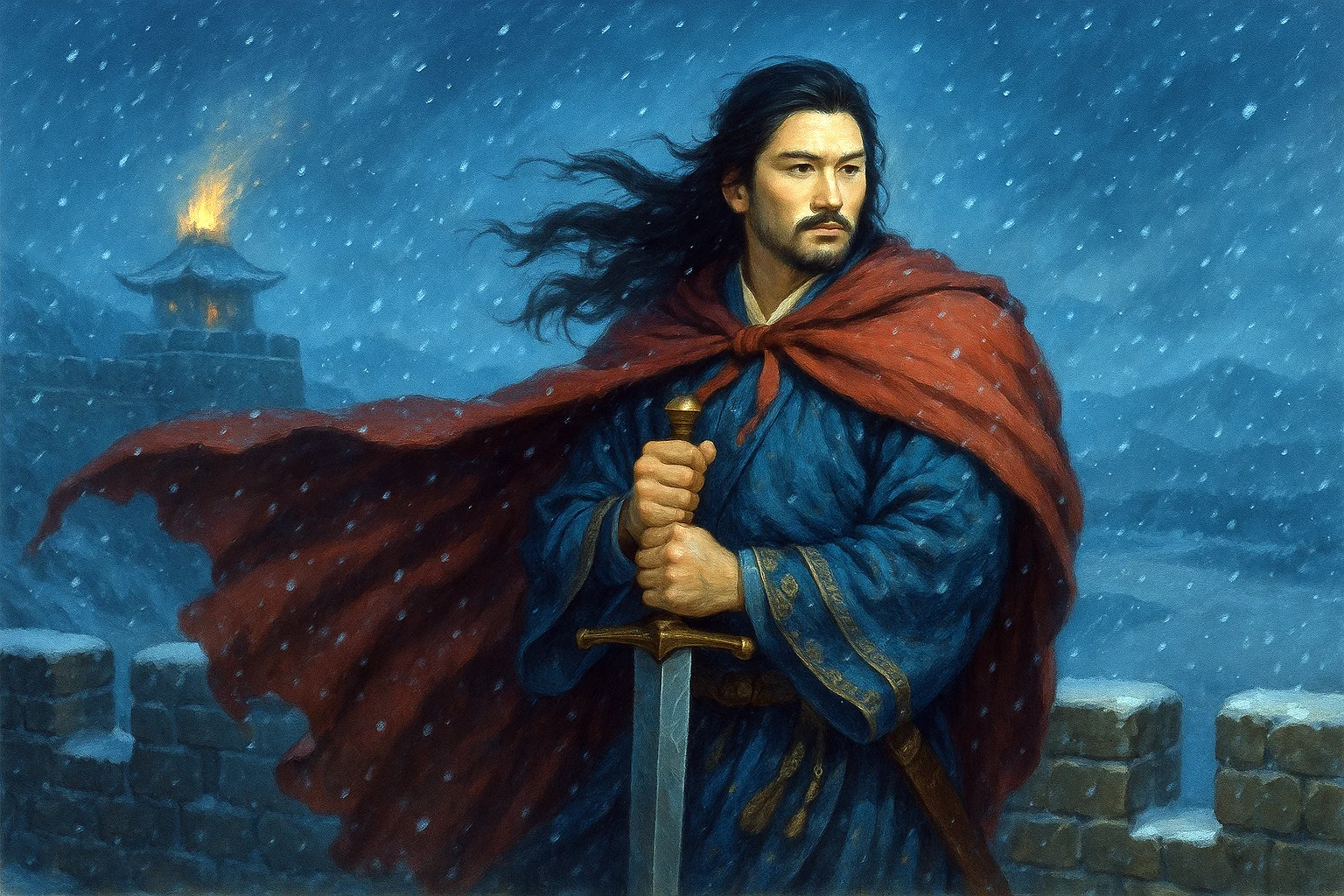
Cén Cān(岑参), 715 - 770 AD, was a native of Jingzhou, Hubei Province. He studied at Mt. Songshan when he was young, and later traveled to Beijing, Luoyang and Shuohe. Cén Cān was famous for his border poems, in which he wrote about the border scenery and the life of generals in a majestic and unrestrained manner, and together with Gao Shi, he was an outstanding representative of the border poetry school of the Sheng Tang Dynasty.