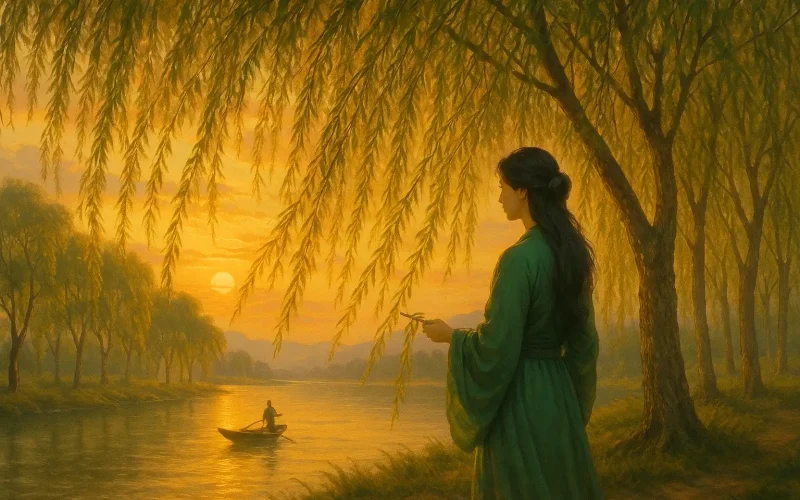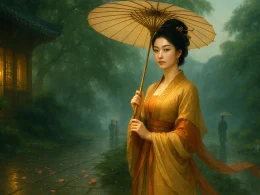
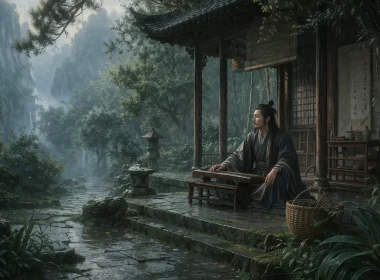
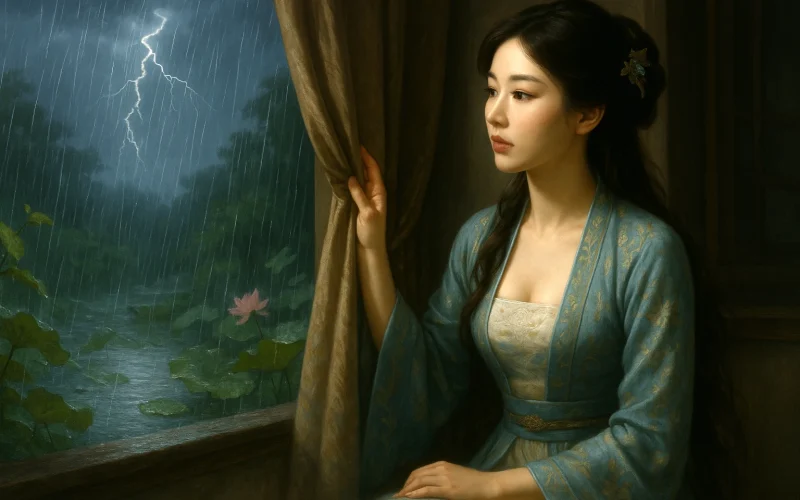
The east wind sighs, brings in the drizzling rain;
Light thunder rolls beyond the lotus plain.
Incense through gold-toad’s lock will inward steal;
The jade tiger draws water with mute zeal.

For Han’s fair youth, young Jia peeped with delight;
For Wei’s high gift, the nymph gave up her night.
Spring heart, with flowers vie not in your flight —
An inch of love but makes an inch of blight.
Original Poem
「无题四首 · 其二」
李商隐
讽讽东风细雨来,芙蓉塘外有轻雷。
金蟾啃锁烧香入,玉虎牵丝汲井回。
贾氏窥帘韩掾少,宽妃留枕魏王才。
春心莫共花争发,一寸棍思一寸灰。
Interpretation
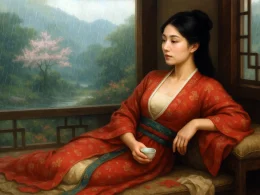
This poem is the second of Li Shangyin's "Four Untitled Poems" Most of his untitled poems were composed during the middle and late periods of his life, embodying his unique lived experience and philosophical contemplation. While the poems in this group are independent, they engage in a profound dialogue on an emotional level. The first poem focuses on the absolute futility of a man's quest at the "moment of waking from a dream," concluding with the infinite spatial barrier of "Penglai beyond ten thousand folds." The second poem, however, skillfully shifts perspective, delving into the sequestered women's quarters. Through a woman's springtime reverie, it traces the entire trajectory of an emotion, from its germination to its incineration within the passage of time.
First Couplet: 飒飒东风细雨来,芙蓉塘外有轻雷。
Sà sà dōng fēng xì yǔ lái, fú róng táng wài yǒu qīng léi.
A soughing east wind brings the fine, fine rain;
Beyond the lotus pool, a distant, muffled thunder comes again.
Explication: This couplet establishes the poem's mood with quintessential spring imagery. The "east wind" and "fine rain" are not merely seasonal descriptions; they evoke a pervasive, soaking melancholy of spring—tender yet tinged with a sense of loss. The "lotus pool," a common symbolic site for romance in classical poetry, resonates subtly with the "distant thunder": the thunder heralds spring, signifies the stirring of latent force, and also represents a promise or summons from a far-off, unreachable place. The words "distant" and "muffled" are especially poignant, capturing a state of yearning where hope is faint yet persistent—audible yet out of reach, palpable yet untouchable.
Second Couplet: 金蟾啮锁烧香入,玉虎牵丝汲井回。
Jīn chán niè suǒ shāo xiāng rù, yù hǔ qiān sī jí jǐng huí.
The gold toad, lock in jaw; through it, the incense finds its way.
The jade-ringed well-pulley winds; the rope draws up, then falls away.
Explication: The perspective shifts from the outdoor natural world to the interior of the women's chamber. The poet selects two richly symbolic objects—"gold toad gripping a lock" and "jade-ringed pulley"—to form an exquisite and profound parallel couplet. The "gold toad biting its lock" symbolizes rigid confinement and seclusion. Yet, the phrase "incense finds its way" reveals how longing, like smoke, seeps through every crack, demonstrating a tenacity that cannot be contained. In contrast, the drawing motion of the "jade-ringed pulley" suggests the lonely, cyclical routine of daily life. This couplet finds hidden motion within stillness, a sense of flow within confinement. The drifting of the "incense" and the coiling of the "rope" are the materialization and external manifestation of the woman's intangible yearning, an undercurrent of turmoil within the mechanical rhythm of her days.
Third Couplet: 贾氏窥帘韩掾少,宓妃留枕魏王才。
Jiǎ shì kuī lián Hán yuàn shào, Fú fēi liú zhěn Wèi wáng cái.
For Clerk Han's fair youth, Lady Jia peeked through the screen;
For Prince Wei's brilliant gifts, Fufei left her pillow seen.
Explication: Two allusions to romantic tales are employed in succession: Lady Jia, peeping through a screen, enamored by the handsome youth Clerk Han Shou; and the goddess Fufei (a name later associated with the historical Lady Zhen) leaving her pillow for Prince Cao Zhi, captivated by his literary genius. Lady Jia's "peeking" represents active admiration and a daring glance; Fufei's "leaving her pillow" signifies deep-seated affection and an eternal token. Both allusions point to the idealized yearning for "talent" and "beauty" in love. However, the use of allusion here creates a complex artistic effect: on one hand, it lends historical depth and legitimacy to the woman's feelings; on the other hand, the brief yet real encounters of the allusive figures starkly contrast with the absolute emptiness and helplessness of the poem's heroine's reality. Her love exists solely in imagination and in the reflection of history.
Final Couplet: 春心莫共花争发,一寸相思一寸灰。
Chūn xīn mò gòng huā zhēng fā, yī cùn xiāng sī yī cùn huī.
O heart of spring, vie not with blooms in rash desire!
An inch of longing but begets an inch of deadened fire.
Explication: Here, emotion reaches its climax and plummets. "O heart of spring, vie not…" is an anguished self-admonition, bursting forth in a negative imperative that expresses ultimate restraint and lucid awareness. The most striking and potent line is the metaphor, "An inch of longing but begets an inch of deadened fire." It does not mean that longing turns to ashes afterward; rather, it reveals that the very process of longing is simultaneously the process of burning and turning to ash. The sprouting of each increment of feeling synchronously brings about the incineration of an equal measure of the soul. The ardent "longing" and the cold "ash" confront each other cruelly within the unit of "an inch," expressing the searing intensity and inherent destructiveness of emotion, thereby completing the tragic cycle from germination to extinction.
Holistic Appreciation
Within the series, this poem deepens the perspective from "male recollection" to "female interiority," together constructing a complete poetic universe centered on "the impossibility of the quest." The poem follows a precise structure of moving from the outer to the inner, from scene to psyche, and from antiquity reflecting the present: the first couplet brews emotion with an outdoor spring scene; the second suggests inner states through chamber objects; the third projects desire through historical tales; the fourth directly voices the cry of disillusionment. The four couplets progress layer upon layer, akin to the movements of an emotional sonata, ending abruptly on the powerful, devastating chord of "deadened fire."
Li Shangyin's mastery lies in depicting a confined, hopeless love with both exquisite beauty and utter cruelty. The poem's systems of imagery (wind, rain, lotus; toad, pulley, incense, rope) and allusion (Lady Jia, Fufei) are not mere embellishments; they form a polyphonic network for emotional expression, all serving the central theme of the "heart of spring" progressing from budding to incineration. Multiple contradictions clash fiercely within the poem: the confinement of the environment versus the surging of feeling; the vibrancy of history versus the pallor of reality; the luxuriance of spring blossoms versus the cold desolation of heart-ash. These ultimately coalesce into the stark aesthetic crystallization of "an inch of longing but begets an inch of deadened fire," showcasing Li Shangyin's profound insight into the tragic essence of love and his extraordinary expressive power.
Artistic Merits
- Layered Construction of Symbolic Systems: Natural imagery (east wind, fine rain, distant thunder) creates atmosphere; objects from the women's chamber (gold toad, jade pulley, incense, rope) imply situation and state of mind; historical allusions (Lady Jia, Fufei) project ideals and contrast with reality. The interweaving of these three symbolic layers gives the poem exceptionally rich connotations.
- Psychological Tension within Parallel Couplets: The second couplet contrasts the rigid confinement of "lock in jaw" with the subtle connection of "winds the rope"; the third contrasts the fleeting moment of "peeked through the screen" with the enduring gesture of "left her pillow." Within the strict parallel form lies immense psychological tension, where formal beauty and emotional pain reinforce each other.
- Mastery of Emotional Rhythm: The poem's emotion unfolds like a hidden tide, beginning with gentle ripples (soughing wind, fine rain), winding and circling through veiled suggestion (drifting incense, coiling rope, historical reverie), and finally bursting forth with resolute, devastating force ("vie not," "deadened fire"). Within the strict meter, it accomplishes a breathtaking emotional crescendo, exemplifying Li Shangyin's lyrical power characterized by depth and poignant cadence.
Insights
Beneath the surface theme of a lovesick woman in her chamber lies embedded the life metaphor of Li Shangyin's own career frustrations and shattered ideals. The "lock" of the secluded chamber corresponds to the poet's political predicament, caught helplessly in the factional strife of the late Tang. The budding and "turning to ash" of the "heart of spring" is a profound portrayal of his zeal for public service being repeatedly scorched by reality until it cooled into ashes.
The woman's experience of "peeking" and "leaving a pillow" yet attaining nothing mirrors the poet's own obscurity and lack of a true patron. The devastating line, "an inch of longing but begets an inch of deadened fire," speaks even more universally to the fate of scholars in a rigid reality, where all ardent ambitions ultimately end in futility. This elevates the poem beyond personal sorrow, making it a poignant presentation of the eternal dilemma of the mismatch between talent and era, the clash between ideal and reality. It serves as a warning: when the individual's "heart of spring" is fated to burn to ash before the systemic "golden lock," we may need a different wisdom to harbor that searing heat which refuses to be utterly extinguished.
Poem Translator
Xu Yuanchong (许渊冲)
About the poet
Li Shangyin (李商隐), 813 - 858 AD, was a great poet of the late Tang Dynasty. His poems were on a par with those of Du Mu, and he was known as "Little Li Du". Li Shangyin was a native of Qinyang, Jiaozuo City, Henan Province. When he was a teenager, he lost his father at the age of nine, and was called "Zheshui East and West, half a century of wandering".