
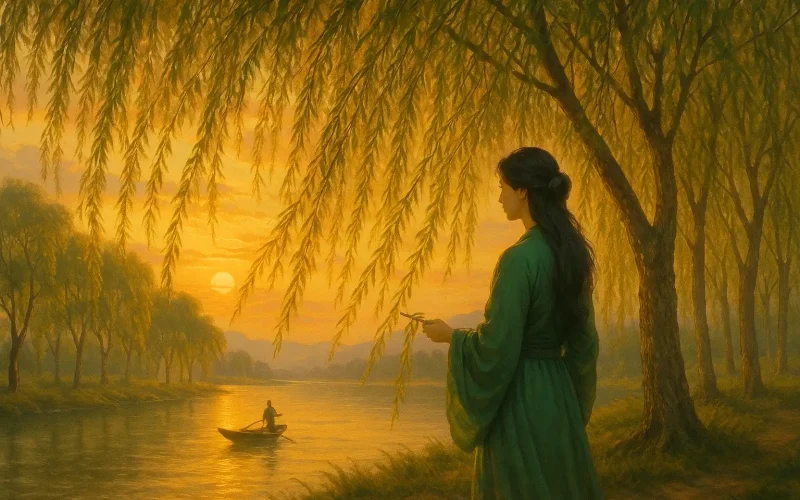
In haze they cling, with tenderness imbued;
A thousand threads brush sunlight faint and subdued.
Wayfarer, spare the branches on the tree —
Half for farewell, half for welcome yet to be.
Original Poem:
「离亭赋得折杨柳二首 · 其二」
李商隐
含烟惹雾每依依,万绪千条拂落晖。
为报行人休折尽,半留相送半迎归。
Interpretation
This poem serves as the concluding piece in the two-part series. While continuing the thematic motif of "The Broken Willow at Farewell" and the setting of the farewell pavilion, it executes a profound shift in both emotional tone and philosophical orientation. In contrast to the first poem's confrontation with the absolute pain of "parting is the only true sorrow," this second work instead excavates a cyclical wisdom and tender hope that transcends one-directional separation from the willow's own posture and fate. Employing personification, the poet elevates the willow from a passive token of farewell to an active mediator of emotion and a symbol of temporal connection, achieving a poetic redemption and philosophical consolation for parting sorrow amidst the mist and fading sunlight.
First Couplet: 含烟惹雾每依依,万绪千条拂落晖。
Hán yān rě wù měi yīyī, wàn xù qiān tiáo fú luòhuī.
Cloaked in mist, embraced by haze, ever tender and forlorn;
A thousand strands, ten thousand thoughts, that stroke the dying light of morn.
Explication: The opening lines, rich in atmospheric evocation and delicate portrayal of posture, imbue the willow with the emotional subjectivity of a sentient being. "Cloaked in mist, embraced by haze" depicts its ethereal, soft beauty while simultaneously evoking the pervasive and clinging nature of parting sorrow. "Ever tender and forlorn" emphasizes this as a constant, intrinsic state. "A thousand strands, ten thousand thoughts" carries a double meaning: literally referring to the willow's abundant branches, and figuratively to the tangled threads of parting grief. The action "stroke the dying light" situates the farewell at the temporal juncture of dusk, charged with a sense of finality and vastness, yet the gentleness of "stroke" softens the weight, rendering the sadness graceful and restrained. This couplet fully personifies the willow, transforming it into the very embodiment and vessel of parting sentiment.
Final Couplet: 为报行人休折尽,半留相送半迎归。
Wèi bào xíngrén xiū zhé jǐn, bàn liú xiāng sòng bàn yíng guī.
O, tell the traveler for me: do not strip my branches bare;
Break but half for your farewell, and half for your return, I pray.
Explication: This couplet forms the soul of the poem. Voiced from the willow's perspective, its conception is strikingly original yet profoundly resonant. "O, tell the traveler for me" presents the willow as an emotional subject actively expressing its plea. The entreaty, "do not strip my branches bare," stems from pity for its own fate, but more deeply, it constitutes a fundamental critique of the logic of parting—it rejects meeting separation with complete depletion (stripping bare). "Break but half for your farewell, and half for your return" is the concrete proposal of this critique. It dismantles the self-contained, final nature of the farewell act by introducing the future-oriented dimension of "your return." Thus, the linear, despairing "departure" is incorporated into a cyclical, hopeful structure of "departure and return." The willow branch thereby becomes a token and covenant connecting the present with the future, parting with reunion.
Holistic Appreciation
This poem is a "dialectic of parting" that observes human feeling through the natural object, employing softness to overcome harshness. The entire poem adopts the unique perspective of the "willow's soliloquy": the first couplet is the willow's "declaration of its state" (I am ever so tender and full of longing), the final couplet is its "utterance of desire" (do not break all, save some for return). This shift in perspective renders the emotional expression more nuanced and profound, and grants the traditional "breaking the willow" motif a renewed interpretive space.
Li Shangyin's depth lies in not simplistically presenting "your return" as mere optimistic fancy. Instead, he grounds it in a clear-sighted recognition of the tragedy inherent in the act of "stripping bare." "Break but half" represents a strategic preservation and wise restraint. It acknowledges the inevitability of parting (still requiring a farewell token) yet resists its absoluteness (reserving a portion for the return). This infuses the poem's tenderness with rational strength and gives its hope the weight of reality. Compared to the first poem's resolute declaration of "parting is the only true sorrow," the second offers an alternative psychological strategy for facing separation through the cyclical perspective of "half for farewell, half for return." Together, the two poems—one deconstructing, the other constructing; one despairing, the other hopeful—constitute a complete poetic exploration of the human condition of parting.
Artistic Merits
- Dramatic Effect of Perspectival Shift: The change from the poet's subjective lyricism in the first poem to the willow's "speaking in its own voice" in the second achieves an objectification of emotion and a vivid embodiment of philosophy, preventing the reasoning from becoming dry and making profound feeling appear more灵动.
- Symbolic Philosophy of Numbers and Division: "A thousand strands, ten thousand thoughts" expresses extreme multiplicity, while "half… half…" emphasizes division. The contrast between "multitude" and "half" contains profound meaning: Even when emotions are as tangled and numerous as "a thousand strands, ten thousand thoughts," they require the rational apportionment and preservation signified by "half" to withstand life's dispersals and reunions.
- Skillful Introduction of Temporal Dimension: By presupposing "your return," the poem extends the simple "farewell in the present" into a temporal continuum of "farewell now—return hereafter." The willow branch thus becomes a token traversing time, connecting the separated individuals across different temporal nodes.
- Linguistic Ambiguity and Expansion of Conception: "Tender and forlorn" describes both the willow's posture and human attachment; "thoughts" refers to both willow twigs and heartstrings; "tell" means both to convey a message and implies a reciprocal gesture. The multiple layers of meaning allow the limited textual space rich interpretive possibilities.
Insights
This work acts as a gentle yet resilient salve for the soul, offering a poetic antidote to the eternal pain of parting. It suggests that when facing inevitable loss and separation, rather than exhausting everything in mourning ("strip bare"), it is wiser to give with measure and preserve with foresight ("break but half"). That preserved half represents faith in a future reunion, hope for the continuity of affection, and, more fundamentally, a wisdom for living that actively constructs meaning and hope amidst life's impermanence.
In the modern world characterized by fluid relationships and frequent farewells, the poem's wisdom of "break but half" is especially precious. It prompts reflection: in every act of emotional investment, can we reserve a space and possibility for "return"? This is not merely about waiting for another, but the cultivation of one's own emotional resilience and the maintenance of relational openness. The willow's "half for farewell, half for return" symbolizes a healthy model of affection: to engage fully without exhausting the self, to bid farewell with depth without closing off the future.
Through this pair of poems, Li Shangyin accomplishes a dual interpretation of "parting": the first reveals its cruel truth as an existential reality; the second explores the poetic and rational possibilities for transcending that cruelty. Together, they convey that true depth of feeling can both gaze directly into the abyss of "the only true sorrow" and, by that very abyss, plant a willow branch saved "for your return."
About the poet
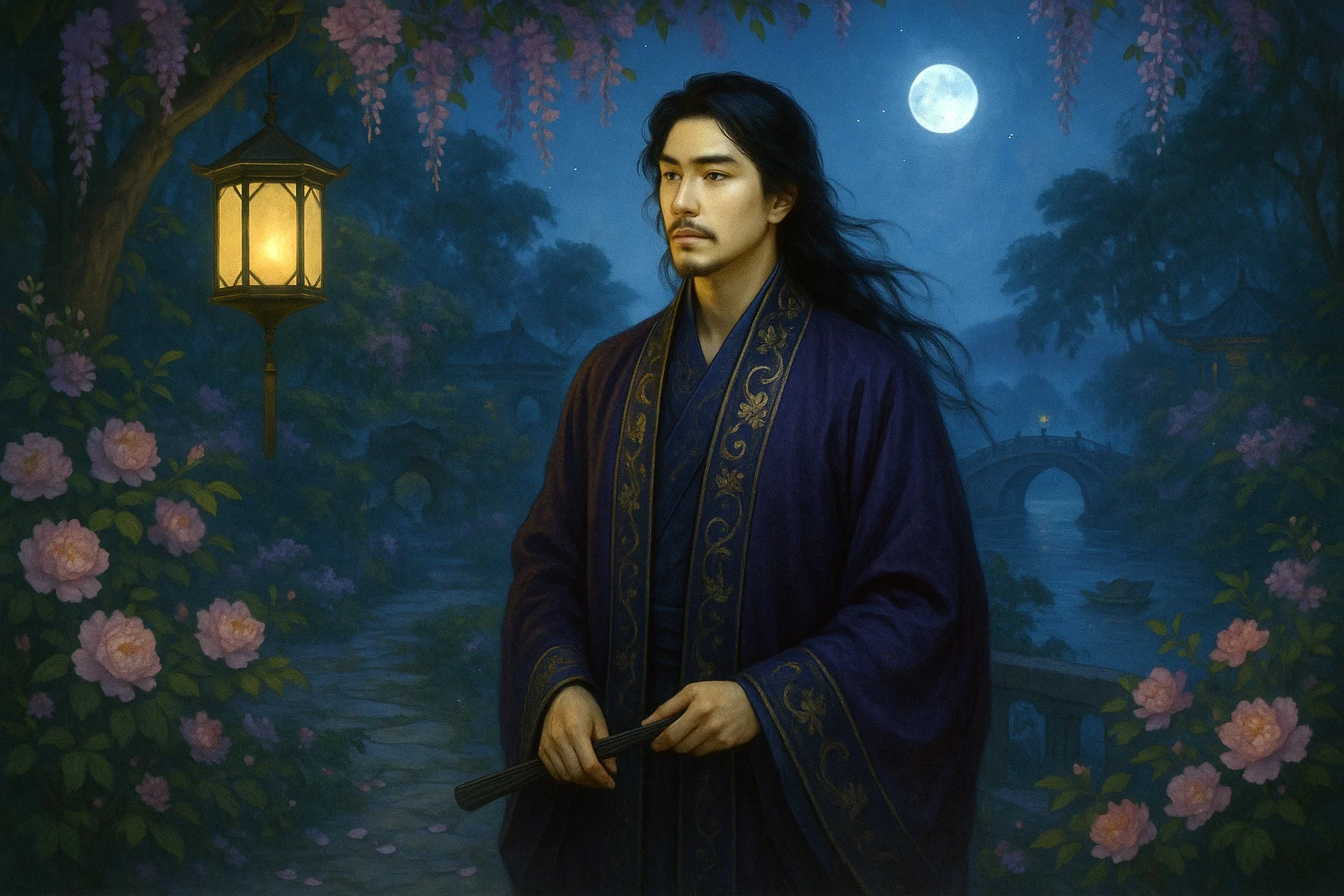
Li Shangyin (李商隐), 813 - 858 AD, was a great poet of the late Tang Dynasty. His poems were on a par with those of Du Mu, and he was known as "Little Li Du". Li Shangyin was a native of Qinyang, Jiaozuo City, Henan Province. When he was a teenager, he lost his father at the age of nine, and was called "Zheshui East and West, half a century of wandering".