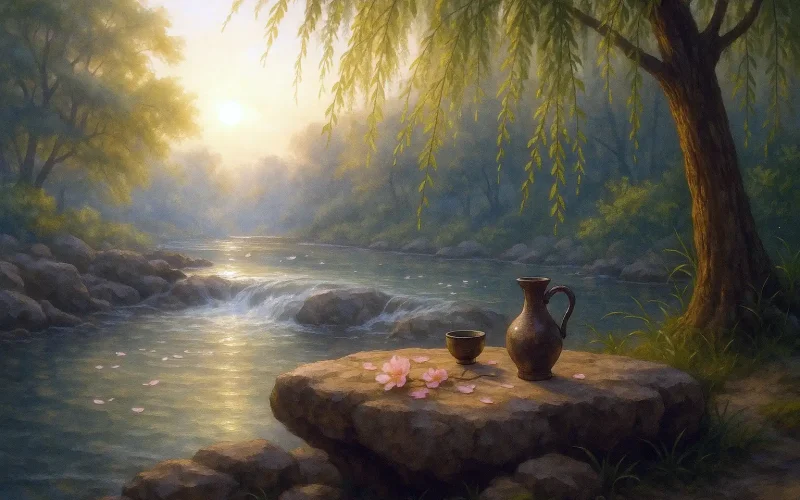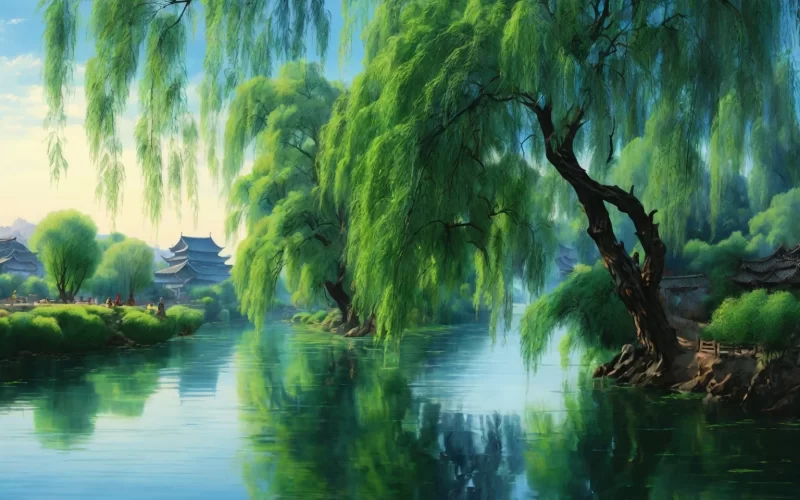

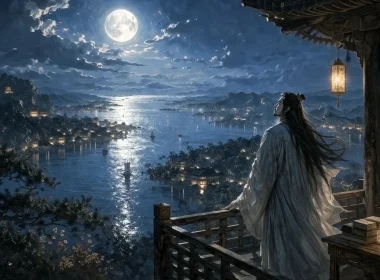
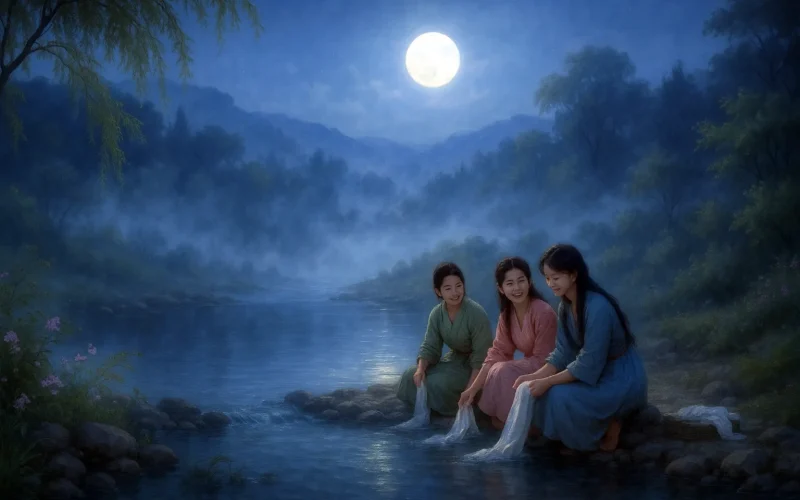
White stones shine where the stream runs clear;
Green rushes grow for hand to hold.
Homes east and west along the water appear;
They rinse their silk under moonlight cold.
Original Poem
「白石滩」
王维
清浅白石滩,绿蒲向堪把。
家住水东西,浣纱明月下。
Interpretation
This poem comes from the Wang River Collection (Wangchuan Ji), compiled by Wang Wei in his later years and composed during his period of seclusion at Wangchuan. During the Tianbao era, Wang Wei lived a life alternating between official duty and retirement at his Wang River estate in Lantian. In poetic exchanges with his friend Pei Di, they created twenty poems celebrating various scenes of Wangchuan, compiled together as the Wang River Collection. This poem's title indicates it is a delicate, lyrical vignette depicting a nighttime waterside scene from that collection. In only twenty characters, the poem employs a painter's eye to select the view and a poet's heart to create the mood. With minimal brushstrokes, it constructs a moonlit world that is limpid as a painting, man and scene meld as one, a miniature masterpiece exemplifying Wang Wei's artistic philosophy of "infusing painting with Zen, infusing poetry with painting."
First Couplet: 清浅白石滩,绿蒲向堪把。
Qīng qiǎn bái shí tān, lǜ pú xiàng kān bǎ.
Clear and shallow spreads the shoal of shining white stone; / Lush, green rushes grow so thick, nearly ready to be grown.
This couplet outlines the basic features of White Stone Shoal with a technique akin to plain outline drawing, yet it implies multilayered sensory experience. The two characters "Clear and shallow" describe not only visual transparency but also suggest the light sound of the flowing stream, evoking an intuitive sense of the water's quality and the play of light. "Shoal of shining white stone" names the subject; white stones are especially conspicuous in clear water, forming the bright base color of the scene. "Lush, green rushes grow so thick" injects vibrant life—the rushes are emerald green, dense, and within reach. This not only provides sharp color contrast but, through the tactile suggestion of "nearly ready to be grown" (implying one could almost gather a handful), transforms static plants into approachable, graspable living presences. Wang Wei does not directly describe moonlight. Instead, through details like stones visible in the clear shallows and the distinct color of the green rushes, he lets the reader naturally sense a bright night lit by moonlight, where all things are clearly revealed. This demonstrates his masterful technique of "writing by not writing."
Second Couplet: 家住水东西,浣纱明月下。
Jiā zhù shuǐ dōng xī, huàn shā míng yuè xià.
Their homes are east and west along the stream; / They wash their gauze in the bright moonlight's gleam.
Human figures enter the scene quietly, lending a subtle dynamism to the tranquil natural setting. The line, "Their homes are east and west along the stream," sketches the human environment with a few deft strokes, depicting a riverside community whose lives are intimately tied to the water—implying a harmonious, interdependent relationship with nature. The concluding phrase, "They wash their gauze in the bright moonlight’s gleam," serves as the poem’s most luminous moment. Here, the commonplace act of washing is elevated into poetry by the simple yet transformative setting, "in the bright moonlight’s." Without ever directly describing the moon’s brightness, the poet lets the very possibility of the activity—washing clearly at night—testify, by quiet implication, to the ample, radiant light. The maidens’ forms, their motions, and perhaps the soft murmur of their talk and laughter bring warmth and gentle sound to the white stone shoal. Thus, the scene shifts delicately from stillness into muted movement, all while preserving an overarching atmosphere of serenity. This technique—using human presence to animate a scene, and motion to heighten a sense of calm—resonates with the effect in Wang Wei’s “Bird Call Valley,” where the line, "The moonrise startles birds in the spring ravine," achieves a similar balance. It demonstrates the poet’s precise control over atmosphere and his gift for revealing stillness within motion, and life within tranquility.
Holistic Appreciation
This is a moonlit night ink-wash vignette painted with words. The poem follows the subtle logic of "moving from scene to people, from stillness to gentle action." The first two lines are like a painter preparing paper and applying washes: "Clear and shallow" defines the water, "white stone" establishes the structure, "green rushes" adds vitality, constructing a visual space that is limpid and elegantly colored. The latter two lines are like the painter adding the spark of life: "Their homes" introduces the human context, "wash their gauze" brings in human activity, and finally, the three words "in the bright moonlight's" command the entire scene, revealing the light source and time that allow all details to be clearly visible. The poem does not directly write a single word about moonlight, yet moonbeams permeate everywhere, creating the hazy beauty of light and shadow being invisible yet omnipresent.
This poem shares the same lineage as other works in the Wang River Collection, collectively embodying Wang Wei's late-life aesthetic pursuit of "the scene as such is truth; the event as such is Zen." White stones, clear water, green rushes, bright moon, laundry-maidens—all are ordinary scenes before the eyes, common events at hand. Yet, observed with the poet's limpid heart, these commonplace images radiate with their essential light. The poem holds no shadow of worldly worry, no aloof sense of solitary detachment from the world. There is only the immediate perfection of forgetting both self and object, and the intimacy between people and scene. This realm is both the artistic "fusion of poetry and painting" and, in terms of life state, "dwelling poetically with Zen spirit."
Artistic Merits
- Elegant and Contrastive Use of Color: The poem uses only two color words, "white" and "green," yet they appear exceptionally bright and pure against the background of "clear and shallow" water and "bright moonlight." The cool luminance of the white stones and the warm lushness of the green rushes form a subtle contrast under moonlight, creating a visual palette that is fresh and lovely, not monotonous.
- The Art of Suggestive Narration and "Leaving Blank Spaces": The poet provides only a few key images (shoal, rushes, homes, washing gauze, bright moon). Their connections and the complete scene require the reader's imagination to fill in. For example, "Their homes are east and west" does not specify the number of people or houses, yet naturally evokes a picture of a village scattered along the water. "Wash their gauze in the bright moonlight" does not describe the maidens' postures or expressions, yet conjures images of their light movements and perhaps their talk and laughter. This "leaving blank" (liúbái) gives the poem infinite space for imagination.
- Structural Ingenuity: Using People to Highlight the Scene, Greater Stillness in Gentle Movement: The introduction of people in the second couplet does not break the tranquility. Instead, the soft dynamism of daily life (washing gauze) sets off the overall stillness of the night, achieving the artistic effect of "The cicada's drone makes the forest seem more still; The bird's song makes the mountain more secluded" ("The Bird-Singing Stream"). This makes the scene still but not silent, full of lively interest.
- Highly Pure Language and Natural Flow of Rhythm: The diction is extremely simple, with no obscure words or artificial carving, yet each character is perfectly placed, like a clear spring flowing. The pentasyllabic rhythm is gentle and unhurried, intrinsically matching the static description of the first couplet and the gentle action of the second, forming a perfect isomorphism between linguistic rhythm and the rhythm of the mood.
Insights
This work is like a pool of clear spring water, reflecting the lucidity and ease of Wang Wei's heart in his later years. It tells us that beauty is not inaccessible; it often resides in the most ordinary scenery and the simplest moments of life—a shoal of white stones, a few clumps of green rushes, village maidens washing clothes under the moon—all are sources of poetry. Observing the world with a Zen mind, the poet strips away the distractions of the mundane world and personal sorrows, letting things appear as they are, thereby arriving at the state where "what meets the eye is truth; what one touches is beauty."
In our current era of information overload and sensory fatigue, this poem invites us to undertake a "lightening of the heart." Setting aside complex thoughts and the pursuit of novelty, we can learn to be like Wang Wei: by the clear, shallow stream, on a moonlit night, quietly gaze at the luster of white stones, the form of green rushes, listen to the sound of washing and the soft whisper of the night breeze. Perhaps it is precisely in this kind of focused yet relaxed contemplation that we can rediscover the world's true face, obscured by daily busyness, and find within it inner tranquility and joy. Wang Wei's White Stone Shoal is not just a landscape in a Tang poem; it is a poetic mode of existence that contemporaries can still seek.
About the poet
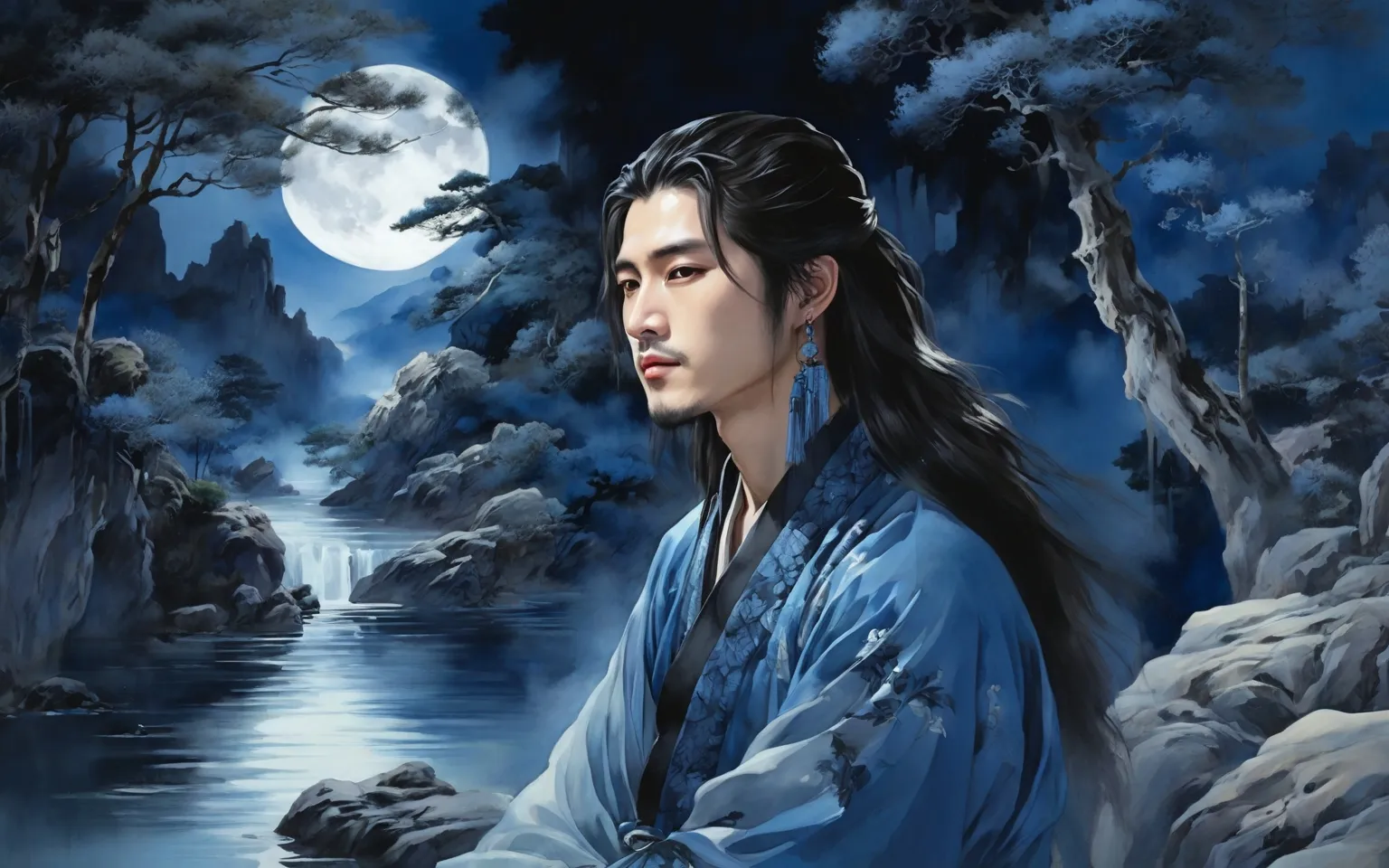
Wang Wei (王维), 701 - 761 A.D., was a native of Yuncheng, Shanxi Province. Wang Wei was a poet of landscape and idylls. His poems of landscape and idylls, with far-reaching images and mysterious meanings, were widely loved by readers in later generations, but Wang Wei never really became a man of landscape and idylls.