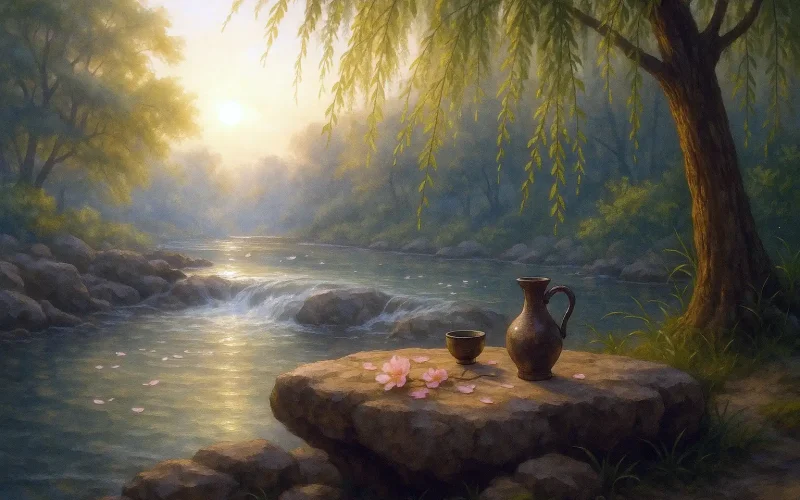

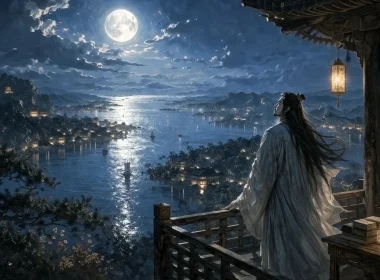
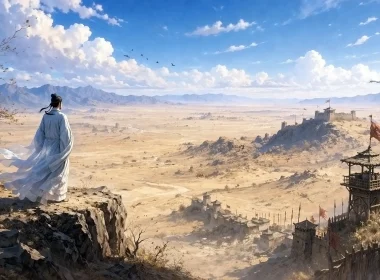
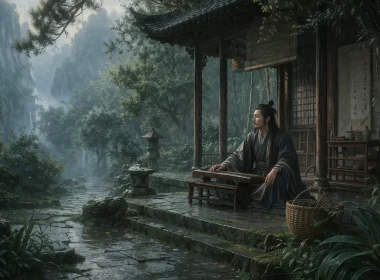
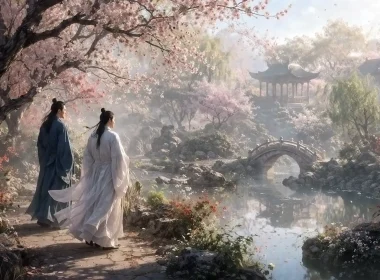
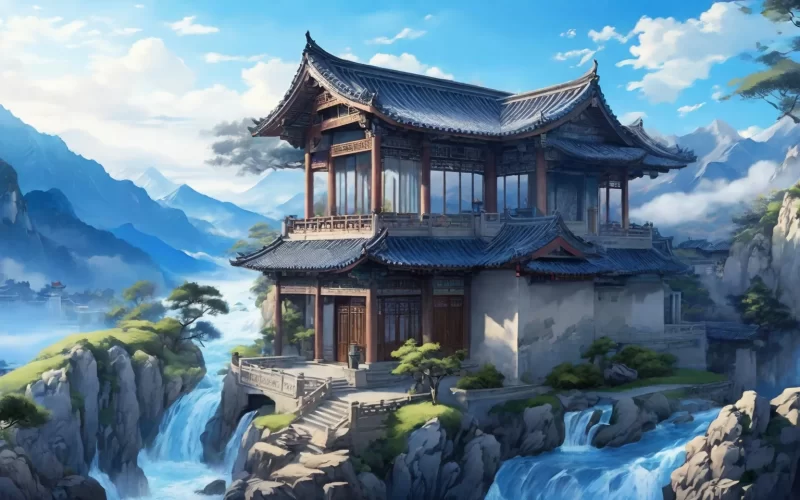
This Peach Spring’s free from worldly dust;
South of Willow Market we seek the just.
I dare not write “common bird” on the door;
To see the bamboo, why ask for more?
Green hills on walls as in the house appear;
East stream flows to the neighbor near.
He shuts his door and writes year after year;
His pines grow old with scales dragons wear.
Original Poem
「春日与裴迪过新昌里访吕逸人不遇」
王维
桃源一向绝风尘,柳市南头访隐沦。
到门不敢题凡鸟,看竹何须问主人。
城上青山如屋里,东家流水入西邻。
闭户著书多岁月,种松皆老作龙鳞。
Interpretation
This poem was composed during Wang Wei's later years while residing in Chang'an. Having experienced the vicissitudes of life, the poet deeply understood the principle of "in my later years I love stillness; / to the myriad affairs I'm indifferent." Living half in office, half in seclusion, his heart yearned for forests and springs. The poem records an ordinary spring day visit. The one visited, Lü Yiren, was a man of high virtue living in seclusion within the bustling capital. Using the "visit but not meeting" premise as its entry point, the poem avoids conventional disappointment. Instead, it seizes this chance to layer by layer evoke an ideal reclusive realm transcending worldly matters, where man and environment are one. It reveals the Zen-inspired joy and masterful spatial poetics characteristic of Wang Wei's late poetry, where "the event is the truth" and "everywhere touched reveals the real."
First Couplet: 桃源一向绝风尘,柳市南头访隐沦。
Táoyuán yīxiàng jué fēngchén, liǔ shì nántóu fǎng yǐnlún.
This Peach Blossom Spring has always shut out worldly ways; / At south of Willow Market, we call on one who strays.
Explication: The opening uses the classic symbol of seclusion, "Peach Blossom Spring," to describe figuratively the spiritual essence of Lü Yiren's dwelling, positioning it as a pure land within the dusty world. "Has always shut out worldly ways" emphasizes its transcendent constancy. It is immediately anchored in reality with the specific, real Chang'an district name "south of Willow Market." The interplay of figurative and literal expresses both longing and clarifies that this visit is a spiritual journey seeking transcendence within the bustling red dust. The term "one who strays" (recluse) is full of admiration for the master's withdrawal from the world.
Second Couplet: 到门不敢题凡鸟,看竹何须问主人。
Dào mén bù gǎn tí fánniǎo, kàn zhú héxū wèn zhǔrén.
At your gate, I dared not inscribe "a common bird"; / To gaze at bamboo, why need I ask for you, my lord?
Explication: This couplet skillfully alludes to典故, expressing nuanced meaning. The Shishuo Xinyu records that when Lü An visited Xi Kang and did not find him, Xi Kang's brother Xi Xi came out to greet him. Lü An inscribed the character 鳳 (phoenix) on the gate and left, using its component parts 凡 (common) and 鳥 (bird) to mock Xi Xi as a vulgar man. Wang Wei reverses this meaning. "Dared not inscribe 'a common bird'" is both self-deprecation and, more importantly, the highest praise and reverence for Lü Yiren, asserting he is certainly no common man. The latter line, "To gaze at bamboo, why need I ask for you," alludes to Wang Huizhi's saying, "How can I pass a day without this gentleman?" It shows that the purpose of the visit is to admire his refined demeanor (like the bamboo), not to be拘泥 on the form of meeting. The state of mind is transcendent and free, turning the chance event of "not meeting" into the certainty of "finding delight."
Third Couplet: 城上青山如屋里,东家流水入西邻。
Chéng shàng qīngshān rú wū lǐ, dōngjiā liúshuǐ rù xī lín.
Green hills atop the wall seem in the room to be; / From eastern house to western neighbor flows the stream, free.
Explication: This couplet is a stroke of genius in depicting the reclusive environment, fully showcasing Wang Wei's genius for "poetry within painting" and his skill in managing spatial relationships. The poet does not describe the narrow confines within the courtyard walls. Instead, taking "in the room" as the viewpoint, he draws in the "green hills atop the wall" from outside. Using the flowing water as a link, he connects the "eastern house" and "western neighbor." These two lines dissolve the physical boundaries between architecture and nature, between one's own home and others'. They create a living environment that is open, flowing, and symbiotic. The green hills entering the room signify the expansion of the mind; the flowing water connecting neighbors signifies the circulation of vitality. This is not merely scenery painting; it is a poetic interpretation of the master's spiritual world and mode of existence: dwelling in a bustling city, yet connecting with nature; situated among people, yet resonating with all phenomena.
Fourth Couplet: 闭户著书多岁月,种松皆老作龙鳞。
Bì hù zhù shū duō suìyuè, zhǒng sōng jiē lǎo zuò lónglín.
Behind closed doors, writing books—how many years have passed! / The pines you planted, all now old, like dragons' scales amassed.
Explication: The final couplet shifts from imagining the actual scene to a profound depiction of the master's reclusive life over time. "Behind closed doors, writing books" is the steadfast commitment of a static spiritual life; "how many years have passed" extends a long temporal dimension. Most marvelous is "The pines you planted, all now old, like dragons' scales amassed." The pine tree symbolizes steadfastness and longevity; "old, like dragons' scales" vividly describes the carving of time and the sublimation of life. These ancient pines are witnesses to the reclusive life; their "dragons' scales" appearance is the very incarnation of the master's noble, aloof character, tempered by the vicissitudes of life yet growing stronger in spirit. It concludes the portrayal of the man with scenery, leaving endless resonance.
Holistic Appreciation
This poem is a "hymn to the reclusive spirit, written through the act of not meeting." Its structure is exquisite, unfolding around the word "visit" in four turns: the first couplet is the intention to visit (visiting the Peach Blossom Spring recluse); the second couplet is the actual visit (arriving at the gate but not meeting, yet finding delight in gazing at bamboo); the third couplet is the visit to the environment (from outside in, perceiving its transcendent realm); the final couplet is the visit through time (imagining his life over the years). Across four couplets, moving from space (south of Willow Market) to state of mind (why need to ask for the master?), from the scene before the eyes (green hills, flowing water) to the passage of time (pines old with dragons' scales), the poem delves layer by layer, portraying the image of an unseen recluse and the spiritual world he represents as incomparably rich, authentic, and sublime. The regret of visiting but not meeting is completely replaced by a profound comprehension of and resonance with the reclusive realm. This is a perfect embodiment of Wang Wei's late-life mindset of "walking to where streams begin, / sitting to watch when clouds arise"—following circumstance, seizing the moment, and finding spring wherever he looks.
Artistic Merits
- Reversal and Transformation of Allusions: "Dared not inscribe 'a common bird'" reverses the Lü An allusion, turning mockery into reverence; "To gaze at bamboo, why need I ask for you" transforms the Wang Huizhi allusion, turning obsession into transcendence. The allusions are like salt in water: they add cultural depth while precisely conveying complex, subtle feelings of respect and freedom.
- Exemplary Practice of Spatial Poetics: The couplet "Green hills atop the wall seem in the room to be; / From eastern house to western neighbor flows the stream, free" is a model in classical Chinese poetry for handling the space between architecture and nature, private and public. Through visual penetration (hills entering the room) and auditory extension (water flowing between neighbors), it dissolves physical barriers with poetic imagination, creating an ideal spatial model of harmony between heaven and man, and among neighbors.
- Narrative Strategy of Interweaving Figurative and Literal: The poem contains a real visit (Willow Market south) and figurative writing (Peach Blossom Spring shutting out the world); there is the scene before the eyes (green hills, flowing water) and imagined events (behind closed doors writing books, pines old with dragons' scales). The interweaving of figurative and literal maintains the authenticity of a travel record while expanding the poem's intellectual and aesthetic space immensely.
- Use of Objects to Symbolize Personality: The entire poem, through a series of images—"bamboo" (nobility), "green hills and flowing water" (breadth of mind and realm), "old pines with dragons' scales" (steadfastness enduring time)—builds upon and elevates the image and charismatic personality of Lü Yiren as an extraordinary recluse transcending the mundane world.
Insights
This work reveals that a true meeting is not necessarily a physical encounter, but a resonance of spirit and an understanding of realm. Wang Wei shows us that when visiting a spiritually elevated person, what matters is not seeing him in person, but touching his soul-world through the environment of his life, the traces he leaves (like bamboo, pines), and the atmosphere he creates.
In today's world of information explosion and frequent yet often spiritually disconnected social interaction, this poem offers a paradigm for deeper connection: Perhaps we should pay more attention to conversing with the "environment" and "traces" of another's spiritual world—their thoughts (writing books), their tastes (planting pines), how they settle themselves in relation to nature and community (green hills, flowing water). Even without "meeting," a profound "spiritual encounter" can be completed. Simultaneously, the poem embodies Wang Wei's longing for an ideal state of being: carving out a pure land for the heart within the dusty world, letting "green hills" enter the bosom and "flowing water" connect neighbors, achieving spiritual richness and personality fulfillment through the沉淀 of time (pines old with dragons' scales). This millennium-old wisdom of reclusion remains a warm and profound prescription for modern people seeking to settle their hearts amidst the clamor.
About the poet
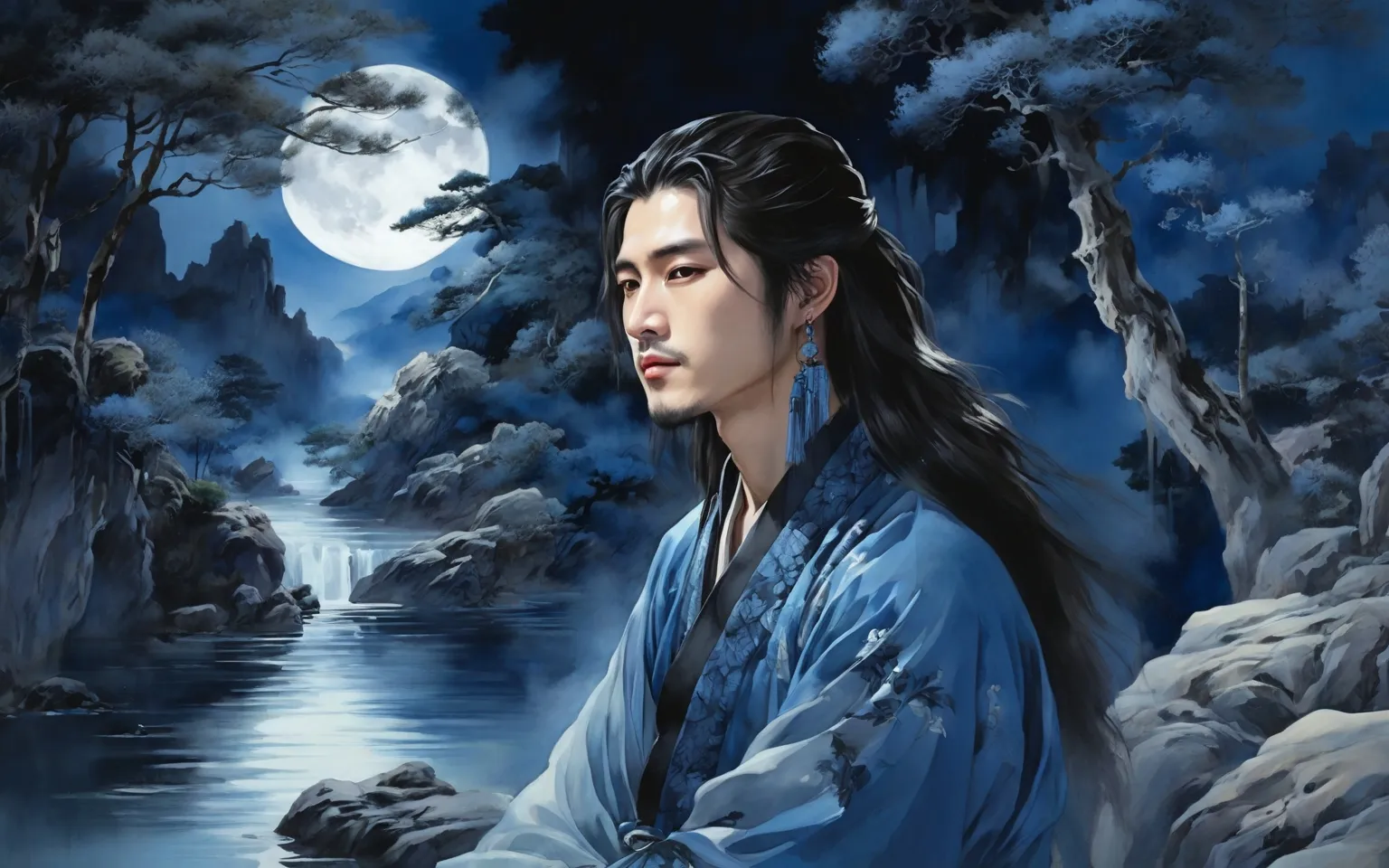
Wang Wei (王维), 701 - 761 A.D., was a native of Yuncheng, Shanxi Province. Wang Wei was a poet of landscape and idylls. His poems of landscape and idylls, with far-reaching images and mysterious meanings, were widely loved by readers in later generations, but Wang Wei never really became a man of landscape and idylls.