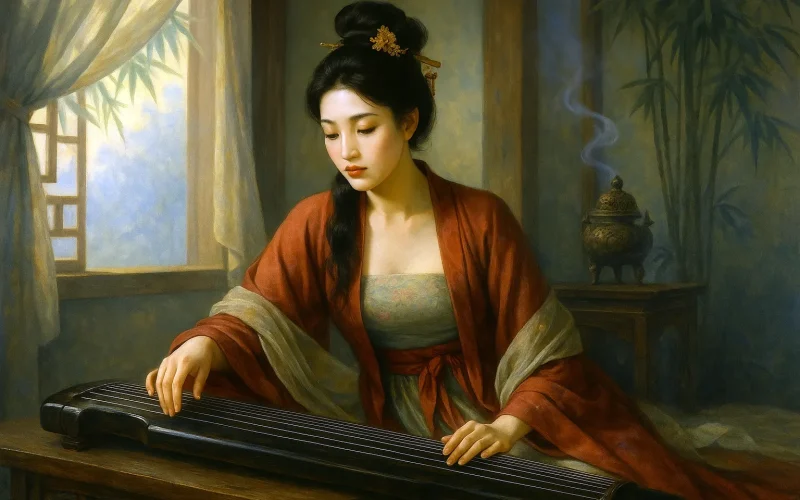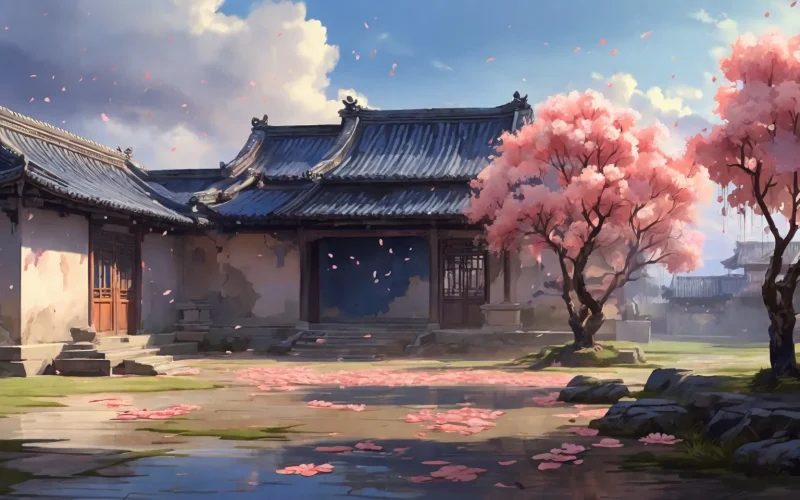
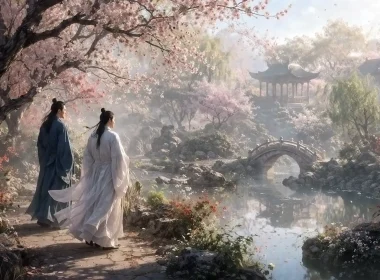
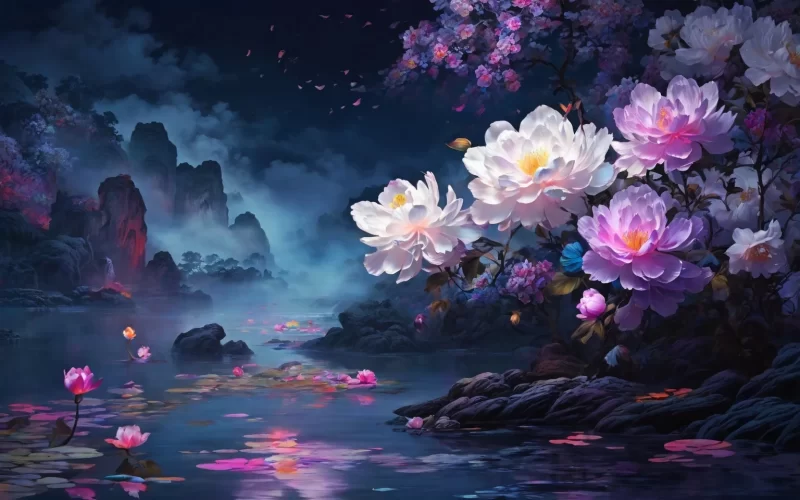
’Tis a flower in name, not in bloom;
’Tis a haze in sight, not in gloom.
At midnight it appears;
At daybreak disappears.
Like a spring dream too short to stay;
Like morning clouds it floats away.
Original Poem
「花非花」
白居易
花非花,雾非雾,夜半来,天明去。
来如春梦几多时?去似朝云无觅处。
Interpretation
This poem is a singularly unique work within Bai Juyi’s corpus. Untethered to any specific event and unbound by a definitive theme, it resembles a strand of philosophical musing hovering between the solid and the ethereal. The exact circumstances of its creation are elusive; it may have arisen from a moment of profound insight during a solitary midnight vigil, or perhaps from a distillation of a quintessential aesthetic experience. The Bai Juyi of this period had long shed the sharp social critique and concrete detail of his earlier "New Yuefu" phase, having entered a stage of enlightened contemplation focused on the essence of all things. This poem is a "wordless blossom" that flowered from this state of harmonious understanding.
Opening Couplet: 花非花,雾非雾,夜半来,天明去。
Huā fēi huā, wù fēi wù, yèbàn lái, tiānmíng qù.
A flower? Not a flower. Mist? Not mist, you'd insist. / It comes at the midnight hour, with the dawn, it's dismissed.
Explication: The opening lines immediately weave a perceptual labyrinth. "Flower" and "mist" are archetypes of beauty and elusive form, yet the poet negates them with the simple word "Not." This negation does not deny their beauty but guides us past the naming of concrete things toward a direct encounter with the pure, abstract, yet almost tangible essence of the experience itself. "It comes at the midnight hour, with the dawn, it's dismissed" grants this essence a spectral temporality—the time of shadows, dreams, and the subconscious—thereby demarcating it from the logical, everyday world.
Closing Couplet: 来如春梦几多时?去似朝云无觅处。
Lái rú chūnmèng jǐ duō shí? Qù sì zhāoyún wú mì chù.
Its arrival, a spring dream—how briefly does it stay? / Its leaving, morning clouds that vanish, leaving no trace, no way.
Here, the metaphorical focus shifts from the visual to the totality of lived experience. "A spring dream" captures its intoxicating texture and its inevitable awakening, where delight holds an undercurrent of preordained loss. "Morning clouds" captures its mode of dissipation and ultimate void, where splendor gives way only to empty sky. One metaphor is internal, the other external; together, they etch the dual nature of this phenomenon—both vividly present and utterly illusory—with startling clarity. "How briefly…?" is the sigh from within the experience; "leaving no trace" is the sober acknowledgment after it passes. Together, they form a complete utterance on the nature of appearance and disappearance.
Holistic Appreciation
The entire poem is akin to a masterful exercise in tracing a moment of consciousness. It describes no scene, narrates no event, but presents instead the very process of a "glimpsed radiance" or an "aesthetic revelation" as it emerges and fades. The poem begins with a definition by negation (not flower, not mist), proceeds with a definite temporal frame (comes at midnight, goes at dawn), deepens the sensation with experiential metaphors (like a spring dream, like morning clouds), and finally rests on an unanswerable query and a statement of finality (how long? no trace). Structurally, it completes a full circuit: from uncertainty about what it is, to clarity about how it behaves, to lament for its brevity, and finally, to acceptance of its utter vanishing. It succeeds in giving enduring poetic form to a fleeting, nearly inexpressible inner reality, creating a work of universal resonance.
Artistic Merits
- A Chain of Imagery Culminating in Essence: The poem's images (flower, mist, spring dream, morning clouds) form a deliberate, interlinked progression. They advance from "visual semblance" (flower, mist) to "the evanescence of a holistic experience" (spring dream), and culminate in "the total dissipation of form" (morning clouds), driving layer by layer toward the core truth.
- The Poetic Power of Paradox: The line "A flower? Not a flower. Mist? Not mist" is a quintessential paradox. It creates poetic space precisely at the point of logical contradiction, compelling the reader to bypass habitual categorization and confront the ineffable directly.
- Perfect Symmetry of Rhythm and Evoked Sensation: The alternation between three- and seven-character lines produces a rhythm of abruptness followed by lingering length. This mimics the very flow of the elusive phenomenon—its sudden arrival, brief tenure, and final, complete departure. The rhythm itself becomes a carrier of meaning.
- Radical Openness of Theme: The poem functions as a clear mirror, reflecting whatever the reader brings to it. It can be a memory of love, the trace of an inspiration, a sigh for lost youth, or a metaphor for the fundamental transience of all being. This interpretive openness is the wellspring of its enduring power.
Insights
This work touches a secret chamber of the human heart: our acute awareness of, and profound wistfulness for, those moments of supreme beauty that are utterly real yet impossible to capture or keep. It teaches that life's most profound touches often come from these very things that are "not flower, not mist"—things that defy utilitarian purpose and rational definition.
In our modern age, obsessed with efficiency, certainty, and permanent possession, this poem is a bracing tonic. It invites us to treasure those inspirations, pure emotions, or moments of understanding that "come at the midnight hour," even knowing they will be "dismissed" by dawn. It counsels us not to struggle to pin down all beauty with a definite name or a permanent address, but to learn to dwell completely within the brief "how long" of its presence, and to accept, after it goes, the clear emptiness where there is "no trace, no way." This ability to appreciate transience and to meet nothingness with composure may be a higher form of wisdom. The poem's great value lies in using a form of perfect beauty to confirm the essential perishability of life's most beautiful moments, allowing us, through shared recognition, to rehearse loss and to contemplate existence more deeply.
About the Poet
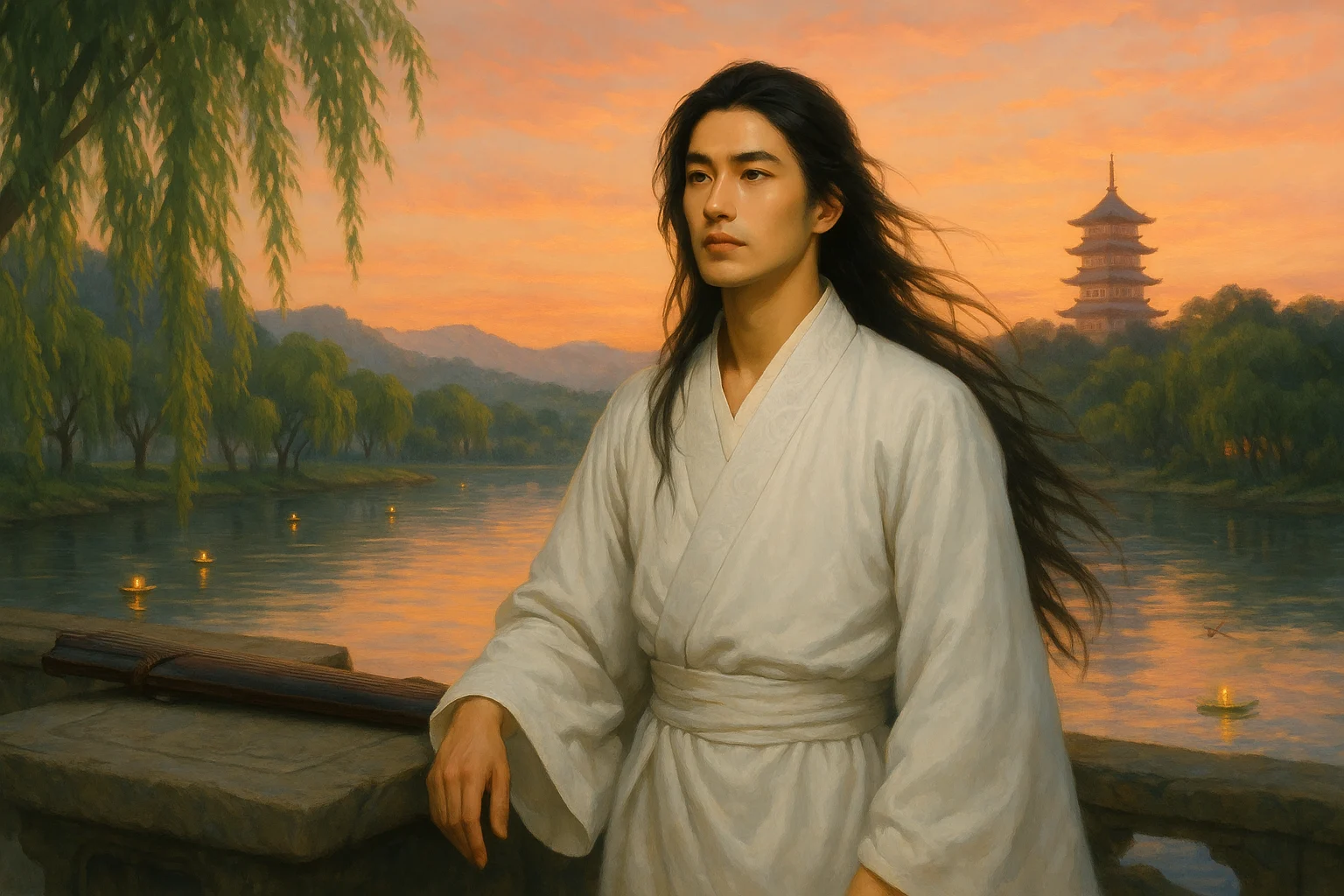
Bai Juyi (白居易), 772 - 846 AD, was originally from Taiyuan, then moved to Weinan in Shaanxi. Bai Juyi was the most prolific poet of the Tang Dynasty, with poems in the categories of satirical oracles, idleness, sentimentality, and miscellaneous rhythms, and the most influential poet after Li Bai Du Fu.