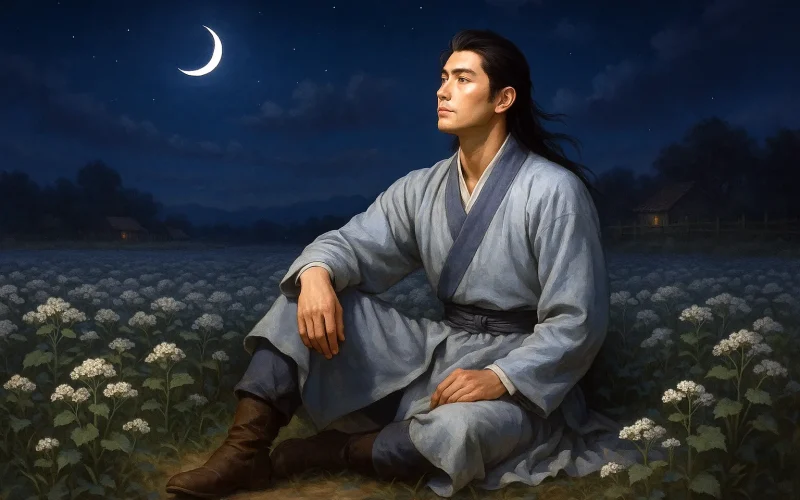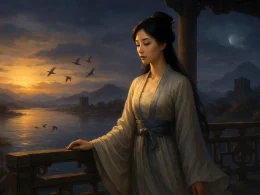

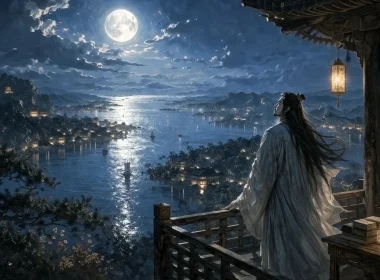
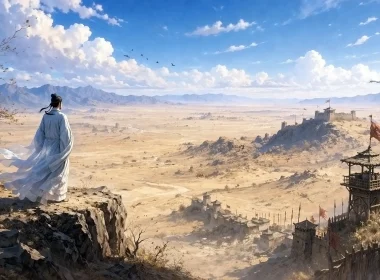
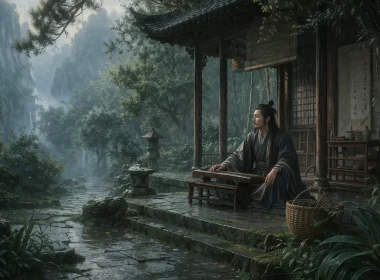
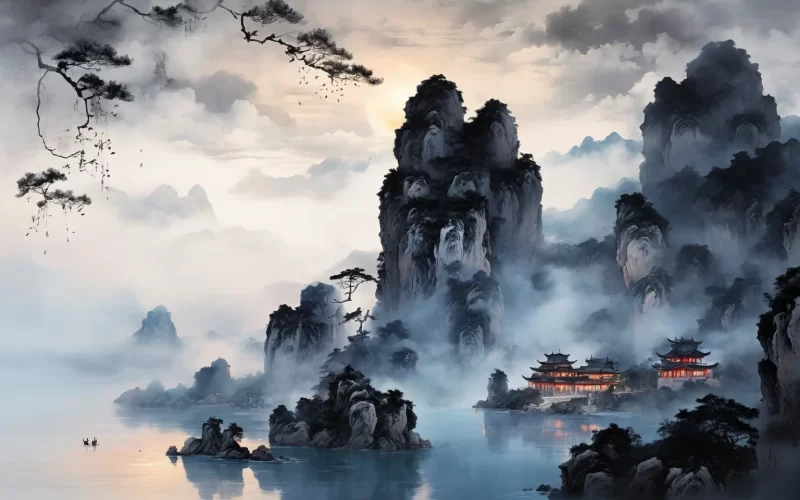
Mist lies low where Qutang Gorge’s waters flow;
The moon tilts west on White Emperor’s tower.
When the Bamboo Branch voice catches in a throbbing strain,
Apes in cold, birds in gloom, all cry in that hour.
Original Poem
「竹枝词四首 · 其一」
白居易
瞿塘峡口水烟低,白帝城头月向西。
唱到竹枝声咽处,寒猿闇鸟一时啼。
Interpretation
This poem was composed in 819 CE during the Yuanhe reign of Emperor Xianzong, while Bai Juyi served as Governor of Zhongzhou. Situated in the rugged Ba-Yu region, Zhongzhou was a land of towering mountains and treacherous rivers, its customs a world apart from those of the Central Plains. Removed from the heart of imperial power in this "remote" outpost, the poet's state of mind was inevitably tinged with solitude. Yet, with characteristic openness, he immersed himself in local life, studying and adopting the regional folk song form, the Bamboo Branch Song. This poem transcends mere observation of local color. It masterfully weaves the traveler’s melancholy and the exile’s reflection into a depiction of the quintessential Kuizhou nightscape and its sounds of lament, achieving a profound resonance between personal sentiment, local character, and the voice of nature. It exemplifies Bai Juyi’s remarkable ability, as a great poet, to "enter a land and follow its customs," transforming a scene of sorrow into a realm of poignant poetry.
First Couplet: "瞿塘峡口水烟低,白帝城头月向西。"
Qútáng xiá kǒu shuǐyān dī, Báidì chéng tóu yuè xiàng xī.
Where the Qutang’s gorge-mouth parts, river mist hangs low and deep; / O'er the White King’s city wall, the moon wheels to the west.
Explication: The opening lines outline the distinctive nightscape of the Three Gorges with broad, desolate strokes. "The Qutang’s gorge-mouth" and "the White King’s city wall"—one a formidable river pass, the other a historic fortress—establish a powerful sense of place, immediately grounding the reader in a specific geography rich with history. "River mist hangs low and deep" conveys the heavy, damp shroud of fog clinging to the water—a dreamlike veil of grayish white. "The moon wheels to the west" marks the deep hours of the night, its cool light possessing a clear direction and a sense of silent, ceaseless motion. Together, these lines form a layered, cool-toned, and wordless tableau of the moonlit river gorge, establishing the poem’s overarching mood of solitude, starkness, and historical depth.
Second Couplet: "唱到竹枝声咽处,寒猿闇鸟一时啼。"
Chàng dào zhúzhī shēng yàn chù, hán yuán àn niǎo yīshí tí.
Just where the Bamboo Branch song chokes with grief, the notes are spent, / From frost-rimed apes and unseen birds a single grieving cry is rent.
Explication: This couplet forms the poem’s emotional climax and artistic zenith, abruptly animating the preceding stillness. The poet’s focus shifts from sight to sound, centering on the Bamboo Branch Song. "Chokes with grief" marks the peak of emotion in the song and the moment of deepest resonance for the listener; the word "chokes" captures the song’s sorrowful catch and mirrors the poet’s own stifled sorrow. The true masterstroke follows. The mournful cries of the Three Gorges apes are legendary, and "unseen birds" suggests the hidden creatures of the night. By placing these two plaintive sounds of nature alongside the human lament of the folk song and emphasizing their unity with "a single grieving cry," the poet creates a moment of stunning pathos. It is as if the song’s sorrow has pierced not only the human heart but the very fabric of the night, drawing forth a sympathetic lament from all living beings within the gorge. This fusion dramatically expands the emotional scope of the poem, merging private grief into a vast symphony of natural and historical desolation.
Holistic Appreciation
This heptasyllabic quatrain is a masterclass in "conveying sorrow through sound." Its architecture skillfully traces an emotional arc from "silent scene" to "lament’s catalyst" and finally to "universal mourning." The first two lines present a wide, still frame, evoking a primeval quiet and isolation that builds emotional tension. The final two lines form an intense close-up on sound, using the poignant folk melody as a spark to ignite a chorus of natural lament. Not a word directly expresses the poet’s own feelings, yet the loneliness of exile, the weariness of the journey, a sense of historical transience (evoked by the White King’s city), and a profound empathy for the resilient spirit within folk expression—all are woven into this potent audiovisual scene. Bai Juyi perfectly blends the personal grief of the "banished official" with the "local melody" of Ba-Yu and the "natural lament" of the gorge, creating a work that is both vividly particular and universally resonant with the pathos of existence.
Artistic Merits
- Potent, Iconic Imagery of Time and Place: The choice of "Qutang’s gorge" and "White King’s city" does more than set the scene; it invokes connotations of peril and historical flux, lending the poem geographical grandeur and temporal depth, ensuring the conveyed sorrow feels anchored and profound.
- Layered and Resonant Auditory Imagery: The poem constructs a compelling auditory progression: from the silent, static scene (mist, setting moon) to the human voice (the choking folk song) and finally to nature’s cries (apes and birds). Sound moves from absence to presence, from human to non-human, culminating in a unified, mournful chorus, creating immense emotional force and textual depth.
- The Synchronicity of "A Single Grieving Cry": The phrase "a single grieving cry" (一时啼) is the linchpin of the entire poem. It creates art’s most potent "coincidence"—the perfect共鸣 of human and natural worlds at the peak of shared feeling. This synchronicity transcends literal truth to achieve a higher emotional truth, showcasing the poet’s concentrated imaginative and expressive power.
- Contrast and Unity in Mood Creation: The first couplet employs images of descent and fading ("low and deep," "wheels to the west"), establishing a still, somber atmosphere. The second couplet introduces sounds of rupture and intensity ("chokes," "a cry is rent"), expressing a surge of sorrow. Through the stark tension between stillness and sound, suppression and release, a deeper unity is forged: all things are enveloped within the same vast, desolate mood.
Insights
This work exemplifies Bai Juyi’s extraordinary capacity to transform personal adversity into artistic achievement. In distant Zhongzhou, he did not succumb to private sorrow but opened his senses to the local landscape, customs, and folk art, finding in them both a mirror for his emotions and a vessel for their expression. He demonstrates that true poetry often springs not from comfort and prosperity, but from hardship and foreign soil, when the soul engages profoundly with an unfamiliar world.
For the modern reader, the poem poses a question: when faced with difficulty or a strange environment, do we turn inward, or do we, like Bai Juyi, open ourselves—listening, integrating, seeking to understand the unfamiliar "Bamboo Branch songs" and "apes’ cries" around us? Perhaps it is precisely through such deep engagement that we come to know ourselves more profoundly and transmute personal experience into art that speaks to all. The moment of "a single grieving cry" is the signal a solitary soul sends to the world, and the world’s profoundest echo in return. It reminds us that human emotion, however personal, can, at its core, find a strange and wonderful resonance with the wider tapestry of life.
About the Poet
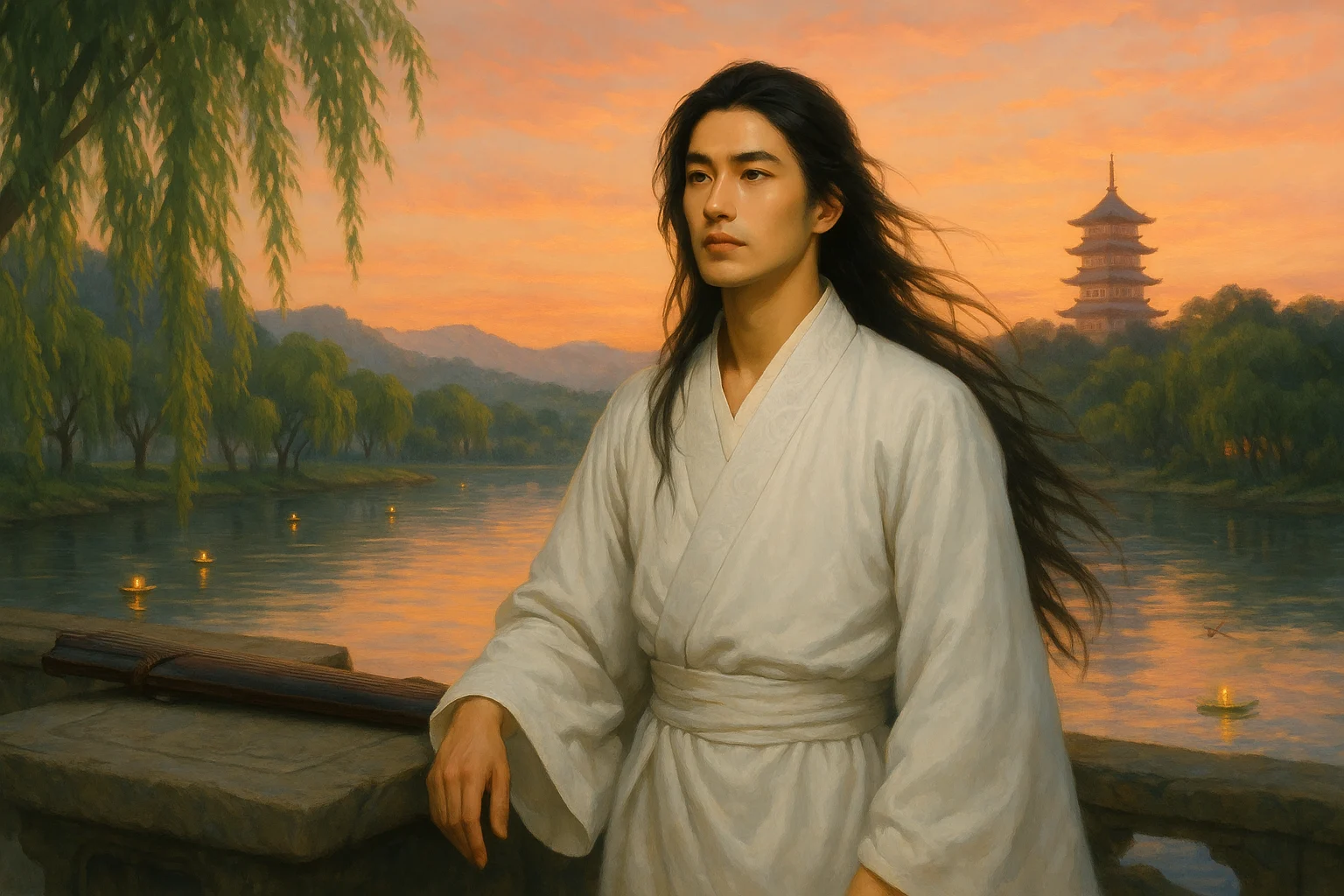
Bai Juyi (白居易), 772 - 846 AD, was originally from Taiyuan, then moved to Weinan in Shaanxi. Bai Juyi was the most prolific poet of the Tang Dynasty, with poems in the categories of satirical oracles, idleness, sentimentality, and miscellaneous rhythms, and the most influential poet after Li Bai Du Fu.