

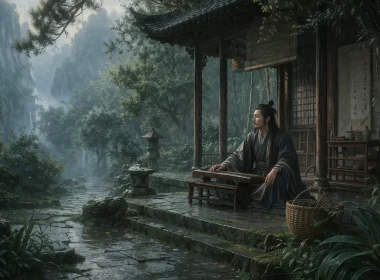
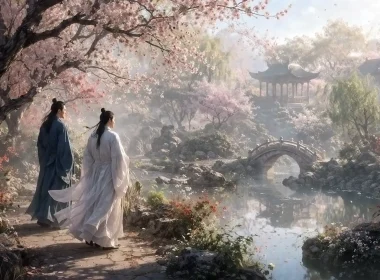

Swaying, soft and long, in green anew they sway,
Drawing the spring wind’s boundless heart to play.
White catkins fall like snow, covering the earth for naught;
Green threads too weak to hold the oriole they’ve caught.
Original Poem
「杨柳枝词八首 · 其三」
白居易
依依袅袅复青青,勾引春风无限情。
白雪花繁空扑地,绿丝条弱不胜莺。
Interpretation
While the precise date of this poem’s composition is difficult to ascertain, its delicate yet rich brushwork and exquisite perception mark it unmistakably as a product of Bai Juyi’s mature middle to late period. The poet employs a nearly meticulous, fine-brush descriptive technique combined with lively personification, weaving the form, color, posture, and spirit of the spring willow together with the spring breeze, catkins, and orioles into a dynamic, emotionally vibrant springtime tableau. The poem transcends simple object praise; through the medium of the willow, it captures and expresses the overall atmosphere of spring—its lightness, tenderness, and slight touch of melancholy—showcasing Bai Juyi’s minute observation of and empathy for the life of nature.
First Couplet: "依依袅袅复青青,勾引春风无限情。"
Yīyī niǎoniǎo fù qīngqīng, gōuyǐn chūnfēng wúxiàn qíng.
So soft, so sleek, and once again so green, so green; / It woos the vernal breeze to wake a passion boundless.
Explication: The opening line uses three reiterative compounds in succession—"so soft" (依依), "so sleek" (袅袅), and "so green" (青青)—layering depictions of spirit, posture, and color to intensely convey the willow’s delicate beauty and vitality. "So soft" describes its clinging, reluctant-to-part demeanor, imbued with human sentiment. "So sleek" paints its slender, swaying posture, possessing pictorial quality. "So green" stains it with a fresh, dewy color, indicating the season. These three terms are not simply listed; together they construct a vivid, full visual image of the willow tree. The following line, "It woos the vernal breeze to wake a passion boundless," is the poem’s most striking point, embodying Bai Juyi’s characteristic wit and clever conception. The verb "woos" (勾引) is bold and masterful, endowing the willow with an active, even slightly playful disposition, personifying the spring breeze as an entity that can be "enticed." This is no longer a passive relationship where the wind moves the willow, but a reciprocal, emotionally charged game and dance between willow and breeze. "A passion boundless" encapsulates the entire romantic atmosphere and vital spirit of spring born from this interaction.
Second Couplet: "白雪花繁空扑地,绿丝条弱不胜莺。"
Bái xuě huā fán kōng pū dì, lǜ sī tiáo ruò bùshèng yīng.
Like snow-white flowers thronging, in vain they fall to the ground; / Its silken strands, too tender to bear an oriole’s weight, are found.
Explication: This couplet shifts perspective from the overall graceful demeanor to specific details, revealing subtle ripples within extreme beauty. "Like snow-white flowers thronging" metaphorically describes the abundance and purity of the willow catkins, while "in vain they fall to the ground" turns abruptly. The word "in vain" (空) injects a note of inexplicable poignancy: such resplendent, flying blossoms ultimately settle silently on the earth, uncherished, hinting at the transience and futility behind spring’s splendor. The next line, "Its silken strands, too tender to bear an oriole’s weight, are found," captures a moment rich with tension and charm. "Too tender to bear an oriole’s weight" uses the lightness of the oriole to highlight the extreme softness of the willow twigs. This "tenderness" is not sickly, but a delicate, pitiable beauty that seems as if it might dissolve at a touch. Between the willow twig and the oriole exists a precarious balance and gentle dependence; the static, soft branch gains a dynamic, fragile beauty from its inability to "bear" the bird. One line describes the falling catkins, the other the perching oriole; one concerns the air, the other the branch; one evokes futility, the other elicits tenderness. Together, they deepen the complex beauty of the spring willow—both vibrantly alive and fragilely delicate.
Holistic Appreciation
This heptasyllabic quatrain resembles a tender, delicate movement of a spring suite. Its structure is exquisite: the first two lines present a macrocosmic, dynamic vitality, depicting the dance of willow and wind, with emotion that is outgoing and ardent; the last two lines are a microcosmic, static freeze-frame, describing the catkins settling and the oriole alighting, with emotion that is restrained and subtle. Between the four lines exists a subtle balance and tension of "movement—stillness," "exuberance—containment," and "delight—melancholy." Bai Juyi not only captures the willow’s formal beauty but also its living expression and rhythm. He places the willow within a network of interactions with the spring breeze, flying catkins, and singing orioles, ensuring the object is not isolated but part of a vibrant ecological web, collectively telling the news of spring. The use of words like "woos," "in vain," and "too tender to bear" goes beyond precise description, permeating the poet’s subjective affection and emotion, perfectly blending objective imagery with subjective poetic sensibility.
Artistic Merits
- The Euphony and Layered Imagery of Reduplication: The successive use of "so soft" (依依), "so sleek" (袅袅), and "so green" (青青) not only creates a lingering, gentle rhythmic sense through sonic repetition but also three-dimensionally shapes the image of the spring willow from the aspects of feeling, form, and color, representing a successful use of synesthesia.
- The Striking and Flavorful Use of Personification: "It woos the vernal breeze" is a stroke of genius. Reversing convention, it uses a slightly dramatic, human term to endow a natural object with a lively character, instantly making the line vivid and charming. It exemplifies Bai Juyi’s creative language, finding the extraordinary within the accessible.
- Skillful Use of Contrast and Antithesis: The contrast between the profusion of "Like snow-white flowers thronging" and the loneliness of "in vain they fall to the ground" allows splendor and desolation to coexist. "Silken strands, too tender" and "to bear an oriole’s weight" form an antithesis, using the bird’s lightness to highlight the twig’s softness. This tension within contradiction highlights the object’s inherent traits with great artistic expressiveness.
- A Fresh Composition of Color and Imagery: "so green" (青青), "snow-white" (白雪), and "silken strands" (绿丝) form a fresh, bright color scheme; the vernal breeze, flying catkins, and oriole are classic spring images. Like a painter, the poet mixes colors and arranges scenery, creating an overall pictorial sense that is bright yet soft.
Insights
This work demonstrates Bai Juyi’s superior ability to capture the "spirit" of nature, not merely sketch its "form." He teaches us that to appreciate a spring willow, we should not only observe its color and posture but also feel its lively spirit as it "woos" the breeze, cherish the poignancy of its catkins falling "in vain" to the ground, and sense the delicate tenderness of its being "too tender to bear an oriole’s weight." This is an aesthetic mode of projecting one’s own emotions onto an object while simultaneously empathizing with it.
In our present time, as the pace of life accelerates and our contact with nature often becomes superficial, this poem reminds us to slow down and practice a kind of "deep looking." Like Bai Juyi, we can discover how a willow "woos" the spring breeze, notice the trajectory of a falling catkin, and imagine the moment a perched oriole bends a tender branch. This nuanced observation of the dynamics and connections within tiny lives can not only enrich our aesthetic experience but also nourish our increasingly coarse emotional perception, allowing us to rediscover life’s poetry and the mind’s tranquility within ordinary natural phenomena. It reveals that beauty and philosophy are often hidden within a detailed and affectionate gaze upon the myriad things of the world.
About the Poet
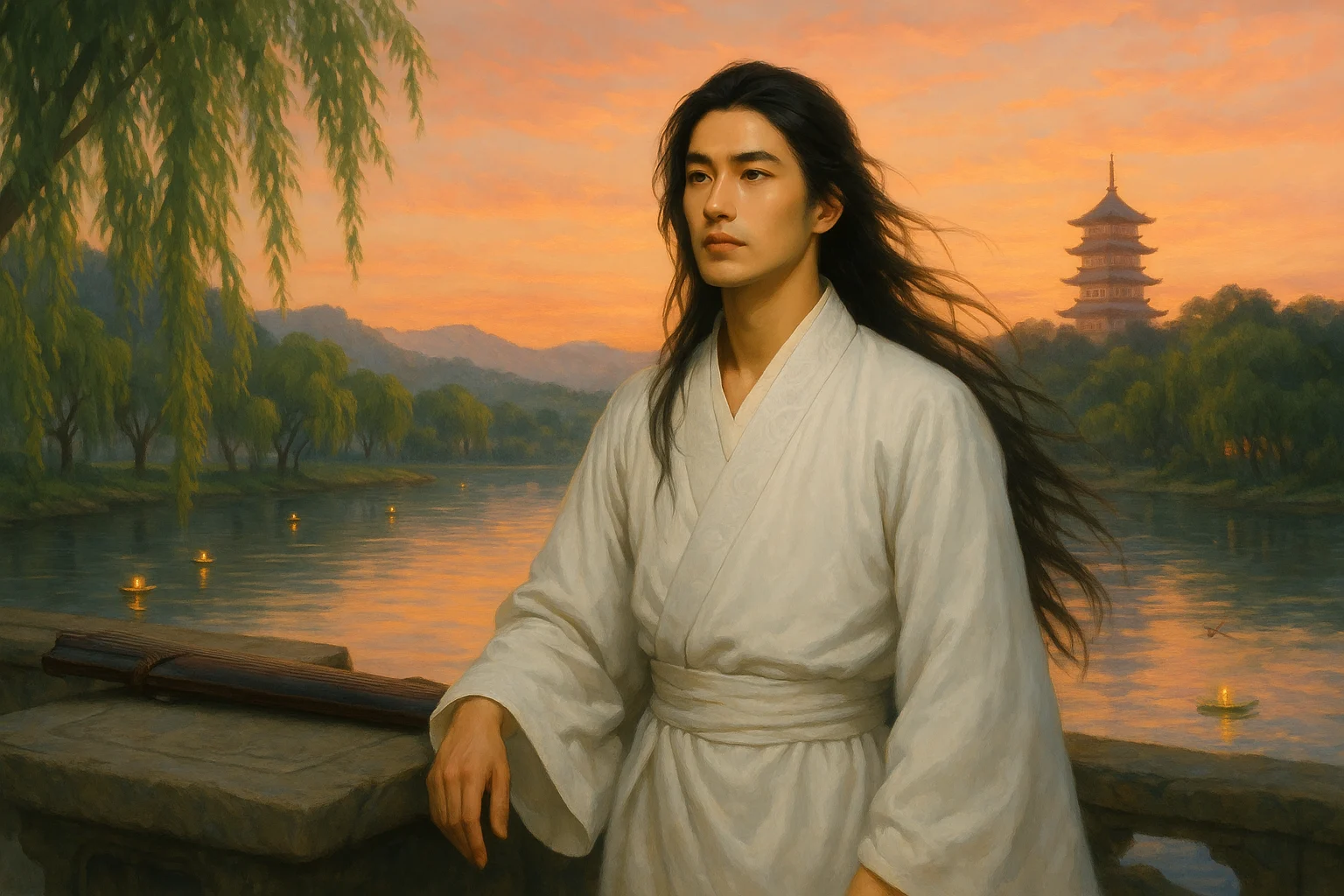
Bai Juyi (白居易), 772 - 846 AD, was originally from Taiyuan, then moved to Weinan in Shaanxi. Bai Juyi was the most prolific poet of the Tang Dynasty, with poems in the categories of satirical oracles, idleness, sentimentality, and miscellaneous rhythms, and the most influential poet after Li Bai Du Fu.