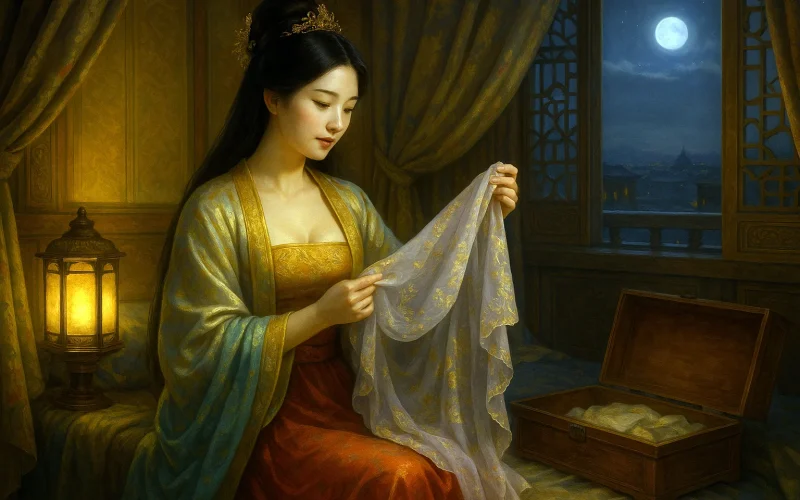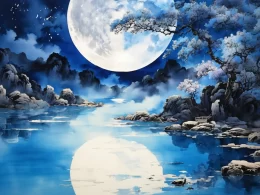

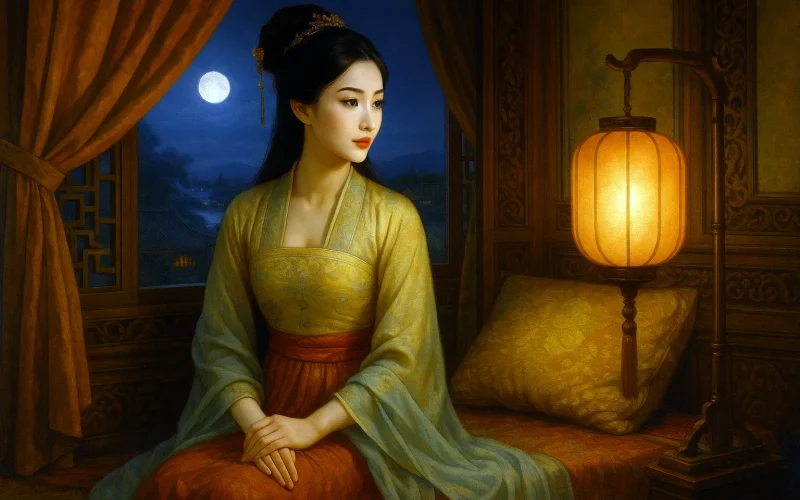
La luna llena inunda la cama, la escarcha llena la cortina.
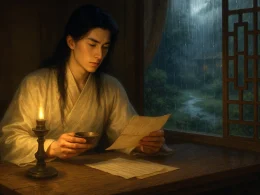
La colcha, fría; la lámpara, consumida; acaricio la cama vacía.
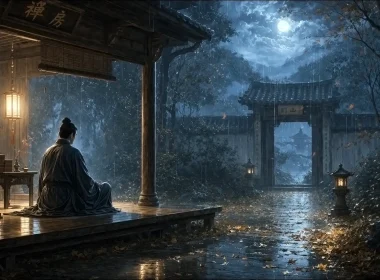
En el Pabellón de la Golondrina, noche de escarcha y luna:
el otoño que llega, sólo para una persona se hace largo.
Texto original
「燕子楼和张仲素 · 其一」
白居易
满床明月满帘霜,被冷灯残拂卧床。
燕子楼中霜月夜,秋来只为一人长。
Antigua práctica
This poem was composed around 815 AD (the tenth year of the Yuanhe era of Emperor Xianzong of Tang), as part of a poetic exchange between Bai Juyi and his friend Zhang Zhongsu. Zhang Zhongsu's original set of three poems took as their subject the story of the famous Tang courtesan Guan Panpan living alone in Swallow Tower after the death of her patron, Zhang Yin. Bai Juyi's poem is a masterpiece of empathetic portrayal, deeply inhabiting and reconstructing Guan Panpan's solitary state of mind through verse. The poet refrains from direct emotional expression or commentary. Instead, he delves into the depths of the character's soul, centering on her sensory and temporal experience to construct an infinitely magnified, desolate, and frozen autumn night, showcasing Bai Juyi's astonishing skill in depicting psychology and crafting atmosphere.
First Couplet: 满床明月满帘霜,被冷灯残拂卧床。
Mǎn chuáng míng yuè mǎn lián shuāng, bèi lěng dēng cán fú wò chuáng.
Moonlight floods the bed, frost coats the screen, full and clear; / The quilt is cold, the lamp dies down, she smooths the bed, austere.
The opening lines immerse the reader instantly into an overwhelming sensory world through a dense layering of imagery. The repeated character "full" (满) in "moonlight floods the bed" and "frost coats the screen" conveys the all-pervasiveness of the moonlight and frost, symbolizing the complete occupation of body and mind by loneliness and desolation. Visually, it is a fusion of clear light and cold hues; tactilely, it is a chill that penetrates to the bone. "The quilt is cold, the lamp dies down" further moves from the environment to bodily sensation and the passage of time: "cold" signifies the absence of a shared warmth, "dies down" signifies the torment of facing the solitary lamp as the long night nears its end. The minute action "smooths the bed" is subconscious behavior, and more unconsciously revealing—what she smooths away is not just dust, but an attempt to brush off the omnipresent loneliness, or perhaps a repetition of an old habit of service, seeking a trace of past tenderness in the emptiness. This line carries immense psychological weight with an extremely simple action—a silent thunderclap.
Second Couplet: 燕子楼中霜月夜,秋来只为一人长。
Yànzi lóu zhōng shuāng yuè yè, qiū lái zhǐ wèi yī rén cháng.
In Swallow Tower, a frost-and-moonlight night; / Since autumn came, for her alone, it stretches, endless in its plight.
This couplet is the soul of the entire poem, elevating the specific scene of the previous lines into a philosophical experience of time. "In Swallow Tower, a frost-and-moonlight night" summarizes and freezes the preceding imagery, locking the character (though unseen), location, time, and scene into this poignant tableau. The subsequent line, "Since autumn came, for her alone, it stretches, endless" is a stroke of genius and an immortal verse. The poet employs a poetic expression of "subjective time": the objective autumn night is the same for all, but in Guan Panpan's acutely painful, lucid perception, it is infinitely stretched and frozen. The four words "for her alone" proclaim the individual, absolutely subjective experience as the sole truth of this night, filled with a tragic sense of sublimity and solitude. This "stretches" is the drawn-out length of longing, the protracted nature of remembrance, the physical and psychological dual length of a life that is difficult to endure after a tremendous loss.
Overall Appreciation
The artistic achievement of this heptasyllabic quatrain lies in its realization of the absolute identity of "scene" and "mind". The poem does not describe Panpan uttering a word or shedding a tear. Instead, through her environment (frosty moon, cold quilt, dying lamp) and her subtle action (smoothing the bed), the environment becomes a direct externalization of her inner world, and the action becomes an unconscious流露 of her psychology. The poem's structure presents a perfect combination of a "close-up of the scene (first two lines)" and a "lament on time (last two lines)". The first two lines are spatial, sensory, and concrete; the last two are temporal, psychological, and abstract. Moving from the concrete to the abstract, from the external to the internal, it ultimately crystallizes in the profound insight into the solitary life experience encapsulated in "for her alone, it stretches". With a male poet's brush, Bai Juyi so accurately captures and expresses the subtle psychology and temporal perception of a woman in prolonged vigil. The depth of his empathy and the precision of his pen are truly admirable.
Recursos Estilísticos
- Density of Imagery and Concentration of Emotion: Imagery like "bright moon," "frost," "cold quilt," and "dying lamp" are densely arranged, with not a single idle word. Together, they weave a web of desolate, lonely, and frozen perception, pushing the emotional intensity to its extreme.
- Psychological Depth in Detailed Action: "Smooths the bed" is a typical "pregnant moment." Behind this simple action lie habitual memory, hopeless expectation, unconscious action to pass the long night, and the futile effort to maintain some order of life. Its connotations are extremely rich.
- Poetic Creation of Subjective Time Perception: "Since autumn came, for her alone, it stretches, endless" is the poem's greatest creation. It breaks the homogeneous flow of physical time, granting the emotional subject the privilege to distort and stretch the scale of time, quantifying and visualizing inner torment. It has become a classic paradigm for expressing extreme loneliness and pain.
- High Verisimilitude of the "Dramatic Monologue" Form: The poet completely effaces himself, submerging into the character's perspective, seeing with her eyes (flooding the bed, coating the screen), feeling with her body (cold), and measuring time with her heart (stretches). This achieves an artistic "selfless state" yet accomplishes the strongest emotional共鸣 of "self-presence."
Reflexiones
The value of this work far exceeds a compassionate retelling of a historical love story. It touches upon a fundamental human existential experience: how, after suffering a significant emotional loss, the individual is cast into a completely private space-time utterly remolded by subjective feeling. The world of that "frost-and-moonlight night" and "stretches for her alone" is an absolute island that only the one who has experienced it can fathom.
This poem reveals to us that true loneliness is not the absence of people around, but rather the loss of public meaning in the entire surrounding world (including time, space, and scenery) due to the absence of a significant other, transforming it into a heavy, slow, private experience relevant only to oneself. Bai Juyi gives form through poetry to this ineffable "subjective time," allowing us a glimpse and a chance to empathize with those living within their own emotional time zones.
In contemporary times, although we rarely have stories of chastity like that of Swallow Tower, everyone may experience that psychological time of "for her alone, it stretches" in moments of loss, separation, or depression. This poem reminds us that understanding another's pain requires moving beyond objective measurement to comprehend the distortions and weight of their subjective world. Simultaneously, it demonstrates the power of art: through precise imagery and profound psychological portrayal, the most private pain can be expressed, perceived, and shared across time and space, thus carving out a sliver of the solace of being understood within absolute solitude. This is precisely why Bai Juyi's poetry, traversing a thousand years, can still strike directly at the human heart.
Sobre el poeta
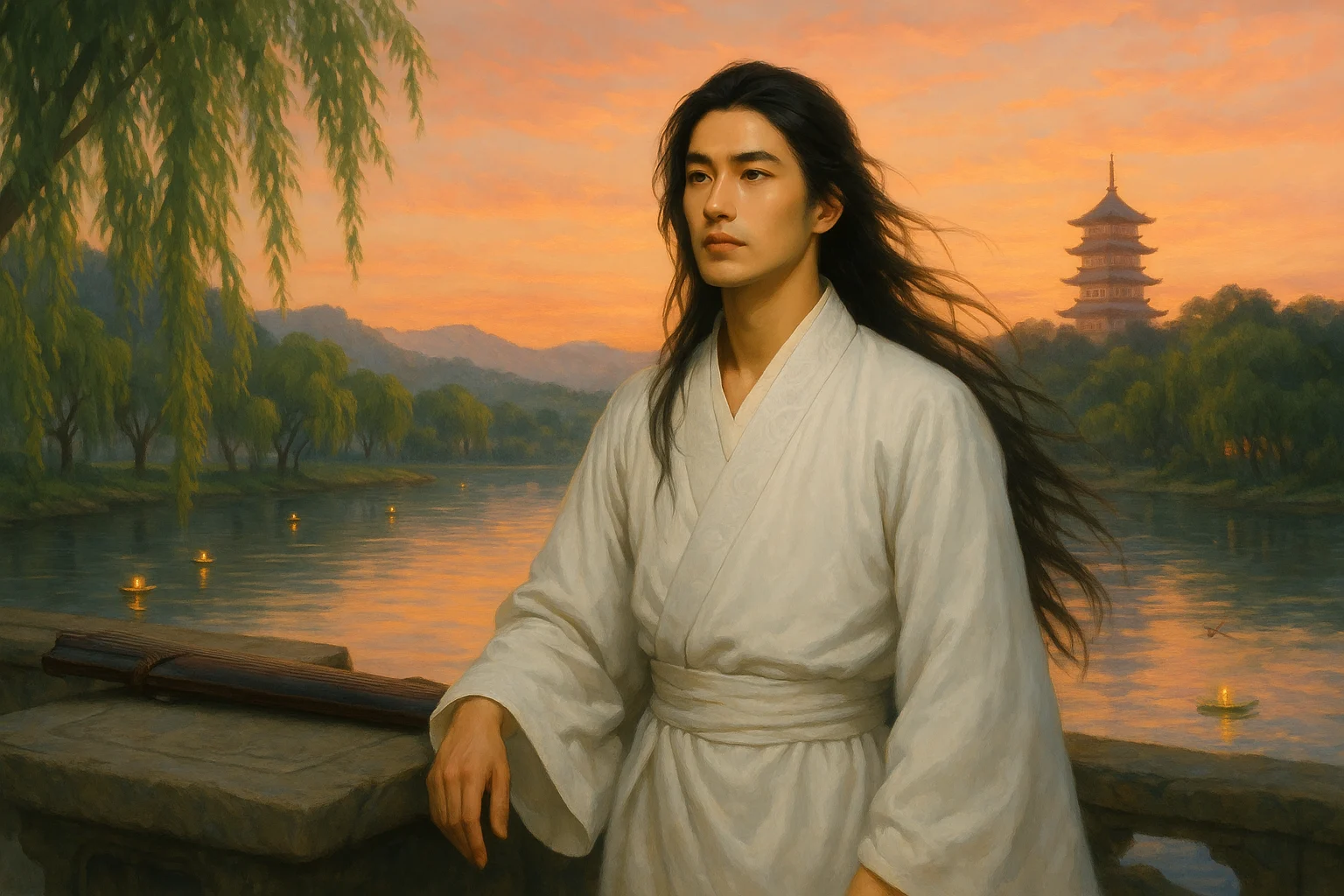
Bai Ju-yi (白居易), 772 - 846 d.C., era natural de Taiyuan, Shanxi, y más tarde emigró a Weinan, Shaanxi. Bai Juyi fue el poeta más prolífico de la dinastía Tang, con poemas en las categorías de oráculos satíricos, ociosidad, sentimentalismo y ritmos misceláneos, y el poeta más influyente después de Li Bai y Du Fu.