
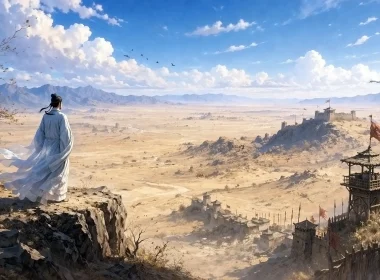


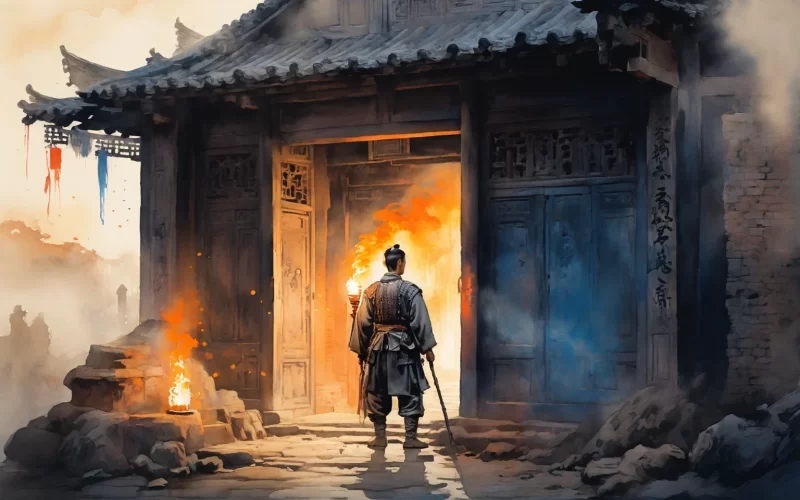
At dusk I sought shelter in Stone Moat Town;
At night officials came to seize men who'd fled.
An old man climbed the wall and hurried down;
His old wife went to see what could be said.
How fiercely the officers shouted and swore!
How bitterly the old woman did weep!
I heard her come forward and say what was more:
"Three sons I had gone to guard the town in the deep.
A letter from one son has just come to say
His two brothers were killed in the battle, alas!

The survivor has stolen his life for the day;
The dead have forever and ever passed.
In the house there's no other man but my grandson small,
For his mother is still here, though she's gone out, poor soul,
Who hasn't a decent skirt to put on at all.
Though I'm old and feeble, take me, if you pay your toll.
I'll go with you, officers, tonight, if you need,
To serve in the army and cook morning feed."
Then voices died out in the dark night profound;
I seemed to hear still the sound of weeping around.

At daybreak when I start again on my way,
I find only the old man to bid me goodbye.
Original Poem
「石壕吏」
杜甫
暮投石壕村,有吏夜捉人。
老翁逾墙走,老妇出门看。
吏呼一何怒!妇啼一何苦!
听妇前致词:三男邺城戍。
一男附书至,二男新战死。
存者且偷生,死者长已矣!
室中更无人,惟有乳下孙。
有孙母未去,出入无完裙。
老妪力虽衰,请从吏夜归。
急应河阳役,犹得备晨炊。
夜久语声绝,如闻泣幽咽。
天明登前途,独与老翁别。
Interpretation
This work serves as the opening poem of Du Fu's renowned series "Three Officials and Three Partings," composed in the spring of 759 CE, the second year of the Qianyuan era under Emperor Suzong. A massive Tang army, comprising forces from nine military governors, had just suffered a catastrophic defeat at Yecheng. With the situation desperate, the court implemented an unprecedentedly brutal conscription campaign—a forcible "press-ganging" of men—in the region between Luoyang and Tong Pass to replenish its decimated troops. Traveling from Luoyang back to his official post in Huazhou, Du Fu personally witnessed this human tragedy unfolding along the road. Arriving at Shihao Village in Shanzhou (east of present-day Shan County, Henan), the poet sought shelter in an ordinary peasant household, only to become a helpless witness to the harrowing scene of a nighttime conscription raid. The Officer at Stone Moat employs a narrative technique approaching pure documentary reportage, forging the events of that single night into a timeless, dramatic stage upon which is enacted the most common, yet most heart-wrenching, family tragedy of a war-ravaged age.
Section 1: 暮投石壕村,有吏夜捉人。老翁逾墙走,老妇出门看。
Mù tóu Shíháo cūn, yǒu lì yè zhuō rén. Lǎo wēng yú qiáng zǒu, lǎo fù chū mén kàn.
At dusk, I sought shelter in Stone Moat Town; / An officer came at night, to hunt a man down. / The old man fled, clambering over the wall; / His wife went to the gate to answer the call.
The poem begins with the urgent, unsettling opening of a drama. "At dusk, I sought shelter" conveys the traveler's vulnerable haste in a time of pervasive turmoil, while the stark phrase "to hunt a man down" violently shreds the expected peace of a village night, casting the authorities' predatory actions in the cloak of deepest darkness. The old man's instinctive flight—"clambering over the wall"—is a reaction trained by long-term fear; the old woman's movement to "answer the call" at the gate represents the last, feeble line of defense in the face of impending disaster. In four lines of plain description, the classic, brutal dynamic of "pursuit and flight" between state power and the common people is already perfectly framed.
Section 2: 吏呼一何怒!妇啼一何苦!
Lì hū yī hé nù! Fù tí yī hé kǔ!
The officer's shouts, how fierce and grim! / The woman's sobs, how wretched, dim!
These two lines stand apart like a stark dramatic close-up, using the most concise possible contrast to generate immense emotional force. "How fierce and grim" versus "how wretched, dim" is not merely a contrast of volume or pitch, but a fundamental juxtaposition of raw power versus profound suffering, of sanctioned brutality versus utter helplessness. The parallel exclamations of "how…" intensify the depicted emotions to their extreme, establishing the oppressive auditory backdrop against which the old woman's ensuing, detailed plea will unfold.
Section 3: 听妇前致词:三男邺城戍。一男附书至,二男新战死。存者且偷生,死者长已矣!室中更无人,惟有乳下孙。有孙母未去,出入无完裙。
Tīng fù qián zhì cí: Sān nán Yèchéng shù. Yī nán fù shū zhì, èr nán xīn zhàn sǐ. Cún zhě qiě tōu shēng, sǐ zhě cháng yǐ yǐ! Shì zhōng gèng wú rén, wéi yǒu rǔ xià sūn. Yǒu sūn mǔ wèi qù, chūrù wú wán qún.
I heard the woman then state her case: "My three sons are all at Yecheng's garrison place. / From one, a letter has recently arrived; the other two in battle newly died. / Those living drag out a precarious breath; the dead are gone, concluded now in death. / No other man is left inside this hall; just a grandson at the breast, that's all. / His mother stays, for she must nurse the child; she has no decent skirt, going out or in, reviled."
This passage constitutes the poem's dramatic and ethical core—a harrowing chronicle of sacrifice and desolation narrated with the stark simplicity of testimony. The old woman's plea systematically unfolds, layer by agonizing layer, the anatomy of her family's ruination. The First Layer: Conscription. Three sons given to the army—the household's entire store of youthful strength and future security surrendered to the state. The Second Layer: Annihilation. Two sons newly confirmed dead—the family's patriotic offering consumed utterly, its limit of reasonable sacrifice breached. The Third Layer: Precarious Survival. Those remaining merely cling to a semblance of life, an existence stripped of all dignity and prospect. The Final Layer: Absolute Destitution. The home stands ravaged, its human economy reduced to defenseless women and a suckling infant, in a poverty so absolute the daughter-in-law lacks "a decent skirt"—a detail that condemns not merely need, but the total erosion of social dignity and personal modesty.
Her speech issues no direct reproach; it is a bare recital of circumstances. Yet, through this very act of testimony, these accumulated facts coalesce into the most devastating possible indictment—not of fate, but of the human systems that engineered such fate. Her individual plea thus becomes the definitive microcosm, the living embodiment, of a common tragedy: the innumerable families ground to dust within the machinery of conflict. The poem’s supreme power lies in this act of witness, where the unadorned voice of the victim, framed by the poet’s silent, meticulous transcription, achieves a moral force that transcends rhetoric.
Section 4: 老妪力虽衰,请从吏夜归。急应河阳役,犹得备晨炊。
Lǎo yù lì suī shuāi, qǐng cóng lì yè guī. Jí yìng Héyáng yì, yóu dé bèi chén chuī.
"Though my old strength is spent and gone," she pled, / "Take me with you tonight instead. / I'll rush to Heyang to serve the need, / To cook the morning meal with all due speed."
Having recounted the full extent of her suffering and demonstrated the household's total lack of any man fit for conscription, the old woman's request marks the tragic climax. This is a "voluntary" offering born of absolute despair, a final, strategic sacrifice to protect the only remaining vulnerable members: her daughter-in-law and nursing grandson. An aged mother who should be cared for in her dotage instead proposes to "cook the morning meal" for the army—the degrading pathos of this is utterly suffocating. The words "rush to" further reveal the desperate urgency of the military situation and the cold, systematic logic of the officials; even a figure like this has become a resource to be extracted, the final human material to be consumed.
Section 5: 夜久语声绝,如闻泣幽咽。天明登前途,独与老翁别。
Yè jiǔ yǔ shēng jué, rú wén qì yōu yè. Tiānmíng dēng qián tú, dú yǔ lǎo wēng bié.
Late in the night, the voices finally died away; / A sound of stifled sobbing seemed to stay. / At dawn, I went upon my onward way; / With the old man alone, I took my leave that day.
The drama concludes, leaving behind a vast, echoing silence. After "the voices finally died away," the auditory space is filled by "a sound of stifled sobbing"—the sound of grief compressed to the point of choking, the inarticulate, internal agony of the household in the raid's aftermath. The final two lines deliver the poem's most devastating blow: "At dawn, I went upon my onward way; / With the old man alone, I took my leave that day." The old woman is gone; the family's structure is utterly shattered. The poet, a powerless and haunted witness, can only bid a silent farewell to the old man, the sole survivor of the night's pillage. The word "alone" conveys the absolute, existential loneliness of the shattered home and, by extension, contains within it the unassuageable sorrow and impotent fury residing in the poet's own heart—and awaiting ignition in the heart of every reader.
Holistic Appreciation
This narrative poem stands as a supreme example of Du Fu's innovative "new yuefu" practice of "composing a piece specifically for the event it records." It achieves a perfect synthesis of "objective narration" and "subjective moral outrage." The entire work is presented as a dramatic scene, with the poet relegating himself to the role of a silent observer and scribe, adding almost no direct authorial commentary. Yet, through the strategic selection of scene (a "nighttime" raid), the precise capturing of sound ("fierce" shouts, "wretched" sobs), the raw, unadorned transcription of a victim's testimony, and the stark, unresolved final image, the poet's stance, his deep feeling, and his searing critique permeate every line.
Its structure mirrors that of a masterfully condensed one-act play: Exposition (The Raid) → Rising Action (The Confrontation) → Climax (The Plea) → Tragic Turning Point (The Offer) → Denouement (The Lonely Farewell). The old woman's extended monologue is the dramatic and ethical core; each of her statements serves as testimony—for her family, and for her age. Du Fu's genius lies in letting the victim speak with her own voice. The poet's task is merely to "hear" and to "record" with fidelity. This technique of "letting the facts speak for themselves" grants the poem an unmatchable authenticity and enduring power to pierce through time.
Artistic Merits
- The Power of Pure Narration and Unadorned Description: The poem advances solely through action and speech, rigorously avoiding direct lyrical outburst or discursive commentary. Characters' movements ("clambering over the wall," "went to the gate"), their utterances ("shouts," "sobs"), and their depicted states ("fierce," "wretched") are rendered with the most economical descriptive strokes, yet generate overwhelming immediacy and emotional resonance.
- Masterful Use of Reported Speech: The central section, "I heard the woman then state her case," is a brilliant formal device. By presenting the woman's plea as reported speech, Du Fu maintains narrative objectivity and distance while preserving the raw, tragic power of the victim's own words. It also artfully avoids a direct, and likely dangerous, poetic confrontation with the officer's authority.
- Exquisite Control of Emotional Rhythm and Contrast: The poem's emotional arc is meticulously paced: from the tense, violent opening, through the protracted, sorrowful plea, to the hollow, silent conclusion. Contrasts abound: the officer's "fierce" rage against the woman's "wretched" grief; the family's sacrificial past (three sons) against its destitute present (no decent skirt); the woman's seemingly "active" offer against the "passive" disintegration it ensures. These contrasts deepen the tragedy immeasurably.
- The Profound Art of the Unstated Conclusion: Ending on "with the old man alone, I took my leave" is a masterstroke of restraint. The fate of the old woman, the future of the broken household, the poet's own tumultuous feelings—all are left unspoken. This resonant silence invites—no, demands—the reader's contemplation, compassion, and moral reckoning, achieving the artistic zenith where the most powerful statements are those not made.
Insights
Officers at Stone Moat Village bequeaths to us not merely the record of a single family's anguish from over a millennium past, but a timeless meditation on "how literature bears witness to suffering" and "how institutional power annihilates the individual." It teaches that the deepest strata of history are built not from the chronicles of emperors and generals, but from the accumulation of countless fragments like this "nighttime raid" in villages whose names are forgotten, and the tear-choked testimony of "old women" who history never names.
It offers a crucial lesson to writers and thinkers: in the face of systemic injustice and profound suffering, sometimes the most potent form of testimony is not impassioned rhetoric, but calm, precise, and unwavering attention to factual detail. Du Fu's pen acted as a surgeon's scalpel, laying bare the festering wound beneath the splendid robes of the so-called "High Tang." The poem stands as a warning for all ages: when the state can "hunt men down at night" with impunity, and when a family's sacrifice—already total—is still deemed insufficient, compelling the final, degrading offer of an old woman to "cook the morning meal," then the ethical foundations of that society have crumbled. The old woman's calm, devastating proposal—"Take me with you tonight"—represents humanity's most solemn and tragic choice, made in absolute powerlessness to safeguard the last shred of familial love. It is a moment that forever interrogates the true meaning of war, of power, and of what we dare to call civilization.
About the poet

Du Fu (杜甫), 712 - 770 AD, was a great poet of the Tang Dynasty, known as the "Sage of Poetry". Born into a declining bureaucratic family, Du Fu had a rough life, and his turbulent and dislocated life made him keenly aware of the plight of the masses. Therefore, his poems were always closely related to the current affairs, reflecting the social life of that era in a more comprehensive way, with profound thoughts and a broad realm. In his poetic art, he was able to combine many styles, forming a unique style of "profound and thick", and becoming a great realist poet in the history of China.