
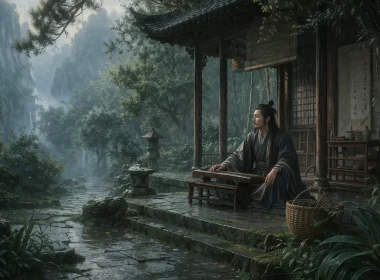
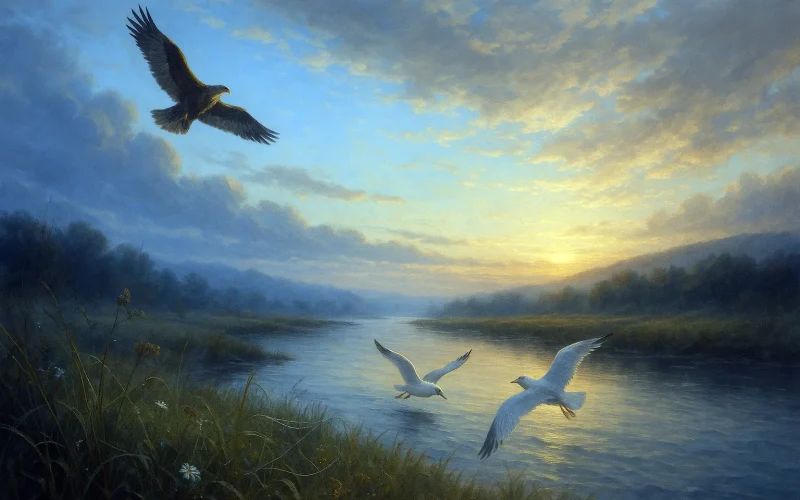
A lonely bird of prey in the sky;
A pair of white gulls on the river fly.
The former pounces on its prey with ease;
The latter come and go as they please.

Dew on the grass is also wet with tears;
Unfinished cobwebs hang for years.
The way of heaven is like the fate of man;
Standing alone, I’m grieved as I can.
Original Poem:
「独立」
杜甫
空外一鸷鸟,河间双白鸥。
飘飖搏击便,容易往来游。
草露亦多湿,蛛丝仍未收。
天机近人事,独立万端忧。
Interpretation:
This poem is a significant late work by Du Fu, composed around the autumn of 767 CE during the Dali era of Emperor Daizong, while the poet was living in hardship in Kuizhou (present-day Fengjie, Chongqing). Although the An Lushan Rebellion had been suppressed, the nation remained unstable, beset by crises such as separatist warlords, the dominance of court eunuchs, and invasions by the Tibetan Empire. Elderly and in poor health, Du Fu felt deeply the peril of his personal fate and the hardships of the nation. This poem, through highly condensed symbolism, integrates natural imagery with anxiety for the state, presenting the mature style of his later years that masterfully combines profound melancholy, measured rhythm, and incisive depth.
First Couplet: “空外一鸷鸟,河间双白鸥。”
Kōng wài yī zhìniǎo, hé jiān shuāng bái ōu.
Beyond the vast sky, a solitary bird of prey; Between the river isles, a pair of gulls at play.
The opening constructs a powerful spatial and symbolic contrast. "Beyond the vast sky" and "between the river isles" delineate two distinct worlds—one high and distant, the other low and proximate. The loneliness, fierceness, and lofty solitude of the "solitary bird of prey" stand in stark contrast to the companionship, gentleness, and carefree ease of the "pair of gulls." This is both an observed scene and a profound metaphor for the poet’s own situation (aloof and indignant like the raptor) versus the common state of the world (untroubled and paired like the gulls), establishing the poem’s foundational tone of solitary indignation.
Second Couplet: “飘飖搏击便,容易往来游。”
Piāoyáo bójī biàn, róngyì wǎnglái yóu.
Adrift, yet skilled in striking mid-air; With ease they glide, a light and heedless pair.
This couplet extends the depiction, further detailing these two modes of being. "Adrift" conveys the perilous environment and extraordinary bearing of the bird of prey; "skilled in striking" highlights the tenacious vitality and combative prowess forged in such circumstances. The phrase "with ease they glide" describes the gulls’ carefree movement while subtly conveying the poet’s complex attitude toward their untroubled existence—a hint of longing, but a deeper sense of alienation. The words "skilled" and "with ease" suggest two fundamentally different philosophies of life and paths of destiny.
Third Couplet: “草露亦多湿,蛛丝仍未收。”
Cǎo lù yì duō shī, zhūsī réng wèi shōu.
The grass is heavy with the dew’s cold wet; The spider’s silken trap is spreading yet.
The poet’s gaze withdraws from the distant heights and river to focus on the minute world close at hand. "The grass is heavy with the dew’s cold wet" is a fine observation of the autumn morning, symbolizing the chill, oppressive, and unresolved quality of the surroundings (dew often hinting at fleeting opportunity). "The spider’s silken trap is spreading yet" implies the pervasive scheming and hidden snares within the human world, fraught with peril. These lines shift from grand symbolism to minute metaphor, thoroughly transforming the natural scene into an emotional and symbolic construct, providing a tightly woven preparatory ground for the direct emotional expression of the final couplet.
Fourth Couplet: “天机近人事,独立万端忧。”
Tiānjī jìn rénshì, dúlì wànduān yōu.
Heaven’s workings mirror the ways of men; Alone, I bear ten thousand griefs again.
The concluding couplet reveals the poem’s core, representing the culmination and elevation of its emotion. "Heaven’s workings mirror the ways of men" is the poet’s philosophical leap upon contemplating nature: from the raptor’s strike, the gulls’ ease, the dew’s damp chill, and the spiderweb’s perilous span, he discerns principles akin to those in human society—struggle, comfort, hardship, and cunning. This recognition of cosmic resonance lifts his sorrow beyond personal circumstance. "Alone" echoes the opening image of the solitary bird and captures the poet’s spiritual stance in his later years—a solitary figure of observation, reflection, and profound concern amidst heaven, earth, and a troubled age. "Ten thousand griefs" lays bare, with utmost gravity, his myriad anxieties about personal fate, the nation’s future, and the moral state of the world.
Holistic Appreciation
This poem is a consummate example of Du Fu’s late mastery of symbolist technique within the regulated verse form. Its structure is meticulous: the first two couplets, through the contrast between bird of prey and gulls, construct a grand symbolic space concerning the individual and the era, struggle and complacency. The third couplet employs fine imagery like dew and spiderwebs to particularize and atmosphericize this anxiety. The final couplet, with philosophical summation and direct emotional expression, fully merges the natural scene with concern for the nation. The emotional flow moves from distant to near, outer to inner, finally coalescing in the poet’s "solitary" presence and "ten thousand griefs."
The image of the "bird of prey" can be seen as a projection of Du Fu’s own spirit—though positioned "beyond the vast sky" (marginalized), in a "drifting" environment (turbulent and unstable), its nature is to "strike" (concerned for nation and people, upright and unyielding). This stance of steadfastness in solitude and reflection in adversity is the most moving portrayal of Du Fu’s late-life spirit.
Artistic Merits
- Multi-Layered Spatial and Imagistic Construction: The poem establishes vertical spatial layers—"beyond the vast sky / between the river isles / the grass / the spider’s trap / alone"—each imbued with rich symbolic meaning, forming a deeply resonant, multi-dimensional picture.
- Deep Fusion of Contrast and Symbolism: The contrast between the "bird of prey" and the "gulls" runs through the first half, serving not only as a contrast of images but as a symbolic opposition of fate, choice, and spiritual realm, bearing immense emotional and intellectual weight.
- Sublimation from Image to Principle, Blending Reason and Emotion: The poem follows the trajectory of "depicting images (first six lines) → extrapolating principle (Heaven’s workings mirror human ways) → expressing emotion (ten thousand griefs)," achieving a natural elevation from the concrete to the abstract, from observation to insight, reflecting the deeply contemplative character of Du Fu’s late poetry.
- Extreme Conciseness and Tension of Language: Five characters, "adrift, yet skilled in striking," capture the raptor’s state of being and spirit; five characters, "alone, I bear ten thousand griefs," encompass the poet’s posture and state of mind. The language possesses remarkable compressive force and emotive power.
Insights
This work shows us how a great poet, in the late stage of life, refined personal solitude and the suffering of an era into philosophical reflection and aesthetic expression of universal significance. It teaches us that true "standing alone" is not nonconformity in comfort, but maintaining clarity of mind, moral fortitude, and emotional fervor under the weight of "drifting" and "ten thousand griefs."
Du Fu’s perspective in linking the "workings of heaven" and the "ways of men" also enlightens us: profound insight into society can sometimes stem precisely from close observation of and empathy with the natural world. In our complex modern society, preserving the capacity for "solitary" observation and reflection, to perceive connections within all phenomena and to discern crisis in minute details, is perhaps a valuable way to inherit the spiritual legacy of Du Fu’s "ten thousand griefs."
About the poet
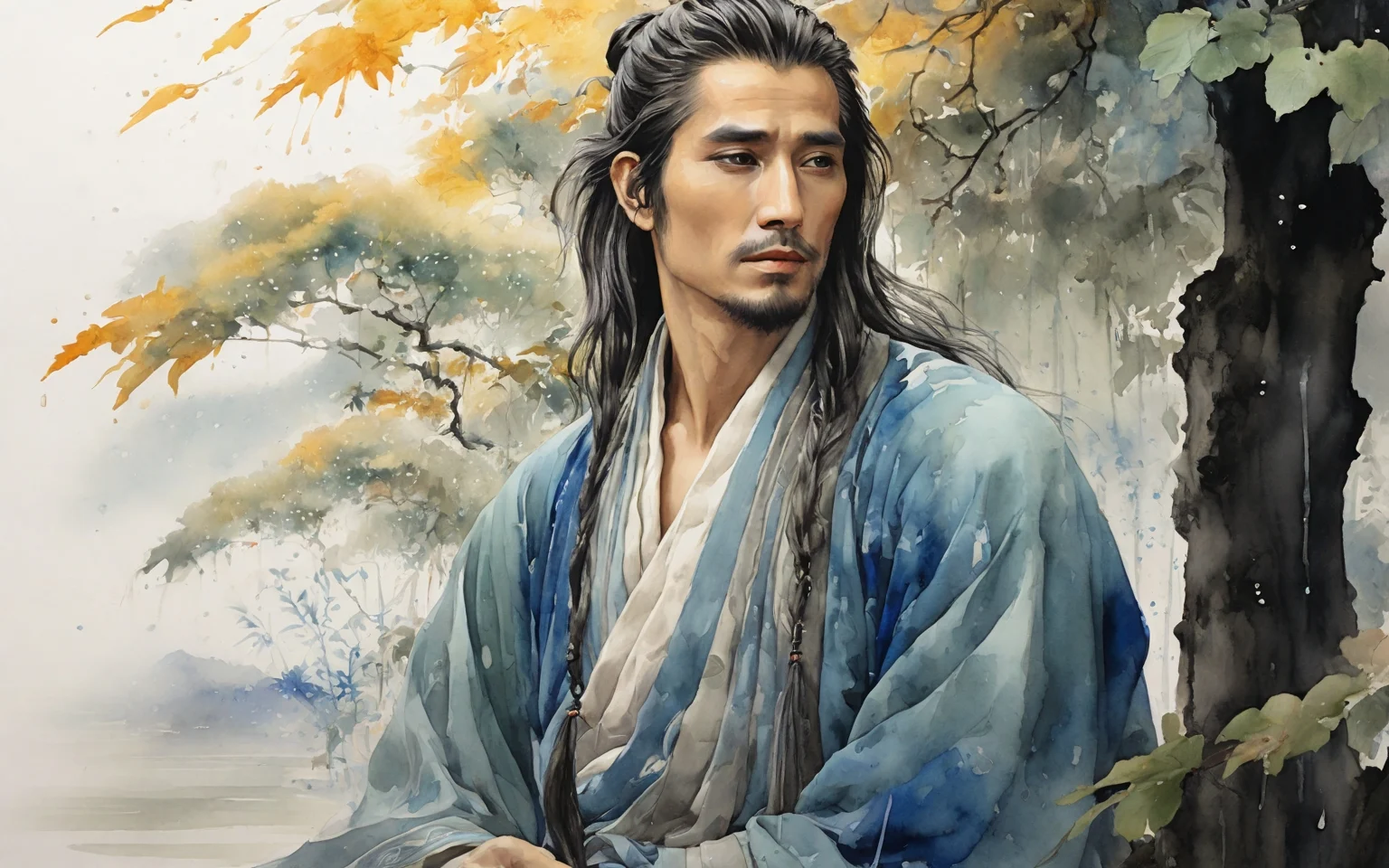
Du Fu (杜甫), 712 - 770 AD, was a great poet of the Tang Dynasty, known as the "Sage of Poetry". Born into a declining bureaucratic family, Du Fu had a rough life, and his turbulent and dislocated life made him keenly aware of the plight of the masses. Therefore, his poems were always closely related to the current affairs, reflecting the social life of that era in a more comprehensive way, with profound thoughts and a broad realm. In his poetic art, he was able to combine many styles, forming a unique style of "profound and thick", and becoming a great realist poet in the history of China.