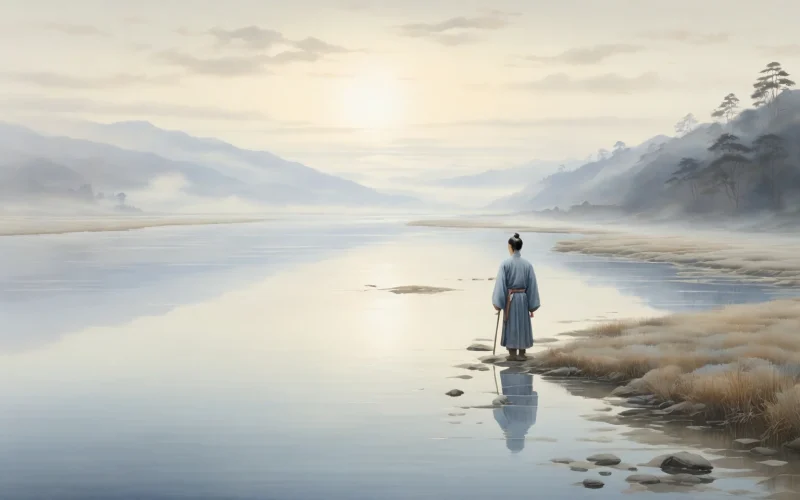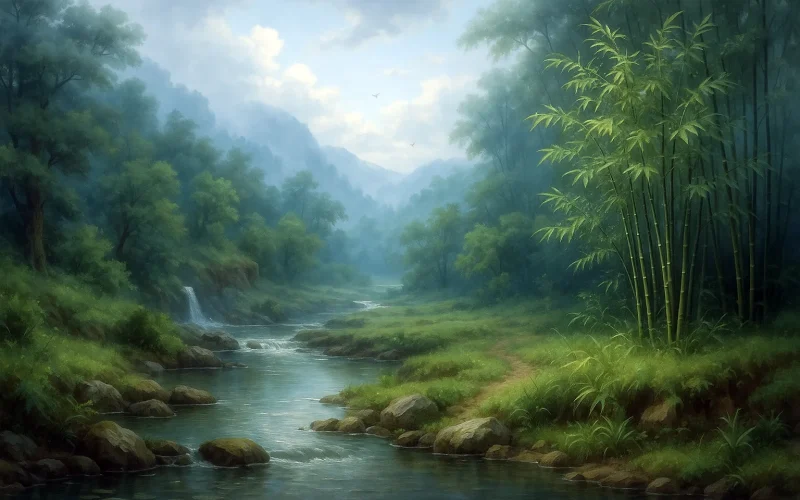
Late autumn—frost and dew weigh deep,
At dawn I walk the valley steep.
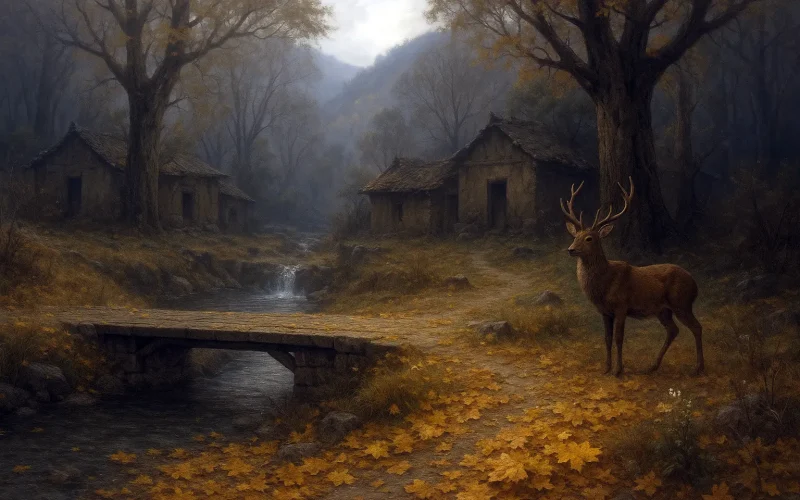
Yellow leaves shroud the brook’s old bridge,
Ancient trees guard the village’s ridge.
Cold blooms sparse in solitude,
Hidden springs pulse in quiet mood.
Long have I forgotten worldly art—
Why startle these deer, my peaceful heart?
Original Poem
「秋晓行南谷经荒村」
柳宗元
杪秋霜露重,晨起行幽谷。
黄叶覆溪桥,荒村唯古木。
寒花疏寂历,幽泉微断续。
机心久已忘,何事惊麋鹿。
Interpretation
This poem was composed during Liu Zongyuan's exile in Yongzhou. After the failed reforms in the first year of Yongzhen (805 AD), he was demoted from a ministry official to a minor post, the Marshal of Yongzhou, beginning a decade of exiled life. This work is one of the representative landscape poems from this period. "South Valley" was located within Yongzhou, a place the poet often visited. One late autumn morning, he walked alone into this secluded valley, passing through a desolate village, seeing only desolate scenes: yellow leaves covering the bridge, ancient trees standing sparse, cold flowers scattered, and the faint, intermittent sound of a hidden spring. The decay of this deserted village is precisely a projection of the poet's inner desolation—his discarded fate, his unrealized ideals, all find their counterparts in these scenes.
Like many of Liu Zongyuan's poems that use landscape to express solitary indignation, this piece superficially describes scenery but is actually lyrical. The poet sketches a stark, cold autumn dawn travel scene with minimal brushstrokes, yet imbues every image with his own life's feelings. The "yellow leaves," "ancient trees," "cold flowers," and "hidden spring" are all reflections of his soul. The softly posed question at the end, "Why should I startle the deer?", subtly and profoundly expresses the delicate tension between man and nature, withdrawal from and engagement with the world.
First Couplet: "杪秋霜露重,晨起行幽谷。"
Miǎo qiū shuāng lù zhòng, chén qǐ xíng yōu gǔ.
Late autumn: frost and dew lie heavy;
At dawn I rise and walk the deep ravine.
The opening immediately establishes the time, climate, and action. "Late autumn" ("杪秋") is the end of autumn, the most desolate season; "frost and dew lie heavy" ("霜露重") both indicates the early hour of the walk (frost and dew not yet evaporated) and evokes the chill and hardship. The poet "rises at dawn" ("晨起") and walks towards the "deep ravine" ("幽谷")—the word "deep" ("幽") describes both the valley's seclusion and the poet's inner solitude. The opening couplet sets the poem's entire tone of austerity and desolate stillness; a solitary figure walks into the bleak cold of deep autumn.
Second Couplet: "黄叶覆溪桥,荒村唯古木。"
Huáng yè fù xī qiáo, huāng cūn wéi gǔ mù.
Yellow leaves bury the brook and bridge;
The deserted village: nothing but old trees.
This couplet describes what is seen on the journey, outlining the decaying scene of a deserted village with the most minimal strokes. "Yellow leaves bury the brook and bridge"—the word "bury" ("覆") describes the thick accumulation of fallen leaves and implies that the place has long been untrodden, the bridge now the domain of leaves. "The deserted village: nothing but old trees"—the village is deserted, its inhabitants gone, only a few old trees remain standing guard. The word "nothing but" ("唯") is most poignant: besides these old trees, there is nothing. No cooking smoke, no human voices, no breath of life. This deserted village is a portrayal of the poet's inner situation: discarded here, forgotten by his time, just like this village.
Third Couplet: "寒花疏寂历,幽泉微断续。"
Hán huā shū jì lì, yōu quán wēi duàn xù.
Chill flowers, sparse, bleak, and desolate;
The hidden spring's faint sound breaks off, goes on.
This couplet continues the description, but shifts the focus from the macroscopic to the microscopic, expanding from sight to sound. "Chill flowers, sparse, bleak, and desolate"—"chill flowers" ("寒花") are the last remnants of autumn blooms, already scarce, and the three words "sparse, bleak, and desolate" ("疏寂历") vividly describe their scattered, withered state. These flowers, like the poet's remaining hopes, are feeble and forlorn. "The hidden spring's faint sound breaks off, goes on"—the spring flows in a deep, hidden place, its sound appearing and disappearing, intermittent. This "breaks off, goes on" ("微断续") sound is both realistic and a symbol of the poet's inner thoughts: those unquellable sorrows, rising and subsiding like this intermittent spring murmur, an unbroken thread.
Fourth Couplet: "机心久已忘,何事惊麋鹿。"
Jī xīn jiǔ yǐ wàng, hé shì jīng mí lù.
Long now I've lost all artful thoughts;
Why should I startle the deer?
The final couplet is the climactic point of the poem, the culmination of emotion. "Artful thoughts" ("机心") refer to thoughts of cunning and scheming, alluding to the Zhuangzi: "Where there are contrivances, there must be artful thoughts." The poet says he "long now" ("久已") has lost these thoughts—he long ago abandoned the struggle for official advancement, no longer harbors any utilitarian ambitions. Yet, walking in this deep ravine, he still startles the deer. The originally carefree deer flee in alarm at his approach.
This question seems self-mocking but actually contains profound meaning. The poet wanted to merge with nature, to be a hermit "without artful thoughts," in harmony with all things. But the deer's flight tells him: You are, after all, an outsider; you do not belong here. The two words "why should" ("何事") ask both the deer and himself—since I have lost artful thoughts, why do I still disturb you? Since I have left the dusty world behind, why can I not truly merge with nature? This softly posed question articulates the deepest contradiction in the poet's heart: he wants to withdraw from the world, yet cannot truly forget it; he wants to retreat, yet is ultimately a "criminal," an exile, not a true hermit. The startled deer is the unbridgeable chasm.
Holistic Appreciation
This ancient-style pentasyllabic poem uses the "dawn walk" as its thread, completing a spiritual journey through the progression of space. The first couplet describes the departure, establishing time and environment; the second depicts the deserted village, using "yellow leaves" and "old trees" to evoke decay; the third describes minute details, using "chill flowers" and "hidden spring" to deepen the desolation; the final couplet expresses the poet's state of mind, concluding the poem with "startle the deer." It progresses from external to internal, from scene to emotion, layer by layer, step by step deeper.
Scene and emotion are highly fused throughout the poem. The "yellow leaves bury the brook and bridge" is the poet's forgotten fate; the "deserted village: nothing but old trees" is his solitary situation; the "chill flowers, sparse, bleak, and desolate" are his remaining hopes; the "hidden spring's faint sound breaks off, goes on" are his fluctuating sorrows. Every image is a projection of his inner world. And the concluding "Why should I startle the deer?" pushes the tension between man and nature, withdrawal and engagement, to its climax, letting the entire poem conclude in a mood of melancholy.
Compared to Liu Zongyuan's poems that directly vent indignation, the emotion here is more restrained, the expression more subtle. The poet does not cry out loud; he merely asks a soft question, yet lets the reader feel the deep waves within his heart. This technique of using plain language to convey deep feeling is the unique charm of Liu Zongyuan's poetry.
Artistic Merits
- Scene and Emotion Fused, Object and Self as One: The entire poem contains not a single word of direct emotional expression, yet every word is an image of the heart; the yellow leaves, ancient trees, chill flowers, hidden spring—all are carriers of the poet's emotion.
- Simple, Plain Language, Profound Meaning: The diction is precise; words like "bury" ("覆"), "nothing but" ("唯"), "sparse" ("疏"), and "faint" ("微") both describe the scene's form and convey the spirit of the feeling, revealing deep meaning within plainness.
- Rigorous Structure, Layered Progression: From macroscopic to microscopic, from visual to auditory, from external scene to inner heart, the layers are distinct, the progression clear.
- Subtle Ending, Lingering Resonance: Concluding with "Why should I startle the deer?", a softly posed question that contains endless melancholy, leaving the reader with lasting afterthought.
Insights
This poem first enlightens us that the relationship between man and nature is not inherently harmonious. Liu Zongyuan had "long now lost all artful thoughts," believing he could merge with nature, but the deer's flight told him: you are, after all, human, an outsider. This sense of separation from nature is especially evident in modern society. We yearn for nature but can often only briefly visit as tourists; we long to return but ultimately cannot truly merge. Liu Zongyuan's poem reminds us: maintaining reverence for nature, maintaining clarity about that "separation," is perhaps more real than fantasizing about complete fusion.
The line "Long now I've lost all artful thoughts" also makes us ponder what true letting go means. Liu Zongyuan says he has "long" lost artful thoughts, but the deer's flight exposes the fact that he has not yet truly merged. This enlightens us: True letting go is not just saying the words; it requires the sifting of time, the test of practice. We often think we have let go of certain attachments, but encountering a specific situation reveals they remain. Liu Zongyuan's poem teaches us: maintaining honesty with ourselves, acknowledging that we have "not yet let go," is also a form of courage.
The softly posed question, "Why should I startle the deer?", also makes us contemplate the intellectual's self-positioning in adversity. Liu Zongyuan could neither return to court nor truly retreat into seclusion; he was in an awkward in-between state. This "in-between state" is a common predicament for many modern people—unable to fully integrate into the system, yet unable to completely escape; yearning for transcendence, yet unable to cut all ties. Liu Zongyuan's poem enlightens us: We need not demand ourselves to be either/or; acknowledging and accepting this "in-between state" is also a form of wisdom for living.
The figure walking alone into the deep valley on that late autumn morning is especially moving. He did not stop walking because he was discarded; he did not shut his door because of loneliness. He still walked, still looked, still felt, still questioned. This posture of maintaining action, perception, and thought even in hardship is itself a spiritual victory. It tells us: even in a "deserted village," even when "frost and dew lie heavy," we must still "rise at dawn and walk the deep ravine"—walk on, and there will be new discoveries; walk on, and there will be new possibilities.
About the Poet
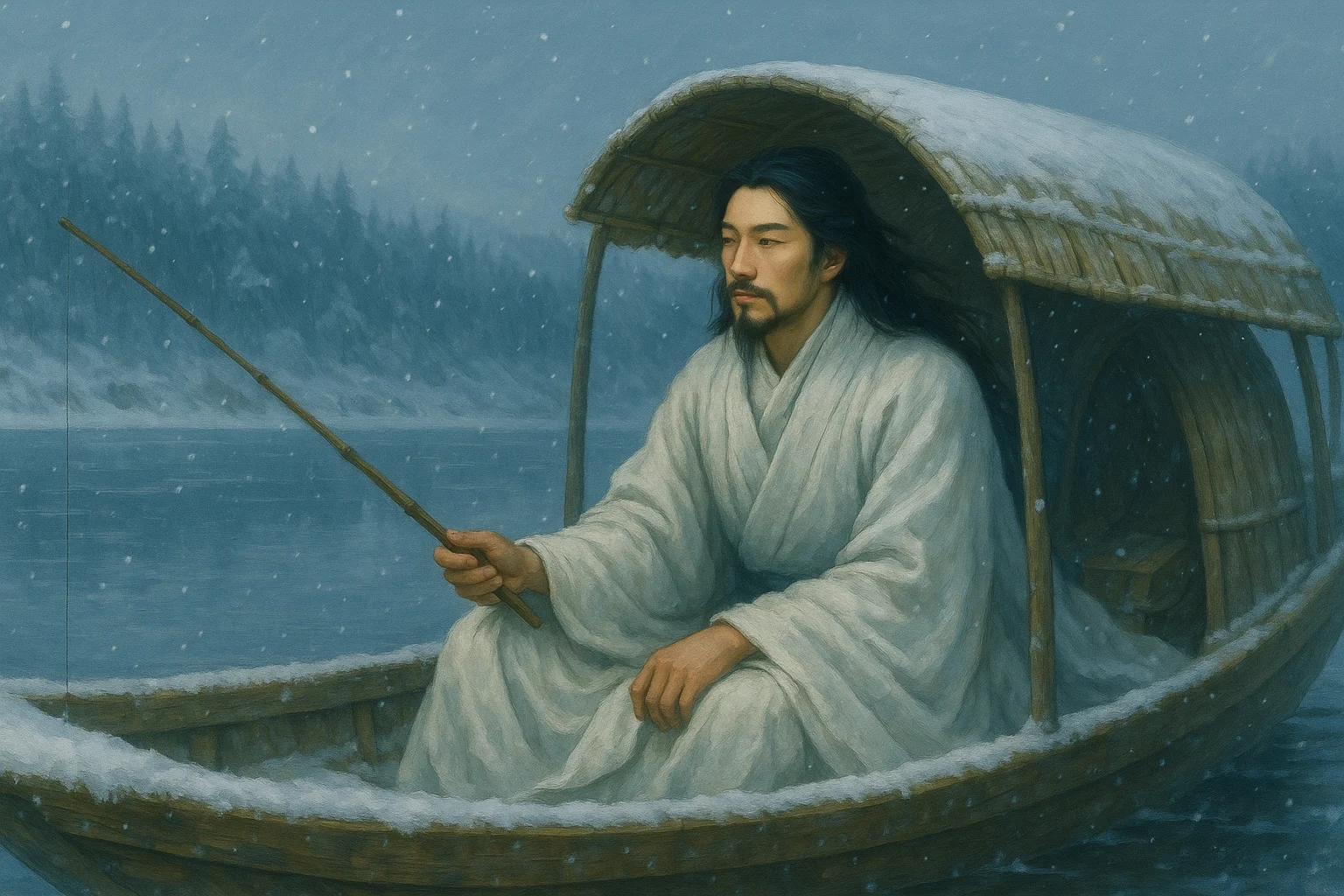
Liu Zongyuan (柳宗元, 773 - 819), a native of Yuncheng in Shanxi province, was a pioneering advocate of the Classical Prose Movement during China's Tang Dynasty. Awarded the prestigious jinshi degree in 793 during the Zhenyuan era, this distinguished scholar-official revolutionized Chinese literature with his groundbreaking essays. His prose works, remarkable for their incisive vigor and crystalline purity, established the canonical model for landscape travel writing that would influence generations. As a poet, Liu mastered a distinctive style of luminous clarity and solitary grandeur, securing his place among the legendary "Eight Great Masters of Tang-Song Prose" - an honor reflecting his enduring impact on Chinese literary history.