
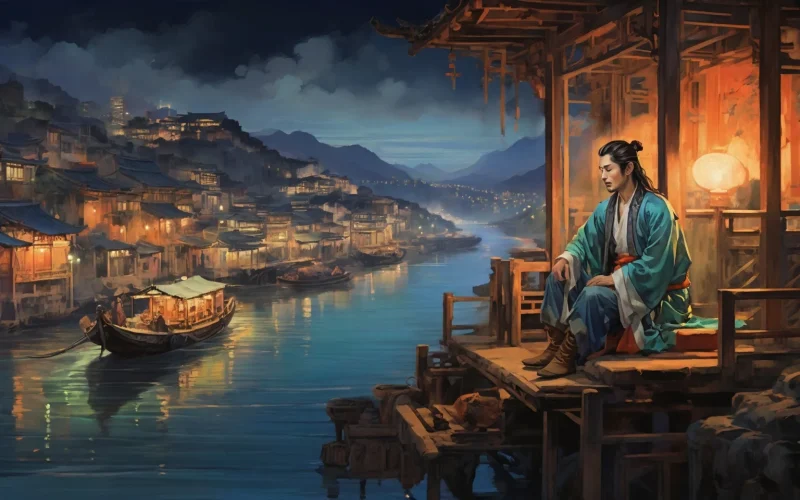
You go from north to south,
From land to river mouth.
Oranges in gardens loom;
Lotus on water bloom.
The night fair's bright as day;
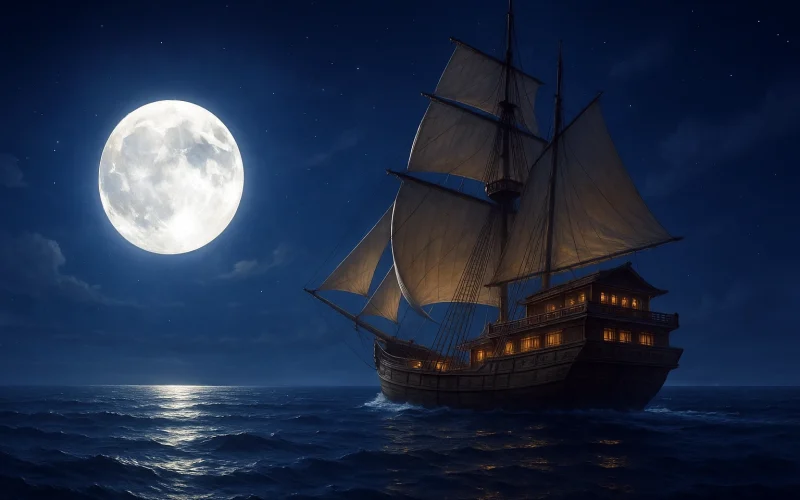
Outside temples boats stay.
Welcome from far and near
Would make you stay a year.
Original Poem
「送友游吴越」
杜荀鹤
去越从吴过,吴疆与越连。
有园多种桔,无水不生莲。
夜市桥边火,春风寺外船。
此中偏重客,君去必经年。
Interpretation
This poem was composed by the late Tang poet Du Xunhe as a farewell to a friend traveling to the Wu and Yue regions. Throughout his life, Du's official career was fraught with difficulties. He repeatedly failed the imperial examinations in his youth and once roamed widely, developing a particular familiarity with the scenery and customs south of the Yangtze. The Wu and Yue region (modern-day southern Jiangsu and Zhejiang) had been a prosperous, affluent, and culturally rich area since the Six Dynasties period, renowned for its scenic water towns and landscapes. Having personally traveled there and deeply appreciated the beauty of its mountains, rivers, and the simplicity of its local customs, the poet wrote this parting poem filled with admiration and longing as his friend set out on his journey. Unlike the typical melancholy of farewell poems, this work is characterized by a lively, brisk tone, vivid imagery, and brims with enthusiastic praise for the region's scenery and heartfelt wishes for the friend's travels, revealing the poet's open-hearted and optimistic side.
First Couplet: "去越从吴过,吴疆与越连。"
Qù Yuè cóng Wú guò, Wú jiāng yǔ Yuè lián.
To reach the land of Yue, one first must pass through Wu;
The borders of Wu and the frontiers of Yue connect.
The opening lines begin with geography, emphasizing the close connection between Wu and Yue. The phrase "To reach the land of Yue, one first must pass through Wu" succinctly sketches the travel route, as if giving directions to the friend. "The borders of Wu and the frontiers of Yue connect" further stresses that the two lands are contiguous and inseparable. This seemingly plain statement carries a deeper implication: Wu and Yue were originally separate states of the Spring and Autumn period, but now, with their connected borders and similar scenery, they have merged into an inseparable whole south of the Yangtze. The opening sets the spatial foundation for the subsequent depiction of the region's scenery.
Second Couplet: "有园多种桔,无水不生莲。"
Yǒu yuán duō zhǒng jú, wú shuǐ bù shēng lián.
Gardens there are full of orange trees;
No waters are without their lotuses.
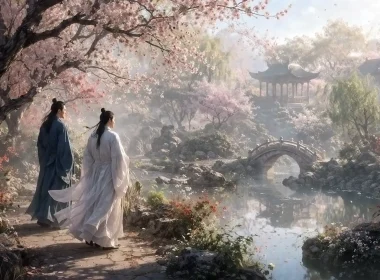
This couplet uses typical imagery to encapsulate the region's distinctive features. The "orange tree" is a fine fruit of the south; Qu Yuan once wrote an "Ode to the Orange," endowing it with the character of "holding fast to its place, not moving." The "lotus" is a symbol of the watery regions, linked both to the folk tradition of "gathering lotuses in the south" and carrying connotations of purity and nobility. "Gardens there are full of orange trees" describes the abundance of the land, while "No waters are without their lotuses" describes the profusion of the waters. Taken together, the two lines completely present the geographical character of Wu and Yue, blessed with both land and water. The words "full of" and "without their" use an exaggerated tone to emphasize the ubiquity of these things, as if orange groves and lotus ponds were everywhere in Wu and Yue, making one's heart yearn for it.
Third Couplet: "夜市桥边火,春风寺外船。"
Yè shì qiáo biān huǒ, chūn fēng sì wài chuán.
Night markets' lanterns glow by the bridgeside;
Spring breezes caress boats outside the temple grounds.
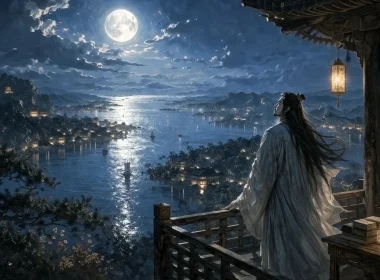
This couplet is the finishing touch that brings the poem to life. It shifts from still life to human activity, showcasing the region's prosperity and vitality. "Night markets' lanterns glow by the bridgeside"—in the watery regions south of the Yangtze, bridges are transportation hubs, night is a time for rest, and the word "glow" lights up the entire scene: it is the lamplight of shops, the bustle of crowds, a lively tableau of nightlife in the water towns. The word "glow" not only describes the brightness of the lanterns but, more importantly, conveys the bustling prosperity of the marketplace. "Spring breezes caress boats outside the temple grounds"—temples are cultural landmarks, boats are the transportation of the water towns; amidst the spring breeze, pleasure boats come and go, revealing both the beauty of nature and the constant flow of visitors. This couplet exhibits perfect parallelism and vivid imagery: the first line describes the liveliness of night, the second the serenity of day; the first depicts the worldly hustle and bustle, the second the blend of nature and culture. In just ten characters, the prosperity and poetic charm of Wu and Yue are captured.
Fourth Couplet: "此中偏重客,君去必经年。"
Cǐ zhōng piān zhòng kè, jūn qù bì jīng nián.
Here they are famed for welcoming travelers warm;
You will, I'm sure, be captivated for a year.
The final couplet shifts from scenery to sentiment, articulating the farewell. The phrase "famed for welcoming travelers warm" describes the simple, hospitable nature of the Wu and Yue people—not only is the scenery beautiful, but the people are even more so. "You will, I'm sure, be captivated for a year" is the poet's humorous tease: with such beautiful scenery and warm people, you'll likely be reluctant to leave and are sure to linger a long time. This "captivated for a year" is both an exaggerated prediction and a sincere blessing—may you, my friend, linger there, reluctant to leave, and fully enjoy the delights of its landscape and people. Unlike the "drink one more cup" sentiment common in many farewell poems, Du Xunhe concludes with this light-hearted tone, expressing both deep affection for his friend and his own boundless yearning for Wu and Yue.
Holistic Appreciation
This is a farewell poem of unique character. Beginning with geography, developing with local features, and concluding with human warmth, it condenses the beauty of Wu and Yue's landscape, the abundance of its produce, the bustle of its markets, and the simplicity of its people into forty characters, inspiring longing in the reader.
Structurally, the poem presents clear layers. The first couplet establishes the geographical location, setting the spatial backdrop. The second couplet uses oranges and lotuses to depict natural abundance, showcasing the region's richness. The third couplet uses night markets and temple boats to portray cultural scenes, revealing its prosperity. The final couplet concludes with hospitality, suggesting the journey will be thoroughly enjoyable. The four couplets progress seamlessly from geography to nature, from nature to culture, and from culture to human sentiment, forming a cohesive whole.
In terms of conception, the poem breaks from the conventions of traditional farewell poetry. Typically, partings dwell on sorrow or offer words of comfort and encouragement, but Du Xunhe adopts a tone of enthusiastic "recommendation," eagerly introducing the beauties of Wu and Yue to his friend. This approach expresses both the poet's deep affection for his friend and his own genuine love for the region. Not a trace of sadness is found; instead, the poem is filled with pure admiration and well-wishing, leaving the reader with a sense of warmth.
Artistically, the poem's greatest subtlety lies in its selection and combination of imagery. "Oranges" and "lotuses" represent the region's produce; "lanterns by the bridgeside" and "boats outside the temple" represent its way of life. Instead of broadly describing the landscape, the poet selects these most quintessentially southern details, using the part to suggest the whole, the small to reveal the large. Particularly the line "Night markets' lanterns glow by the bridgeside," using "glow" to depict the night market, is both novel and apt, becoming the poem's most dazzling highlight.
It is noteworthy that, although not a single word directly mentions "farewell," the sentiment of parting permeates the poem. The first couplet, giving directions, uses the tone of one seeing someone off; the second and third couplets, describing local features, share the experience of one who has been there; the final couplet's prediction of being "captivated for a year" is the friendly tease between companions. This method of conveying farewell by describing scenery, rather than expressing sorrow, precisely reflects the deep friendship between the poet and his friend—precisely because the bond is deep, he hopes his friend will enjoy himself to the fullest and thus bids farewell in such a lighthearted manner.
Artistic Features
- Typical Imagery, Suggesting Much with Little: Selecting the most characteristic southern imagery—oranges, lotuses, bridges, lanterns, temples, boats—the poem sketches the unique character of Wu and Yue, letting the part represent the whole. With a few sparse strokes, the essence of the region south of the Yangtze is revealed.
- Vivid Colors, Strong Visual Imagery: The brightly lit "lanterns glow by the bridgeside" of the night market and the vibrant spring scene of "Spring breezes caress boats outside the temple grounds" create strong visual impressions. The entire poem resembles a brightly colored scroll painting of a water town.
- Simple, Unadorned Language, Sincere Emotion: Devoid of obscure phrases or deliberate ornamentation, it nonetheless expresses the beauty of Wu and Yue and the feelings of farewell to perfection. Genuine feeling is found in the plain; deep affection is found in the simple.
- Careful Structure, Clear Progression: Progressing from geography to nature, from nature to culture, and from culture to human sentiment, the layers advance seamlessly, forming a cohesive whole. It exemplifies the exemplary structure of introduction, development, turn, and conclusion in regulated verse.
- Breaking New Ground, Avoiding Cliché: Breaking from the conventional mold of farewell poems dwelling on sorrow, it treats parting with an attitude of enthusiastic recommendation, giving it a unique character. This spirit of innovation is precisely what makes Du Xunhe's poetry valuable.
Insights
This poem, first and foremost, teaches us that: Farewell need not be solely about sadness; it can also be filled with beautiful wishes and longing. With a light and lively tone, the poet paints an enchanting picture of the region south of the Yangtze for his friend, transforming the parting into a departure filled with anticipation. This optimistic and open-hearted attitude towards life is worth emulating today.
Secondly, the description of "有园多种桔,无水不生莲" reminds us that: The charm of a place is often embodied in its most ordinary yet most typical features. Just as Wu and Yue is remembered for its oranges and lotuses, each of our hometowns possesses such unique marks. Discovering and cherishing these marks is the most profound expression of love for one's native soil.
On a deeper level, the bustling marketplace scene depicted in "夜市桥边火" shows us that: True poetry exists not only in landscapes, but also in the hustle and bustle of everyday life. The lanterns by the bridge, the pleasure boats by the temple—these ordinary scenes of life can also become the most beautiful scenery.
In this fast-paced era, this poem reminds us: The meaning of travel lies not only in seeing the sights, but also in experiencing the local character and human warmth. Like Du Xunhe, approaching with an open mind—to discover, to experience, to appreciate—is how every journey can become a beautiful memory in one's life.
Poem translator
Xu Yuanchong (许渊冲)
About the Poet
Du Xunhe (杜荀鹤 846 - 904), a native of Shitai, Anhui, was a realist poet of the late Tang Dynasty. He became a jinshi (presented scholar) in the second year of the Dashun era (891 AD). During the Later Liang Dynasty, he was appointed to the Hanlin Academy but passed away just five days later. His poetry carried forward the spirit of the new yuefu (Music Bureau) tradition established by Du Fu and Bai Juyi, focusing exclusively on the sufferings of the common people. His poetic style was simple, unadorned, and deeply poignant. He often employed a relatively free metrical form, later known as the "Du Xunhe Style," which stood out as a unique and powerful voice amidst the ornate and decadent poetic trends of the late Tang period.