
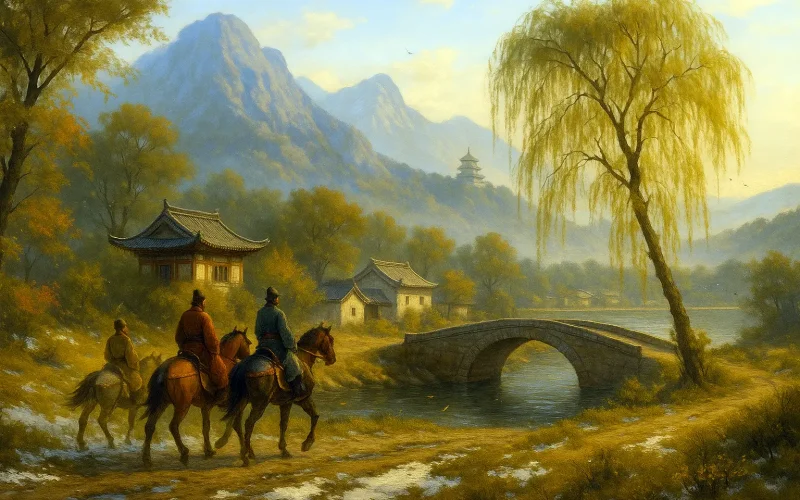
The snow in warming sun has half melted away;
You who will go on fragrant grass hear your horse neigh.
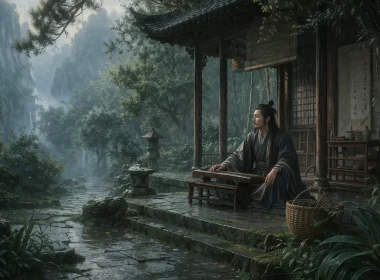
Over the mountain path clouds veil the temple drear;
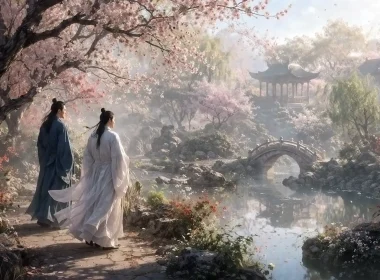
The willow tips caress the bridge on River Clear.

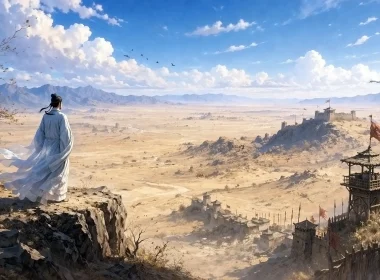
Your ideal will fly up as high as the wild geese;
My mind still flutters like a streamer in the breeze.
Coming together, I cannot go back with you.
How lonely I'd feel at home when spring comes anew!
Original Poem
「宣州送裴坦判官往舒州时牧欲赴官归京」
杜牧
日暖泥融雪半消,行人芳草马声骄。
九华山路云遮寺,清弋江村柳拂桥。
君意如鸿高的的,我心悬旆正摇摇。
同来不得同归去,故国逢春一寂寥!
Interpretation
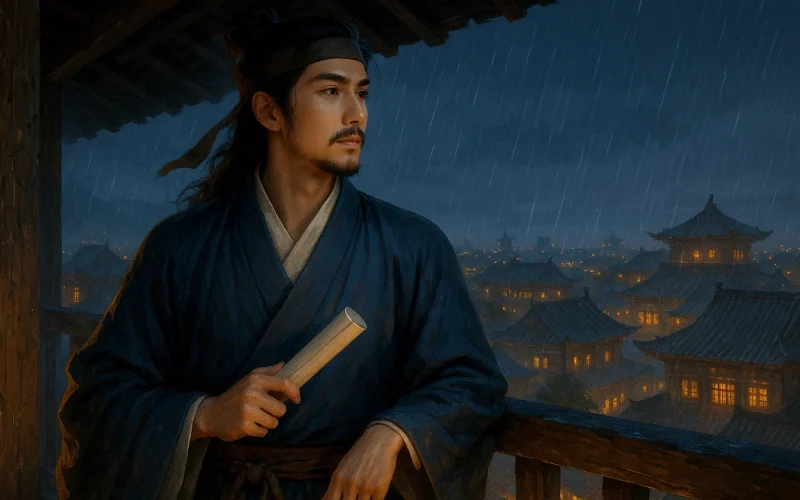
This poem was composed in the early spring of 839 AD, as Du Mu concluded his term as Military Advisor in Xuanzhou and prepared to return to the capital to assume the posts of Left Rectifier of Omissions and Compiler at the Historiography Institute. This transfer, ostensibly a promotion, was in reality a reluctant choice to leave the affluent Jiangnan region for the turbulent political vortex at the empire's center. The recipient of this farewell, Pei Tan (courtesy name Zhijin), was Du Mu's colleague in Xuanzhou, now departing to serve as a Judge in Shuzhou. Both were officials subject to transfer, yet their career paths now diverged in different directions. The lament "we came together but cannot return together" refers not only to their immediate parting but also metaphorically suggests the inevitable divergence of fates among late Tang scholar-officials within the political chessboard.
The specific spatiotemporal context of this farewell is significant: Xuanzhou (modern Xuancheng, Anhui), a cultural hub in Jiangnan, with the Buddhist sacred site of Mount Jiuhua nearby and the Qingyi River flowing through it, provided the tangible basis for the poem's imagery of "clouds veil the temple" and "willows sweep the bridge." Meanwhile, the Chang'an to which Du Mu was returning was mired in the dual predicaments of the Niu-Li factional strife and eunuch dominance. This tension between the geographical act of returning to the capital and the psychological sense of departing from it elevates the farewell poem beyond conventional expressions of friendship, transforming it into a microcosm of scholar-officials confronting the dilemmas of their age.
First Couplet: 日暖泥融雪半消,行人芳草马声骄。
Rì nuǎn ní róng xuě bàn xiāo, xíngrén fāngcǎo mǎ shēng jiāo.
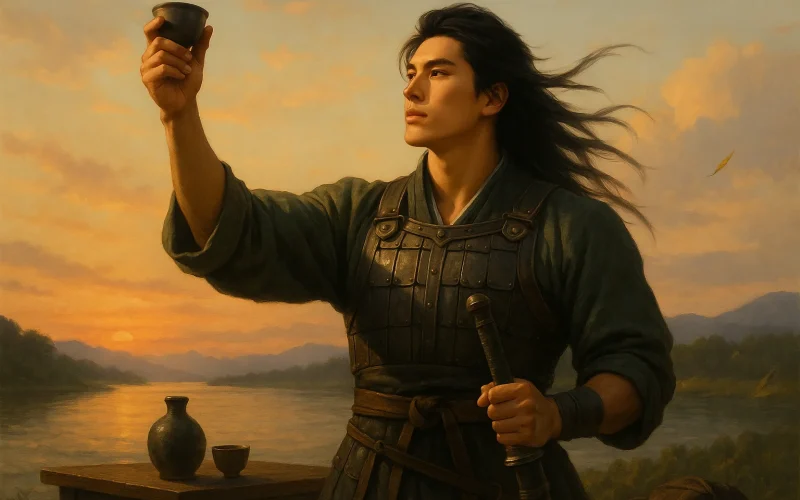
Sun-warmed earth turns soft, where melting snow yet stays; Through fragrant grass, the traveler's proud horse neighs.
Explication: The opening line establishes the poem's tone through meticulous observation of seasonal change. Within the seven characters, three sensory experiences—sunlight (visual), earth (tactile), snowmelt (implied auditory)—blend to capture the transitional climate characteristic of early spring in Jiangnan. This state of "half-melted" liminality mirrors the emotional suspense of the poet's impending departure and his friend's imminent journey. The next line depicts motion through a soundscape: the fragrant grass hints at an auspicious beginning for the journey, while the personification in "proud horse neighs" describes not only the mount's high spirits but also implicitly conveys the traveler's (Pei Tan's) buoyant ambition as he heads toward his new post. Between this quiet scene and dynamic action, the complex spatiotemporal sensation of parting is already evoked.
Second Couplet: 九华山路云遮寺,清弋江村柳拂桥。
Jiǔhuáshān lù yún zhē sì, Qīngyìjiāng cūn liǔ fú qiáo.
On Mount Jiuhua's path, clouds veil the temple's site; By Qingyi's village bridge, willows sweep with light.
This couplet unfolds two classic Jiangnan travel scenes in parallel lines. "Clouds veil the temple's site" depicts the misty and profound scenery of a mountain path, where the clouds are both a natural phenomenon and a metaphor for the unknown and mutability of the road ahead. "Willows sweep with light" portrays the gentle beauty of a riverside landscape; the willows brushing the bridge is a static image, but the verb "sweep" endows it with a delicate sense of movement. These two scenes realistically sketch Pei Tan's probable route and, aesthetically, form complementary pairs: one concealed, one revealed; one misty, one clear—together constructing a visual allegory of the official's itinerant life. An official's path is like traversing mountains and fording rivers, sometimes shrouded in mist, sometimes bright with promise.
Third Couplet: 君意如鸿高的的,我心悬旆正摇摇。
Jūn yì rú hóng gāo dídí, wǒ xīn xuán pèi zhèng yáoyáo.
Your will, like wild geese soaring, sure and high; My heart, a hanging banner, tossed nearby.
This couplet uses metaphor to achieve a bidirectional reflection of emotions. "Like wild geese soaring, sure and high" compares the friend's aspirations to geese in lofty flight, with the reduplicated "didi" (distinct, clear) intensifying his sense of purpose and resolute stride. "A hanging banner, tossed nearby" draws from the Strategies of the Warring States ("the heart dangles like a suspended banner") to metaphorize the poet's own feeling of rootlessness. The careful antithesis of these metaphors not only reveals the difference in their present states of mind but, on a deeper level, illuminates two typical postures scholar-officials assumed toward their careers: Pei Tan represents the proactive vigor of one embarking on a new appointment, while Du Mu embodies the hesitation and uncertainty following years of bureaucratic vicissitudes. The drifting quality of "tossed" forms a stark contrast with the steadiness implied by "proud horse neighs" in the opening couplet.
Fourth Couplet: 同来不得同归去,故国逢春一寂寥!
Tóng lái bùdé tóng guī qù, gùguó féng chūn yī jìliáo!
We came together but cannot return as one; In our old capital, meeting spring—what loneliness under the sun!
The final couplet releases its emotional tension amidst intersecting time and space. The internal repetition ("together… together…") intensifies the drama of their misaligned fates: their shared journey to Xuanzhou in the past was a spatial alignment, but their divergent return paths now signify a fork in their official trajectories. "In our old capital, meeting spring" should imply brightness and joy, but the appended "what loneliness" suddenly renders the spring scene desolate and cold. The word "what" carries immense weight: this is not ordinary solitude but a magnified, singular loneliness experienced amidst the season of universal renewal. As Pei Tan strides toward new journeys in Shuzhou, Du Mu faces the old road back to the heart of political strife; this "return" conversely becomes a deeper form of wandering.
Holistic Appreciation
This is a polyphonic farewell poem that inscribes spiritual solitude within the bustle of spring. Du Mu's profundity lies in setting the farewell scene amidst the vibrant vitality of Jiangnan's early spring, only to have that vitality inversely highlight the inner desolation of the parting figures—especially the poet himself. The poem establishes an exquisite emotional counterpoint: nature's "sun-warmed earth turns soft" corresponds to the human world's "heart… tossed"; the traveler's "proud horse neighs" corresponds to the returning poet's "what loneliness"; the friend's "will… sure and high" corresponds to the poet's own "cannot return as one." This juxtaposition of multiple contrasts grants the poem a psychological depth far exceeding that of ordinary farewell verses.
The poem's spatial narrative is masterfully conceived. Horizontally, it traces a radiating geographical map of separation. Vertically, it builds a three-dimensional emotional coordinate system: from the ground of melting snow and soft earth, to the sky of soaring geese, to the heart with its tossing banner. The choice of imagery in "clouds veil the temple" and "willows sweep with light" further contains metaphors for an official's path: the temple veiled by clouds hints at an unpredictable road ahead, while the willows sweeping the bridge seem to exert a gentle guiding force. As the friend heads toward the cloud-shrouded paths of Mount Jiuhua, the poet must return to the seemingly clear yet profoundly lonely springscape of Chang'an; this shared, bidirectional uncertainty constitutes the deepest ache of their parting.
Particularly noteworthy is the poem's paradoxical presentation of "spring." Traditional farewell poems often use autumn scenery to set off parting sentiment; Du Mu deliberately chooses spring: melting earth, fragrant grass, willows, warm sun—everything is growing and reviving. Yet it is precisely this exuberant spring light that reflects the eternal regret of "cannot return as one." While spring in the natural world arrives majestically, human parting occurs quietly. This contrast between the rhythms of life and the misalignments of human existence constitutes Du Mu's unique discovery about "spring": the deepest solitude may precisely blossom in the liveliest season.
Artistic Merits
- The Psychological Transmutation of Phenological Description: The intermediary state of "melting snow yet stays," the viscous quality of "earth turns soft," the spreading tendency of "fragrant grass"—these early spring characteristics are skillfully transformed into psychological counterparts for emotional suspense, burgeoning attachment, and spreading parting sorrow. Du Mu imbues natural details with emotional logic, achieving a deep psychologization of descriptive language.
- A System of Metaphors with Generational Implications: "Like wild geese soaring, sure and high" and "a hanging banner, tossed nearby" are not merely portraits of individual mood but can also be read as symbols of two existential postures among late Tang scholar-officials. The newer generation of officials still harbored soaring ambitions, while those tempered by bureaucratic life already felt adrift. These two images form a map of the era's spiritual terrain.
- A New Paradigm of Farewell through Spatiotemporal Folding: Compressing "came together" (the past shared journey to Xuanzhou), "cannot return as one" (the present divergence), and "old capital, meeting spring" (future life in Chang'an) within the same poetic realm. This montage technique, breaking linear chronology, transforms the farewell from a momentary event into an ongoing psychological journey spanning past, present, and future.
Insights
This work reveals an eternal dilemma in human relationships: the deepest loneliness often occurs at the moment when seemingly tight connections—"coming together," colleagues, shared era—are severed. Du Mu and Pei Tan were colleagues in Xuanzhou, having shared the misty rains of Jiangnan, yet on this spring morning they embarked on distinctly different trajectories. The lesson for the modern reader is this: intimacy forged by shared experience may conceal fundamental divergence; and when separation arrives, that very shared path becomes the yardstick for measuring solitude.
The poem's discovery in "In our old capital, meeting spring—what loneliness" redefines the meaning of "return." For Du Mu, returning to the political center of Chang'an was not a warm homecoming but entry into another form of wandering. This reminds us: geographical return does not necessarily bring peace of mind; sometimes "returning" marks the beginning of a deeper alienation. When we envy others setting off on new journeys, we may overlook the solitary, spring-illuminated desolation that those returning to familiar places must face.
Ultimately, this poem offers wisdom for examining connection amidst change. Du Mu does not linger in the sorrow of parting. Through the contrast between "Your will… sure and high" and "My heart… tossed," he reveals the inevitable divergence of life's paths. This divergence is not betrayal but the natural and necessary unfolding of life within the river of time. True wisdom in farewell may lie in this: being able to clearly see the imprint of affection from "coming together," while also accepting with equanimity the fate of "cannot return as one," and preserving within spring's solitude the warmth of memories from that once-shared journey.
Poem translator
Xu Yuanchong (许渊冲)
About the poet
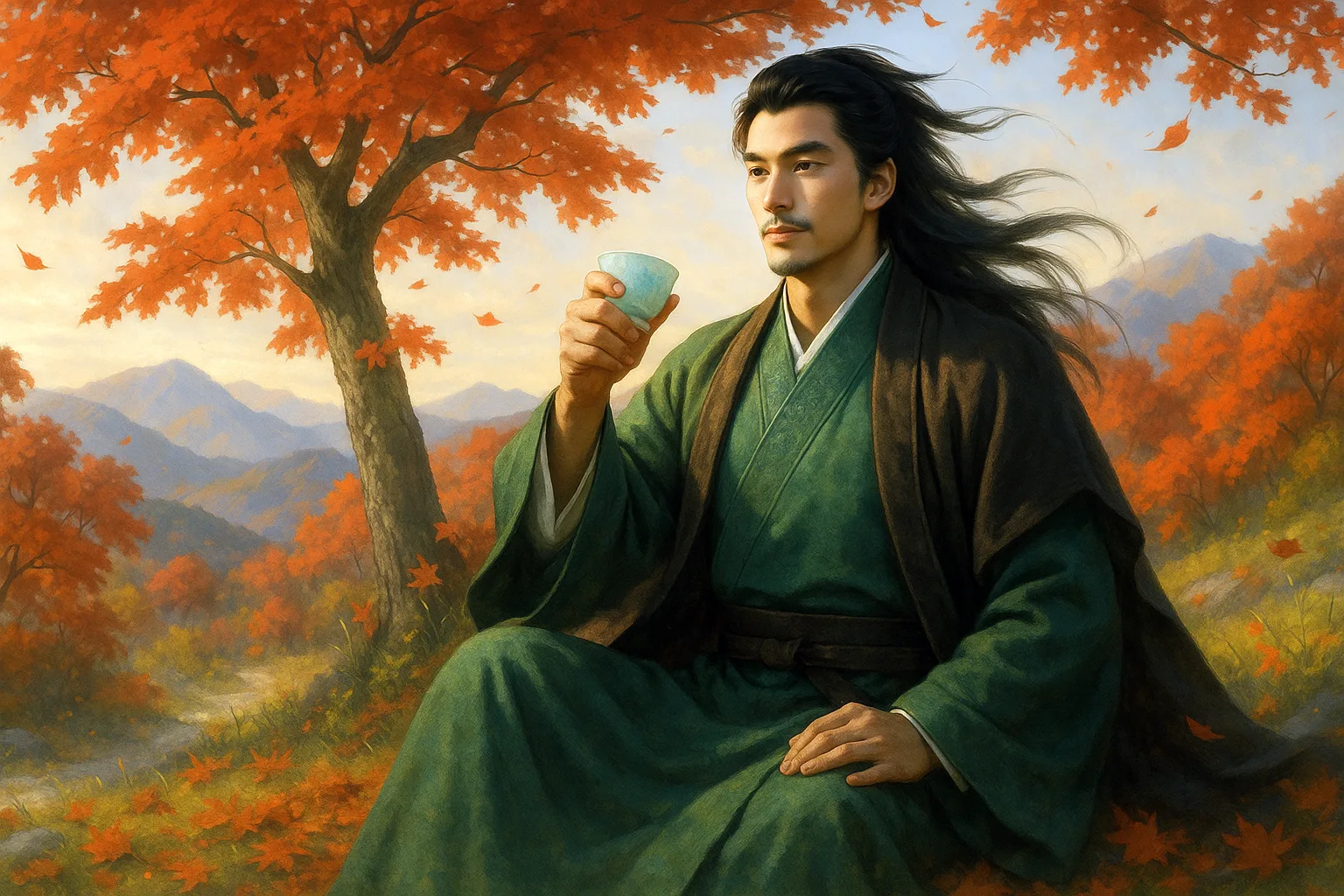
Du Mu (杜牧), 803-853 AD, was a native of Xi'an, Shaanxi Province. Among the poets of the Late Tang Dynasty, he was one of those who had his own characteristics, and later people called Li Shangyin and Du Mu as "Little Li and Du". His poems are bright and colorful.