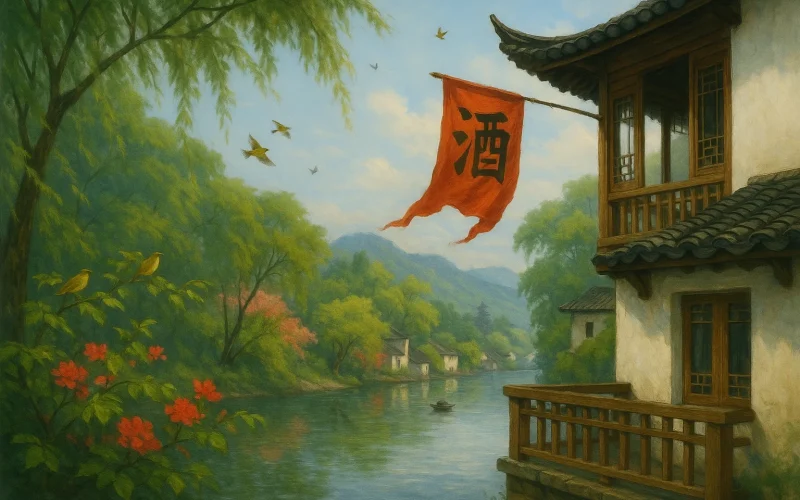

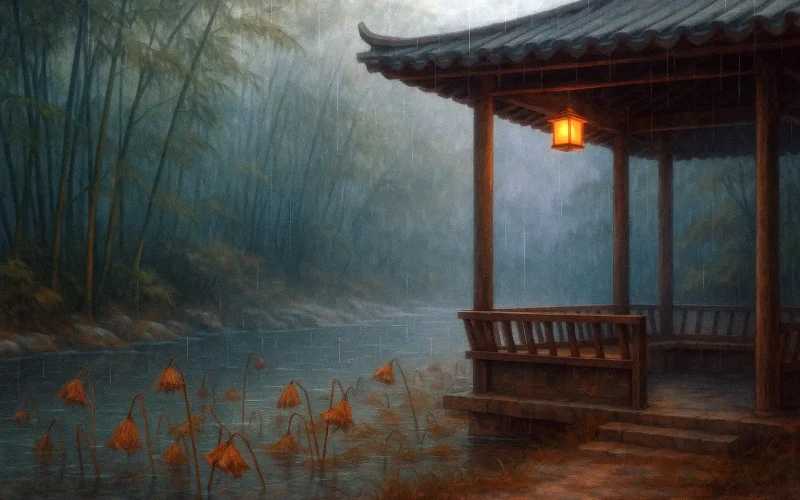
In the bamboo grove by the clean poolside I stay;
Separated from you by towns, I miss you far away.
The autumn gloom undispersed and late frost remain;
Only the withered lotus listen to the rain.
Original Poem
「宿骆氏亭寄怀崔雍崔衮」
李商隐
竹坞无尘水槛清,相思迢递隔重城。
秋阴不散霜飞晚,留得枯荷听雨声。
Interpretation
This poem is a quintessential work from Li Shangyin's early period, exemplifying a perfected craft of atmosphere and an ultimate subtlety in emotional expression. Composed while traveling afar after leaving the secretariat of Linghu Chu, the poet lodged at the Luo Pavilion and longed for his cousins, Cui Yong and Cui Gun, who had recognized and nurtured his talent. Using the autumn scenery of the pavilion garden as his canvas and his yearning as ink, he painted a spiritual map imbued with serene solitude, dampness, and acute aural sensitivity. The line, "I have kept these withered lotus leaves to hear the rain at night," elevates the classical Chinese poetic aesthetics of "beauty in decay" and "the appreciation of sound" to an unprecedented height, becoming an enduring and evocative scene that transcends time.
First Couplet: 竹坞无尘水槛清,相思迢递隔重城。
Zhú wù wú chén shuǐ kǎn qīng, xiāng sī tiáo dì gé chóng chéng.
The bamboo grove, spotless; the pool by the rail, clear;
My thoughts of you stretch endlessly, barred by wall on wall out there.
Explication: The opening couplet presents two juxtaposed realms: one is the supremely serene physical space before the eyes ("spotless," "clear"); the other is the inner emotional landscape, infinitely expansive yet obstructed ("stretch endlessly," "barred"). The "clarity" and "purity" of the first line do not form a cheerful backdrop. Instead, their very perfection highlights the 'impurity' of emotion—a heart stirred and troubled by longing. "Barred by wall on wall" describes not only physical distance but also metaphorically suggests obstacles in life's journey and career, infusing the yearning with the poignancy of a drifting existence. The clear scene and deep feeling intensify each other through contrast.
Final Couplet: 秋阴不散霜飞晚,留得枯荷听雨声。
Qiū yīn bù sàn shuāng fēi wǎn, liú dé kū hé tīng yǔ shēng.
The autumn gloom persists, unfading; late comes the frost's chill air.
I have kept these withered lotus leaves to hear the rain at night—a treasure there.
Explication: This couplet contains one of Li Shangyin's most celebrated and evocative creations, achieving a remarkable shift from visual oppression to auditory solace. "The autumn gloom persists" represents a dual knot of visual and psychological weight, the sky a vast, low-hanging vault of gray. "Late comes the frost's chill" implies a suspended, abnormal sense of time, as if all things wait in stifling stillness. Yet, upon this oppressive ground, "I have kept these withered lotus leaves to hear the rain" shines forth. The words "have kept" convey gratitude, active choice, and, more profoundly, a deep wisdom of finding value in decay. Withered lotus, the remnants of past splendor, embody life's decline. Yet, to the poet's ear, they transform into a natural instrument that receives the sky's music, transposing the rain's rhythm. The sound of rain on dry leaves—clear, cold, sporadic, unmelodic—achieves a perfect resonance with the poet's sleepless night, his lingering thoughts, and his solitary heart. This "hearing" is focused attention in loneliness, a dialogue within silence, an artistic act of internalizing external desolation into aesthetic experience and existential companionship.
Holistic Appreciation
This is a poem of exquisite structure and profound feeling, centered on the themes of "separation and listening." Its four lines trace a clear emotional arc: "quiet observation—distant longing—lingering gloom—attentive listening." The first couplet is spatial, moving from the near (bamboo grove, poolside rail) to the far (beyond the walls), establishing the breadth of longing and its obstruction. The latter couplet is temporal, moving from day (persistent gloom) to night (listening to rain), deepening the intensity of emotion and personal circumstance.
Li Shangyin's mastery lies in never letting longing spill forth directly, but rather dissolving it entirely into minute perceptions of the environment. The "endless stretch" of thought contrasts with the spatial "clarity"; the inability of longing to reach its object resonates with the oppressive "persistent gloom." Ultimately, all inexpressible, undeliverable feeling finds an alternative outlet—listening to the "rain on withered leaves," a soundscape rich with the beauty of imperfection and a sense of solitude. This sound is both a silent address to distant friends and an echo, a confirmation, of the self's solitary heart. In the moment of "hearing the rain," the feelings of missing others and lamenting one's own fate merge indistinguishably.
Artistic Merits
- Sensory Shift and Aesthetic Sublimation: The poem progresses from the visual "clarity" of the grove and pool, and the "gloom" of autumn, to the tactile sense of "lateness" in the frost, finally focusing on the auditory act of "listening" to the rain. Hearing becomes the ultimate channel for processing and transforming the preceding oppressive sensory experiences, and the key to the poem's aesthetic elevation.
- Active Poetics in "Have Kept": "Have kept these withered lotus leaves" is not passive residue but the result of the poet's conscious aesthetic choice and attribution of meaning. Within a scene of decay that most would wish to clear away, the poet discovers its unique aesthetic value and emotional function, revealing Li Shangyin's distinctive and profound artistic vision.
- Contrast and Unity of Imagery: The resilient freshness of "bamboo" and lucidity of "water" contrast with the decayed texture of "withered lotus"; the pervasive, heavy "autumn gloom" contrasts with the clear, punctuating "sound of rain." These contrasts are ultimately unified within the poet's solitary yet keenly perceptive consciousness, forming a cohesive emotional realm.
- Extreme Linguistic Sparseness, Extreme Evocative Richness: The poem employs plain, accessible language. Yet, through precise selection and combination of images (bamboo, water, walls, gloom, frost, lotus, rain) and the nuanced use of words like "endlessly" and "have kept," it creates a complex evocative scene and emotional space far exceeding the literal meaning of the words.
Insights
This work is like an autumn dewdrop distilled from solitude, longing, and aesthetic insight, reflecting the timeless human effort to express emotion across separation. It suggests that when direct communication is blocked by "wall on wall" (be it geographical, psychological, or temporal), feeling need not suffocate but may instead seek more subtle, more intricate vessels—perhaps waiting, with a pond of withered lotus, for a night rain, entrusting a heart full of longing to the clear, pattering sound.
In our contemporary age, where communication seems effortless yet can feel profoundly alienating, this poem's posture of "listening" is especially valuable. It reminds us that true connection and the settling of emotion sometimes require the patience and the capacity to appreciate imperfection and silence, much like "having kept these withered lotus leaves." It is not about seeking an echo in the clamor, but about cultivating, in lonely hours of "persistent gloom," a heart sensitive enough to catch the "sound of rain" and find within it solace and resonance. Li Shangyin's "hearing the rain" is, ultimately, a superior form of emotional self-possession and spiritual cultivation. It teaches us that even when the world offers obstruction and gloom, we can still, within our inner "Luo Pavilion," "keep" a scene for ourselves and learn to dwell with it in mindful communion.
Poem translator
Xu Yuan-chong (许渊冲)
About the poet
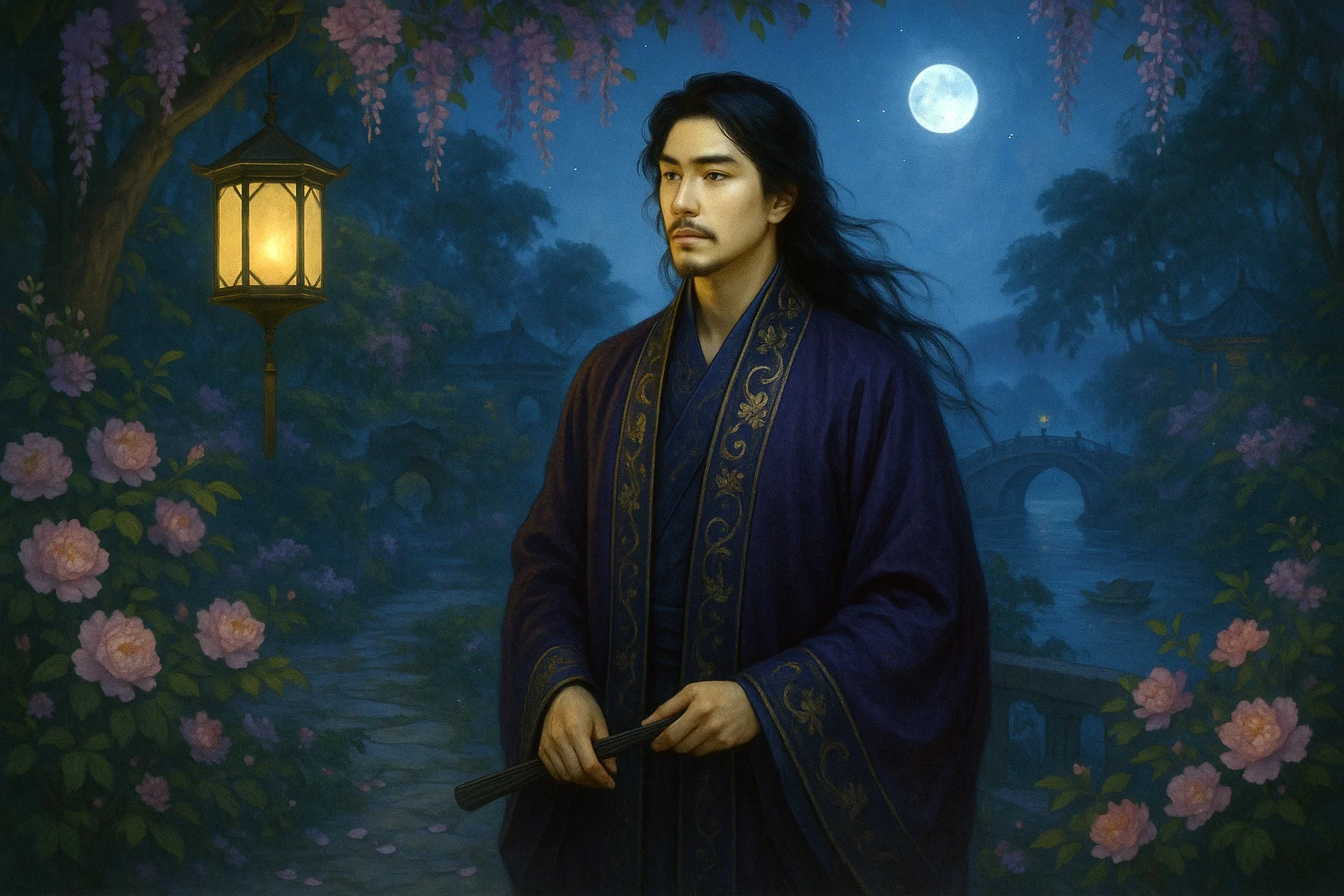
Li Shangyin (李商隐), 813 - 858 AD, was a great poet of the late Tang Dynasty. His poems were on a par with those of Du Mu, and he was known as "Little Li Du". Li Shangyin was a native of Qinyang, Jiaozuo City, Henan Province. When he was a teenager, he lost his father at the age of nine, and was called "Zheshui East and West, half a century of wandering".