

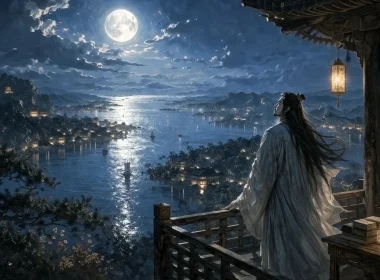


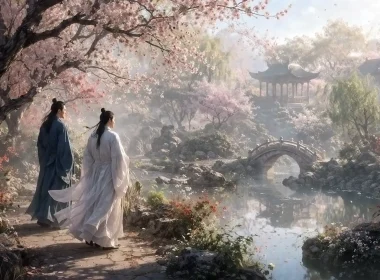

West of Jia Pavilion and north of Lonely Hill,
Water brims level with the bank and clouds hang low.
Disputing for sunny trees, early orioles trill;Pecking vernal mud in,
young swallows come and go.A riot of blooms begins to dazzle the eye;
Amid short grass the horse hoofs can barely be seen.
I love best the east of the lake under the sky;
The bank paved with white sand is shaded by willows green.
Original Poem
「钱塘湖春行」
白居易
孤山寺北贾亭西,水面初平云脚低。
几处早莺争暖树,谁家新燕啄春泥。
乱花渐欲迷人眼,浅草才能没马蹄。
最爱湖东行不足,绿杨阴里白沙堤。
Interpretation
This renowned work was composed in the spring of 823 or 824 CE, during the Changqing reign of Emperor Muzong, while Bai Juyi served as Governor of Hangzhou. Having weathered earlier political turmoil, this appointment to Hangzhou offered the poet spiritual relief and nourishment. The landscape of West Lake greatly soothed his soul and inspired a deep love for nature and life. Using the poet’s "stroll" as its thread, the poem unfolds like a handscroll, meticulously capturing and vividly depicting every subtle sign of West Lake in early spring. It perfectly fuses the poet’s keen perception of nature’s rhythms, his intoxication with the scenic beauty, and a leisurely, contented semi-reclusive mindset. It stands as the most vibrant and celebrated piece among his travel and landscape poetry.
Opening Couplet: 孤山寺北贾亭西,水面初平云脚低。
Gūshān sì běi Jiǎ tíng xī, shuǐmiàn chū píng yún jiǎo dī.
North of Lonely Hill Temple, west of Duke Jia’s Arbor, the water’s rim / First levels with the bank; the fringe of the clouds hangs low and dim.
Explication: The poem begins by sketching the general location and West Lake’s setting through landmark architecture, its plain narrative immediately establishing a sense of space. "The water’s rim / First levels with the bank" is the most definitive signal of early spring: winter’s low water now rises with the season; the word "First" tightly connects to the moment, depicting the nascent stage of nature’s reawakening. "The fringe of the clouds hangs low" imbues the scene with a dynamic, vast atmosphere; the clouds nestle close to the lake, mist and water merging. This shows the humidity of the spring air and reveals the poet’s broad, tranquil state of mind as he gazes into the distance. One line suggests horizontal movement (spatial displacement), the other a vertical connection (water meeting sky), together setting a grand yet fresh stage for the whole poem.
Following Couplet: 几处早莺争暖树,谁家新燕啄春泥。
Jǐ chù zǎo yīng zhēng nuǎn shù, shéi jiā xīn yàn zhuó chūn ní.
In a few warm spots, orioles, new come, for sunny trees contend; / From which house newly back, to mold their nests, do swallows wend?
Explication: The poet’s gaze draws in from the grand background to the dynamic details of life, shifting from stillness to movement, focusing on the birds most representative of early spring. "In a few spots" rather than everywhere, and "From which house" rather than every house—the diction is exquisitely measured, accurately portraying a season where vitality first stirs, not yet in full, lush bloom. "For sunny trees contend" describes the orioles’ lively, active nature; the word "contend" conveys both sound and action, fully expressing their desire for sunlight and warmth. "To mold their nests" depicts the swallows’ diligent work; the word "newly" marks their recent return, brimming with fresh hope. The orioles’ "new come" and the swallows’ "newly back" are precisely symbols of spring’s novelty and vitality. The poet presents this in a questioning tone, adding a layer of intimate curiosity.
Third Couplet: 乱花渐欲迷人眼,浅草才能没马蹄。
Luàn huā jiàn yù mí rényǎn, qiǎn cǎo cáinéng mò mǎtí.
Flowers, riot of hues, begin to dazzle eyes in view; / Shallow grass, barely grown enough, can hide the hooves from you.
Explication: This couplet further directs the gaze to plants, capturing the progress of spring in even finer detail. "Flowers, riot of hues, begin to dazzle eyes"; "riot" describes the initial, scattered blooming, not the peak of profusion; the phrase "begin to" is especially masterful. It describes the dynamic process of flowers blooming in succession and conveys a sense of budding, imminent—not yet fully realized—splendor, creating a tension with the expectation of "dazzle eyes." This precisely captures the character of early spring blooms. "Shallow grass, barely grown enough, can hide the hooves" measures spring by another minute scale (grass height versus horse’s hoof). "Barely grown enough" echoes "shallow," emphasizing its newborn tenderness. The detail "hide the hooves" cleverly integrates the natural scene with the poet’s own experience of "strolling" (a spring ride on horseback), placing the observer within the scenery, making it intimate and tangible.
Final Couplet: 最爱湖东行不足,绿杨阴里白沙堤。
Zuì ài Hú dōng xíng bùzú, lǜ yáng yīn lǐ Bái Shā Dī.
My favorite part is east of the lake: I can’t have enough of the sight— / The Shore of Whitish Sand, embraced in the shade of willows green.
The final couplet summarizes the poem, directly expresses the poet’s feeling, and pinpoints his "favorite part." The three words "can’t have enough" signify both physical lingering, an unwillingness to leave, and psychological insatiability, an endless appreciation. They gather all the beauties and sensations of spring described in the previous six lines into a rich, sustained emotional experience within the poet’s heart. The final image settles on "The Shore of Whitish Sand, embraced in the shade of willows green"—bright in color (green, white), elegant in composition (shade, causeway). It concludes with this specific, radiant image of the causeway, leaving readers with infinite space for reverie and longing, its resonance enduring.
Holistic Appreciation
This heptasyllabic regulated verse is the pinnacle of Bai Juyi’s landscape poetry, perfectly embodying his artistic traits of meticulous observation, lucid language, and the fusion of emotion and scene. Using the "spring stroll" as the warp and the "signs of early spring" as the weft, its structure is both disciplined and supple. The opening couplet broadly outlines the vast background of spring water leveling the banks and low-hanging clouds. The following and third couplets are like detailed close-ups, capturing and magnifying the quintessential details of early spring from two dimensions—birds (orioles, swallows) and plants (flowers, grass)—in progressive layers. Moreover, each couplet contains a subtle sense of temporal progression ("new come," "newly back," "begin to," "barely grown enough"), achieving utmost precision. The final couplet then gathers the poet’s sentiments, expressing his intoxication directly with "My favorite", echoing the theme with "can’t have enough", and finally resting on the classic image of the Shore of Whitish Sand. It completes a full and delightful aesthetic journey. The entire poem brims with the joy of discovering spring, a sensitivity to life’s rhythms, and a serene, leisurely mood of harmony between humanity and nature.
Artistic Merits
- Keen Observation, Precise Capture: The poet’s observation of early spring’s natural signs achieves a scientific precision. Words like "First levels," "new come," "newly back," "begin to," and "barely grown enough" are not casual strokes but accurately reflect the unique phenomena of the specific transitional stage from winter to spring, as life begins to sprout, embodying the highest artistic truth.
- Changing Scenes with Each Step, Orderly Structure: The poem closely follows the act of "strolling"; the perspective constantly shifts and moves, from the overall lake view to specific orioles, swallows, flowers, and grass, finally arriving at the destination, the Shore of Whitish Sand. The scenes connect naturally, the progression clear, guiding the reader to tour alongside the poet’s steps and gaze.
- Accessible Language, Refreshing Imagery: The entire poem uses not a single obscure word or abstruse allusion, employing only plain, almost colloquial language for description. Yet, it paints West Lake in early spring as vibrantly alive, as if before one’s eyes. This art of "achieving the remarkable with the commonplace" and "profound meaning in simple words" is the greatest charm of Bai Juyi’s poetry.
- Sincere Emotion, Feeling Fused with Scene: The poem is imbued with the poet’s genuine delight and intoxication with nature and West Lake. This emotion is not empty praise but permeates the vivid depiction of every plant, bird, and flower; feeling and scene merge into an indivisible whole, possessing immense evocative power.
Insights
This work is not merely a beautiful landscape poem; it is a vivid guide on how to feel life and discover beauty. Through his exceptional example, Bai Juyi shows us: True poetry originates from sustained, meticulous observation and contemplation of the world around us. He could perceive the rhythm of the changing seasons and the joy of life stirring from subtle details easily overlooked by others—"the water’s rim first levels with the bank", "shallow grass barely grown enough".
In our present era of information overload and hurried steps, this poem reminds us to slow down, to "stroll" and "discover" like the poet, engaging all our senses. Spring is not just a season; it is a state of mind and a capacity—the acuity to see "orioles, new come, in a few warm spots", the softness of heart to find joy in "swallows newly back" molding their nests, the patience to appreciate the gradual process of life in "flowers, riot of hues" and "shallow grass." It encourages us, no matter where we are, to maintain a freshness towards nature and life, to seek uncommon wonder in ordinary scenery, allowing our spirits to be nourished and to dwell in the tranquility and beauty of a place like "the Shore of Whitish Sand, embraced in the shade of willows green."
Poem translator
Xu Yuanchong (许渊冲)
About the Poet

Bai Juyi (白居易), 772 - 846 AD, was originally from Taiyuan, then moved to Weinan in Shaanxi. Bai Juyi was the most prolific poet of the Tang Dynasty, with poems in the categories of satirical oracles, idleness, sentimentality, and miscellaneous rhythms, and the most influential poet after Li Bai Du Fu.